
On this page
Start here
Quick answer
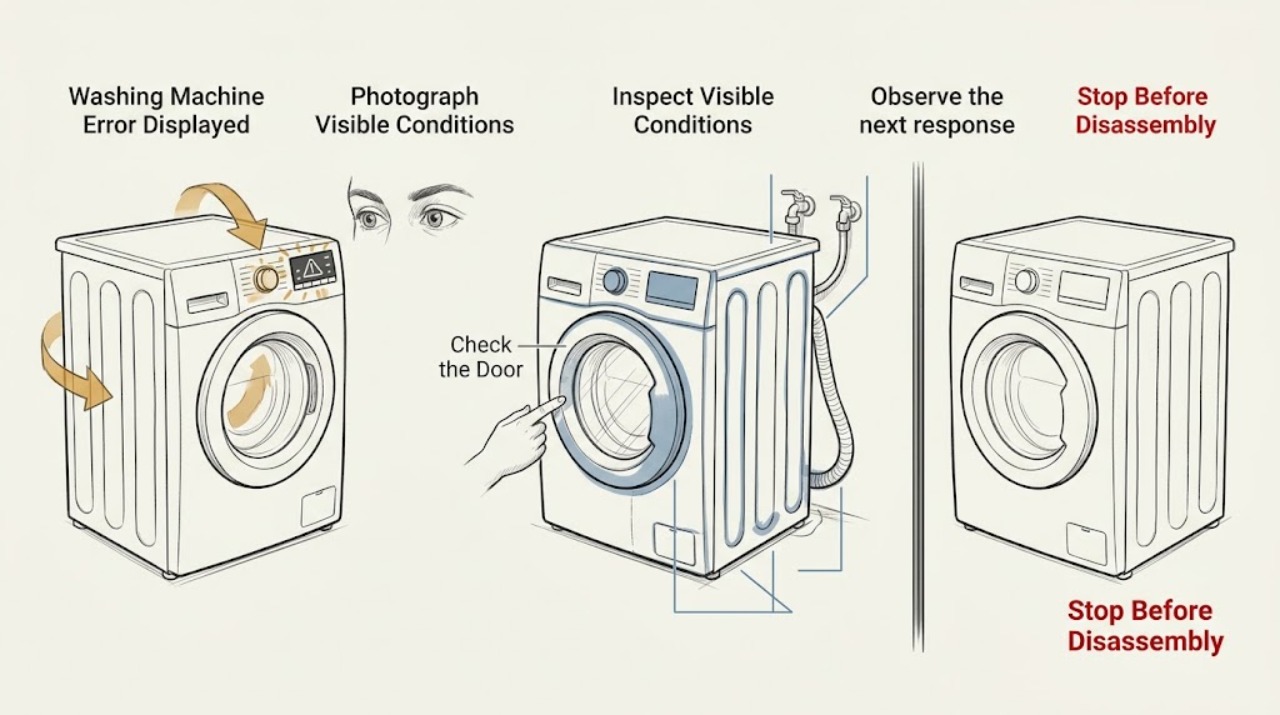
When a Maytag washing machine displays an error, photograph the complete code or light pattern before clearing it, and record the model, top-load or front-load design, and the point in the cycle when it appeared. Maytag says its published code lists may not contain every code for every model, so use the owner's manual for that exact washer. Common branches include a locked door or lid, low or interrupted water flow, slow draining, excessive suds, an overload or out-of-balance load, motor-speed sensing, control lock, and a system error. Check only accessible items such as the door or lid area, inlet hoses, drain-hose path, load, and detergent quantity. A single manual-approved reset can be appropriate for some codes, but a returning code, uncontrolled water, a locked tub full of water, smoke, burning smell, arcing, violent movement, or repeated power trips means stop using the washer and arrange professional service.
Work through in order
Diagnostic checks
Use only checks that match the exact appliance or system and its official guide.
-
Check 1
Photograph the exact code, letters, numbers, flashing lights, or beep pattern and note the model number, top-load or front-load design, and the cycle stage when it appeared.
Expected result: Maytag states that its published lists may not include every code for every model and that the owner's manual for the specific model is the reference.
Next step: Keep the record and continue only with checks that match the model and code; do not clear a code before documenting it.
Why this matters
Why: A precise display and washer design prevent a code from one family being interpreted as a different fault in another family.
-
Check 2
Inspect the door or lid area with the washer stopped for clothing, objects, detergent buildup, or visible damage that could prevent the door or lid from locking.
Expected result: Maytag links front-load F5 E2 to a door that is not locking and top-load LdL or lid messages to objects or buildup around the lid-lock area.
Next step: Remove only an accessible obstruction after the tub is safe; do not force the door or lid, defeat the lock, or continue if it is damaged or remains locked with water inside.
Why this matters
Why: A closure or lock signal can prevent a cycle from starting or progressing even when the rest of the washer has power.
-
Check 3
Check the hot and cold supply faucets, visible inlet hoses, and hose routing without disconnecting a wet connection; look for a closed faucet, kink, crushed section, or obvious damage.
Expected result: Maytag associates F8 E1 or LO FL with low water flow on front-load models and LF, LO FL, or F8 E1 with a fill taking too long on top-load models.
Next step: If the area is wet or a connection is damaged, close the faucets and stop; otherwise correct only an obvious external hose position supported by the manual and watch for recurrence.
Why this matters
Why: A supply restriction changes the next step from code clearing to restoring the correct external water supply or arranging service for a valve or sensor fault.
-
Check 4
Inspect the visible drain hose route and household standpipe or sink for a kink, blockage, dislodged hose, or backup, and note whether water remains in the tub after a drain phase.
Expected result: Maytag identifies drn or F9 E1 as drain-related examples and notes that a restricted drain hose or standpipe can also contribute to suds or delayed draining.
Next step: Do not reach into a tub with moving parts or standing water; arrange service or plumbing help if water remains, backs up, or the external path is not clearly safe.
Why this matters
Why: A drain-path problem can leave the washer unable to advance, while a dry, clear external path points toward a model-specific pump or control diagnosis.
-
Check 5
Review the load and detergent only after the washer is safe: look for a single bulky item, an overloaded basket, excessive suds, or detergent that is not marked for high-efficiency use.
Expected result: Maytag describes Sud or Sd as excess suds, OL as an oversized top-load load, Ofb as an out-of-balance load, and F7 E1 as a motor-speed condition that can involve overload or shipping-bolt history.
Next step: Follow the model's load and detergent guidance, redistribute or reduce only accessible laundry when safe, and stop if the basket moves violently, leaks, or the code returns.
Why this matters
Why: Load or suds correction can pause or extend a cycle without proving a failed control or motor; a repeated error with a normal load needs service.
-
Check 6
Read the control panel for Control Lock, paused or canceled-cycle, power-failure, or other status indications before treating the message as a component failure.
Expected result: Maytag lists LOC or LC as Control Lock on front-load models, Int as a paused or canceled cycle, and PF as a power interruption on top-load guidance.
Next step: Use the exact manual to clear a user setting or resume a cycle; do not bypass a lock or repeatedly cycle power when electrical or water symptoms are present.
Why this matters
Why: A locked control or interrupted cycle can block input or leave the washer waiting, while a repeated system error after normal operation requires a different path.
-
Check 7
If the exact model manual permits a reset for the recorded code, perform that one reset only with a dry floor and no smoke, burning smell, leak, violent movement, or other safety warning, then note whether the same code returns.
Expected result: Maytag gives reset or clear steps for some front-load and top-load codes but directs owners to contact support or schedule service when a code does not clear or returns.
Next step: Stop using the washer and arrange qualified service for a returning code, locked water-filled tub, repeated power interruption, or an unresolved error.
Why this matters
Why: A one-time reset can separate a transient control state from a persistent fault; recurrence is evidence for diagnosis, not a reason to repeat resets indefinitely.
Use your observations
Decision map
Find the observation that best matches what you see, then follow the next safe action.
-
PATH 01Next step
What you see
The display is LOC or LC, or another clearly identified control-lock status, and there is no leak or electrical hazard.
Do this next
Use the exact model manual to release Control Lock; do not defeat the lock or open panels.
Why this path and its safety boundary
Why it matters: The controls may be locked rather than mechanically failed.
-
PATH 02Next step
What you see
The door or lid does not lock, clothing or buildup is visible at the closure, or the washer shows a door or lid-lock code.
Do this next
Remove only an accessible obstruction when safe; request service for damage, a repeated lock code, or a door or lid that remains locked over water.
Why this path and its safety boundary
Why it matters: A closure obstruction or damaged lock area may be preventing safe cycle operation.
-
PATH 03Next step
What you see
The code indicates slow or low fill, and a faucet is closed or an inlet hose is visibly kinked without leakage.
Do this next
Restore the faucet or hose position only as the manual permits; stop and request service if the code returns or a connection is damaged.
Why this path and its safety boundary
Why it matters: The external water supply path may be restricting fill.
-
PATH 04Next step
What you see
The code indicates draining, water remains in the tub, the standpipe backs up, or the drain hose is visibly restricted.
Do this next
Keep the washer stopped with standing water and arrange safe appliance or plumbing service if the external path cannot be corrected without disassembly.
Why this path and its safety boundary
Why it matters: A drain installation or restriction is a priority before considering a pump or control component.
-
PATH 05Next step
What you see
Sud or Sd appears with visible suds, OL or Ofb appears with an overloaded or unbalanced load, and there is no smoke, leak, or violent movement.
Do this next
Follow the model's detergent and load guidance; request service if the same code occurs with a normal load or the basket moves dangerously.
Why this path and its safety boundary
Why it matters: The washer may be extending, pausing, or correcting the load rather than reporting a failed motor or control.
-
PATH 06Next step
What you see
The exact code is not listed for the model, returns after one manual-approved reset, or the washer has smoke, burning smell, arcing, repeated trips, severe vibration, or water near electricity.
Do this next
Stop using the washer, keep clear of unsafe water or electrical areas, and give service the model, design, code, cycle stage, and observations.
Why this path and its safety boundary
Why it matters: The issue needs model-specific professional diagnosis and should not be forced through more resets.
Helpful context
Understand the symptom
An error display is a symptom identifier, not a diagnosis by itself. The same-looking letters and numbers can have different meanings across Maytag washer designs, and some messages describe a normal pause, lock, suds response, or load correction rather than an immediately failed part. Capture the display before it disappears.
Maytag publishes separate guidance for front-load and top-load washers. The checks below keep those paths distinct: front-load examples include door locking, suds, water flow, drain time, and motor sensing, while top-load examples include lid locking, load balance, overload, water supply, drain, power, and suds.
Only perform external, low-risk observations. Do not enter service diagnostics, remove panels, or work on wiring, locks, motors, pumps, or water valves unless a qualified technician is handling the washer.
Safety boundary
Stop conditions
- Stop immediately for smoke, burning smell, visible arcing, repeated power trips, damaged cord or wiring, or severe uncontrolled vibration.
- If water is near an outlet, plug, control area, or wet floor makes the plug unsafe to reach, keep clear and do not touch wet electrical equipment.
- Stop for uncontrolled filling, a locked tub full of water, a damaged door or lid lock, a burst or leaking hose, or water that continues to back up.
- Do not open panels, work on energized parts, defeat a door or safety interlock, enter service diagnostics, or repeat resets to hide a returning code.
Only after diagnosis
Potential parts
- door or lid lock assembly
Only consider this category after the exact model and service diagnosis confirm a failed lock rather than an obstruction, buildup, or alignment issue.
Confirm the full model and manufacturer fit information before ordering. - water inlet valve
Only consider this category when a recurring fill error remains after external faucets and hoses are confirmed and a technician identifies an inlet fault.
Do not assume the code identifies the valve across top-load and front-load designs; verify the model. - drain pump or drain hose component
Only consider this category after a drain restriction or damaged component is confirmed and household plumbing is ruled out.
Confirm model-specific routing, fit, and safe installation before sourcing a component. - water-level or pressure-sensing component
Only consider this category when a recurring water-level or overfill-related diagnosis is confirmed for the exact washer.
A code is not proof of a compatible part; use the model manual and professional diagnosis. - motor or control component
Only consider this category after service confirms a persistent motor-speed or system-control fault with load, water, and drain causes ruled out.
Internal electrical components require qualified diagnosis and exact model fit confirmation.
When checks do not resolve it
Need a professional?
Arrange qualified Maytag washer service when the exact code is not resolved by the model manual, returns after one appropriate reset, appears with a normal load, or is accompanied by a lock fault, standing water, uncontrolled fill, electrical symptom, severe vibration, smoke, or heat damage. Provide the complete model number, top-load or front-load design, exact display, cycle stage, and safe photographs. Use a plumber when the household drain backs up independently of the washer.
Common questions
FAQ
Can I use any Maytag washer error-code list for my machine?
No. Maytag publishes separate front-load and top-load guidance and warns that its lists may not include every code for every model. Record the exact display and use the owner's manual for the complete model.
What should I do before clearing a Maytag washer error?
Photograph the code or light pattern, note the cycle stage, and check for a safe external cause such as a door or lid obstruction, hose restriction, drain backup, suds, or load problem. Use a reset only when the exact model guidance permits it and only once.
When does a washer error need service immediately?
Stop for smoke, burning smell, arcing, severe vibration, repeated trips, uncontrolled filling, standing water near electricity, a damaged lock or hose, or a code that returns after the model-approved check. Do not open panels or defeat an interlock.
Read the exact guide
Official sources
- Contact UsMaytag · Maytag model and serial information, washer category support, product manuals, and service routing
- TroubleshootMaytag · Maytag troubleshooting, product documents, washer and laundry service routing
- Error Codes in Top Load HE WashersMaytag Product Help · Maytag top-load washer error-code meanings, lid, fill, drain, balance, overload, power, suds, and model-specific service guidance
- Error Codes in Front Load WashersMaytag Product Help · Maytag front-load washer error-code meanings, door, suds, water-flow, drain, motor, and model-specific service guidance
Community feedback
Share a repair observation
Share a plain-text repair observation. Accepted observations are published automatically; this page may take a moment to update.