
On this page
Start here
Quick answer
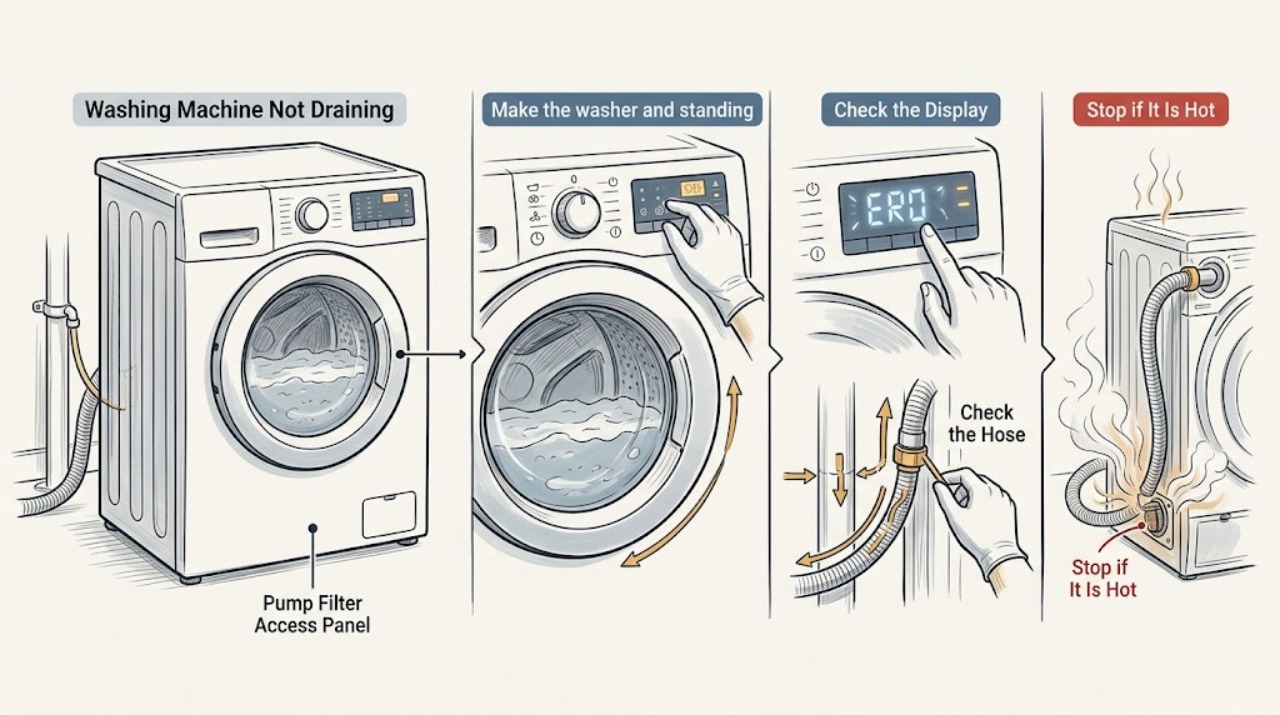
If a Maytag washer leaves water behind, stop the cycle and keep hands, plugs, and controls away from water or a wet floor. Check the selected cycle and whether the lid or door is securely closed, then inspect the accessible drain hose and household drain for kinks, clogs, a sealed connection, siphoning, or incorrect installation. A drain-pump filter is accessible only on some front-load models, so follow the exact manual and use safe water handling; do not tilt or disassemble the washer. A humming pump with little water movement, a grinding pump, a returning drain code, a leak, hot water, burning odor, smoke, or electrical risk is a stop-use condition that needs qualified service.
Work through in order
Diagnostic checks
Use only checks that match the exact appliance or system and its official guide.
-
Make the washer and standing water safe
Stop the cycle. If there is a leak or water on the floor, keep people away and close the water supply taps if they can be reached without standing in water. Disconnect power only from a dry, safe location; never touch a plug, outlet, or control while standing in water.
Expected result: The water is hot, leaking, near an outlet or cord, the machine smells burnt, smokes, sparks, trips protection, or the floor is unsafe; or the washer and floor are dry enough for a visual check.
Next step: For any hazard, leave the washer off and arrange qualified appliance or electrical help. If the area is safe, note the water level and continue without opening the machine.
Stop if: Stop for water contacting electrical parts, smoke, burning odor, sparks, repeated breaker trips, a damaged cord, or hot water that cannot be handled safely.
Why this matters
Why: Drain troubleshooting is secondary to flood and electrical safety. Hot water and an energized wet area can cause injury even when the washer's drain fault is minor.
-
Check the cycle, door or lid, and displayed code
With the washer safe and stopped, record the complete display code and whether the tub is full, partly full, or merely leaves wet clothing. Confirm the selected cycle reached drain or spin and that the lid or door is fully closed; do not force a locked door or lid.
Expected result: The code or cycle indicates a door/lid, load, or incomplete-cycle condition, or the machine reaches drain and the water remains.
Next step: Use the exact model manual for the code or cycle and make only the documented low-risk correction. If it still fails at drain, continue to the external drain checks.
Stop if: Do not bypass a lid or door lock, force the door, or restart a machine with a leak, abnormal electrical smell, or unstable cabinet.
Why this matters
Why: Maytag notes that the washer may not proceed when the lid or door condition is not satisfied; wet clothing alone does not prove that the pump or hose is blocked.
-
Inspect the accessible drain hose and household drain
With power off, look behind the washer without tilting it. Straighten a visibly kinked or pinched drain hose, check for an obvious accessible obstruction, and inspect the standpipe or laundry tub for a backup. The hose should be loose yet secure, not taped airtight into the drain, and routed according to the installation instructions.
Expected result: The hose is kinked or clogged, the standpipe or sink is backed up, or the hose is sealed into the drain; alternatively, the external path looks clear.
Next step: Correct only the visible hose routing or external drain obstruction, then use the model-approved drain or spin cycle once. If the path is clear or the washer still will not drain, continue to the installation-height and pump branches.
Stop if: Do not pull the washer from a hard-to-move installation, disconnect a full hose over an unsafe floor, or use a chemical drain cleaner in the washer or drain path.
Why this matters
Why: A restricted or sealed external path can stop drainage or create siphoning even when the washer pump is operating.
-
Rule out siphoning or incorrect drain height
Compare the hose entry, air gap, and standpipe or tub height with the model's installation instructions. Do not seal the hose to the pipe. Check that the hose is not inserted too far and is not routed beyond the model's allowed height; use the supplied U-shaped form when applicable.
Expected result: The hose is taped or sealed, inserted too far, routed too low or high, or water drains away and then returns; alternatively, the routing matches the manual.
Next step: Restore the manual's hose routing without moving or tilting the appliance, then run only the documented cycle if no safety hazard exists. If water still remains, service the washer and household drain as appropriate.
Stop if: Stop if correcting the route would require lifting or tilting the machine, stressing a connector, or disturbing a hard-piped installation.
Why this matters
Why: Maytag explains that an airtight or incorrectly placed hose can create siphoning, backflow, or gravity drainage that looks like a washer drain failure.
-
Use the pump-filter branch only when the model supports it
For a front-load model that explicitly has an accessible drain-pump filter, read the model manual first. With power off and water safely contained, use the manual's drain hose or filter procedure; open it slowly and stop if water is hot, excessive, contaminated, or cannot be controlled. Do not assume a top-load washer has the same filter or remove a panel to find one.
Expected result: The manual identifies an accessible filter and it contains lint or a foreign object, or the model has no user-accessible filter or the filter area cannot be opened safely.
Next step: Clean and reinstall the filter only exactly as the manual directs, then test the approved drain cycle once. If the filter is clear, the pump makes grinding or only hums, or the fault returns, arrange service.
Stop if: Do not open the filter with hot or uncontrolled water, use tools to force it, tilt the washer, reach into the pump, or continue after a leak or electrical hazard.
Why this matters
Why: Maytag says the drain-pump filter is present and cleanable on some front-load models, not universally; a blocked filter can reduce drainage.
-
Interpret pump sounds without dismantling the washer
From a safe, dry position, note the sound only during a model-approved drain attempt: a steady hum, a brief gurgle near the end, no sound, grinding, or repeated clicking. Do not place hands near the pump or run the washer with a removed panel.
Expected result: A hum occurs with little water movement, a gurgle occurs as the tub empties, the pump is silent, or a grinding or harsh sound occurs with standing water.
Next step: If the water drains and the sound is the documented end-of-drain behavior, follow the model manual. If the pump is ineffective, silent, grinding, or the code returns, keep the washer off and request qualified service.
Stop if: Stop for grinding, loud impact, smoke, burning odor, leak, repeated fault, or any need to expose or test the pump electrically.
Why this matters
Why: Maytag describes pump humming during drain and gurgling as air enters near the end as possible normal sounds; a silent, harsh, or ineffective pump changes the service decision.
-
Check load, foam, and drain timing
If there is no standing water hazard and the model manual permits a retry, note whether the load was tightly packed, unbalanced, or washed with non-HE or excess detergent. Do not add chemicals or run repeated cycles; use the correct cycle and detergent guidance for the model.
Expected result: The washer leaves wet items after a tightly packed or unbalanced load but drains normally when the load condition is corrected, or water remains regardless of load.
Next step: Correct the load and detergent practice only if the washer's drain path is otherwise normal. For persistent standing water, a returning code, or abnormal foam, stop and arrange service or model-specific guidance.
Stop if: Stop for overflow, leak, hot water, chemical irritation, burning odor, smoke, or repeated attempts that leave the tub full.
Why this matters
Why: Maytag notes that tightly packed loads may prevent a proper spin and leave clothing wetter; persistent standing water points to the drain path, pump, control, or plumbing instead.
-
Prepare a precise service handoff
Keep the washer off when the external path and model-approved filter check do not restore drainage. Give service the model number, front-load or top-load type, code, water level, cycle stage, hose and standpipe observations, filter result if applicable, pump sound, recent installation or plumbing work, and any leak or electrical event. Do not tilt or disassemble the machine.
Expected result: Water remains, drainage is slow, the pump is silent or harsh, the code returns, or the cause cannot be confirmed safely.
Next step: Request qualified Maytag appliance service and, when the standpipe backs up independently, a qualified plumbing check. Use emergency help for active electrical, fire, or unsafe flood conditions.
Stop if: Do not bypass a lock, replace a pump from a sound alone, perform live electrical tests, or continue operating a washer that leaks or smells burnt.
Why this matters
Why: The remaining possibilities include a pump, internal hose, lid or door interlock, pressure sensing, wiring, control, or household drain problem that requires model-specific diagnosis.
Use your observations
Decision map
Find the observation that best matches what you see, then follow the next safe action.
-
PATH 01Next step
What you see
Water is near electrical parts, the floor is unsafe, the water is hot, there is smoke, burning odor, sparking, a damaged cord, or repeated breaker trips.
Do this next
Stop, keep people away, isolate power only from a dry safe location, and obtain qualified appliance or electrical help. Do not touch the plug or controls in water.
-
PATH 02Next step
What you see
The selected cycle has not reached drain or the lid or door is not securely closed, with no leak or electrical hazard.
Do this next
Use the exact manual's cycle and lock guidance once; do not force or bypass the lid or door lock.
-
PATH 03Next step
What you see
The drain hose is kinked, clogged, sealed into the standpipe, or the household drain is blocked.
Do this next
Correct only the accessible routing or external obstruction, preserve the required air gap and manual routing, and retry the approved drain cycle once.
-
PATH 04Next step
What you see
Hose insertion or height creates siphoning or backflow, or water leaves and returns, while the washer itself is otherwise safe.
Do this next
Restore the model's installation routing without tilting or moving the machine; service the washer or plumbing if drainage remains abnormal.
-
PATH 05Next step
What you see
A front-load manual identifies an accessible pump filter and safe water handling is possible.
Do this next
Clean and reinstall it exactly as the model manual directs. Do not assume a filter exists on another model or open it with hot or uncontrolled water.
-
PATH 06Next step
What you see
The pump hums or gurgles while water moves and the behavior matches the model's documented drain operation.
Do this next
Treat the sound as potentially normal; service it if water does not move, the sound becomes grinding or harsh, or a code returns.
-
PATH 07Next step
What you see
Water remains after the external checks, the pump is silent or ineffective, the drain code returns, or the cause is uncertain.
Do this next
Keep the washer out of service and arrange qualified Maytag appliance service, with plumbing service when the household drain itself backs up.
Helpful context
Understand the symptom
Not draining can mean the washer cannot move water, the drain path is blocked, the external plumbing is backing up, or the cycle has not reached its drain step. Front-load and top-load Maytag models do not expose the same filter or emergency-drain parts, so use the model manual rather than assuming a filter is present.
Do not reach into standing water near a plug or appliance, open a filter with a full hot tub, tilt the washer, remove a pump, or keep resetting a fault. If water is near electrical parts, isolate the area and get qualified help from a dry, safe location.
When checks do not resolve it
Need a professional?
Request qualified Maytag appliance service when water remains after the manual-approved hose and filter checks, the pump is silent, grinding, or ineffective, a drain code returns, the washer leaks, or the cause would require tilting, panel removal, lock bypass, or electrical testing. Arrange plumbing help when the standpipe or utility sink backs up independently. For hot water near electrical parts, smoke, burning odor, sparks, damaged wiring, or an unsafe flooded floor, stop use and obtain appropriate emergency or qualified help.
Common questions
FAQ
Why is my Maytag washer humming but not draining?
Maytag says a pump can hum during drain, but water should move. Check the accessible hose and external drain, and use a pump-filter procedure only if the exact front-load manual identifies that filter. A hum with little water movement, grinding, or a returning code needs service.
Does every Maytag washer have a drain-pump filter?
No. Maytag describes an accessible drain-pump filter on some front-load models. Check the exact manual before opening anything; do not tilt a washer or remove a panel to search for a filter.
Can a Maytag drain hose installation cause water to remain?
Yes. A kink, clog, airtight taped connection, excessive insertion, or incorrect height can restrict flow or cause siphoning and backflow. Compare the hose with the model installation instructions and correct only accessible routing without moving the washer.
Is gurgling during Maytag washer drain normal?
Maytag describes gurgling near the end of drain as possible when the pump pulls in air after most water has left. It is not a normal explanation when water remains, the pump is harsh or ineffective, a leak occurs, or a drain code returns.
When should I stop using a Maytag washer that will not drain?
Stop for water near electrical parts, hot or uncontrolled water, a leak, smoke, burning odor, sparks, a damaged cord, repeated breaker trips, grinding, or a returning drain fault. Keep the washer off and arrange qualified appliance or electrical service.
Read the exact guide
Official sources
- Not Draining - Front Load WasherMaytag Product Help · Official Maytag front-load guidance; hose dimensions and filter access are model-specific.
- Washer Not Draining or Spinning? Troubleshooting GuideMaytag Product Help · Official Maytag washer guide; front-load and top-load implementation details remain model-specific.
- Cleaning the Drain Pump FilterMaytag Product Help · Only models whose manual identifies this accessible filter procedure; not a universal washer instruction.
- Gurgling or Slurping - NoiseMaytag Product Help · Official Maytag washer noise guidance; standing water or a returning fault requires further diagnosis.
- Not Draining - WasherMaytag Product Help · Official Maytag top-load guidance; exact model installation instructions control.
- Humming or Whirling - NoiseMaytag Product Help · Official Maytag washer noise guidance; a sound is not a substitute for model-specific service diagnosis.
Community feedback
Share a repair observation
Share a plain-text repair observation. Accepted observations are published automatically; this page may take a moment to update.