
On this page
Start here
Quick answer
A standalone Maytag washing machine does not heat-dry clothes; clothes that come out wet usually point to water left in the tub, an incomplete or low-speed spin, an unbalanced load, or excess suds. Stop the cycle safely, note whether water remains, then use the model-approved Drain & Spin or Spin cycle after checking the load, spin setting, detergent, and accessible drain path. Maytag lists washers and dryers as separate appliances, so discuss a heated dry cycle only if the exact unit is a washer-dryer combination or has a documented dryer section. Do not reach into a moving basket, bypass a lid or door lock, open the cabinet, or keep operating the machine with a leak, burning odor, damaged cord, repeated fault, or failure to drain.
Before you begin
Safety first
- Do not open the cabinet, handle the pump, motor, heater, wiring, or control, bypass a lid or door lock, probe energized parts, or order a part without exact-model confirmation and diagnosis.
Work through in order
Diagnostic checks
Use only checks that match the exact appliance or system and its official guide.
-
Check 1
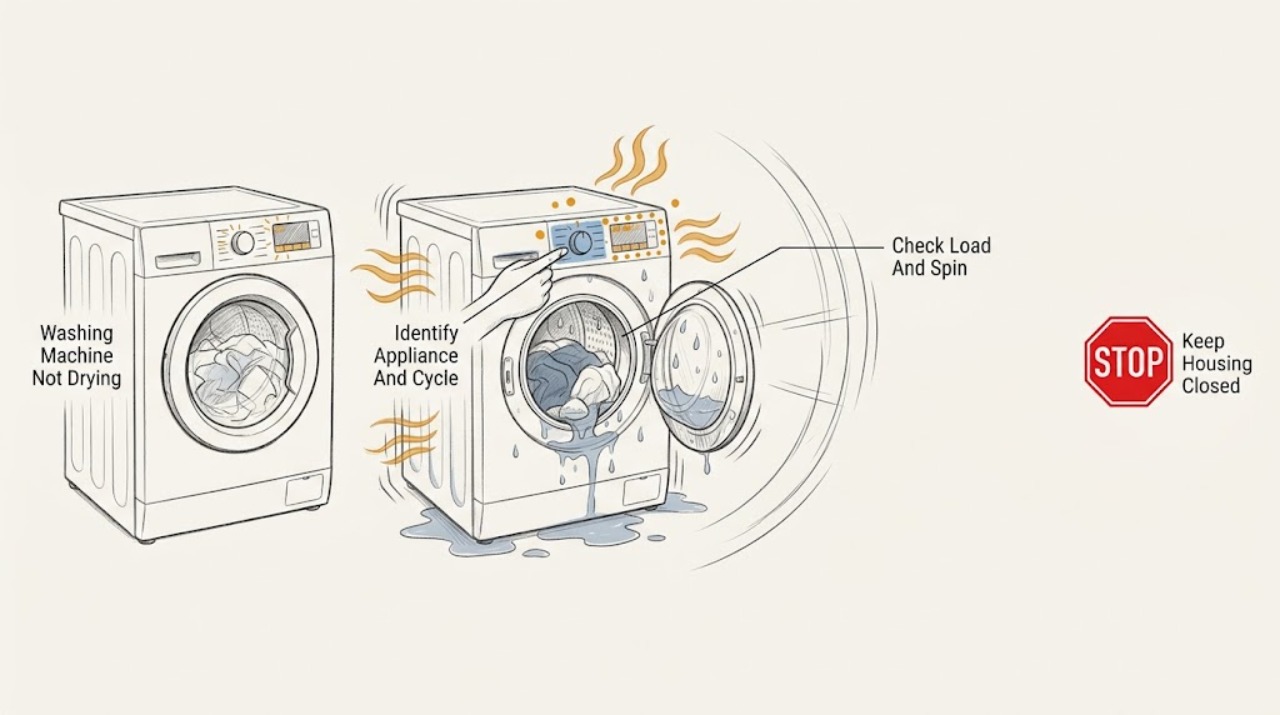
From the controls and exterior label, identify whether this is a standalone Maytag washer, a stacked washer plus dryer, or a model that explicitly combines washing and heated drying; record the model number and the cycle and spin option that were selected.
Expected result: The unit has washer-only controls, a separate dryer, or a documented dry-cycle control; note whether the load was on Delicate, Hand Wash, Low Spin, No Spin, or a normal higher-spin setting.
Next step: For a normal washer, continue with the water and spin checks below. For a combination unit, photograph the controls and use only the exact model's dry-cycle instructions; do not import advice from a separate Maytag dryer.
Stop if: Stop if the model label is missing, controls are damaged, the unit is not the assigned appliance, or identifying the model would require removing a panel.
Why this matters
Why: A washer-only unit cannot be diagnosed as a failed heater. Maytag says lower-spin and delicate selections retain more water, while its laundry-set page shows washer and dryer as separate appliances; a combination unit needs its own manual before any dry-cycle interpretation.
-
Check 2
After the cycle has stopped and the basket is no longer moving, look through the opening or at the tub area for standing water; do not put a hand into the basket and do not force a locked door or lid.
Expected result: There is visible water, the tub is empty but the load is saturated, or the tub is empty and the load is only slightly damp; also record any drain or fault message.
Next step: If water remains, do not start another full wash. Use the model-approved drain procedure and continue to the hose or user-accessible filter check; if the machine cannot drain, arrange appliance service.
Stop if: Stop and disconnect power only by the normal plug or switch when safe if there is leaking water near electrical parts, a damaged cord, smoke, a burning odor, or repeated breaker operation; do not open the cabinet.
Why this matters
Why: Visible water makes incomplete draining the first branch. An empty tub makes drain blockage less likely and shifts the check toward spin speed, balance, suds, or the fabric load. A recurring drain code is not proof that a heater or dryer section failed.
-
Check 3
With the washer stopped, loosen and redistribute the garments, remove an obviously overloaded group, and check the selected cycle's spin setting against the garment-care requirement; never add hands or tools while the basket is moving.
Expected result: The load is tightly packed, is one heavy or bulky item, is bunched to one side, or the control shows Low Spin, No Spin, Delicate, or Hand Wash; note whether the cycle paused or ended without a strong final spin.
Next step: Run the model-approved Drain & Spin or Spin cycle with a balanced, modest load. If it reaches a normal spin and the clothes are drier, correct the load or cycle choice; if it will not spin or the symptom returns with a balanced load, stop repeated testing and arrange service.
Stop if: Stop for violent movement, scraping, a loose-looking basket, a door or lid that will not lock normally, or any need to bypass an interlock or access the drive system.
Why this matters
Why: Maytag states that unbalanced or bulky loads can reduce spin speed and leave wet clothes, and that low or no spin and gentle cycles intentionally remove less water. A balanced load on an appropriate spin setting that still will not spin points toward a machine fault rather than a load-selection issue.
-
Check 4
With the machine off, inspect only the exposed drain hose and the drain connection for a kink, crushing, a sealed connection, or obvious blockage; if the exact model instructions identify a user-accessible pump filter, follow those instructions and protect the floor from water.
Expected result: The hose is kinked or crushed, the connection is taped or sealed into the standpipe, the hose is inserted too far, a model-approved filter contains lint or debris, or the accessible path looks clear.
Next step: Correct hose routing only as shown in the installation instructions and clean only the specified user-accessible filter. If water still remains or the model requires cabinet access, stop and request a qualified appliance technician.
Stop if: Do not pull the washer out across wet flooring, disconnect internal hoses, remove a pump, or open panels. Stop for a spill that reaches electrical parts or for an inaccessible filter.
Why this matters
Why: Maytag links poor draining and water returning to hose routing, siphoning, or a clogged filter on some models. A clear accessible path with persistent standing water makes a pump, internal hose, control, or other model-specific fault more likely.
-
Check 5
Review the detergent label, measured amount, dispenser setting, and the tub or display for persistent foam or a Sud, Sd, or SUD message; do not add extra detergent to force the cycle to finish.
Expected result: There are excessive suds, a suds code, non-HE detergent, an unmeasured or excessive dose, or no visible suds and the correct detergent was used.
Next step: Let an active suds-removal routine finish, then follow the model-approved rinse or Drain & Spin instruction. For the next load, use the required detergent type and amount from the model and detergent instructions; escalate if wet loads recur without suds.
Stop if: Stop if foam overflows, water leaks, an error persists after the documented routine, or the washer repeatedly ends without draining or spinning.
Why this matters
Why: Maytag says excess suds can make the washer reduce spin speed, extend rinsing, and leave a very wet load. With no suds and correct detergent, the wet load needs the spin, drain, balance, or model-specific service branch instead.
-
Check 6
Only for a verified washer-dryer combination, compare the exact model manual's dry-cycle selection, load-size limit, filter or airflow access, and any displayed dry fault; for a normal washer, do not run or troubleshoot a heating cycle that the appliance does not have.
Expected result: The washer spins and drains normally but a documented dry mode fails, or there is no dry mode and the load is simply wet after spin.
Next step: For a combo dry-mode fault, record the exact model, mode, load, and code and use only its manufacturer-approved external checks before service. For a washer-only unit, return to the drain/spin branch; if high spin completes yet clothes remain abnormally wet, arrange diagnosis.
Stop if: Do not open a heater or cabinet, clean an inaccessible vent, defeat a door lock, or continue a test with a burning odor, smoke, overheating, leak, or electrical fault.
Why this matters
Why: A combination unit may have a separate drying path, but a standalone washer's wet load remains an extraction issue. The Maytag washer and dryer documentation is organized by appliance and model, so another dryer's airflow or heat instructions cannot be assumed to apply.
Use your observations
Decision map
Find the observation that best matches what you see, then follow the next safe action.
-
PATH 01Next step
What you see
Water remains in the tub after the cycle or a drain message appears, especially when the drain hose or a model-approved pump filter is obstructed.
Do this next
Keep the washer out of full-load use, correct only visible hose setup or the exact model's user-accessible filter procedure, and arrange qualified appliance service if water remains or internal access is needed.
-
PATH 02Next step
What you see
The tub is empty, but the selected cycle was Low Spin, No Spin, Delicate, or Hand Wash, or the final spin was visibly weak and the load was heavy, single, or bunched.
Do this next
Use an appropriate model-approved spin setting with a balanced load and run Drain & Spin or Spin once. If the basket still will not reach spin or the result repeats on a balanced load, request service rather than bypassing the lock.
-
PATH 03Next step
What you see
Foam or a Sud, Sd, or SUD message appeared, and the load is wet or the cycle added rinses and ended with little spin.
Do this next
Allow the documented suds routine to finish, use the model-required detergent type and measured dose on a later load, and escalate if wet loads continue with no suds.
-
PATH 04Next step
What you see
The tub is empty, the load is balanced, the correct cycle and detergent were used, and a model-approved high-spin cycle completes but clothing remains unusually saturated.
Do this next
Stop repeated full-load tests and provide the technician with the model, cycle, load type, water result, spin behavior, codes, and any noise or vibration. Do not order a part until the exact model and failed component are confirmed.
-
PATH 05Next step
What you see
A verified combination washer-dryer drains and spins normally, but only its documented dry mode fails; a standalone washer has no dry control.
Do this next
Preserve the exact model and dry-mode code, perform only external checks named in that model's manual, and arrange qualified service for cabinet, heater, sensor, vent, or electrical diagnosis.
-
PATH 06Next step
What you see
There is a leak near electrical parts, smoke, a burning odor, damaged cord, sparking, repeated breaker operation, violent movement, an unlisted code, or a door/lid safety problem.
Do this next
Stop using the washer, keep people away, and use qualified appliance service; leave the area and follow local emergency guidance for smoke, fire, or a strong burning odor.
Helpful context
Understand the symptom
First separate wet-after-spin from a true dryer problem
The assigned appliance is a washing machine, and most Maytag washers remove water by spinning rather than by heating. If the tub is empty but garments are wet, diagnose extraction: cycle choice, spin speed, balance, suds, and drain performance. If the laundry room has a separate dryer, that dryer has a different fault path. A stacked set is still two appliances. Only a model that explicitly combines washing and heated drying should be tested for a dry-cycle fault, and its model manual controls the permitted checks.
Use the water result to choose the next branch
Standing water after the cycle makes a drain restriction, pump problem, hose setup, or siphoning issue more likely than a heat problem. An empty tub with a slow or skipped final spin shifts attention to a low-spin setting, delicate or hand-wash cycle, an overloaded or single bulky load, leveling, or a safety-controlled spin. Maytag also notes that too much or non-HE detergent can create suds and reduce spin speed. Record the observation before changing more than one variable.
Keep model-specific service work out of a wet-clothes check
A drain-pump filter exists on some Maytag front-load models, not every washer. Follow the exact owner's instructions before opening any user-accessible filter, and keep towels ready for water. Do not remove cabinet panels, handle a pump or motor, defeat a lid or door interlock, or substitute a part based on a generic picture. The model number, cycle, displayed code, water level, and whether the final spin actually completed give a technician more useful information than a guess that the washer needs a dryer part.
Safety boundary
Stop conditions
- Stop using the washer for smoke, a burning odor, sparking, a damaged cord, repeated breaker operation, or water reaching electrical parts.
- Do not reach into a moving basket, force a locked door or lid, bypass an interlock, or remove cabinet panels.
- Stop draining or filter work if water cannot be contained, the filter is not identified as user-accessible for the exact model, or internal hoses or the pump would need to be disconnected.
- Stop repeated test cycles when the washer will not drain or spin, a fault returns, the basket moves violently, or a leak persists.
Only after diagnosis
Potential parts
- model-specific drain pump or pump filter
Consider this only when water remains, the approved hose path is clear, and the exact model's service information identifies a pump or filter fault. A filter is user-accessible on some models only; a pump replacement is professional work.
Confirm the complete model number and Maytag fit information before any part is selected; do not substitute a generic pump or open the cabinet from this symptom alone. - model-specific spin, lock, or suspension component
Consider a component only after the tub is empty, the load is balanced, the correct spin setting and detergent are confirmed, and a service diagnosis identifies the failed part.
Spin, lock, motor, control, and suspension parts vary by model and configuration; verify the exact Maytag model and qualified diagnosis before ordering or opening the appliance.
When checks do not resolve it
Need a professional?
Request appliance service for persistent standing water, a failed or repeated spin fault, an unresolved drain problem, a recurring error, abnormal noise or vibration, a leak, or a combination-unit dry-mode fault after the model-approved external checks.
Safety scope: Do not open the cabinet, handle the pump, motor, heater, wiring, or control, bypass a lid or door lock, probe energized parts, or order a part without exact-model confirmation and diagnosis.
Have this ready
- Provide the complete Maytag model number, washer type, selected cycle and spin setting, whether water remained, load size and fabric type, detergent type and amount, exact display code, and whether a single balanced Drain & Spin or Spin test completed.
Common questions
FAQ
Does a Maytag washing machine dry clothes with heat?
Usually no. A standalone washer removes water through drain and spin. Maytag presents washer and dryer appliances separately. Treat a heated-dry symptom as applicable only when the exact model is documented as a washer-dryer combination; otherwise diagnose why the washer did not extract enough water.
Why are clothes wet when no water is left in the tub?
Check the cycle and spin setting, load balance, bulky or single-item loading, and excess suds. Low or no spin, gentle cycles, imbalance, and suds can all reduce water extraction. Run one model-approved Drain & Spin or Spin test after correcting the identified condition.
What if water is still sitting in the Maytag washer?
Treat it as a drain problem first. Inspect only the exposed hose and any pump filter that the exact model identifies as user-accessible. Do not disconnect internal hoses or remove the cabinet; arrange service if the water remains or a drain fault returns.
Can too much detergent make a Maytag washer leave clothes wet?
Yes. Maytag says non-HE or excessive detergent can create suds, reduce spin speed, extend rinsing, and leave a very wet load. Let a suds routine finish, then use the detergent type and measured amount required by the model and detergent instructions.
When should I stop troubleshooting and call for service?
Call when the washer will not drain or spin with a balanced load, the symptom repeats after the model-approved checks, or a combination unit's dry mode fails. Stop immediately for smoke, burning odor, sparking, damaged cord, water near electrical parts, violent movement, repeated breaker operation, or a failed door or lid lock.
Read the exact guide
Official sources
- Excessive Suds in a Front Load WasherMaytag Product Help · Official Maytag front-load washer guidance for excessive suds; detergent instructions remain model- and product-specific.
- Not Draining - Front Load WasherMaytag Product Help · Official Maytag front-load washer guidance; a drain-pump filter is model-dependent and must not be assumed on every washer.
- Cycle Time is Not Advancing - Front Load WasherMaytag Product Help · Official Maytag front-load washer guidance; cycle timing and display behavior vary by model.
- Washer and Dryer SetsMaytag · Official Maytag product page used only to distinguish washer features from the separate dryer section and to avoid applying dryer instructions to a washer-only topic.
- Not Turning, Tumbling, or Spinning - Front Load WasherMaytag Product Help · Official Maytag front-load washer guidance; apply the cycle and hose points only where the reader's model has the corresponding controls and layout.
Community feedback
Share a repair observation
Share a plain-text repair observation. Accepted observations are published automatically; this page may take a moment to update.