
On this page
Start here
Quick answer
Start by separating the symptom: if water remains, treat the washer as a drain problem before a spin or drive problem; if the tub drains but the basket never starts, check the selected cycle and the lid or door lock; if an empty or light load works but a normal or heavy load fails, imbalance, leveling, bulky items, or suds become more likely. A washer that starts spinning and then stops, rebalances, flashes a Spin Light, or shows a code needs the sequence and model-specific code recorded rather than repeated resets. Stop immediately for water near electrical parts, a leak, hot water, violent movement, metal-on-metal noise, smoke, burning odor, sparks, or a repeated breaker trip. A drain-pump filter is user-accessible only on some front-load models and must be handled exactly as the model manual states. If a safe external check does not restore spin, keep the washer out of service and arrange qualified Maytag repair.
Work through in order
Diagnostic checks
Use only checks that match the exact appliance or system and its official guide.
-
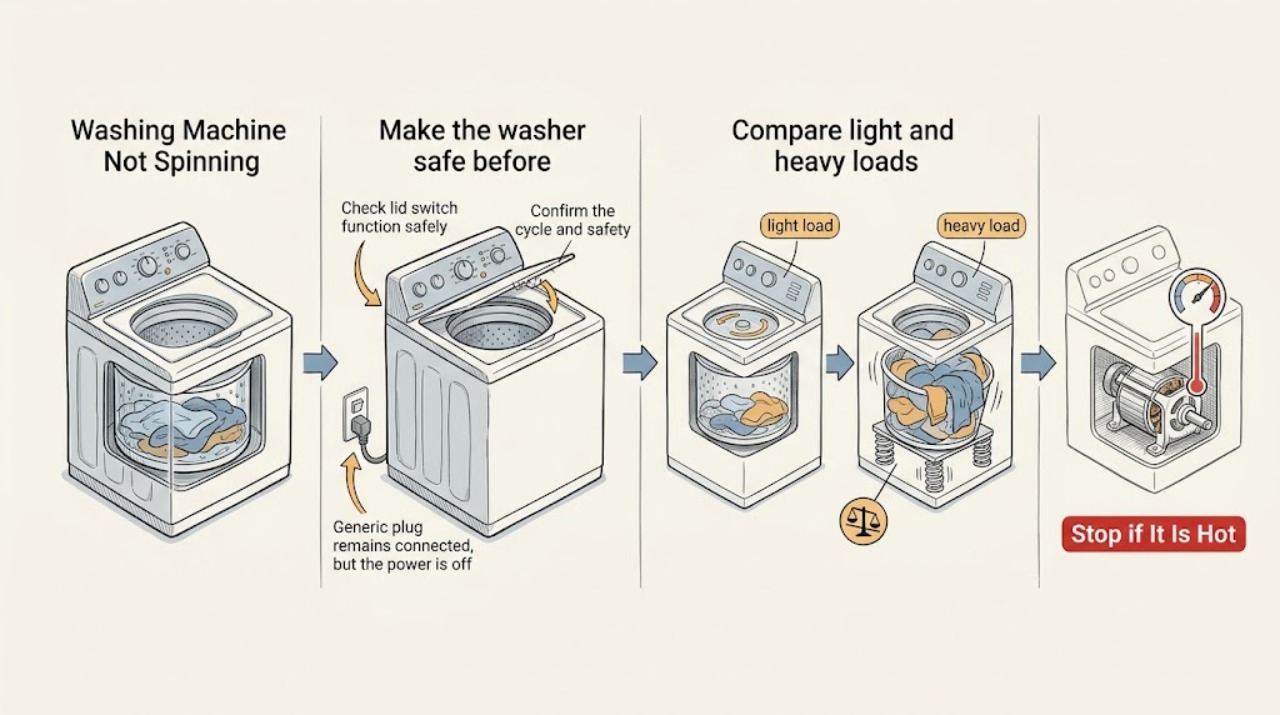
Make the washer safe before checking spin
Stop the cycle and keep hands away from the basket. If water is on the floor, near the cord or outlet, or hot, keep people away and close the supply taps only from a safe position. Disconnect power only from a dry location; do not touch a plug or control while standing in water.
Expected result: There is a leak, standing water near electrical parts, smoke, burning odor, sparks, a damaged cord, violent walking, metal impact, or a repeated breaker trip; or the washer and floor are dry and stable.
Next step: For any hazard, leave the washer off and arrange appropriate appliance, electrical, or emergency help. If the area is safe, continue without opening the cabinet.
Stop if: Stop immediately for water contacting electrical parts, smoke, burning smell, sparks, damaged wiring, violent movement, metal grinding, or repeated trips.
Why this matters
Why: Flood, electrical, fire, and mechanical hazards take priority over a spin check and should not be reproduced.
-
Confirm the cycle and safety lock
With the washer stopped and safe, record the cycle, selected spin speed, and any complete error code or flashing light. For a top-load model, close the lid fully and inspect only the visible latch area; for a front-load model, close the door without forcing it and note the lock indicator. Do not insert anything into the lock or run the washer with it open.
Expected result: Low Spin, No Spin, Delicate, Hand Wash, or an equivalent gentle setting was selected; a power interruption occurred; the lid or door will not latch; a lock indicator or code persists; or a normal setting and lock were accepted.
Next step: If no hazard exists, use the model-approved cycle or Drain & Spin once. Remove only visible debris with the manual-approved method. If the lock will not engage or the code returns, keep the washer off and arrange service; otherwise continue to load and drain checks.
Stop if: Do not force or pry the door, defeat the lid switch, or repeatedly restart a returning code, leak, abnormal sound, burning odor, or electrical fault.
Why this matters
Why: Maytag says reduced-spin settings leave more water and a power failure can prevent full spin. The lid or door interlock must permit spin, while a front-load door may remain locked when water has not drained; an error code is model-specific.
-
Compare light and heavy loads, then check stability
When the basket is stopped and safe to open, redistribute clothing evenly and remove some items if tightly packed. Do not wash a single heavy item alone when the manual warns it is difficult to balance. With the washer empty or safely stopped, look for rocking, an unplanted foot, or hoses and nearby objects contacting the cabinet; adjust feet only as the installation instructions allow.
Expected result: An empty or light load spins but a normal or heavy load fails; the washer shows loud vibration, self-correction, a flashing Spin Light, rocking, or external contact; or it remains stable and still will not spin with a light load.
Next step: Redistribute or reduce the load, use the model-recommended Bulky or Sheets/Bedding cycle, and correct only an accessible leveling or contact issue. Run one supervised approved cycle if safe; if it walks, bangs, or fails again, keep it off and request service.
Stop if: Do not lift, tilt, move a stacked washer, remove a pedestal, or continue after violent movement, cabinet or metal contact, structural damage, or a loose basket.
Why this matters
Why: Load distribution, bulky items, an unlevel washer, and external contact can reduce spin speed or stop it. If a stable light load also fails, a load-balance explanation becomes less likely, but this does not identify a failed part.
-
Treat standing water as a drain-path problem
If water remains in the tub, inspect only the accessible drain hose and household standpipe or laundry sink with power off. Look for a kink, clog, sealed hose connection, backup, siphoning, or an installation route that does not match the manual. A pump filter may be accessible only on some front-load models; follow that model's water-containment procedure if applicable.
Expected result: The hose or household drain is restricted, the washer hums but water does not move, the pump is silent or harsh, or the tub is empty and the external drain path is clear.
Next step: Correct only visible external routing or blockage. Use a pump-filter procedure only when the exact manual identifies it and water can be controlled safely. If a locked front door remains closed because water has not drained, do not force it; arrange appliance service. If the household standpipe backs up independently, arrange plumbing help.
Stop if: Do not open a filter with hot or uncontrolled water, tilt the washer, remove a pump, use chemical drain cleaner, or reach into an internal hose.
Why this matters
Why: Poor drainage can prevent or limit spin. A pump that is ineffective or harsh needs model-specific service; a front-load filter is not universal. If the tub is empty, drainage becomes less likely as the primary explanation, though it is not proof of a drive fault.
-
Check whether excess suds explain the wet load
Review the detergent type and amount used for the load, without adding more product or mixing cleaners. If heavy suds appeared while the drain path is clear, follow the model's documented suds or rinse guidance; do not run repeated cycles to force a spin.
Expected result: Excess foam coincides with the wet-load or no-spin symptom and clears under the manual's guidance, or there is no excess foam and the washer still will not spin.
Next step: Use the correct detergent practice on future loads. If standing water, no-spin, a code, or abnormal sound persists, stop use and arrange qualified appliance service.
Stop if: Stop for overflow, chemical irritation, leak, hot water, smoke, burning odor, sparks, or a returning no-spin fault.
Why this matters
Why: Maytag warns that too many suds can interfere with pumping and spinning. No excess suds makes that explanation less likely and leaves the control, lock, drain, motor, drive, or suspension unresolved; sound alone cannot identify one part.
-
Prepare a service handoff for persistent no-spin
Keep the washer out of service when it still will not spin after the safe checks. Record the model number, front-load or top-load type, cycle and spin setting, code or light, water level, lock behavior, load and detergent context, stability, hose and filter observations, pump sound, recent power or installation work, and any leak or electrical symptom. Do not diagnose a motor, belt, suspension, or control by sound alone.
Expected result: The washer never enters spin, starts and then stops, leaves standing water, has a returning lock or drain fault, or spins with violent noise or scraping.
Next step: Request qualified Maytag appliance service for the washer. Request plumbing help when the household standpipe backs up independently. Use emergency or qualified electrical help for active electrical, fire, or unsafe flood conditions.
Stop if: Do not bypass a lock, tilt or dismantle the washer, perform live electrical tests, or keep operating it with smoke, burning odor, violent vibration, or metal contact.
Why this matters
Why: Remaining causes can involve the interlock, pump, pressure sensing, motor, drive, suspension, wiring, control, or household plumbing and require model-specific diagnosis.
Use your observations
Decision map
Find the observation that best matches what you see, then follow the next safe action.
-
PATH 01Next step
What you see
Water is near electrical parts, the floor is unsafe, water is hot, there is a leak, smoke, burning odor, sparks, damaged wiring, violent movement, metal impact, or repeated breaker trips.
Do this next
Stop use, keep people away, isolate power only from a dry safe location, and obtain the appropriate appliance, electrical, or emergency help. Do not reproduce the spin symptom.
Why this path and its safety boundary
Why it matters: More likely: an active flood, electrical, fire, or mechanical safety hazard is present; ordinary cycle selection or load balance is no longer the first concern. Less likely: a harmless setting-only explanation cannot be safely assumed while the hazard is active.
-
PATH 02Next step
What you see
Water remains in the tub, the front-load door stays locked with water inside, or the washer hums without moving water.
Do this next
With power off and water controlled, check only the visible hose and household drain. Use a pump-filter procedure only when the exact front-load manual identifies it. Do not force a locked door or open a hot or uncontrolled filter; use appliance service for pump or internal faults and plumbing service for an independent standpipe backup.
Why this path and its safety boundary
Why it matters: More likely: a restricted or incorrectly routed drain hose, household standpipe problem, siphoning, excess suds, or a model-dependent pump or filter issue. Less likely: a primary motor or drive fault as the first explanation, though it cannot be ruled out until model-specific drainage is confirmed.
-
PATH 03Next step
What you see
The tub drains, but the basket never spins, including when an empty or light load is used.
Do this next
Record the cycle, spin selection, code or light, and lock behavior. Correct only a visible obstruction and run one model-approved cycle if safe. If the lock does not engage, the code returns, or the basket remains still, keep the washer off and arrange qualified Maytag appliance service.
Why this path and its safety boundary
Why it matters: More likely: the selected cycle or spin speed, a top-load lid or front-load door interlock, a returning control condition, or a motor or drive problem. Less likely: a drain restriction and load imbalance alone when the tub is empty and stable; no individual failed part can be identified from this symptom.
-
PATH 04Next step
What you see
An empty or light load spins, but a normal or heavy load fails, leaves clothes wet, rebalances repeatedly, or triggers loud vibration or a flashing Spin Light.
Do this next
Redistribute or reduce the load, use the model-recommended Bulky or Sheets/Bedding cycle, and correct only accessible leveling or external contact. Run one supervised approved cycle; stop and request service if the washer walks, bangs, or repeats the condition.
Why this path and its safety boundary
Why it matters: More likely: uneven distribution, an overloaded or bulky load, excess suds, an unlevel washer, or external contact. Less likely: a complete motor or control failure if the basket reliably spins when lightly loaded, although a load-sensitive mechanical or suspension issue remains possible.
-
PATH 05Next step
What you see
The washer starts spinning and then stops, repeatedly rebalances, flashes a Spin Light, displays a code, or makes abnormal noise after the safe checks.
Do this next
Record what happened immediately before the stop, the code or light, water level, load, and sound. Apply only the matching safe load, level, or external drain check once. If the event returns or includes violent vibration, metal contact, smoke, burning odor, or electrical symptoms, keep the washer off and arrange qualified appliance service.
Why this path and its safety boundary
Why it matters: More likely: a detected imbalance, leveling or external-contact problem, incomplete drainage or suds condition, power interruption, or a model-specific control or mechanical fault. Less likely: a simple no-start lock explanation if the basket visibly began to spin; a lock, drain, control, motor, drive, or suspension issue is not excluded.
Helpful context
Understand the symptom
The most useful first split is whether water remains and whether the basket ever began to spin. Standing water points first to the drain path; a fully drained tub with no basket movement shifts attention to the selected cycle and safety lock. If spin works only with a light load, load balance, bulky items, level, or suds become more plausible. Top-load and front-load Maytag models use different lock, drain, and filter arrangements, so use the exact model manual for controls and access.
Do not bypass a lid or door lock, reach into a moving basket, tilt the washer, remove a panel, or keep restarting a machine that walks, leaks, smells burnt, or trips protection. A wet load with standing water should be treated as a drain problem before a drive diagnosis.
When checks do not resolve it
Need a professional?
Request qualified Maytag appliance service when the lock will not engage, water remains after model-approved external checks, the pump is silent or harsh, the washer remains unstable, a code returns, or the no-spin condition would require tilting, panel removal, lock bypass, or electrical testing. Request plumbing help when the household standpipe backs up independently. Stop and obtain appropriate emergency or qualified help for water near electrical parts, smoke, burning odor, sparks, damaged wiring, violent movement, hot water, or an unsafe flooded floor.
Common questions
FAQ
Why does my Maytag washer fill but not spin?
Check the selected cycle and spin setting, lid or door lock, load balance, level, and whether water remains. Low or No Spin, an unbalanced load, a lock issue, or a drain restriction can prevent a full spin; a recurring fault needs service.
Can an unbalanced load stop a Maytag washer from spinning?
Yes. Maytag says an unbalanced or overloaded load can cause shaking, reduced speed, longer cycles, and a stop in spinning. Redistribute or reduce the load and use the model-recommended cycle; stop if the washer walks or bangs.
Does standing water prevent a Maytag washer from spinning?
It can. Check the accessible drain hose and household drain, and use a pump-filter procedure only if the exact front-load manual identifies an accessible filter. Do not open a full or hot filter, tilt the washer, or remove internal parts.
Why is my Maytag washer leaving clothes wet after spinning?
Low or No Spin, a gentle or bulky cycle, an unbalanced load, excess suds, or incomplete draining can leave clothes wet. Correct only the matching condition from the model manual; standing water, a returning code, or a harsh pump needs service.
When should I stop using a Maytag washer that will not spin?
Stop for water near electrical parts, a leak, hot water, violent movement, metal scraping or impact, smoke, burning odor, sparks, damaged wiring, or repeated breaker trips. Keep the washer off and arrange qualified appliance or electrical service.
Read the exact guide
Official sources
- Humming or Whirling - NoiseMaytag Product Help · Official Maytag washer noise guidance; sound alone does not identify a failed part.
- Rattling or Tapping Noise - Front Load WasherMaytag Product Help · Official Maytag front-load guidance used for safe vibration triage.
- Lid Locking on a Top Load High Efficiency WasherMaytag Product Help · Official Maytag top-load guidance; top-load features vary by model.
- Not Turning, Tumbling, or Spinning - Front Load WasherMaytag Product Help · Official Maytag front-load guidance; exact model features and access vary.
- Spin Light FlashingMaytag Product Help · Official Maytag top-load guidance; exact light patterns and codes vary by model.
- Cleaning the Drain Pump FilterMaytag Product Help · Only models whose manual identifies this accessible filter procedure.
- Not Spinning - WasherMaytag Product Help · Official Maytag top-load guidance; exact model cycle and installation details control.
- Not Draining - Front Load WasherMaytag Product Help · Official Maytag front-load guidance; filter access and hose details are model-specific.
- Washer Not Draining or Spinning? Troubleshooting GuideMaytag Product Help · Official Maytag washer guide; front-load and top-load implementation details remain model-specific.
- Latching a Front Load Washer DoorMaytag Product Help · Official Maytag front-load guidance; exact model lock behavior and manual control.
Community feedback
Share a repair observation
Share a plain-text repair observation. Accepted observations are published automatically; this page may take a moment to update.