
On this page
Start here
Quick answer
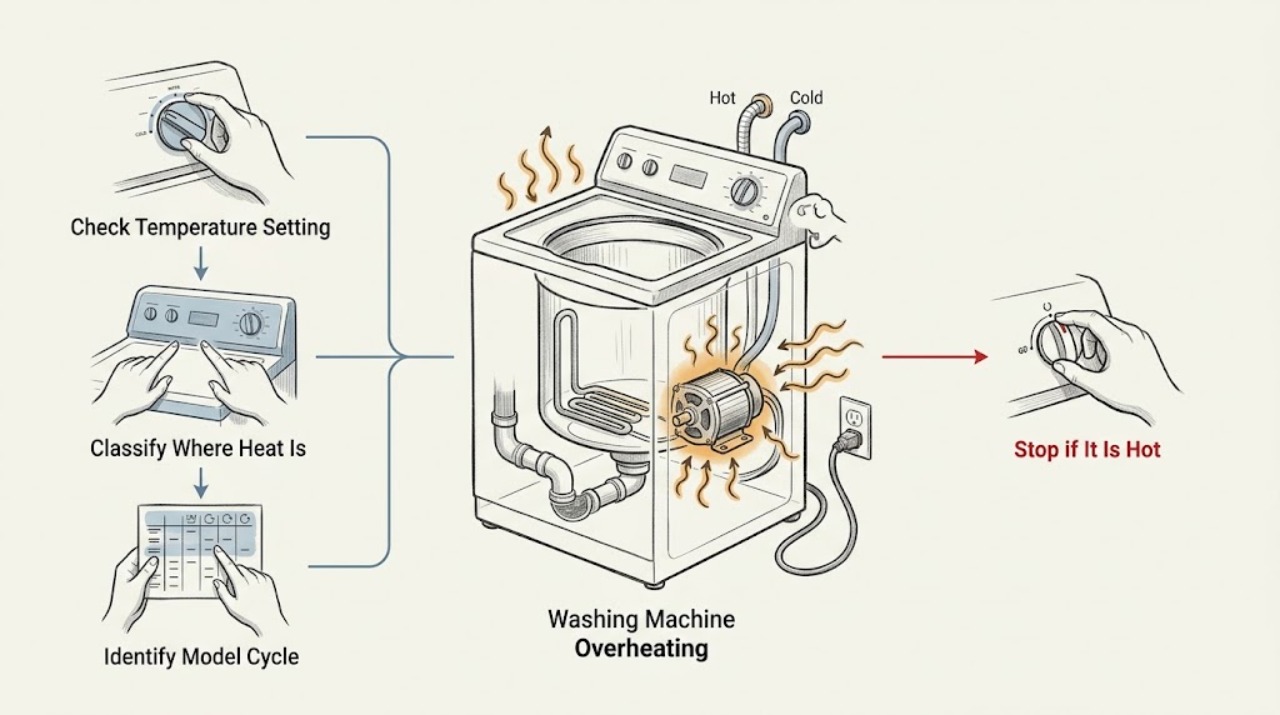
A Maytag washer can feel warm during a Sanitize, Steam, or hot-water cycle without overheating. First distinguish warm water in the tub from an unusually hot cabinet, control panel, cord, or outlet. Stop the washer and keep it disconnected if there is a burning odor, smoke, sparking, a hot or discolored plug, repeated breaker trips, water near electrical equipment, a damaged cord, or a burn hazard. Otherwise record the model, load type, selected temperature, and cycle stage. Check that the hot and cold hoses are connected to the correct valves, both faucets are open, and the temperature setting matches the model guide. Excess detergent can create suds, extra rinses, wet loads, and longer operation; a blocked drain or heavy load can also prolong a cycle. A Maytag error such as F0E4 means the washer sensed water that was too hot and calls for hose verification and only a single safe control reset. Persistent abnormal heat, an error that returns, a motor that stalls, or heat at the electrical connection needs qualified service.
Work through in order
Diagnostic checks
Use only checks that match the exact appliance or system and its official guide.
-
Check 1
Stop the washer and record what is hot: the wash water, door or lid glass, cabinet, control area, motor area, power cord, plug, or outlet. Note the cycle stage and whether there is a burning odor, smoke, sparking, leaking water, or a breaker trip. Do not touch a surface that may burn you.
Expected result: Only the water is warm during a selected heated cycle, the cabinet is unusually hot, the cord or outlet is hot or discolored, or the washer is smoking, sparking, leaking, or tripping protection.
Next step: For water warmth with no hazard, continue with model and cycle checks. For abnormal external heat or any hazard, stop using the washer, isolate power only from a dry safe position if possible, and arrange qualified help.
Stop if: Stop for smoke, burning smell, sparks, arcing, a hot or melted plug, a discolored outlet, repeated breaker trips, water near electrical equipment, or a burn hazard.
Why this matters
Why: Warm water can be an intended cycle result. Heat at the electrical path or a hazard sign indicates an electrical or appliance fault and is not a temperature-setting problem. Cabinet or motor heat with stalled operation also needs service assessment.
-
Check 2
Write down the full model number, whether the washer is top-load or front-load, the selected cycle and options, and the exact displayed message. Use the matching Maytag manual to confirm whether the cycle includes Sanitize, Steam, or another heated option.
Expected result: The manual confirms a heater or heated cycle, the selected cycle is not intended to heat, or an exact code such as F0E4 appears.
Next step: Follow only the exact model instructions and preserve the code and cycle details for service. Do not change several options at once or use a generic reset repeatedly.
Stop if: Stop if the display returns a fault with abnormal heat, the washer cannot be stopped normally, or any check would require opening the control panel or cabinet.
Why this matters
Why: A confirmed heated cycle can explain warm water and a longer heating phase. A temperature code or heat on a non-heated cycle selects a fault path, but a code from a different model must not be assumed to have the same meaning.
-
Check 3
Compare the selected temperature, Steam or Sanitize option, fabric-care instructions, and the model cycle guide. If the washer has just filled, observe whether the hot and cold water entering the tub matches the selected cycle without reaching into the water or touching a hot surface.
Expected result: A heated option is selected, a normal cycle is using unexpectedly hot water, the cycle is warm by design, or the water temperature does not match the selection.
Next step: If the cycle is intentionally heated and the washer has no hazard sign, let the documented cycle finish. If a normal cycle is abnormally hot or the code returns, stop using the washer and arrange service after the external hose check.
Stop if: Stop for scalding water, steam escaping abnormally, a hot cabinet or control area, smoke, burning odor, sparking, or any need to reach into the tub while it is hot.
Why this matters
Why: Maytag temperature control blends incoming hot and cold water and can add warm water even on some cold selections. Unexpectedly hot water or F0E4 suggests a hose-routing or temperature-control issue rather than a normal heated cycle.
-
Check 4
From a dry position, visually trace the external hot and cold inlet hoses to confirm that hot is connected to hot and cold to cold, both faucet valves are open, and the hoses are not kinked. If a connection must be disturbed, first turn off the water supply and follow the model installation instructions; do not reach behind a wet or energized washer.
Expected result: The hoses are reversed, one faucet is closed, a hose is kinked, a connection is wet, or the external hose arrangement is correct.
Next step: Correct only a clearly identified external routing or valve position using the installation guide, then inspect for leaks with the washer off. If the temperature remains abnormal, or a connection leaks, leave the washer out of service.
Stop if: Stop for a spraying or uncontrolled leak, water near the outlet or cord, a damaged hose, a hot connection, or any need to move the appliance or open its rear panel.
Why this matters
Why: Maytag identifies reversed hot and cold hoses as a cause of incorrect temperature readings and lists open hot and cold supplies as required for proper operation. A wet connection is a leak and electrical-safety concern, not merely a temperature issue.
-
Check 5
With the washer stopped and safe to open, record whether the load is tightly packed, a single bulky item, unusually wet, or surrounded by excessive suds. Check the detergent label and amount against the model guide; use only the detergent type and amount permitted for that washer.
Expected result: A large or uneven load is present, the load is wet because spin was reduced, Sud or Sd is displayed, or the load and detergent amount are normal.
Next step: For a documented suds routine, follow the model guidance and correct future detergent dosing. For repeated long cycles with a normal load, or any hot motor/cabinet symptom, arrange service rather than adding more cycles.
Stop if: Stop for hot or scorched fabric, smoke, burning odor, a stalled or grinding motor, water overflowing, or any electrical hazard.
Why this matters
Why: Maytag says bulky or unbalanced loads can extend operation, while excess detergent can trigger suds reduction, extra rinses, reduced spin, and wetter laundry. These can make the washer run longer but do not justify ignoring external heat or a burning smell.
-
Check 6
After the washer is stopped and the water is safe to handle, inspect only the visible drain hose routing, standpipe or laundry sink, and any model-approved accessible pump-filter area. Look for a kink, clog, overflow, or water left in the tub; do not open a filter while water is hot or under pressure.
Expected result: The drain hose is kinked or clogged, the drain is poorly routed, the tub retains water, excessive suds are present, or the visible drain path is clear.
Next step: Correct only a visible hose-routing issue or accessible blockage as the model guide permits, with water and power safely controlled. If water remains, the pump hums without draining, or heat recurs, stop using the washer.
Stop if: Stop for hot water, uncontrolled wastewater, water near electricity, a seized or grinding pump, smoke, burning odor, or any need to dismantle the pump or cabinet.
Why this matters
Why: Maytag links restricted or incorrectly routed drains and excess suds to slow or incomplete draining. Retained water can lengthen or interrupt spin and may be mistaken for the washer overheating; a pump or motor that becomes hot or stalls is a service symptom.
-
Check 7
If the exact model displays F0E4 or another temperature-related code, photograph the code and confirm the model before acting. Only when there is no leak, heat, smell, sparking, or breaker problem may you perform the model's single documented control reset; do not repeatedly reset it.
Expected result: The code clears and does not return, the code returns, or the code is accompanied by abnormal heat or a safety hazard.
Next step: If the code returns, leave the washer out of service and provide the code, model, cycle, hose arrangement, and heat observations to qualified service. Do not guess at a sensor or heater replacement.
Stop if: Stop for any hazard, a code that returns immediately, a hot plug or cord, water near electrical equipment, smoke, sparks, or a need to access internal wiring.
Why this matters
Why: Maytag describes F0E4 as water temperature sensed too hot and provides hose verification plus a five-minute power disconnect as a reset path. A returning code or a code with physical overheating indicates unresolved service work.
-
Check 8
Do not run a cycle solely to reproduce overheating. Only when the washer is cool, dry, stable, and free of hazard signs may you perform one brief model-approved recheck with the original settings while staying nearby. Stop at the first abnormal heat, smell, noise, message, leak, or breaker response.
Expected result: The washer completes normally and only the selected water was warm, or the abnormal heat, code, long cycle, stalled motor, leak, or electrical symptom returns.
Next step: If any abnormal symptom returns, disconnect or isolate the washer safely, keep it out of service, and arrange Maytag or qualified appliance and electrical service with the recorded details.
Stop if: Stop immediately for smoke, burning odor, sparks, arcing, abnormal cabinet or motor heat, hot plug, water near electricity, repeated trips, or a stalled or grinding motor.
Why this matters
Why: A normal recheck supports a cycle, load, hose, or suds explanation but does not prove an internal part is healthy. Recurrence or heat outside the tub means the washer needs qualified diagnosis.
Use your observations
Decision map
Find the observation that best matches what you see, then follow the next safe action.
-
PATH 01Next step
What you see
Only the wash water is warm during a model-documented Sanitize, Steam, or hot-water cycle, and there is no abnormal cabinet, motor, cord, or outlet heat.
Do this next
Arrange qualified service and follow the exact model guidance.
Why this path and its safety boundary
Why it matters: Treat the warmth as a possible intended cycle behavior. Let the documented cycle run only if there is no safety concern, and use the model guide for cycle timing.
-
PATH 02Next step
What you see
Water is unexpectedly hot on a non-heated cycle, the hot and cold hoses are reversed, or F0E4 indicates water temperature is too hot.
Do this next
Arrange qualified service and follow the exact model guidance.
Why this path and its safety boundary
Why it matters: Stop after the safe external hose and faucet check, follow the exact model guidance, and arrange service if the temperature or code persists. Do not infer a heater or sensor part.
-
PATH 03Next step
What you see
Sud or Sd appears, excessive bubbles are visible, the load is bulky or unbalanced, or the cycle is long with wet laundry but no external heat hazard.
Do this next
Arrange qualified service and follow the exact model guidance.
Why this path and its safety boundary
Why it matters: Follow the model's suds or load guidance, use the correct detergent amount, and check only accessible drain routing. Persistent long cycles or physical heat still require service.
-
PATH 04Next step
What you see
The tub retains water, draining is slow, the visible hose is kinked or clogged, or the pump runs without removing water.
Do this next
Arrange qualified service and follow the exact model guidance.
Why this path and its safety boundary
Why it matters: Stop the washer, control water and power safely, and correct only a visible model-approved hose or access issue. A persistent drain or hot pump symptom needs qualified service.
-
PATH 05Next step
What you see
The cabinet, control area, motor area, door or lid, or other external appliance surface is unusually hot, especially with stalled movement, grinding, or a burning odor.
Do this next
Arrange qualified service and follow the exact model guidance.
Why this path and its safety boundary
Why it matters: Stop using the washer and arrange qualified appliance service. Do not open the cabinet, access the motor, bypass a thermal or lid interlock, or keep restarting it.
-
PATH 06Next step
What you see
The plug, outlet, cord, or control area is hot, discolored, wet, smoking, sparking, or the breaker trips again.
Do this next
Arrange qualified service and follow the exact model guidance.
Why this path and its safety boundary
Why it matters: Stop immediately, do not reset and retry, and from a dry safe position isolate power only if it can be done without approaching the hazard. Arrange qualified electrical or appliance service.
-
PATH 07Next step
What you see
A hose, tub, pump, or overflow places water near the outlet, plug, cord, control area, or other electrical equipment.
Do this next
Arrange qualified service and follow the exact model guidance.
Why this path and its safety boundary
Why it matters: Do not touch wet electrical equipment or stand in water. Keep the washer out of service and have the leak and electrical risk assessed by qualified personnel.
-
PATH 08Next step
What you see
A temperature or system code returns after the exact model's permitted single reset, or the same abnormal heat returns during a safe recheck.
Do this next
Arrange qualified service and follow the exact model guidance.
Why this path and its safety boundary
Why it matters: Record the code, model, cycle stage, hose arrangement, load, and physical heat location, then leave the washer out of service for qualified diagnosis.
Helpful context
Understand the symptom
Warm water is not the same as an overheating washer
A heated wash or Steam Clean option can deliberately warm the water and extend the cycle. The water temperature, however, does not explain a hot plug, discolored outlet, burning smell, smoke, or a cabinet that is too hot to approach. Record which surface or water component is hot and whether the symptom appears during fill, wash, drain, spin, or after the cycle.
Model and cycle details matter
Maytag top-load and front-load models do not share every cycle or error code. Use the model number to open the matching manual and do not apply a top-load instruction to a front-load machine. The F0E4 family of guidance means the washer sensed water that was too hot; it is not proof that every Maytag model has the same heater or temperature system.
Long operation can have non-heater causes
Extra rinses from excessive suds, a restricted drain, a wet or unbalanced load, and an unsuitable cycle can keep the washer running longer. These conditions may be described as overheating even when the actual symptom is a long cycle or hot water. Correct only accessible settings, detergent amount, load arrangement, and visible hose routing; do not open the cabinet or test internal parts.
Heat at the electrical path is a stop condition
Do not keep resetting a breaker or running cycles to reproduce heat. If the cord, plug, outlet, control area, or cabinet is hot, scorched, wet, sparking, or smoking, stop from a dry position and arrange qualified appliance or electrical service. Never use an extension cord, bypass a safety device, or work on live wiring.
Safety boundary
Stop conditions
- Smoke, burning odor, sparks, arcing, a hot or discolored plug or outlet, or a repeated breaker trip is present.
- Water is near an outlet, cord, control area, or other electrical equipment, or the floor is wet where the washer is connected.
- The cabinet, control area, motor area, cord, or outlet is unusually hot, melted, scorched, or damaged.
- Water is scalding, steam is escaping abnormally, or the door, lid, or tub cannot be handled safely.
- The pump or motor stalls, grinds, smells hot, or needs repeated restarts to continue.
- A check would require opening the cabinet, accessing live wiring, bypassing a lid or door interlock, or dismantling a heater, pump, or motor.
Only after diagnosis
Potential parts
- temperature sensor or water-temperature control
Consider this only after the exact model manual and qualified diagnosis connect a recurring temperature code or abnormal water temperature to that control path.
Confirm the full model and manufacturer's fit information; do not choose a part from a generic code description. - water inlet valve or inlet hose
Relevant only if external routing is correct and qualified diagnosis finds a failed valve or a damaged hose causing incorrect temperature or leakage.
Hot and cold arrangements vary by model; verify the model-specific part and installation instructions. - drain pump or pump filter
Consider this only when the model has an accessible filter or service diagnosis confirms a pump or drain restriction after visible hose checks.
Confirm model fitment and safe access instructions before ordering or servicing any drain component.
When checks do not resolve it
Need a professional?
F0E4 or another temperature code returns after the exact model's permitted reset and hose check., A normal cycle produces unexpectedly hot water or the cabinet, motor, control area, cord, plug, or outlet becomes hot., The washer repeatedly runs long, stalls, drains poorly, or leaves water after accessible load, detergent, and drain checks., A hose, tub, pump, or overflow leaks near the power connection or the washer is wet and cannot be safely isolated., There is smoke, burning odor, sparking, arcing, a damaged electrical connection, repeated breaker tripping, or a burn hazard.
Common questions
FAQ
Can a Maytag washer feel warm during a normal cycle?
Yes. Sanitize, Steam, and other heated cycles can warm the water and extend operation. The cabinet, motor, cord, plug, or outlet should not become unusually hot, smoky, wet, or discolored.
What does F0E4 mean on a Maytag washer?
On the Maytag model covered by the F0E4 guide, it means the washer sensed water that was too hot. Verify the hot and cold hose routing and follow the model's single permitted reset; if the code returns, arrange service.
Can excess detergent make a washer overheat?
Excess detergent can create suds, extra rinses, reduced spin, wet loads, and longer cycles. That may look like overheating, but it does not explain a hot plug, smoke, burning odor, sparking, or abnormal cabinet heat.
Should I keep resetting the breaker if the washer gets hot?
No. A hot, damaged, wet, or discolored electrical connection or a repeated trip is a stop condition. Keep the washer out of service and arrange qualified appliance or electrical inspection.
Read the exact guide
Official sources
- Not Draining - Front Load WasherMaytag · Maytag front-load washers
- Water Not Hot or Not Warm EnoughMaytag · Maytag top-load washers
- Cycles, Options, and Modifiers on a Top Load HE WasherMaytag · Maytag top-load HE washers
- Electrical Supply Needed for a WasherMaytag · Maytag washers
- Tripping Breaker - WasherMaytag · Maytag top-load washers
- F0 E4 - Front Load WasherMaytag · Maytag front-load washers covered by this error guide
- Checking the Fill Hoses if the Washer is not FillingMaytag · Maytag washers
- Excessive Suds in a Front Load WasherMaytag · Maytag front-load washers
- Long Cycle Time - WasherMaytag · Maytag top-load washers
- Not Draining - WasherMaytag · Maytag top-load washers
Community feedback
Share a repair observation
Share a plain-text repair observation. Accepted observations are published automatically; this page may take a moment to update.