
On this page
Start here
Quick answer
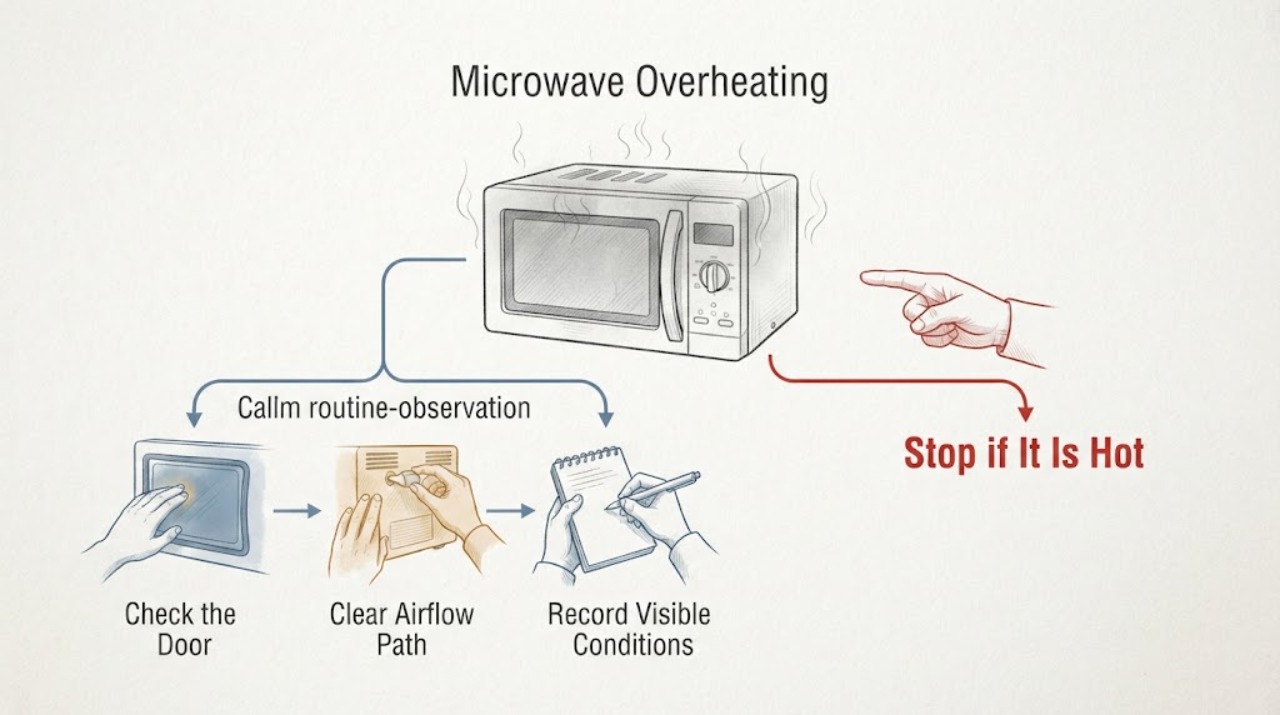
Some warmth after cooking can be normal, especially after back-to-back cycles or in a hot room, but extreme heat, a burning smell, smoke, sparks, or a hot cord is a stop condition. Stop the microwave, disconnect power safely, and let it cool. Check only that accessible ventilation is clear and that the symptom is not caused by repeated heavy use; do not open the cabinet. Persistent or severe overheating needs qualified service.
Work through in order
Diagnostic checks
Use only checks that match the exact appliance or system and its official guide.
-
Check 1
Stop heating, disconnect power at the plug or breaker if safe, and note whether the extreme heat is at the cabinet, door area, plug, cord, or nearby wall.
Expected result: Only the cabinet is warm, or the plug/cord, door area, or wall outlet is unusually hot.
Next step: Do not use the microwave again when the cord, plug, outlet, or door area is hot or damaged; arrange service.
Why this matters
Why: Location helps separate expected surface warmth from an electrical connection or localized appliance fault.
-
Check 2
After full cooling, inspect external ventilation openings and the surrounding clearance for blocked airflow, grease, towels, or adjacent heat-producing equipment.
Expected result: Airflow is clear or blocked; the microwave is installed near a heat source or in a hot environment.
Next step: Clear only accessible external obstructions and provide the manual-specified clearance; do not remove panels.
Why this matters
Why: Restricted airflow and ambient heat can increase surface temperature and cooling demand.
-
Check 3
Record whether overheating follows one short cycle, a long cycle, or several back-to-back cycles, and whether food heats normally or the unit stops early.
Expected result: Only repeated/long use causes warmth, or a short cycle also causes extreme heat/early shutdown.
Next step: Do not continue testing a severe symptom. Arrange service when heat is excessive or reproducible after cooling.
Why this matters
Why: Heavy use can produce expected warmth, while extreme heat or early shutdown on a short cycle suggests cooling, thermal, or internal component trouble.
-
Check 4
Check for smoke, burning or electrical odor, sparks/arcing, melted material, abnormal noise, or a damaged cord without touching hot parts.
Expected result: Any of these signs is present, or the microwave cools and operates normally without abnormal signs.
Next step: For any safety sign, keep power disconnected and obtain qualified service. Do not open the unit.
Why this matters
Why: Smoke, burning, sparks, and damaged electrical parts are safety faults.
-
Check 5
If the appliance is cool and no safety symptom exists, run no more than one short supervised cycle after clearing external airflow.
Expected result: The short cycle is normal, or the unit rapidly becomes extreme-hot again.
Next step: Stop and service it if severe heat returns, even if food still heats.
Why this matters
Why: A normal controlled cycle after cool-down supports a use/environment factor; recurrence indicates unresolved cooling or internal fault.
Use your observations
Decision map
Find the observation that best matches what you see, then follow the next safe action.
-
PATH 01Next step
What you see
The exterior is warm only after repeated cycles, with clear vents and normal heating/no odor.
Do this next
Allow cooling between cycles and keep airflow clear; monitor for changes.
Why this path and its safety boundary
Why it matters: Heat buildup from heavy use or ambient conditions may be expected.
-
PATH 02Next step
What you see
The unit becomes extreme-hot during one short cycle or stops early.
Do this next
Disconnect power and arrange service; do not repeat the test.
Why this path and its safety boundary
Why it matters: Cooling, thermal protection, or an internal component fault is more likely.
-
PATH 03Next step
What you see
The plug, cord, or outlet is hot or damaged.
Do this next
Disconnect power if safe and have the appliance/circuit inspected by a qualified professional.
Why this path and its safety boundary
Why it matters: The electrical connection is unsafe to continue using.
-
PATH 04Next step
What you see
Smoke, burning smell, sparks, or melted material is present.
Do this next
Keep power disconnected, ventilate the area if safe, and obtain qualified service; never open the cabinet.
Why this path and its safety boundary
Why it matters: This is an immediate stop condition.
Helpful context
Understand the symptom
First classify the heat: a warm exterior after a normal cycle can differ from a cabinet too hot to touch, heat at the plug, or a burning odor. Do not touch hot surfaces repeatedly and never open the microwave to inspect internal parts.
Use a cool-down and airflow observation
Repeated or back-to-back use and high ambient temperature can raise surface temperature. Blocked ventilation can prevent cooling and can lead to protective shutdown.
When checks do not resolve it
Need a professional?
Stop using the microwave and disconnect power for extreme heat, burning smell, smoke, sparks/arcing, melted parts, a hot/damaged plug or cord, or repeated thermal shutdown. Do not open the cabinet or bypass safety switches.
Common questions
FAQ
Is a warm microwave exterior always a fault?
No. Panasonic notes that repeated cycles and hot surroundings can increase surface temperature. Extreme heat, burning odor, smoke, sparks, or a hot cord is different and requires immediate shutdown.
Can I remove the microwave cover to find the cause?
No. Panasonic specifically says not to open or service the unit yourself when excessive heat may involve cooling or internal components.
What should I do if overheating returns after clearing vents?
Disconnect power and arrange qualified service. Wolf lists cooling and thermal protection faults among causes of abnormal microwave shutdowns.
Read the exact guide
Official sources
- Microwave Drop-Down Door Oven Begins Cook Cycle but Shuts Down Before End of CycleSub-Zero, Wolf, and Cove · microwave cooling and thermal protection
- Panasonic - Commercial Microwave Oven NE-Series Excessive Heat (hot to touch)Panasonic · microwave excessive external heat
- UCGSub-Zero, Wolf, and Cove · microwave operation and safe controls
Community feedback
Share a repair observation
Share a plain-text repair observation. Accepted observations are published automatically; this page may take a moment to update.