
On this page
Start here
Quick answer
On the Miele TSH783WP, a steady low buzz or hum during a heat-pump or condensed-water function can be normal: Miele attributes those sounds to the compressor or condensed-water pump. Brief start-up noise in a cold room and some drum-roller squeak can also be normal. First confirm that the dryer stood for at least one hour after positioning, then record the sound's phase and character with the appliance off between checks. Do not keep running it to test a harsh grind, hard knock, repeated impact, burning or rubber smell, smoke, hot plug, abnormal heat, water near electrics, or a fault/tripped breaker; leave it off and arrange qualified Miele/appliance or electrical service.
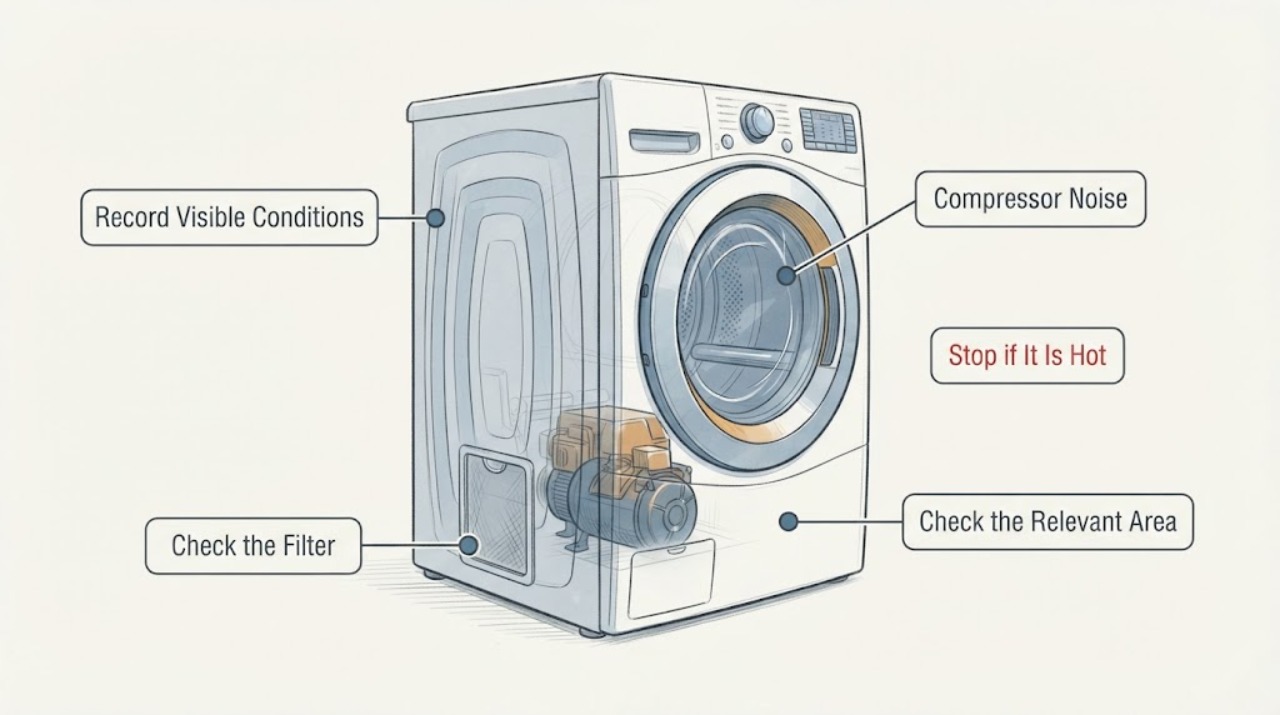
Work through in order
Diagnostic checks
Use only checks that match the exact appliance or system and its official guide.
-
Check 1
With the dryer switched off, cool, and dry, read the rating plate inside the door and record TSH783WP plus the market/product identification. Keep the serial number for service; do not substitute a similar TSH or other Miele model's manual.
Expected result: The plate confirms TSH783WP, or the model/market cannot be read or differs from TSH783WP.
Next step: Use the exact local Miele manual when the identity is confirmed. If it cannot be confirmed, keep the article's normal-sound statements as general guidance only and obtain the exact model before any model-specific service decision.
Why this matters
Why: The opened Miele product sheet identifies TSH783WP as a 9 kg T1 heat-pump dryer, while the operating instructions are a market-specific TSH783WP document. A different or incomplete identity can change sounds, controls, and service guidance.
-
Check 2
From a normal, dry position outside the cabinet, record when the sound occurs: at start-up, during drum tumbling, during a condensed-water/Steam function, after the cycle, or continuously. Describe it as a low hum/buzz, whirr, squeak, scrape, grind, rattle, thump, or hard knock. Do not open the cabinet or place hands near moving parts to listen.
Expected result: The sound is a steady low hum during a heat-pump or water-pump phase, or it is metallic, harsh, impact-like, rapidly worsening, or present with a fault or safety symptom.
Next step: A low, stable hum without warning symptoms can be monitored after the remaining external checks. Leave the dryer off for a harsh, load-independent, worsening, or impact noise and arrange service.
Why this matters
Why: Miele states that compressor and condensed-water-pump hum can be normal. Timing and character that do not fit a low operating hum should not be labelled a compressor fault from sound alone.
-
Check 3
With the appliance off and cool, remove the load and inspect only the visible drum, door seal, drum lifters, and accessible filter area for a coin, zipper pull, bra wire, loose button, or trapped garment. Do not reach into a moving drum or open the cabinet.
Expected result: A hard item or trapped garment is visible, the noise was tied to one load, or the drum area is clear but the sound remains without laundry.
Next step: Remove only an obvious loose item and monitor only if there is no damage or hazard. If the empty-load sound is a scrape, grind, repeated knock, or worsening vibration, keep the dryer off and request qualified service.
Why this matters
Why: A loose item can make a rattle or intermittent knock. A sound that remains without the load deserves more caution because it may involve installation or an internal system, but this check cannot identify which part.
-
Check 4
With the dryer off, visually check that it stands steadily on all feet, is not rocking or touching a wall, cabinet, door, basket, or stacked appliance, and has clear cooling-air intake and underside space. Do not tilt, pull out, unstack, or lift a heavy unit yourself.
Expected result: The cabinet rocks or contacts another surface, the intake/underside gap is covered, or the installation is stable and clear but the sound continues.
Next step: Remove only external objects clearly blocking airflow or touching the cabinet. Use qualified help for leveling or moving. Persistent noise on a stable, clear installation needs appliance service.
Why this matters
Why: Miele's exact-model instructions require a level, stable installation and unobstructed ventilation. Contact can transmit vibration, and blocked airflow can lengthen drying and increase heat; a clear installation does not prove an internal failure.
-
Check 5
Confirm from the installation history whether the dryer stood for at least one hour after it was positioned. Note the room temperature, especially whether it is below 10 °C, and whether any start-up noise settles after the first few minutes. Do not start a cycle solely to wait out a harsh or hazardous sound.
Expected result: The one-hour settling period was not met, or the room was below 10 °C and a brief start-up noise subsided; alternatively, the noise continues or becomes harsher.
Next step: If the only sound fits the documented brief cold-start pattern and no warning exists, follow the exact local manual after the settling period. If it continues, changes, or affects operation, stop use and arrange service.
Why this matters
Why: The TSH783WP instructions specify a one-hour wait after positioning. Miele's support guidance says a cold dryer can make start-up noises below 10 °C that subside after a little while. Those limited conditions do not explain persistent grinding, hard impacts, smoke, or overheating.
-
Check 6
When the dryer is off and cool, clean and reseat only the accessible lint/plinth filters using the exact TSH783WP manual. Check that external ventilation is clear; do not touch heat-exchanger fins or reach toward a fan.
Expected result: A filter is wet, damaged, blocked, missing, or not seated, the intake is obstructed, or filters and airflow are clear but the sound or heat problem remains.
Next step: Restore only a clean, dry, undamaged, correctly seated filter and clear external airflow. A damaged filter, unusual heat, warning, or persistent noise requires service; never operate without required filters.
Why this matters
Why: Miele warns that filter and airflow problems can impair heat-pump operation and drying. Cleaning an accessible filter may remove an airflow contributor, but it does not diagnose or repair a compressor, fan, pump, roller, bearing, or refrigeration system.
-
Check 7
From a dry, safe position, note whether the display stays on, a fault message appears, the dryer stops, or a household fuse/breaker opens. Visually inspect only the accessible plug and cord for scorching, melting, cuts, looseness, or unusual heat; do not probe wiring or repeatedly reset protection.
Expected result: There is smoke, burning or rubber odor, a hot plug/cord, abnormal heat, water near electrics, damaged wiring, a trip, fault message, hard impact, or repeated loss of power.
Next step: Stop the dryer. Isolate power only from a safe position if there is no need to touch a hot/wet connection, do not move the appliance, and arrange appropriate appliance, electrical, or emergency service.
Why this matters
Why: These are stop-use symptoms, not evidence that a compressor merely sounds normal. A normal display also does not clear a persistent mechanical or heat problem.
Use your observations
Decision map
Find the observation that best matches what you see, then follow the next safe action.
-
PATH 01Next step
What you see
A low, steady hum occurs only while the heat-pump or condensed-water function is operating, with no fault, abnormal heat, odor, vibration, or water near electrics.
Do this next
Monitor it during ordinary use after confirming placement, filters, and ventilation. Request service if it changes, becomes harsh, or is joined by a warning symptom.
Why this path and its safety boundary
Why it matters: This matches Miele's documented normal compressor or condensed-water-pump sound rather than proving a compressor defect.
-
PATH 02Next step
What you see
The dryer was in a room below 10 °C and made a start-up noise for only the first few minutes, then settled without another symptom.
Do this next
No repair is indicated by that pattern alone. Keep the dryer correctly installed and stop use if the sound no longer settles or changes character.
Why this path and its safety boundary
Why it matters: Miele describes this limited cold-start pattern as normal; the duration and improvement matter more than the owner's unfamiliarity with heat-pump equipment.
-
PATH 03Next step
What you see
A squeak or rubbing sound appears with the drum or one load, but there is no impact, hazard, damage, or fault and the installation is stable.
Do this next
Remove only an obvious accessible item and monitor cautiously. If the sound is present without the load, occurs on every rotation, worsens, or affects drying, leave the dryer off and arrange service.
Why this path and its safety boundary
Why it matters: Miele notes that some roller-supported drum grinding or squeaking can be normal, while a loose garment item can create a load-specific rattle. The observation does not identify a roller or another part.
-
PATH 04Next step
What you see
The sound is a persistent metallic grind, scrape, hard knock, repeated impact, or strong vibration; it remains when the load is removed or accompanies worsening drying/heat.
Do this next
Stop using the dryer and request qualified Miele/appliance service. Provide the exact model, market, sound phase, whether it was load-dependent, installation history, and any display message.
Why this path and its safety boundary
Why it matters: That pattern is not established as normal by the cited Miele guidance. It could involve installation or an internal drive, fan, pump, drum-support, or heat-pump system, but sound alone cannot select a component.
-
PATH 05Next step
What you see
Smoke, burning or rubber odor, sparks, a hot plug or cord, abnormal cabinet heat, water near electrics, damaged wiring, a repeated breaker trip, or a hard impact is present.
Do this next
Stop immediately, isolate power only from a safe position when possible, do not touch or move the dryer, and use appropriate emergency, electrical, or appliance service. Do not reproduce the sound.
Why this path and its safety boundary
Why it matters: This is a safety event, not a normal heat-pump noise. Continuing to run the appliance can add fire, electric-shock, heat, or water damage risk.
Helpful context
Understand the symptom
Why a heat-pump dryer can hum
The TSH783WP is a heat-pump tumble dryer. Miele's support guidance says buzzing or humming can simply mean that the heat-pump compressor or condensed-water pump is operating. The exact-model operating instructions likewise describe compressor operating noise as normal and not, by itself, a fault. That explanation applies to a steady, low sound without a warning symptom; it is not a diagnosis of every noise described as a compressor sound.
First-use and placement checks matter
For this model, the official operating instructions say to wait at least one hour after positioning before starting, so the heat-pump system is not put into service immediately after movement. The same instructions require a stable, level installation and unobstructed cooling-air openings. This is especially important for a first-time owner: a sound caused or amplified by placement, cabinet contact, or blocked ventilation should not be mistaken for a failed compressor.
Sound alone cannot identify an internal part
A sound record can separate a normal operating hum, a brief cold-start noise, a load-related rattle, and a persistent harsh or impact noise, but it cannot identify a compressor, fan, pump, roller, bearing, or refrigeration fault. Keep internal diagnosis, refrigerant work, and any dismantling for Miele or a qualified appliance technician.
When checks do not resolve it
Need a professional?
Book Miele or qualified appliance service for persistent, worsening, harsh, load-independent, fault-associated, or heat-related noise. Use qualified electrical or emergency help for sparks, smoke, hot connections, damaged wiring, repeated trips, or water near electrics.
Have this ready
- Give the rating-plate model and market, serial number, the sound description, when it starts and stops, room temperature, whether it changes with a load, whether the machine was moved recently, filter/airflow observations, display messages, and any odor, heat, water, or power event.
Common questions
FAQ
Is a compressor hum normal on a Miele TSH783WP heat-pump dryer?
A steady low hum during heat-pump operation can be normal, and Miele also attributes some hum to the condensed-water pump. It is not a reason to replace a compressor unless a qualified technician finds a fault or the sound comes with warning symptoms.
When should a new sound stop the dryer?
Stop for a persistent harsh grind, hard knock, repeated impact or vibration, smoke, burning or rubber odor, sparks, hot plug or cord, abnormal heat, water near electrics, damaged wiring, a fault, or a repeated breaker trip. Do not reproduce the sound or diagnose an internal part from audio alone.
Read the exact guide
Official sources
- TSH783WP IT-itMiele · Miele TSH783WP operating instructions for the IT/Italian market; exact-model heat-pump operation, placement, filter, noise, and service guidance
- TSH783WP GB LW 9kgMiele Great Britain · Miele TSH783WP product specification for the GB/UK market; exact model and heat-pump dryer identity
- Miele Tumble Dryer | There are noises when the tumble dryer starts up.Miele Great Britain · Miele tumble dryer support guidance on brief low-temperature start-up noises
- Miele Tumble Dryer | You can hear buzzing or humming noises in the tumble dryer.Miele Great Britain · Miele tumble dryer support guidance on buzzing/humming from the heat-pump compressor or condensed-water pump
- Miele Tumble Dryer | The tumble dryer is making grinding and squeaking noises.Miele Great Britain · Miele tumble dryer support guidance on potentially normal roller-supported drum grinding/squeaking
Community feedback
Share a repair observation
Share a plain-text repair observation. Accepted observations are published automatically; this page may take a moment to update.