
On this page
Start here
Quick answer
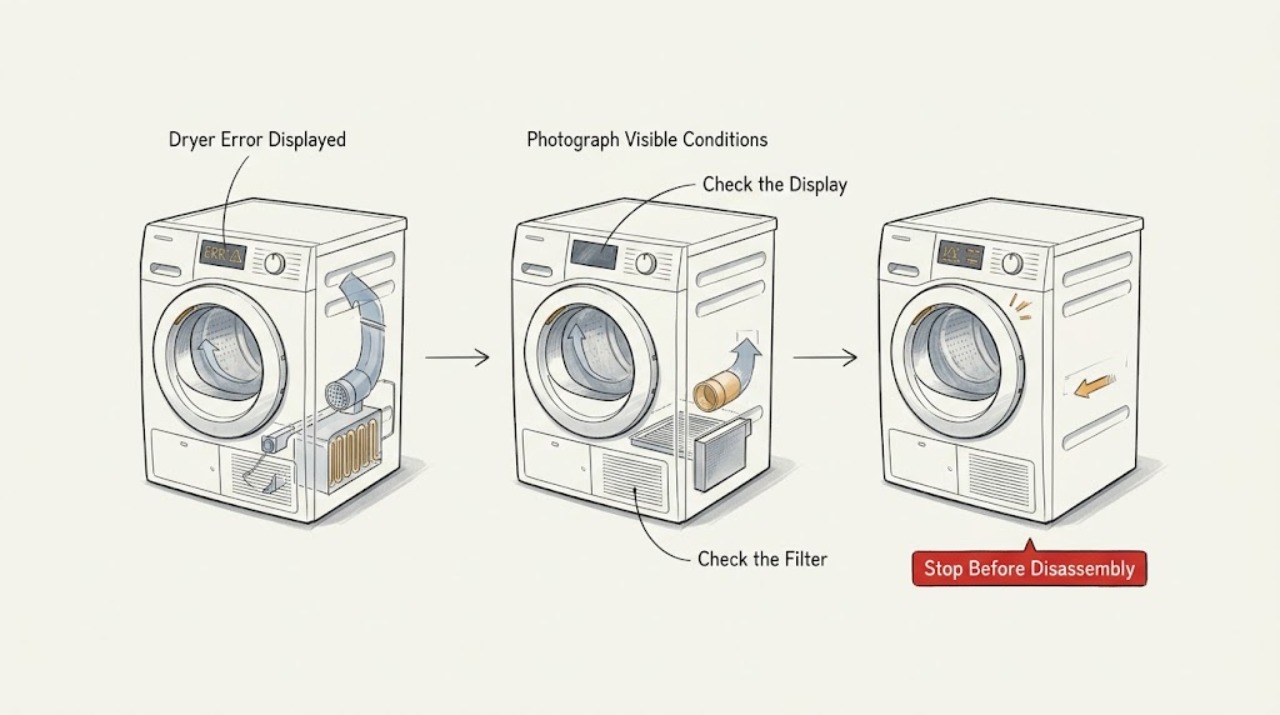
Do not diagnose a Miele dryer from a generic error list. Photograph or write down the exact code, symbols, wording, model identifier, program, and point in the cycle when it appeared. Some messages have a user-level fix: a dark display can be energy-saving standby, an Empty the container message can mean the condensate container is full or its drain hose is kinked, and a Clean the lint filter or Check the airways message calls for model-specific filter and airflow care. Miele documents F1 on applicable dryers as a short-circuited refrigerant temperature sensor that cannot be remedied by the user. For a message with no obvious cause, Miele allows one off/on restart; if the same fault returns, stop and contact service. Smoke, sparks, burning or gas odor, severe heat, a damaged cord, a dryer that will not stop, or a repeated breaker trip always overrides message troubleshooting.
Work through in order
Diagnostic checks
Use only checks that match the exact appliance or system and its official guide.
-
Check 1
Stop the program and record the exact display, indicator, symbols, model identifier, selected program, load, and cycle stage. Photograph the panel before opening the door or clearing the message. Also note whether the drum is moving, whether the dryer is hot, and whether the message returns immediately.
Expected result: The code is exact and repeatable, the display is a general text or indicator message, or the display cannot be read reliably.
Next step: Use the exact Miele model manual or support page for that message. If the display is unreadable or the same fault is recurring, leave the dryer off and provide the photo and model to qualified Miele service.
Why this matters
Why: A precise code and stage can distinguish a user-maintenance message from a sensor, control, heating, or airflow fault. A guessed code or cross-model interpretation can send the diagnosis in the wrong direction.
-
Check 2
If the display is dark but the dryer appears otherwise normal, press or touch a control once. Check whether the display wakes from energy-saving standby; do not remove panels or assume a dark display is an error code.
Expected result: The display wakes and controls respond, or it remains dark and the dryer does not respond.
Next step: If the display wakes, read and record any actual message before continuing. If it stays dark, check only the user-accessible supply state and stop; arrange qualified appliance or electrical service if the dryer remains unresponsive.
Why this matters
Why: Miele documents automatic display shutoff as a possible energy-saving behavior. A display that stays dark after a normal control input may indicate a power or control fault rather than a message that can be cleared.
-
Check 3
For Clean the lint filter, Check the airways, or a dashes-style interruption, switch the dryer off and let it cool. Clean the door lint filters and any plinth or toe-kick filter as the exact manual describes. If the model exposes a heat exchanger, inspect and clean it only by the documented light-vacuum method; do not touch sharp fins or install a wet filter.
Expected result: Lint, detergent residue, a damaged filter, an obstructed grille, or visible heat-exchanger soiling is present; the filters and airflow path are clean; or cleaning cannot be completed safely.
Next step: Complete the documented cleaning and reinstall filters fully and dry. If the message returns, the filter is damaged, the heat exchanger is blocked, or the dryer overheats, stop using it and arrange service.
Why this matters
Why: Miele links filter and airway restriction with insufficient airflow, heat-exchanger problems, canceled programs, and technical service needs. A clean path does not prove the heater, sensor, or control is healthy.
-
Check 4
If Empty the container or check the drain appears, switch the dryer off before handling the condensate container. Empty and refit the container securely, then check the visible drain hose for a kink. Do not spill water onto the outlet, cord, or controls.
Expected result: The container is full, the drain hose is kinked, the message clears, or the message returns with an empty container and clear hose.
Next step: Run no more than one model-supported check after the container is secure and the area is dry. If the message returns or water leaks, stop and arrange Miele service.
Why this matters
Why: Miele identifies a full condensate container or kinked drain hose as the common causes for this message. A recurring message after those checks points to a drain, pump, sensor, or control issue.
-
Check 5
If the display shows Adjust the load and the associated symbol, open the door and loosen or redistribute the laundry; remove a few items only if the load is excessive. If the message concerns residual-moisture sensing or returns with a normal load, do not infer a sensor part from the message.
Expected result: The load was empty, nearly empty, rolled up, already dry, or the residual-moisture fault remains after a normal load.
Next step: Use the model-supported program for an individual item if appropriate. If the sensing fault or message persists, stop and provide the exact display and model to Miele service.
Why this matters
Why: Miele says its electronics can cancel some programs when the drum is empty, nearly empty, or the laundry is already dry; it separately identifies an inoperative residual-moisture sensing system as a technical fault.
-
Check 6
If the exact display is F1, or another message identifies a sensor, heating, refrigerant, or technical fault, do not open the dryer or attempt a component test. If a generic message has no obvious cause and there is no hazard, switch the dryer off and on once, start one model-supported program, and monitor whether the same message returns.
Expected result: F1 or another technical fault remains, a generic message clears once, or the same message returns after the single restart.
Next step: For F1 or any recurring technical message, leave the dryer off and arrange qualified Miele service. Keep the code, model, program, and timing available for the technician.
Why this matters
Why: Miele states that F1 is a technical refrigerant-temperature-sensor fault on applicable models. For other messages, a one-time restart can separate a transient interruption from a recurring fault; recurrence is not a reason for repeated resets.
Use your observations
Decision map
Find the observation that best matches what you see, then follow the next safe action.
-
PATH 01Next step
What you see
The display is dark but wakes when a control is pressed and no fault message is present.
Do this next
Read any actual message after the display wakes. Arrange service if it remains dark and unresponsive.
Why this path and its safety boundary
Why it matters: The dryer may be in energy-saving standby rather than showing an error.
-
PATH 02Next step
What you see
The display says Empty the container or check the drain.
Do this next
Switch off, empty and refit the container, and correct only an obvious hose kink. Stop for leaks or a returning message.
Why this path and its safety boundary
Why it matters: The condensate container may be full or the visible drain hose may be kinked.
-
PATH 03Next step
What you see
The display requests cleaning of lint filters or airways, or shows dashes after a program interruption.
Do this next
Clean and dry the model-specific filters and air path as documented. Use service if the message returns or the filter or heat exchanger is damaged.
Why this path and its safety boundary
Why it matters: Lint, filter residue, a blocked airway, or a heat-exchanger restriction may be involved.
-
PATH 04Next step
What you see
Adjust the load and its symbol appears and the laundry is empty, nearly empty, rolled up, or already dry.
Do this next
Open the door, loosen or redistribute the load, and use a model-supported program for an individual item if appropriate. Escalate a recurring sensing fault.
Why this path and its safety boundary
Why it matters: The electronic load or moisture check may have canceled the program.
-
PATH 05Next step
What you see
F1 appears, or a code identifies a sensor, refrigerant, heating, or other technical fault.
Do this next
Do not open or repeatedly restart the dryer. Leave it off and provide the exact code, model, program, and stage to Miele service.
Why this path and its safety boundary
Why it matters: The exact model needs qualified technical diagnosis; F1 is documented as a refrigerant temperature sensor short circuit on applicable models.
-
PATH 06Next step
What you see
A message with no obvious cause clears after one off/on restart but does not return during one monitored model-supported program.
Do this next
Resume normal use only if there is no odor, heat, damage, or recurring message. Stop and arrange service if it returns.
Why this path and its safety boundary
Why it matters: The interruption may have been transient, but the event should remain documented.
-
PATH 07Next step
What you see
The same message returns after the documented user check or single restart.
Do this next
Leave the dryer off, record the exact display and stage, and arrange qualified Miele service.
Why this path and its safety boundary
Why it matters: The fault is recurring and should not be chased with repeated resets.
-
PATH 08Next step
What you see
There is smoke, fire, sparking, a burning or gas odor, severe heat, a damaged cord, water at electrical equipment, a dryer that will not stop, or a repeated breaker trip.
Do this next
Leave the area for fire or gas danger and seek help from a safe location. Isolate power only when safe, do not reset repeatedly, and arrange qualified appliance, electrical, or gas service.
Why this path and its safety boundary
Why it matters: This is an immediate stop condition and the display code is secondary.
Helpful context
Understand the symptom
The exact display is the diagnosis starting point
Miele uses many model-dependent codes, symbols, and text messages. Write the code exactly, including punctuation, symbols, and whether it appears at startup, during heating, while draining condensate, or at the end of a program. A message such as Ctrl may describe a remote-control setting, while F1 is a technical sensor fault on applicable models. The same-looking symptom should not be assigned a part without the model manual.
Keep a displayed fault within a safe boundary
Only perform external, model-documented checks. Do not bypass a door or temperature safety, probe live wiring, open the cabinet, defeat a control, or keep restarting a dryer that smells hot or burnt. Filter and condensate work can involve water, so stop if water reaches the plug, outlet, or controls.
Safety boundary
Stop conditions
- Stop immediately for smoke, flame, sparks, a burning or gas odor, severe heat, melting, a damaged cord or control, water near electrical equipment, a dryer that will not shut off, or a breaker that trips again.
- Do not repeatedly reset or restart a recurring fault, clear a code by guessing, bypass a safety control, or operate without the complete filter system.
- Do not open the cabinet, probe live wiring, touch heat-exchanger cooling fins, open a gas path if fitted, or replace a sensor, heater, or control from a code alone.
- Do not install a filter dripping wet, use a water jet on the appliance, or handle condensate where water could reach the plug, outlet, or controls.
Only after diagnosis
Potential parts
- lint filter, plinth filter, or filter insert
Only consider this after inspection shows a filter is damaged, deformed, worn, or unable to seal and a qualified diagnosis links it to the message or airflow fault.
Confirm the exact Miele model identifier and manufacturer fit information before ordering; a filter prompt alone does not identify a replacement. - condensate pump or drain component
Only consider this after the container is empty, the visible hose is correctly routed, and qualified service confirms a drain or pump fault.
Condenser and heat-pump layouts vary by model; do not infer compatibility from an Empty the container message. - temperature or moisture sensor
Only consider this when qualified diagnosis links the exact model's recurring code or sensing fault to a sensor; F1 is not a universal code across all Miele dryers.
Confirm the complete model and the documented fault before ordering; do not test or replace a sensor as a household workaround. - heater, heat-pump, or control assembly
Only consider this after qualified service confirms the exact heating or control fault and rules out filters, airflow, condensate, load, and settings.
Use the exact model and a professional diagnosis; a generic display message does not establish assembly fit.
When checks do not resolve it
Need a professional?
Arrange qualified Miele service when F1 or another technical code persists, a sensing message returns with a normal load, a filter or airway message returns after correct care, the condensate message returns with a secure container and clear hose, a generic message returns after one restart, or the dryer overheats, smells burnt, sparks, leaks near electrical equipment, or will not stop. Use an electrician for the outlet, cord, or household circuit and qualified gas service for a gas odor on any applicable gas model.
Have this ready
- The complete Miele model identifier and serial information available on the data plate
- The exact code, wording, symbols, indicator lights, and a photo of the display
- The program, load, cycle stage, and whether the message appeared at startup, during heating, during drainage, or at the end
- The filter, plinth-filter, airway, heat-exchanger, condensate-container, and drain checks already completed
- Any smoke, odor, spark, overheating, leak, damaged cord, failure to stop, or repeated breaker event
Common questions
FAQ
What should I do first when my Miele dryer displays an error?
Record the exact code or wording, symbols, model, program, load, and cycle stage. Use the exact model manual or Miele support page; do not substitute a similar-looking code from another model.
What does F1 mean on a Miele dryer?
On applicable Miele tumble dryers, F1 identifies a short-circuited refrigerant temperature sensor and is a technical fault that the user cannot remedy. Leave the dryer off and arrange qualified service.
How do I clear an Empty the container message?
Switch the dryer off, empty and securely refit the condensate container, and check the visible drain hose for a kink. If the message returns or water leaks, stop and arrange service.
Can I reset a Miele dryer error by turning it off and on?
For a message with no obvious cause, Miele documents one off/on restart and one monitored program attempt. If the same message returns, do not keep resetting it; record the code and contact service.
When should I stop troubleshooting a Miele dryer error?
Stop for smoke, flame, sparks, a burning or gas odor, severe heat, melting, a damaged cord or control, water near electrical equipment, a dryer that will not stop, or a repeated breaker trip. Isolate power only when safe and arrange qualified appliance, electrical, or gas service.
Read the exact guide
Official sources
- Cold air or Finish flashesMiele USA · Miele tumble-dryer no-obvious-cause message, one restart, and recurring-fault service guidance
- Adjust the load and symbolMiele USA · Miele tumble-dryer load, empty-drum, already-dry, and residual-moisture display guidance
- IMPORTANT SAFETY INSTRUCTIONSMiele · Miele dryer fire, electrical, flammable-material, moving-drum, lint, and qualified-service safety boundaries
- Empty out container indicator light lights upMiele USA · Miele tumble-dryer condensate-container and drain-hose display guidance
- Dashes in the displayMiele USA · Miele tumble-dryer airway, lint-filter, plinth-filter, heat-exchanger, and ventilation display guidance
- Cleaning and careMiele · Miele dryer filter, airflow, heating, interior cleaning, and qualified maintenance boundaries
- Fault F1Miele USA · Miele tumble-dryer F1 display and refrigerant temperature sensor fault on applicable models
- PDR 908 HP Heat-Pump Dryer Operating InstructionsMiele · Miele heat-pump dryer filter, plinth filter, heat exchanger, airflow, moisture, and display troubleshooting for the documented model family
- Display dark/not workingMiele USA · Miele tumble-dryer energy-saving display standby and unresponsive-display guidance
Community feedback
Share a repair observation
Share a plain-text repair observation. Accepted observations are published automatically; this page may take a moment to update.