
On this page
Start here
Quick answer
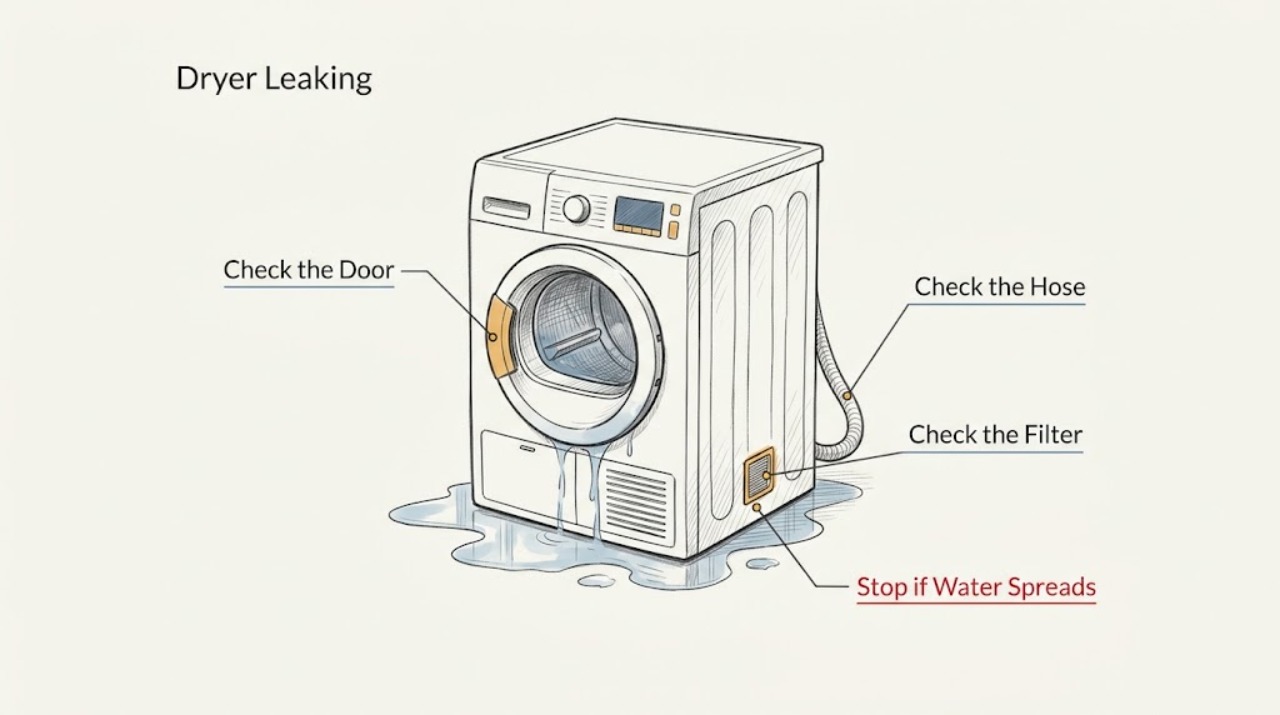
Stop the Miele dryer and identify where water first appears before changing anything. Miele's support identifies an incorrectly connected drain hose, a missing, clogged, or incorrectly fitted non-return valve, and back-flow from a drain shared with a washing machine as leak paths. On models that use a condensed-water container, empty and reseat it; on models connected to an external drain, inspect only the visible hose and connection for a kink, loose end, or back-flow condition, following the exact model manual. If the leak began after heat-exchanger cleaning, check that the heat exchanger and condenser-system cover are fully seated. Do not open the cabinet or keep running the dryer with water near electrical parts; persistent leaks, water from underneath, or an internal condensate fault need Miele service.
Before you begin
Safety first
- This article covers stopping the dryer, identifying the first wet point, ordinary-access container emptying and reseating, visible hose observation, and model-approved cover or filter checks. It does not authorize cabinet removal, internal pump or seal work, live electrical testing, sharp-fin contact, or building-drain modification.
Work through in order
Diagnostic checks
Use only checks that match the exact appliance or system and its official guide.
-
Check 1
Stop the dryer, keep hands and the floor dry, and identify the first visible wet point without removing panels: the condensed-water container area, an external drain connection, the door or front, the heat-exchanger access area, or underneath the cabinet. Disconnect power only from a dry, safe position.
Expected result: Water starts at a tank or hose connection, appears only after heat-exchanger cleaning, forms underneath, reaches an electrical area, or the source cannot be seen without moving or opening the appliance.
Next step: Use the matching container, external-drain, cleaning-related, or service branch below. If the source is hidden or water is near electrical parts, leave the dryer off and arrange Miele service.
Stop if: Do not run a leaking dryer to reproduce the leak, reach behind a wet or moving appliance, tilt it, or remove cabinet panels.
Why this matters
Why: The location and timing separate a container or drain-installation problem from a cleaning-seal issue or an internal leak. An unseen source or water near electrics is not a routine hose adjustment.
-
Check 2
For a model using a condensed-water container, check the container from its normal access, empty it if full, and reseat it fully as shown in the exact Miele manual. For a model using external drainage, inspect the visible drain hose, its end, and the connection for a kink, loose fit, blockage, or water returning from a shared washing-machine drain; do not disconnect a hidden or wet connection.
Expected result: The container is full or not seated, the hose is kinked or loose, the hose end is immersed or shares a drain without the required non-return arrangement, or the visible path is sound but water still leaks.
Next step: Correct only the ordinary-access container seating or visible hose routing permitted by the model instructions. If the valve or shared drain arrangement is unclear, if water returns, or if the leak continues, stop and contact Miele service or a qualified plumber for the building drain.
Stop if: Do not bypass a water-level sensor, force a hose, open the pump or base, or make an unverified valve or shared-drain modification.
Why this matters
Why: Miele associates a full container or kinked drain hose with a drain warning, and identifies an incorrect, missing, or clogged non-return valve and a shared drain as possible back-flow causes. A sound visible path with continuing leakage makes an internal condensate fault more likely.
-
Check 3
If water appeared after cleaning the heat exchanger, with the dryer off and cool, check that the heat exchanger, condenser-system lid, and any user-accessible cover or filter are fully seated and closed exactly as the model instructions show.
Expected result: The cover or heat exchanger is visibly mis-seated, a filter is missing or damaged, the area is correctly closed, or water continues to escape after correct refitting.
Next step: Refit the cover and filter only as the manual permits, keep any washed filter dry before installation, and monitor only if there is no continuing leak. If the cover will not close, a seal is damaged, or water returns, arrange Miele service.
Stop if: Do not touch sharp heat-exchanger fins, pressure-wash the appliance, pour water into an open machine, or operate it with a missing cover, wet filter, or continuing leak.
Why this matters
Why: Miele identifies an incompletely closed condenser system as the direct cause of a post-cleaning leak. A damaged filter or an unchanged leak after correct closure points beyond a simple cover-seating issue.
-
Check 4
Check the user-accessible lint and plinth filters only where the exact Miele manual identifies them, removing lint and allowing a water-rinsed filter to dry completely before refitting; visually check the accessible heat-exchanger face without touching the fins.
Expected result: Filters are heavily soiled, wet, deformed, or torn; the heat exchanger has visible lint; or the filters and accessible area are clean but the leak or warning remains.
Next step: Restore the filters exactly as instructed and do not operate with a damaged, wet, or missing filter. If the leak persists, the filter cannot sit flush, or water is coming from underneath, keep the dryer off and request service.
Stop if: Do not touch cooling fins with bare hands, insert tools into the condensate path, open the cabinet, or order a part from the symptom alone.
Why this matters
Why: Miele links dirty or damaged filters with restricted airflow and heat-exchanger blockage, and says a damaged or out-of-shape plinth filter must be replaced. Clean filters do not rule out a blocked condensate path or technical fault.
Use your observations
Decision map
Find the observation that best matches what you see, then follow the next safe action.
-
PATH 01Next step
What you see
The dryer uses a condensed-water container, the container is full or was not seated, and no water is reaching the floor or electrical area.
Do this next
Empty and reseat the container under the exact model instructions, then use the dryer only if the leak has stopped and no warning returns. Escalate if the container fills unusually quickly or the warning returns.
Why this path and its safety boundary
Why it matters: A full or mis-seated container is more likely than an internal leak.
-
PATH 02Next step
What you see
The dryer is connected to an external drain and water appears at the hose, sink connection, floor drain, or a drain shared with the washing machine; the hose is kinked or loose, or water can flow back.
Do this next
Correct only the visible hose routing or connection that the exact instructions allow, and have an unclear valve or blocked building drain assessed by Miele service or a qualified plumber. Stop if water returns or the hose cannot be secured safely.
Why this path and its safety boundary
Why it matters: The external condensate installation or back-flow protection is more likely than a full container. Miele specifically calls out the non-return valve and shared drain arrangement.
-
PATH 03Next step
What you see
The leak started immediately after heat-exchanger cleaning and the condenser-system lid or heat-exchanger cover is not fully seated, or a filter is wet or not flush.
Do this next
Allow wet filters to dry, refit the cover and filter exactly as the model manual shows, and do not run the dryer until the closure is secure. Request service if it will not close or water returns.
Why this path and its safety boundary
Why it matters: An open or incorrectly closed cleaning access is more likely than a failed pump.
-
PATH 04Next step
What you see
Water appears underneath or inside the cabinet, the visible container and drain path are correct, the cleaning cover is secure, or the source is near electrical parts.
Do this next
Keep the dryer off, protect the floor, and arrange Miele service with the model number, first wet point, cycle timing, container level, drain arrangement, and any warning shown.
Why this path and its safety boundary
Why it matters: An internal condensate path, seal, pump, or technical fault remains possible, and the leak has not been proven to be an ordinary-access issue.
Helpful context
Understand the symptom
Start with the first wet point
Water at the front, at a drain connection, under the appliance, or immediately after heat-exchanger cleaning does not prove the same fault. Keep the dryer stopped and, only if it is safe to reach from a dry position, disconnect power. Record whether the water appears during a cycle, after a cycle, or while the appliance is idle. Use the full model number to select the applicable Miele operating instructions before touching a hose, container, filter, or condenser cover.
Match the condensate arrangement
A Miele dryer may collect condensed water in a container or send it through an external drain hose, depending on the model and installation. A full container is a different check from a hose that is kinked, loose, or allowing water to flow back from a shared drain. Do not assume that every Miele dryer has the same container, valve, hose routing, or user-accessible condensate components.
Cleaning-related leaks need a cover and filter check
If the leak began after cleaning the heat exchanger, Miele specifically directs the user to check that the heat exchanger and condenser-system lid are securely seated. Miele also warns that soiled or damaged filters can clog the heat exchanger and that a filter cleaned with water must be dry before refitting. If the cover, filter, or heat exchanger cannot be restored exactly as the model instructions show, stop and arrange service.
When checks do not resolve it
Need a professional?
Contact Miele service when water is underneath or inside the cabinet, reaches electrical parts, returns after the container, visible hose, cover, and permitted filter checks, or appears with a persistent warning. Use a qualified plumber for a blocked or unsafe building drain. Do not open the dryer, access an internal pump, bypass sensors, or continue operation to test a leak.
Safety scope: This article covers stopping the dryer, identifying the first wet point, ordinary-access container emptying and reseating, visible hose observation, and model-approved cover or filter checks. It does not authorize cabinet removal, internal pump or seal work, live electrical testing, sharp-fin contact, or building-drain modification.
Common questions
FAQ
Can a full condensed-water container make a Miele dryer leak?
It can stop the drying program and is a relevant first check on models that use a container, but a floor leak is not automatically explained by a full tank. Empty and reseat the container as the exact manual shows; investigate the external drain or request service if water continues or appears underneath.
Why did the Miele dryer start leaking after heat-exchanger cleaning?
Miele identifies an incompletely closed heat exchanger or condenser-system lid as a cause of water running out after cleaning. With the dryer off and cool, check the ordinary-access cover and filter seating exactly as the model instructions show. Do not operate it with a missing cover or a continuing leak.
Should I open the Miele dryer to reach the drain or pump?
No. The safe scope here is limited to normal container, visible hose, cover, and model-approved filter access. Water underneath, an internal source, a persistent warning, or a drain component that is not clearly user-accessible should be handled by Miele service.
Read the exact guide
Official sources
- Miele Tumble Dryer | Water runs out of the tumble dryer after the heat exchanger has been cleaned.Miele USA · Official Miele USA support article for applicable tumble dryers; cover and condenser-system design varies by model.
- Miele Tumble Dryer | Fault F66 appears on the tumble dryer display.Miele USA · Official Miele USA support article for tumble dryers with the described filters and heat-exchanger access; exact model instructions control.
- Miele Tumble Dryer | Water is leaking from the tumble dryer.Miele USA · Official Miele USA support article for tumble dryers; the exact model operating instructions control the installation details.
- 12222710-03Miele · Official Miele operating-instructions PDF; model and regional configuration must be confirmed before applying its container or hose instructions.
Community feedback
Share a repair observation
Share a plain-text repair observation. Accepted observations are published automatically; this page may take a moment to update.