
On this page
Start here
Quick answer
First identify whether the Candy dryer is vented, condenser, or heat pump because the leak path is different. A vented dryer normally sends moist air through an exhaust path and does not use a condensate tank; look for a disconnected or damaged vent path rather than a water container. A condenser or heat-pump dryer collects condensed water in a tank or may use a direct drain hose; check the tank seating, visible hose routing, and user-accessible filters only as the exact model instructions allow. Stop using the dryer for water under the machine, a damaged seal, a persistent leak after those checks, or any suspected internal pump, overflow, or electrical fault.
Before you begin
Safety first
- This article supports model identification, ordinary-access tank emptying and reseating, visible hose and vent observation, and model-approved filter, condenser, and seal-surface maintenance. It does not authorize casing removal, internal pump or overflow work, building-vent alteration, live electrical testing, or improvised hose or seal repairs.
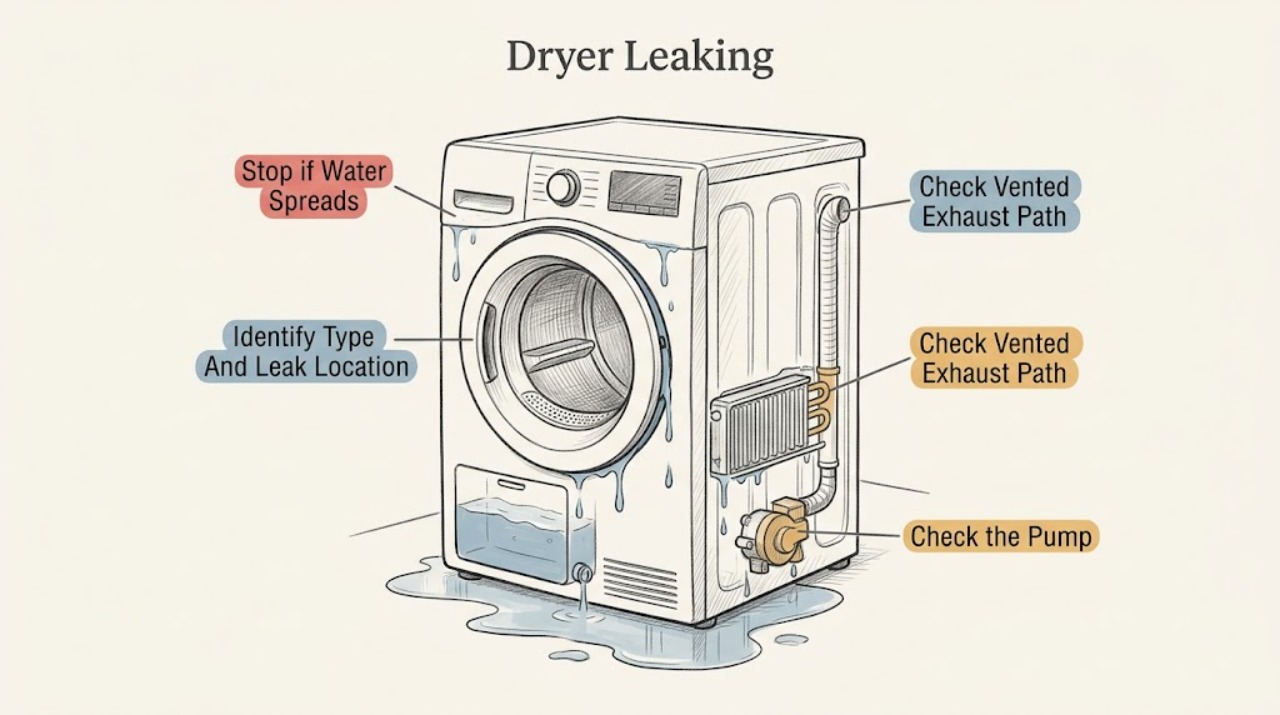
Work through in order
Diagnostic checks
Use only checks that match the exact appliance or system and its official guide.
-
Check 1
From the Candy product label, manual, or specifications, identify whether the dryer is vented, condenser, or heat pump, then observe where water first appears: at the front door, tank, rear hose, floor beneath the cabinet, or an outdoor vent path.
Expected result: The appliance has an outdoor exhaust hose and no tank; it has a condensate tank; it has a direct-drain hose; or the dryer type and leak origin cannot be established.
Next step: Use the vented branch for an exhaust-path issue, or the condenser/heat-pump tank and direct-drain branches for a condensate issue. If type or origin remains uncertain, stop and obtain the exact model manual or service help.
Stop if: Do not pull out a stacked or built-in dryer, remove panels, or guess the water path from the cabinet shape.
Why this matters
Why: The architecture determines whether water should be exhausted as moist air or collected and pumped as condensate. A leak location alone does not prove which internal component failed.
-
Check 2
For a confirmed vented Candy dryer, inspect only the visible exhaust hose, its connection, and the outside outlet for disconnection, crushing, sharp kinks, lint obstruction, or an outlet that cannot open; do not reach into the wall or modify the duct.
Expected result: The hose is detached, kinked, crushed, visibly blocked, or the exterior outlet is obstructed; alternatively, the visible vent path is open and secure but moisture or water remains.
Next step: Restore only the visible hose connection and routing allowed by the exact model instructions, then observe a permitted cycle. If the leak or condensation persists, stop using the dryer and arrange Candy service or qualified vent assessment.
Stop if: Do not connect the hose to a chimney, extractor hood, boiler outlet, or another appliance, and do not drill or dismantle the building vent as a user repair.
Why this matters
Why: A restricted or disconnected vent can trap moist air and cause condensation around the exhaust path. A clear path makes a cabinet leak, seal, or another fault more likely; a vented model still should not be treated as a tank-based dryer.
-
Check 3
For a confirmed condenser or heat-pump Candy dryer using a water container, remove and empty the tank into a stable basin, inspect the tank and visible seating area for cracks or displacement, and refit it fully according to the exact model manual.
Expected result: The tank is full, cracked, not seated, or leaking at its visible connection; alternatively, the tank is empty and correctly seated while water appears elsewhere or the leak returns immediately.
Next step: Replace or refit the tank only through the exact model-approved user procedure and monitor for recurrence. If it leaks, remains empty unexpectedly, or water reaches the floor, stop using the dryer and arrange service.
Stop if: Do not tilt the appliance, reach into the tank cavity, bypass a level sensor, glue a cracked tank, or operate with water near electrical parts.
Why this matters
Why: Candy describes condensate being collected in a container on condenser-type dryers and says a full reservoir can interrupt drying. A damaged or mis-seated tank can leak externally; an empty, sound tank with water elsewhere makes the condensate path or pump more likely.
-
Check 4
For a condenser or heat-pump Candy dryer fitted with a direct-drain kit, inspect the visible outlet hose and drain connection for a twist, kink, loose joint, poor slope, or a hose that was changed during installation; do not disconnect a wet connection over the appliance or floor.
Expected result: The hose is visibly kinked, twisted, loose, unsupported, or not routed to the intended drain; alternatively, the connection looks sound but water still appears at the dryer or does not reach the drain.
Next step: Correct only the external routing and connection allowed by the exact model instructions, then observe the next permitted cycle from a dry, safe position. If water still leaks or the connection requires disassembly, request service.
Stop if: Do not force fittings, extend the hose with an unverified connector, pull the dryer across water, or open the casing to reach the pump.
Why this matters
Why: Candy's drain guidance says condensate can be directed to the sewer, and that hose routing and tight, stable connections affect free flow and leakage. A sound external connection with continued leaking makes a hidden blockage, overflow, or pump issue more likely.
-
Check 5
With the dryer cool and disconnected only as the model manual directs, clean the lint filter and any model-designated accessible condenser or filter, and inspect the door seal and access-flap seal for lint, deformation, or visible damage without removing the cabinet.
Expected result: Lint blocks the filter or condenser, a seal is dirty or damaged, the condenser symbol or maintenance indication is present, or the accessible areas are clean while the leak remains.
Next step: Restore each cleaned component exactly as instructed and monitor only a permitted cycle. Replace a seal or other part only after the exact model and fit are confirmed; arrange service when the leak persists or the component is not user-accessible.
Stop if: Do not remove a fixed condenser, insert tools into the pump path, wash electrical parts, use an unapproved chemical, or continue operating with a damaged seal or unresolved leak.
Why this matters
Why: Candy's drying guidance links blocked filters and condenser components with poor airflow and moisture handling, while a damaged or contaminated seal can let water escape. Clean accessible areas do not rule out an internal condensate pump or overflow fault.
Use your observations
Decision map
Find the observation that best matches what you see, then follow the next safe action.
-
PATH 01Safety boundary
What you see
The Candy dryer is confirmed vented, there is no water container, and the visible exhaust hose or outside outlet is detached, kinked, blocked, or not routed as instructed.
Do this next
Restore only the visible vent path under the exact manual and arrange vent or appliance service if water or condensation persists.
Why this path and its safety boundary
Why it matters: An exhaust-path problem is more likely than a condensate tank or pump; moisture may condense around a restricted or disconnected vent.
Safety stop: Do not add a drain kit, connect to another appliance's flue, modify the wall vent, or dismantle the dryer.
-
PATH 02Safety boundary
What you see
The dryer is condenser or heat pump, water is present at the tank or its visible seat, and the tank is full, cracked, displaced, or leaking at the external connection.
Do this next
Empty and refit the tank only as the model manual allows. Do not use a cracked tank; confirm the exact model before any replacement and request service if the leak returns.
Why this path and its safety boundary
Why it matters: A tank or tank-seating leak is more likely than a vented-dryer issue, but an apparently empty tank with water elsewhere may indicate a deeper condensate fault.
Safety stop: Do not glue, tape, bypass, or improvise a tank repair, and do not operate with water near electrical parts.
-
PATH 03Safety boundary
What you see
The dryer is condenser or heat pump, a direct-drain kit is fitted, and the external hose is kinked, twisted, poorly supported, or leaking at a visible joint.
Do this next
Correct the external hose routing and secure connection only under the exact Candy instructions, then monitor one permitted cycle. Request service if the hose cannot be corrected without moving or opening the appliance.
Why this path and its safety boundary
Why it matters: The direct condensate-drain installation is more likely than an internal pump; poor routing can prevent free flow or discharge water beside the machine.
Safety stop: Do not force, extend, puncture, or disconnect a wet hose over the appliance, and do not assume a generic drain adapter fits.
-
PATH 04Safety boundary
What you see
The visible tank or direct-drain hose is sound and correctly seated, accessible filter/condenser maintenance is complete, but water still leaks from under the cabinet or the tank remains empty unexpectedly.
Do this next
Stop using the dryer, protect the floor and nearby electrical equipment, and arrange authorized Candy service with the model, dryer type, water path, and leak pattern.
Why this path and its safety boundary
Why it matters: An internal overflow path, condensate pump, blockage, sensor, or control fault is more likely than a simple tank or hose problem.
Safety stop: Do not remove panels, clean or replace an internal pump, bridge a sensor, or keep restarting the dryer to locate the leak.
-
PATH 05Safety boundary
What you see
Water first appears around the door or access flap, and the visible seal is dirty, displaced, torn, or compressed unevenly while the tank and external hose are not leaking.
Do this next
Clean only the user-accessible seal surface and refit the door or flap as the exact manual allows. Stop and arrange service for a torn seal, persistent leak, misalignment, or water near electrical parts.
Why this path and its safety boundary
Why it matters: A seal or door alignment issue is more likely than a condensate pump, but water may still originate behind the seal and require service.
Safety stop: Do not stretch, glue, cut, or substitute a seal without exact model fit information, and do not continue using a dryer that leaks through the door.
-
PATH 06Safety boundary
What you see
The Candy dryer type, water path, or first leak location cannot be established from the label, manual, and ordinary-access observations.
Do this next
Stop testing, obtain the exact model manual, or ask Candy service to identify the architecture and inspect the leak before ordering parts.
Why this path and its safety boundary
Why it matters: The evidence is insufficient to choose between vent condensation, tank seating, direct-drain routing, seal, overflow, and pump branches; applying the wrong procedure can create a separate leak or electrical hazard.
Safety stop: Do not guess the dryer type, add a drain kit, drill or cut a hose, or dismantle the appliance based only on the word ‘leaking.’
Helpful context
Understand the symptom
Classify the Candy dryer before tracing water
A leak does not have one universal Candy dryer procedure. Candy's product range includes vented, condenser, and heat-pump designs. Vented models use an exhaust path and may have no water container, while condenser and heat-pump models turn extracted moisture into condensate that is collected in a tank or directed to a drain. Use the exact model manual and visible installation to select the matching checks.
The safe external checks are different by type
On a condenser or heat-pump dryer, a full or mis-seated tank, a kinked direct-drain hose, an overflowing condensate path, or excess lint around filters and seals can leave water on the floor. On a vented dryer, a loose, kinked, or obstructed exhaust path can cause moisture problems, but it is not a reason to add a tank or alter the vent without model-specific instructions. Do not open the cabinet to find the pump.
When a leak is a service condition
If water continues to appear after the permitted external checks, or if the source is under the cabinet, inside the door, or near electrical parts, keep the dryer out of use and arrange Candy service. A missing model number makes exact hose, tank, seal, condenser, and pump access uncertain, so do not buy a part or dismantle the appliance based on the leak location alone.
Safety boundary
Stop conditions
- Identify vented versus condenser versus heat-pump design before applying a vent, tank, direct-drain, condenser, or pump procedure.
- Stop for water under the machine, water near electrical parts, a damaged door or tank seal, an unexplained empty tank, or a persistent leak after permitted external checks.
- Do not open the cabinet, access an internal condensate pump or overflow path, bypass a sensor, or perform live electrical testing.
- Do not add a tank or drain kit to a vented dryer, or apply vented-dryer assumptions to a condenser or heat-pump dryer, without exact model instructions.
- Do not force, puncture, glue, extend, or reroute a hose or seal as a generic repair; arrange authorized Candy service when the visible checks do not resolve the leak.
When checks do not resolve it
Need a professional?
Arrange authorized Candy service when the dryer type or leak path is uncertain, water appears under the cabinet or near electrical parts, a tank or direct-drain connection still leaks after model-approved reseating, a door seal is damaged, accessible cleaning does not resolve the leak, or an internal overflow, condensate pump, blockage, sensor, or control fault is suspected. For a vented dryer, arrange qualified vent assessment when the visible exhaust path is clear but condensation or water persists.
Safety scope: This article supports model identification, ordinary-access tank emptying and reseating, visible hose and vent observation, and model-approved filter, condenser, and seal-surface maintenance. It does not authorize casing removal, internal pump or overflow work, building-vent alteration, live electrical testing, or improvised hose or seal repairs.
Common questions
FAQ
Does every Candy dryer use a water tank when it leaks?
No. Candy sells vented, condenser, and heat-pump dryers. A vented model may have no water container and should be checked through its exhaust path; condenser and heat-pump models may collect condensate in a tank or send it to a direct drain.
Why is my Candy condenser or heat-pump dryer leaking onto the floor?
Check the model-approved external path first: a full or displaced tank, a kinked or loose direct-drain hose, blocked accessible filters or condenser, or a damaged seal can all change where water appears. If the tank and hose are sound but water still leaks underneath, stop using the dryer and arrange service for an internal overflow or condensate-pump fault.
What should I check on a Candy vented dryer that is leaking or creating condensation?
Confirm that the visible exhaust hose is connected, not crushed or kinked, and that the outside outlet can open. Do not add a water tank or connect the hose to another appliance. If the visible vent path is clear but water or condensation persists, arrange qualified vent or Candy service.
Can I replace the Candy dryer drain pump myself?
Do not assume a pump replacement is a user check. A persistent leak with a sound tank or external hose can involve an internal pump or overflow path; keep the dryer out of use and have Candy service identify the exact model-specific repair.
Read the exact guide
Official sources
- Jak podłączyć suszarkę do odpływu wody: prosty poradnik CandyCandy · Official Candy Poland guidance in Polish; used for general condensate-drain principles, while the exact model manual controls installation and fit.
- Tumble dryers: Condenser, heat pump or built-inCandy · Official Candy UK product catalogue; available types and specifications vary by market and exact model.
- I have heard that your condenser tumble dryers have EasyCase tank for the collection of water. Can you explain how it works?Candy · Official Candy UK information for Candy condenser models equipped with EasyCase; not all Candy dryers use this tank design.
- CSE V9DF-80 Smart DryerCandy · Official Candy product page for model CSE V9DF-80; it is an example of a vented Candy dryer and does not establish specifications for other models.
- Pourquoi mon sèche-linge ne sèche plus ?Candy · Official Candy France guidance in French; general maintenance concepts apply to relevant Candy dryer types, while exact procedures are model-dependent.
Community feedback
Share a repair observation
Share a plain-text repair observation. Accepted observations are published automatically; this page may take a moment to update.