
On this page
Start here
Quick answer
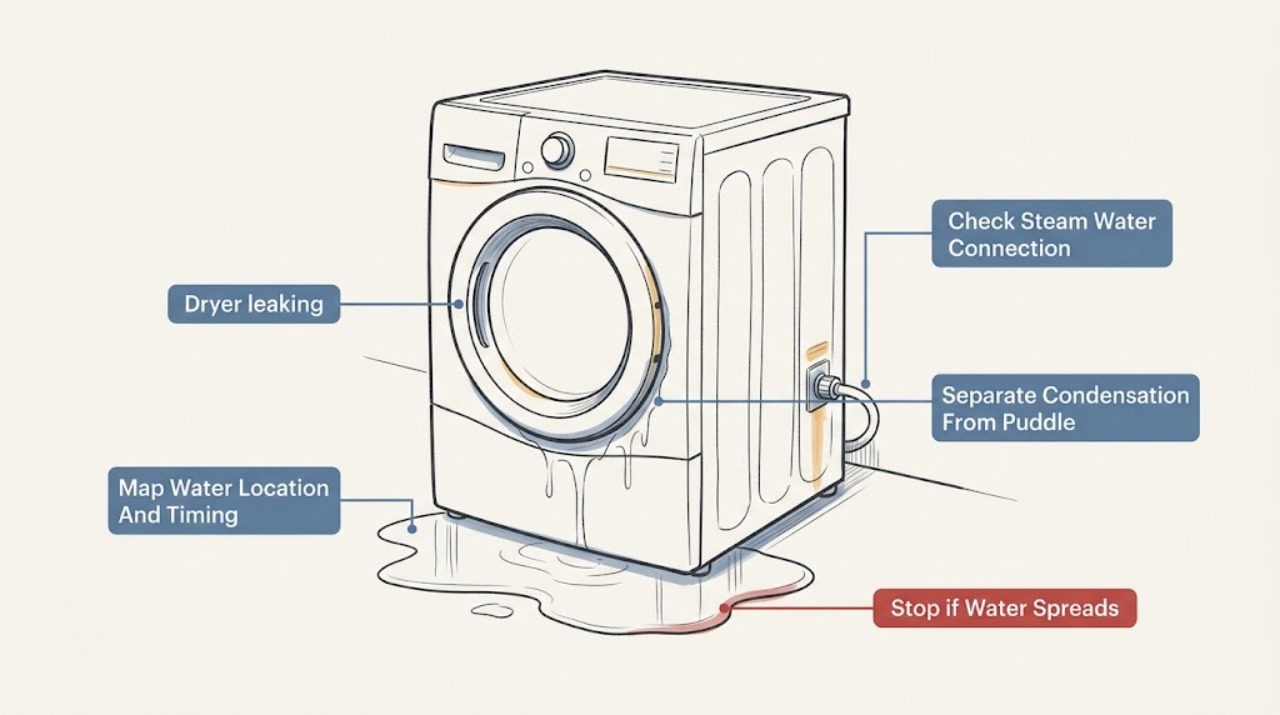
Start by locating the water and recording when it appears. On an Amana steam dryer, a loose water-inlet connection or missing hose washer can leak at the back; turn the water supply off before handling a wet connection and follow the model's installation instructions. A couple of drips from the door when it is opened after a steam cycle can be normal condensation, especially with a small load or Static Reduce, but a puddle is not. Water on the floor behind the dryer, long dry times, steam inside, or weak exhaust points to restricted venting and needs prompt lint and vent attention because restricted airflow is a fire risk. If the leak continues when no steam cycle is running, the source is inside the cabinet, or there is a gas, electrical, burning, or recurring airflow problem, stop using the dryer and arrange Amana or qualified appliance service.
Before you begin
Safety first
- This article covers safe observation, turning off the steam water supply, ordinary accessible hose and vent inspection, and lint-screen care. It does not authorize cabinet removal, live electrical testing, gas work, concealed vent work, water-valve disassembly, or guessed parts replacement.
Work through in order
Diagnostic checks
Use only checks that match the exact appliance or system and its official guide.
-
Check 1
Stop the cycle, dry the visible area, and use a dry towel or paper towel around the door edge, rear water connection, floor behind the dryer, and nearby washer or wall plumbing; note whether the water returns during a steam cycle, immediately when the door opens, or while any heated cycle runs.
Expected result: Classify the wet pattern as a couple of door drips after steam, a wet rear hose or connector, a puddle behind the dryer, water from the front or cabinet, or water that is present even when the dryer is idle.
Next step: Use the matching check below and photograph the wet location before moving the appliance. If the source cannot be isolated without pulling the dryer or opening it, stop and arrange service.
Stop if: Do not reach behind a powered or moving dryer, remove a cabinet panel, or continue a cycle when water can contact electrical parts.
Why this matters
Why: Door-only drops after steam fit condensation; a rear wet connection points to the steam water line; a rear-floor puddle with slow drying points toward exhaust moisture; water from inside the cabinet or while idle is not explained by normal door condensation and needs service or an external plumbing check.
-
Check 2
If the dryer has a Steam option and the rear connection is wet, turn off the cold-water faucet, then inspect the accessible inlet hose, faucet or Y connector, dryer water-inlet connection, and visible hose washers for a loose coupling, missing washer, kink, cut, bulge, or other damage; do not overtighten or dismantle the valve.
Expected result: Record whether moisture starts at the faucet/Y connector, along the hose, at the dryer's inlet, or nowhere on the steam line; note whether both ends have washers and whether a coupling is visibly loose or damaged.
Next step: With the faucet still off, correct only an accessible connection in the exact installation instructions' manner, then check for leaks before running Steam. Replace a visibly damaged hose only with a model-appropriate part or arrange service when fit is uncertain.
Stop if: Do not test a leaking connection under pressure, use a hose with bulges, cuts, or wear, overtighten a coupling, or open the dryer's water valve or cabinet.
Why this matters
Why: A wet coupling or missing/damaged washer can explain a steam-cycle leak. A dry water line makes the steam inlet less likely and shifts attention to condensation, exhaust moisture, an external source, or an internal dryer fault.
-
Check 3
If water is only on the door or inside drum after Steam or Static Reduce, run no further test until the surface is dry; compare a suitable larger load with the model's instructions and observe the door when it is opened, without adding water or changing sealed components.
Expected result: Note whether there are only a couple of drops at door opening, wet spots on a small or delicate load, or a continuing stream or puddle that reaches the floor or returns after the door is closed.
Next step: If the result is limited to a couple of door drops and there is no rear or floor water, wipe the door and use the documented load/cycle combination. If water continues or spreads, stop using the dryer and continue only with the accessible vent check and service boundary.
Stop if: Do not dismiss a puddle as condensation, run repeated steam cycles to reproduce a leak, or use the dryer if water is reaching electrical controls or the floor.
Why this matters
Why: Amana describes a couple of door drips as possible steam condensation and says small loads or Static Reduce can leave wet spots. A continuing leak or floor puddle exceeds that normal pattern and requires the vent, inlet, external plumbing, or service path.
-
Check 4
With the dryer unplugged and cool, clean the lint screen and inspect the ordinary accessible exhaust run behind the dryer and the exterior hood for crushed or kinked ducting, lint, debris, nests, or an obstructed flap; do not enter the duct or remove the cabinet.
Expected result: Record whether the duct is crushed or kinked, the lint screen or accessible connection is loaded, the exterior hood opens and is clear during normal operation, and whether the dryer had long dry times, interior steam, little lint on the screen, or weak exhaust.
Next step: Clear only ordinary accessible lint or debris and restore the duct without crushing it. If the path is concealed, damaged, inaccessible, repeatedly restricted, or still produces water behind the dryer, arrange professional vent cleaning or appliance service before further drying.
Stop if: Do not run the dryer with a disconnected exhaust, use plastic or foil ducting as an improvised repair, reach into a hot or moving drum, or ignore a fire-risk airflow warning.
Why this matters
Why: Amana associates restricted airflow with long drying, heat or humidity in the laundry area, steam or moisture in the dryer, little lint on the screen, and water puddles usually behind the dryer. A blocked or crushed path can therefore look like a water leak as well as a drying fault.
-
Check 5
If the inlet and accessible exhaust are dry or clear, check from a safe position that the dryer is level and that water is not tracking from the washer, wall, faucet, drain, or a nearby supply line onto the dryer or floor; do not pull a gas dryer or disconnect utility lines to inspect hidden areas.
Expected result: Record whether the dryer rocks or is visibly out of level, whether the wet trail begins at a nearby appliance or wall connection, and whether the dryer itself stays dry while the floor becomes wet.
Next step: Use the installation instructions for ordinary leveling information and arrange the appropriate appliance or plumbing service when the source is external, hidden, or requires moving a gas or hard-wired dryer.
Stop if: Stop for water near an outlet, gas connection, electrical cord, wall cavity, or any hidden leak; do not open the wall or service panel.
Why this matters
Why: Amana says a level dryer is needed for moisture sensing, but a wet trail that begins at another appliance or wall is not proof of an internal dryer leak. A dry cabinet with an external trail shifts the repair to the source appliance or household plumbing.
-
Check 6
Before requesting service, record the exact model, cycle, water location, whether the dryer heats and tumbles, any Check Vent or displayed code, and the result of the permitted inlet and exhaust inspections; do not clear a recurring condition by repeatedly restarting the dryer.
Expected result: Note AF or F4E3, an F# E# service code, L2 or PF, no heat, unusual noise, burning smell, or no code despite a continuing leak; distinguish a one-time door drip from recurring water.
Next step: Stop using the dryer for persistent water, restricted airflow, no heat, burning odor, or a service code, and give the technician the recorded pattern and steps already taken.
Stop if: Do not remove terminal covers, test live voltage, bypass a safety device, work on gas, or replace a heater, valve, thermostat, or control from a code or leak symptom alone.
Why this matters
Why: Amana associates AF/F4E3 with restricted airflow, F#E# with a control problem requiring service, and L2 with low or no line voltage that can keep the heater from turning on. A code or persistent leak narrows the handoff but does not identify a user-replaceable part.
Use your observations
Decision map
Find the observation that best matches what you see, then follow the next safe action.
-
PATH 01Safety boundary
What you see
Water appears during or shortly after a Steam cycle, the rear hose or connector is wet, and the door shows more than a normal couple of condensation drops.
Do this next
Turn off the cold-water faucet, document the wet connection, and correct only an accessible installation issue that the exact manual permits; arrange service for a damaged hose, valve, cabinet leak, or any uncertainty.
Why this path and its safety boundary
Why it matters: The steam water line, hose washer, faucet/Y connector, or dryer inlet connection is more likely than exhaust moisture.
Safety stop: Do not run Steam with a wet connection, pressure-test a damaged hose, overtighten couplings, or open the water inlet valve housing.
-
PATH 02Safety boundary
What you see
Only a couple of drops appear at the door when it is opened after Steam, especially with a small or Static Reduce load, and there is no floor puddle or rear wetness.
Do this next
Wipe the door, use the model-appropriate load and cycle, and monitor. Escalate if water becomes continuous, reaches the floor, occurs outside Steam, or is accompanied by poor drying.
Why this path and its safety boundary
Why it matters: This matches Amana's described condensation pattern rather than an established leak from a failed part.
Safety stop: Do not keep running Steam to create more water or ignore a spreading puddle.
-
PATH 03Safety boundary
What you see
Water or a puddle is mostly behind the dryer and the load is warm but damp, dry times are long, steam remains inside, lint accumulation is abnormal, or exhaust airflow is weak.
Do this next
Unplug and cool the dryer, clean the lint screen, inspect accessible ducting and the exterior hood, and arrange professional vent cleaning when the path is concealed, crushed, or still restricted.
Why this path and its safety boundary
Why it matters: Restricted venting can keep moist air inside and allow condensation in the dryer or vent material, making the appliance appear to leak water.
Safety stop: Do not run with a disconnected or improvised vent, ignore a fire-risk restriction, or dismantle the cabinet to chase lint.
-
PATH 04Safety boundary
What you see
The steam connection and accessible vent are dry or clear, but water returns while the dryer is idle, comes from inside the cabinet, follows a wall or nearby appliance, or cannot be traced safely.
Do this next
Keep the dryer off, shut off the relevant water supply if safe, protect the floor, and request Amana or qualified appliance/plumbing service with photos and the timing pattern.
Why this path and its safety boundary
Why it matters: The source is not established as normal condensation or a simple accessible vent restriction; it may be external plumbing, a hidden hose, or an internal dryer fault.
Safety stop: Do not pull a gas or hard-wired dryer, open the wall or cabinet, or continue operation near water and electrical connections.
-
PATH 05Safety boundary
What you see
A recurring leak is accompanied by a burning smell, smoke, no heat, unusual noise, AF/F4E3, F#E#, L2, or another persistent warning.
Do this next
Stop using the dryer and provide the exact code, model, cycle, wet location, and permitted checks to Amana or a qualified technician; use a qualified electrician when a supply-voltage issue is indicated.
Why this path and its safety boundary
Why it matters: The leak may coexist with airflow, power, control, or another appliance fault. A code is a service clue, not proof of one replaceable part.
Safety stop: Do not bypass safety devices, work on gas or live electrical terminals, or keep restarting a dryer with smoke, burning odor, or a service code.
Helpful context
Understand the symptom
A dryer leak is not always a failed water-containing part
Amana steam dryers intentionally use a water connection, while ordinary heated dryers can collect moisture when damp exhaust air cannot escape. A few drops on the door after steam can be condensation; water pooling behind the cabinet with long dry times is a different pattern that makes restricted venting more likely. Do not order a water valve or pump until the wet location and cycle timing are known.
Protect the dryer and the home while you trace the source
Before moving or inspecting a wet dryer, stop the cycle and keep hands and tools away from live electrical areas. For a steam model, close the cold-water faucet before checking an inlet connection. For an exhaust problem, inspect only ordinary accessible areas and leave cabinet, gas, electrical, and concealed vent work to a qualified professional. Amana's own guidance directs users to service when heating, error, or persistent performance problems remain.
Safety boundary
Stop conditions
- Turn the dryer off and stop use for a continuing leak, floor puddle, water near electrical parts, smoke, burning odor, gas concern, or violent or unusual operation.
- For a steam dryer, turn off the cold-water faucet before handling a wet connection; do not pressure-test, overtighten, or open the water inlet valve housing.
- Do not run a dryer with a disconnected, crushed, improvised, or visibly restricted exhaust; restricted airflow can create heat, moisture, and fire risk.
- Do not open the cabinet, test live voltage, bypass safety devices, work on gas, pull a hard-wired dryer, or guess at a heater, valve, thermostat, pump, or control replacement.
Only after diagnosis
Potential parts
- steam-dryer inlet hose and hose washer
Consider this category only when the wet pattern begins at a steam water-line connection and inspection confirms a damaged hose, missing washer, or failed seal; a technician or exact installation manual should identify the replacement.
Confirm the exact Amana model, hose type, washer arrangement, and installation requirements; do not use an old, bulged, cut, kinked, or unverified hose. - dryer exhaust duct component
Consider this category only when inspection confirms crushed, damaged, or incorrectly fitted exhaust ducting and the model's installation instructions identify a compatible replacement.
Confirm the exact model and approved exhaust material and routing; do not substitute a plastic or foil accordion duct or extend the run beyond the installation limits.
When checks do not resolve it
Need a professional?
Arrange Amana or qualified appliance service when water continues outside the described couple-of-drops condensation pattern, a steam connection or internal cabinet area leaks, the source cannot be isolated safely, a rear puddle persists after ordinary accessible vent checks, the dryer does not heat, a service or airflow code returns, or there is smoke, burning odor, gas concern, electrical exposure, or unusual noise. Use a qualified vent-cleaning professional for a concealed or repeatedly restricted exhaust and a plumber or appliance technician when the wet trail starts at household plumbing or another appliance.
Safety scope: This article covers safe observation, turning off the steam water supply, ordinary accessible hose and vent inspection, and lint-screen care. It does not authorize cabinet removal, live electrical testing, gas work, concealed vent work, water-valve disassembly, or guessed parts replacement.
Common questions
FAQ
Why is my Amana dryer leaking water from the back?
If it has a Steam cycle, check the cold-water inlet hose, faucet or Y connector, washers, and dryer inlet for a wet connection after turning off the faucet. If the water is a puddle behind the dryer with long dry times or weak exhaust, restricted venting can retain moist air and mimic a leak.
Are a few drops of water on an Amana dryer door normal?
A couple of drops when opening the door after a Steam cycle can be normal condensation, and small or Static Reduce loads can leave wet spots. A continuing stream, floor puddle, rear wetness, or water outside the Steam cycle is not explained by that limited condensation pattern.
Can a blocked dryer vent cause water on the floor?
Yes. Amana says restricted venting can keep moist air inside the dryer or vent material and create puddles usually behind the dryer. Unplug and cool the dryer, clean the lint screen, inspect accessible ducting and the exterior hood, and arrange professional vent cleaning when the restriction is concealed or persists.
What should I do if my Amana Steam dryer hose is leaking?
Stop the cycle and turn off the cold-water faucet before handling the wet connection. Check for washers at both ends and visible cuts, bulges, kinks, wear, or a loose coupling. Do not overtighten or use a damaged hose; use the exact installation instructions or arrange service when the connection or inlet valve is uncertain.
When should I stop using a leaking Amana dryer?
Stop for a continuing leak, floor puddle, water near electrical parts, smoke, burning odor, gas concern, no heat, unusual noise, a recurring airflow warning, or a service code. Give the technician the model, cycle, wet location, code, and the permitted checks you completed.
Read the exact guide
Official sources
- Leaking During Steam Cycle - DryerAmana Product Help · Official Amana Product Help troubleshooting page for dryers with a Steam cycle; exact model installation instructions control.
- Dryer Vent may be Blocked or RestrictedAmana Product Help · Official Amana Product Help guidance for household dryer exhaust restriction; model installation instructions control the exact vent system.
- Dryer is not Drying or Experiencing Long Dry Times - Product HelpAmana Product Help · Official Amana Product Help guidance for dryer performance; exact model and installation instructions control.
- Installation of Water Line - DryerAmana Product Help · Official Amana installation guidance for Steam dryer water lines; exact model installation documents control.
- How to Check VentingAmana Product Help · Official Amana Product Help vent-maintenance guidance; the exact model installation instructions control permitted materials, length, and elbows.
- Error Codes in DryersAmana Product Help · Official Amana dryer code reference; code availability and exact corrective actions vary by model.
- Water on the Door - DryerAmana Product Help · Official Amana Product Help page for dryer water on the door; applicability is strongest for Steam or Static Reduce models.
Community feedback
Share a repair observation
Share a plain-text repair observation. Accepted observations are published automatically; this page may take a moment to update.