
On this page
Start here
Quick answer
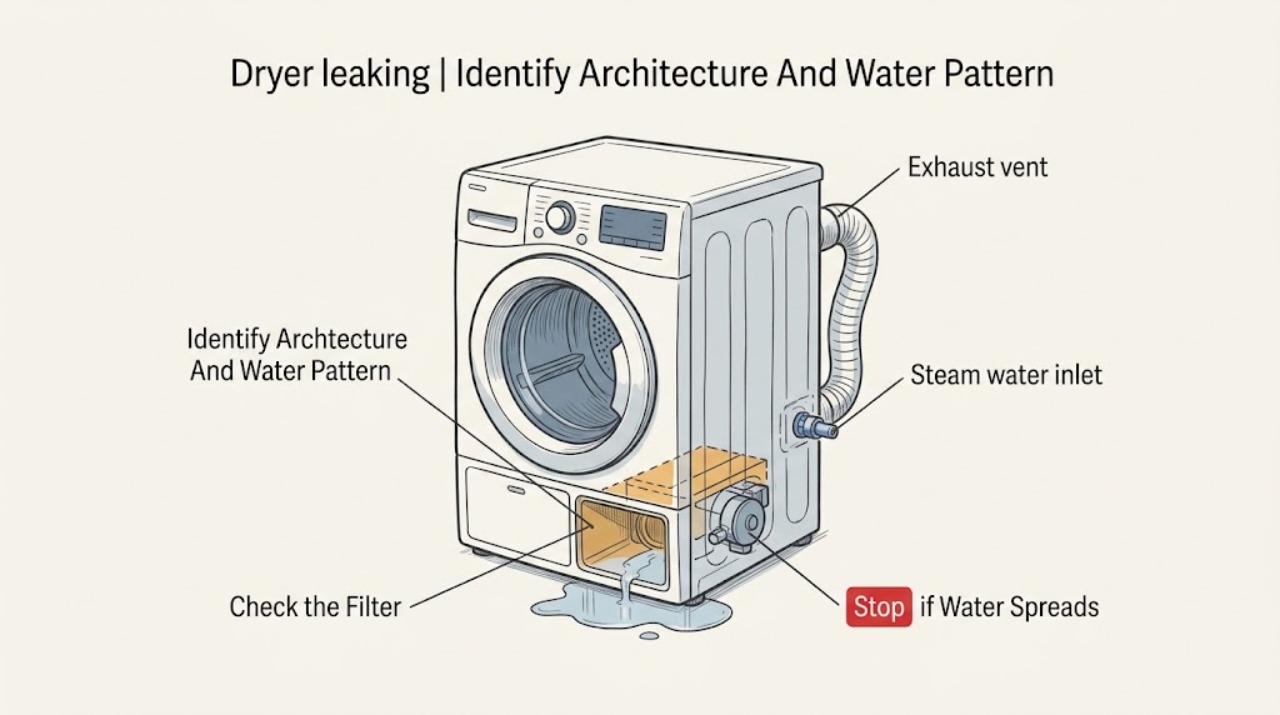
First identify whether your Electrolux dryer is a heat-pump or condenser model, a vented model, or a dryer with a Steam option. A heat-pump or condenser dryer that leaks underneath may have a blocked condensate pump, clogged filter or condenser, incorrect leveling, or a kinked direct-drain hose; a small amount of water in the tank after drying makes a blocked condensate pump more concerning and requires service. A vented dryer can leave water in a long or cold exhaust hose when moisture condenses, so check the accessible hose and outside vent without drilling or improvising. If the leak appears during Steam, inspect the water inlet connection with the water supply off. Stop using the dryer for a continuing puddle, water near electrical or gas parts, a damaged hose, an internal cabinet leak, an error, or any condition that needs disassembly, and arrange Electrolux or qualified service.
Before you begin
Safety first
- This article covers architecture identification, ordinary accessible filter, condenser, hose, water-line, and vent observations, and turning off water or power before those checks. It does not authorize cabinet or base removal, live electrical testing, gas work, concealed vent work, pump disassembly, or guessed parts replacement.
Work through in order
Diagnostic checks
Use only checks that match the exact appliance or system and its official guide.
-
Check 1
Stop the cycle, dry the floor, and check the exact Electrolux manual or control panel for Heat Pump, Condenser, Vented, Steam, a condensate tank, or a direct-drain connection; use a dry towel to trace where water first returns without moving a gas or hard-wired dryer.
Expected result: Classify the appliance as heat-pump/condenser, vented, Steam-equipped, or unknown, and record whether water starts under the dryer, in the rear exhaust or hose, at a rear water connection, at the door, or inside the cabinet.
Next step: Follow only the matching architecture check below and photograph the water trail. If the source cannot be isolated without pulling the dryer or opening it, keep it off and arrange service.
Stop if: Do not reach behind a powered or moving dryer, pull a gas or hard-wired unit, or operate it when water can contact electrical parts.
Why this matters
Why: Heat-pump and condenser models use a condensate path; vented models can collect condensation in exhaust ducting; Steam models have an additional water inlet. An unknown architecture or an internal cabinet source cannot be safely diagnosed by a generic leak procedure.
-
Check 2
For a heat-pump or condenser dryer, switch it off and let it cool, then clean the lint filters and the condenser only through the ordinary access and method specified in the manual; check from the front or side that the appliance is stable and level, and inspect a direct-drain outlet hose for a kink without disconnecting hidden plumbing.
Expected result: Record whether filters or the accessible condenser are loaded with fluff, the dryer rocks or is visibly out of level, the outlet hose is kinked, and whether water stops leaking after the permitted cleaning or hose correction.
Next step: Restore each filter, condenser, and hose exactly as the manual specifies, then run a short monitored cycle only if no water reached electrical areas. If the leak remains, stop and arrange service rather than opening the pump or sealed base.
Stop if: Do not operate without the lint filter, force a condenser, remove a pump cover, or use water near a live connection; stop if a filter, seal, access flap, or hose is damaged.
Why this matters
Why: Electrolux says excess fluff can contribute to blockages and overflowing, and that a level appliance, clean filters or condenser, and an unkinked direct-drain hose are relevant to leaks. Improvement after this check supports a maintenance or routing cause; continued leakage shifts toward the condensate pump or an internal path.
-
Check 3
After a drying cycle has stopped, check the condensate container or water tank level and compare it with the amount of water on the floor; do not remove or clean a condensate pump unless the exact manual explicitly identifies it as user-accessible.
Expected result: Record a normally filled tank, a tank with very little water despite a floor leak, an empty tank with no leak, or a tank that cannot be accessed safely; note whether the leak occurs only while drying.
Next step: Keep the dryer off and contact Electrolux or an authorized technician when a floor leak is paired with a nearly empty tank, or when the pump path is inaccessible; provide the tank level, cycle timing, filter result, and photos.
Stop if: Do not tilt the dryer, pour water into the machine, bypass a pump, or open the base to reach a condensate component.
Why this matters
Why: Electrolux identifies water under the dryer plus very little water in the tank as a sign associated with a blocked condensate pump, which is a service fault. A normal tank with a leak makes a blocked pump less decisive and leaves overflow, seals, leveling, direct-drain routing, or an external source to assess.
-
Check 4
For a vented dryer, unplug it before inspection, then check only the accessible exhaust hose, wall connection, and exterior vent for crushing, kinks, lint, debris, or a blocked damper; do not drill the hose or connect it to an extractor hood, chimney, boiler outlet, or other unapproved path.
Expected result: Record whether the hose is long, cold, kinked, wet inside, or poorly routed, whether the outside vent is open, and whether clothes are warm but damp or the laundry area is unusually humid.
Next step: Restore the approved vent routing and clear ordinary accessible debris according to the manual; arrange professional vent cleaning or service when the duct is concealed, damaged, repeatedly wet, or still restricted.
Stop if: Never run a gas dryer without an exhaust duct venting outdoors, and do not run any dryer with a disconnected, crushed, improvised, or unsafe exhaust.
Why this matters
Why: Electrolux explains that moisture can condense in a long hose when room temperature is low, while a dirty or incorrectly fitted vent prevents moist air from leaving. A rear puddle plus wet exhaust or weak airflow makes vent condensation or restriction more likely than a condensate-pump failure.
-
Check 5
If the exact dryer has a Steam option and water appears during or shortly after Steam, turn off the cold-water faucet before handling the accessible hose connection; inspect the hose, washers, faucet or connector, and dryer inlet for a wet coupling, missing washer, kink, cut, bulge, or other damage without opening the inlet valve.
Expected result: Record whether moisture begins at the faucet or connector, along the hose, at the dryer's inlet, or nowhere on the water line; note whether a small amount of door condensation is the only water seen.
Next step: Keep the water supply off, follow only the exact installation instructions for an accessible connection, and arrange service for a damaged hose, cracked fitting, inlet-valve area, or any recurring leak.
Stop if: Do not test a damaged hose under pressure, overtighten a coupling, use an unverified washer, or open the cabinet or inlet valve housing.
Why this matters
Why: A wet Steam connection supports an inlet hose, washer, coupling, or valve-area leak. A dry line shifts attention to condensation, exhaust or condensate routing, an external source, or an internal fault. A few drops at the door after a Steam phase can be condensation rather than a hose failure.
-
Check 6
Before service, record the model, dryer architecture, cycle, load, first wet location, tank level if applicable, filter/condenser and vent observations, and any display code or no-heat condition; do not repeatedly restart a leaking dryer to reproduce the symptom.
Expected result: Note a recurring leak while idle, a puddle that grows during drying, a blocked-airflow code or warning, no heat, a burning smell, smoke, gas odor, unusual noise, or an internal leak that cannot be seen from ordinary access.
Next step: Keep the dryer off and arrange Electrolux or qualified appliance service; use a qualified vent professional for concealed exhaust restrictions and an electrician or gas professional when the supply itself is implicated.
Stop if: Do not test live voltage, open gas fittings, bypass thermal or door protection, remove cabinet panels, or order a pump, heater, valve, sensor, or seal from the symptom alone.
Why this matters
Why: A persistent leak or safety symptom is not a user-level parts diagnosis. Electrolux's support guidance directs users to authorized service when the relevant cleaning, routing, and operating checks do not resolve a leak or when a condensate pump fault is suspected.
Use your observations
Decision map
Find the observation that best matches what you see, then follow the next safe action.
-
PATH 01Safety boundary
What you see
The dryer is a heat-pump or condenser model, water leaks onto the floor during drying, and the condensate tank contains very little water afterward.
Do this next
Keep the dryer off and request Electrolux or authorized service, providing the tank level, leak timing, model, and permitted filter/condenser result.
Why this path and its safety boundary
Why it matters: Electrolux associates this combination with a blocked condensate pump; filter dirt or incorrect operation may contribute, but the pump fault requires service rather than cabinet disassembly.
Safety stop: Do not tilt the dryer, open the pump base, pour water into the circuit, or continue drying on the assumption that the puddle is harmless.
-
PATH 02Safety boundary
What you see
A heat-pump or condenser dryer has fluff or a flashing maintenance indication, a kinked direct-drain hose, an unlevel body, dirty seals, or water that improves after permitted cleaning or routing correction.
Do this next
Restore filters, condenser, seals, level, and drain hose according to the exact manual, monitor one suitable cycle, and arrange service if water returns.
Why this path and its safety boundary
Why it matters: Overflow, condensate routing, leveling, or a seal issue is more likely than a failed heater. If the leak persists despite a clean, correctly restored path, an internal condensate component remains possible.
Safety stop: Do not force access flaps, run without filters, or open the base to reach the pump or hidden drain path.
-
PATH 03Safety boundary
What you see
The dryer is vented, the rear hose or wall connection is wet, and the dryer has long dry times, warm damp loads, unusual laundry-room humidity, or weak outside airflow.
Do this next
Unplug and cool the dryer, correct only accessible approved vent routing, clear ordinary debris, and arrange professional vent inspection when the path is concealed or remains restricted.
Why this path and its safety boundary
Why it matters: Moisture may be condensing in a cold, long, kinked, or restricted exhaust rather than leaking from a water tank or pump.
Safety stop: Do not drill the hose, route exhaust into a building cavity or unapproved outlet, or run a gas dryer without outdoor exhaust.
-
PATH 04Safety boundary
What you see
The dryer has Steam, water appears during or after a Steam cycle, and a rear faucet, connector, hose, washer, or dryer inlet is wet.
Do this next
Turn off the cold-water faucet, keep the dryer off, and use the exact installation instructions or service for a damaged hose, fitting, washer, or inlet-valve area.
Why this path and its safety boundary
Why it matters: The Steam water line or its connection is more likely than ordinary door condensation or vent moisture.
Safety stop: Do not pressurize a damaged line, overtighten couplings, or open the inlet valve housing.
-
PATH 05Safety boundary
What you see
Only a small amount of condensation is visible inside or at the door after a Steam phase, with no continuing flow, rear wetness, floor puddle, or water while idle.
Do this next
Wipe the door and monitor the next model-appropriate cycle. Escalate if drops become a stream, reach the floor, occur outside Steam, or coincide with poor drying.
Why this path and its safety boundary
Why it matters: Electrolux describes condensation inside the drum after Steam as normal; this limited pattern does not establish a failed part.
Safety stop: Do not repeatedly run Steam to reproduce a leak or dismiss water that spreads beyond the door area.
-
PATH 06Safety boundary
What you see
Water returns while the dryer is idle, comes from inside the cabinet, appears near electrical or gas connections, or persists after the architecture-specific accessible checks.
Do this next
Keep the dryer off, shut off the relevant water supply if it has Steam, protect the floor, and arrange Electrolux or qualified appliance service with the model and water pattern.
Why this path and its safety boundary
Why it matters: The source is not established as ordinary condensation, vent routing, or a simple accessible maintenance issue; continued operation could worsen water or safety damage.
Safety stop: Do not move a gas or hard-wired dryer, open the cabinet or wall, test live wiring, or continue operation near water.
Helpful context
Understand the symptom
The same puddle can have different causes on different Electrolux dryers
A heat-pump or condenser dryer routes extracted moisture to a tank or drain, so filters, the condenser, leveling, and the condensate pump matter. A vented dryer sends moist air outside, and water can condense in a long or cold hose. A Steam option adds a separate water inlet that does not exist on every dryer. Check the manual or rating information for the exact architecture before touching a filter, condenser, drain hose, or water connection.
Use the water pattern as the diagnostic evidence
Water underneath with very little in a condensate tank is a different finding from water inside a vent hose, a wet Steam connection at the rear, or a couple of drops from normal steam condensation. Filters and condensers are ordinary maintenance only when the manual makes them accessible; a blocked condensate pump is a service fault in Electrolux's guidance. Do not assume that a replacement pump, hose, seal, or nozzle will fit without the exact model.
Safety boundary
Stop conditions
- Stop using the dryer for a continuing leak, floor puddle, water near electrical or gas parts, smoke, burning or gas odor, unusual noise, or a recurring warning.
- For a Steam dryer, turn off the cold-water faucet before handling a wet connection; do not pressure-test, overtighten, or open the inlet-valve housing.
- Do not run a gas dryer without an exhaust duct venting outdoors, or any dryer with a disconnected, crushed, improvised, or unsafe exhaust path.
- Do not open the cabinet, base, wall, gas fitting, or live electrical area; do not bypass protection or guess at a pump, heater, valve, sensor, or seal replacement.
Only after diagnosis
Potential parts
- condensate pump assembly
Consider this category only when a heat-pump or condenser dryer leaks underneath with little water in the tank and a technician confirms a blocked or failed condensate pump after the permitted filter and routing checks.
Confirm the exact model, pump configuration, connectors, and manufacturer fit information; do not infer compatibility from the Electrolux brand alone. - dryer water-inlet hose and hose washer
Consider this category only when a Steam dryer leak begins at the water connection and inspection confirms a damaged hose, missing washer, or failed seal that the exact installation instructions identify for replacement.
Confirm the exact model, hose specification, washer arrangement, and installation guidance before ordering; do not use a visibly damaged or unverified hose. - approved exhaust duct component
Consider this category only when a vented dryer's inspection confirms crushed or damaged ducting and the exact model's installation instructions support replacement.
Confirm the model's approved exhaust material, diameter, routing, and length limits; do not substitute an unapproved hose or route exhaust indoors.
When checks do not resolve it
Need a professional?
Arrange Electrolux or qualified appliance service when a heat-pump or condenser dryer leaks with very little water in its tank, when a clean and correctly routed condensate path still overflows, when a vented dryer remains wet behind the unit or has concealed/repeated airflow restriction, when a Steam water connection leaks, or whenever water returns while idle, comes from inside the cabinet, reaches electrical or gas parts, or is accompanied by an error, no heat, smoke, burning odor, gas concern, or unusual noise. Use a professional vent-cleaning service for inaccessible exhaust restrictions.
Safety scope: This article covers architecture identification, ordinary accessible filter, condenser, hose, water-line, and vent observations, and turning off water or power before those checks. It does not authorize cabinet or base removal, live electrical testing, gas work, concealed vent work, pump disassembly, or guessed parts replacement.
Common questions
FAQ
Why is my Electrolux dryer leaking water underneath?
First identify whether it is a heat-pump or condenser dryer. Electrolux associates a floor leak plus very little water in the condensate tank with a blocked condensate pump that needs service. Also check permitted filter, condenser, leveling, seal, and direct-drain hose conditions; do not open the base.
Can a vented Electrolux dryer put water on the floor?
Yes. Moisture can condense in a long or cold vent hose, and a kinked or restricted exhaust can retain wet air. Unplug and cool the dryer, inspect accessible routing and the outside vent, and arrange professional vent service when the path is concealed or remains restricted.
Is water inside an Electrolux dryer after Steam normal?
Some condensation water inside the drum after a Steam cycle is normal. A continuing stream, rear wet connection, floor puddle, or water while the dryer is idle is a different pattern and should be investigated or serviced.
What should I check on an Electrolux condenser or heat-pump dryer that leaks?
With the dryer off and cool, clean accessible lint filters and the condenser as the manual describes, confirm the dryer is level, inspect seals, and check a direct-drain hose for kinks. If water remains under the unit or the tank stays nearly empty, stop and request service for the condensate path.
When should I stop using a leaking Electrolux dryer?
Stop for a continuing puddle, water near electrical or gas parts, smoke, burning or gas odor, an internal cabinet leak, a damaged hose, an error, or restricted exhaust. Do not open the cabinet, test live wiring, perform gas work, or guess at a pump or valve replacement.
Read the exact guide
Official sources
- Moisture, condensation, water in tumble dryerElectrolux Support · Official Electrolux UK support article for vented, condenser, and heat-pump tumble dryers; regional models may differ and the exact manual controls.
- Dryer - Not Drying and Extended Drying TimeElectrolux · Official Electrolux support article for dryers; details such as heat-pump behavior and vent installation remain model-specific.
- How to use the Steam programme on your Electrolux tumble dryerElectrolux Support · Official Electrolux UK support article for selected tumble dryers with a Steam programme; exact model instructions control the water system and access.
- Leakage of the water from inlet hoseElectrolux Support · Official Electrolux support article for appliances with a water inlet; use for a Steam-equipped dryer only when the exact model has that water connection and its manual permits access.
- Water leakage from under the dryerElectrolux Support · Official Electrolux UK support article for tumble dryers; exact model manual and regional service terms control.
- Tumble dryer is leakingElectrolux Support · Official Electrolux UK support article applying to Heat Pump Dryers and Condenser Tumble Dryers; exact model manual controls access and maintenance.
Community feedback
Share a repair observation
Share a plain-text repair observation. Accepted observations are published automatically; this page may take a moment to update.