
On this page
Start here
Quick answer
A Fisher & Paykel dryer leak needs the dryer type identified before any check. On heat-pump or condensing models with a water tank, Fisher & Paykel lists a full or incorrectly fitted tank, an obstructed or disconnected drain hose, and a door that is not closed as possible causes of water under the machine. Stop the cycle, keep the area and hands dry, and check only the normal external tank, door, and hose access. If water is near electrical equipment, the tank or hose is damaged, the leak continues after the model-specific external checks, or water is coming from a concealed area, stop using the dryer and arrange trained service. A small amount of water in the drum can also be a condensation or ventilation issue on applicable models; do not assume that a vented dryer has a tank.
Before you begin
Safety first
- Do not operate with an active or unexplained leak, water near electrical equipment, a damaged tank, damaged hose, damaged cord, missing filter, or a concealed water path. Do not open panels, move the dryer through water, dismantle the drain system, or test energized parts.
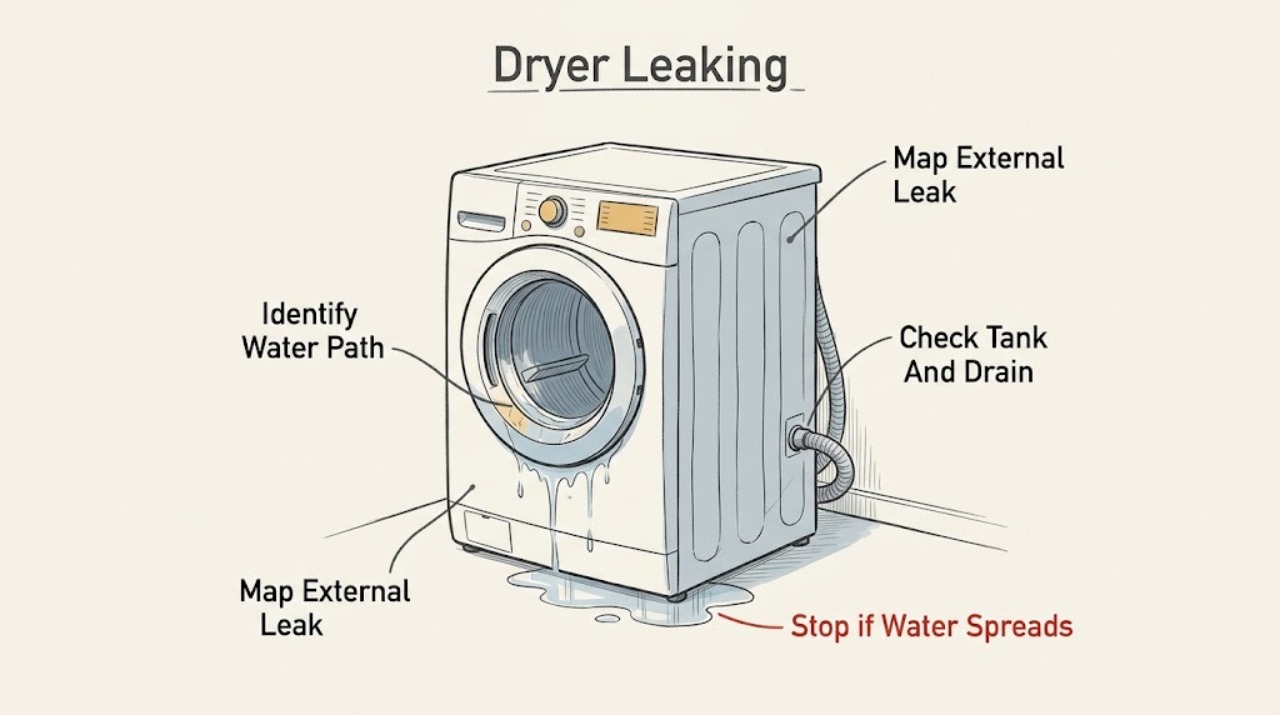
Work through in order
Diagnostic checks
Use only checks that match the exact appliance or system and its official guide.
-
Check 1
From the appliance label or records, identify the exact Fisher & Paykel model and whether it is a heat-pump/condensing dryer with a water tank, a model connected to a drain hose, or a vented design; do not remove panels to identify it.
Expected result: Record the model, whether a removable tank is present, whether a drain hose is connected, and whether the guide describes water collection or external venting.
Next step: Use the exact model guide for the remaining external checks and record the model for service. If the model or water path cannot be established safely, stop and ask Fisher & Paykel support or a trained technician.
Stop if: Do not pull the dryer out, open the cabinet, disconnect unknown plumbing, or reach behind wet electrical equipment to identify the design.
Why this matters
Why: A tank or drain-hose check is relevant only when the model is designed for that water path. A vented model may require a different manual, so applying heat-pump tank instructions to it can misdirect the diagnosis.
-
Check 2
Stop the cycle and inspect from a dry, stable position around the front, door edge, visible tank area, and accessible hose connection; do not move the appliance or put hands into standing water.
Expected result: Record whether water is under the front or rear, at the door edge, inside the drum, around the tank, at a visible drain-hose connection, or near the plug, outlet, cord, or controls.
Next step: Photograph the location without touching wet electrical parts. Continue only with the applicable tank, hose, or door observation when the area is dry and safe; otherwise arrange service.
Stop if: If water is near electrical equipment, the floor is unsafe, the leak is active or spreading, or the source is hidden, keep away and arrange qualified appliance service.
Why this matters
Why: A floor puddle near the tank or drain path supports a water-collection or drainage check on applicable models. Water at the door can follow an obstructed or incompletely closed door. Water near electrical equipment or from a concealed area is a stop-use condition, not a routine cleaning check.
-
Check 3
For a model that has a removable water tank or a user-accessible plumbed drain, check only the normal access described in its guide: support and empty a full tank, reseat it level, and look for a kinked, crushed, detached, or visibly damaged drain hose without forcing fittings.
Expected result: The tank is full, not seated, cracked or wet; the drain hose is connected and clear-looking; or the hose is kinked, displaced, damaged, blocked, or not part of this model’s design.
Next step: Empty and correctly reseat an intact tank, or correct only an obvious accessible hose displacement if the model guide permits it. Do not run the dryer if the tank or hose is damaged, the leak returns, or the hose remains blocked or uncertain; contact trained service.
Stop if: Do not dismantle the pump or drain system, seal a crack with tape, use tools on unknown fittings, or operate without the water tank or required filter in place.
Why this matters
Why: A full or misfitted tank can explain water under a heat-pump dryer, while a blocked, loose, or damaged drain path can explain leakage on a plumbed setup. A crack, recurring leak, unknown connection, or absent water path requires model-specific service rather than a guessed replacement.
-
Check 4
Check from the outside that the door closes fully and nothing is obstructing it; if the symptom is water inside the drum rather than a floor puddle, record whether the surrounding laundry space is unusually hot, humid, cold, enclosed, or poorly ventilated.
Expected result: The door is obstructed or not fully closed; the drum contains water but the floor is dry; or the door closes and the room is well ventilated with no clear environmental explanation.
Next step: Clear only a visible door obstruction and follow the exact guide. Improve ventilation only as the model guide permits; if water remains, returns, or appears with a damaged seal or door, stop use and arrange trained service.
Stop if: Do not force the door, remove its seal, operate in a cupboard or enclosed unsafe space, or continue testing when water reaches electrical equipment.
Why this matters
Why: An incompletely closed door is one listed cause of water under applicable Fisher & Paykel dryers. Water in the drum can be recondensation on applicable heat-pump models when ambient conditions are unsuitable, while a persistent unexplained leak needs service.
-
Check 5
Prepare a service handoff with the exact model and serial number, dryer design, leak location, whether the tank was full or reseated, drain-hose arrangement, door observations, drum moisture, room conditions, and any displayed alert or fault code.
Expected result: The leak stops after a permitted external correction, recurs, comes from a damaged or concealed area, or is accompanied by an alert, electrical concern, or unsafe condition.
Next step: Use the manufacturer’s support channel or a trained Fisher & Paykel service technician for a recurring, unexplained, or unsafe leak. Keep the dryer out of service until the cause is assessed when water or damage remains.
Stop if: Do not remove panels, test live components, bypass a leak or door safety, or keep running cycles to reproduce an active leak.
Why this matters
Why: A one-time full-tank or displaced-hose event is different from a recurring leak or a concealed appliance fault. The model and water-path details prevent a technician from applying the wrong tank, drain, or venting procedure.
Use your observations
Decision map
Find the observation that best matches what you see, then follow the next safe action.
-
PATH 01Next step
What you see
The exact model has a removable water tank, the tank is full or not seated correctly, and the puddle is near the tank area without electrical contact.
Do this next
Stop the cycle, support and empty the tank, reseat it as the model guide shows, and keep the dryer off if the tank is cracked, wet externally, or the leak returns. Arrange trained service for a recurring leak.
-
PATH 02Next step
What you see
The dryer uses a drain hose and the hose is kinked, crushed, detached, blocked, damaged, or displaced, while the tank or floor shows water.
Do this next
Do only the accessible hose correction allowed by the exact guide. Do not dismantle the drain system; arrange Fisher & Paykel service when the obstruction, connection, or damage is not obvious or the leak persists.
-
PATH 03Next step
What you see
Water is at the door edge or in the drum, the door is obstructed or not fully closed, or the room is hot, humid, cold, enclosed, or poorly ventilated without a clear tank or hose fault.
Do this next
Clear a visible obstruction and follow the exact model guide. For drum moisture on applicable heat-pump models, use the manufacturer’s ventilation guidance; if water returns or the door/seal is damaged, stop use and arrange service.
-
PATH 04Next step
What you see
Water is near the outlet, plug, cord, controls, or other electrical equipment; the source is concealed; the tank or hose is damaged; the leak is active or recurring; or a fault alert appears.
Do this next
Do not operate or investigate further. Keep people away, isolate power only from a dry and safe location if possible, and contact a trained appliance technician; use emergency help for an immediate electrical or fire hazard.
Helpful context
Understand the symptom
Start with the dryer type
Fisher & Paykel sells dryer designs with different water paths. The opened heat-pump guides describe moisture being collected in a water tank or sent through a drain hose; a vented model may not have that arrangement. Use the model label and its guide to determine whether a tank, plumbed drain, condenser or other model-specific component is actually present before interpreting a puddle.
A leak location changes the next safe step
Water directly under the dryer, water in the drum, and moisture at the door do not prove the same cause. A tank that is full or not seated, a blocked or displaced drain hose, and an obstructed door are external checks on applicable models. Water in the drum without a floor puddle can instead reflect recondensation when the surrounding space is too hot, humid or cold. Do not remove panels or move the appliance to chase a hidden water path.
Keep water away from electrical risk
Stop before any check if water reaches the plug, outlet, power cord, control area, or other electrical equipment. Do not operate the dryer with a damaged cord, damaged tank, damaged hose, missing filter, or an unexplained active leak. A trained Fisher & Paykel service technician should handle concealed leaks, internal cleaning, fault codes, and repairs beyond the user-guide checks.
When checks do not resolve it
Need a professional?
Arrange trained Fisher & Paykel appliance service when the leak persists after permitted external tank, drain-hose, and door checks; the model-specific water path is uncertain; a tank, hose, door, or seal is damaged; a fault alert appears; or water reaches electrical equipment.
Safety scope: Do not operate with an active or unexplained leak, water near electrical equipment, a damaged tank, damaged hose, damaged cord, missing filter, or a concealed water path. Do not open panels, move the dryer through water, dismantle the drain system, or test energized parts.
Have this ready
- Exact Fisher & Paykel model and serial number
- Dryer design and whether a water tank or drain hose is fitted
- Leak location and whether water was in the drum or under the machine
- Tank, hose, door, room-ventilation, and alert observations
Common questions
FAQ
Do all Fisher & Paykel dryers have a water tank?
No assumption is safe without the model. The opened heat-pump guides describe a tank or optional drain hose, but a vented design may use a different water path. Identify the exact model before checking or ordering anything.
What should I check first if water is under the dryer?
Stop the cycle and, only from a dry safe position, locate the puddle. On applicable heat-pump models, check whether the water tank is full or incorrectly fitted and whether a connected drain hose is blocked, detached, or damaged. Check the door for an obstruction.
Why is there water inside the dryer drum but not on the floor?
On applicable Fisher & Paykel heat-pump models, the guide says water may recondense when the surrounding air is too hot, humid, or cold. Use the model’s ventilation guidance and arrange service if moisture persists, spreads, or is accompanied by another leak.
Can I keep running the dryer to find the leak?
No. Do not reproduce an active or unexplained leak, especially near the outlet, cord, or controls. Record the location and model from a dry position and arrange trained service when the permitted external checks do not clearly resolve it.
Read the exact guide
Official sources
- USER GUIDE NZ AU HEAT PUMP CLOTHES DRYER DH8060P5, DH8060PG5, DH1060P5 & DH1060PG5 modelsFisher & Paykel · Fisher & Paykel heat-pump dryer water-tank, drain-hose, door, condensation, safety, and service guidance for the listed models
- INSTALLATION GUIDE / USER GUIDE NZ AU HEAT PUMP CLOTHES DRYER DH8060P modelFisher & Paykel · Fisher & Paykel DH8060P heat-pump dryer water collection, drain setup, user warnings, leak checks, and service boundaries
Community feedback
Share a repair observation
Share a plain-text repair observation. Accepted observations are published automatically; this page may take a moment to update.