
On this page
Start here
Quick answer
First identify where the water is coming from, then check the Bosch dryer is level, clean and refit the user-accessible fluff filter, and inspect any external condensation-drain hose for kinks, damage, or a slipped connection. If your condenser or heat-pump model uses a water container, empty it carefully and seat it fully. A little residual water in a condensation system can be normal, but an active leak, water near electrics, a damaged hose, or a leak that returns after these checks needs professional service. Do not remove panels or work inside the dryer.
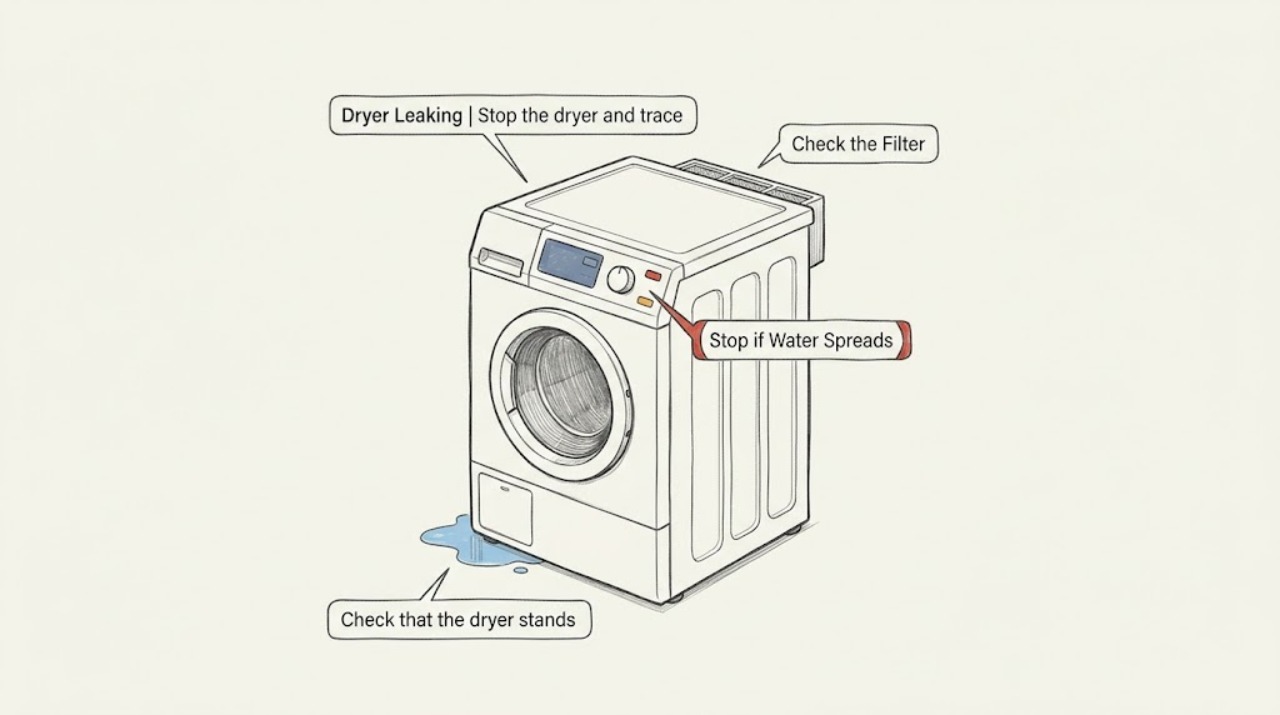
Work through in order
Diagnostic checks
Use only checks that match the exact appliance or system and its official guide.
-
Check 1
Stop the dryer and trace the first visible water point without moving the appliance or removing its panels.
Expected result: Water is pooled at the front or under the container, appears at the rear near a hose, or is spread from underneath with no clear external source.
Next step: If water is near the power connection, stop and unplug only when safe. Otherwise dry the surrounding floor, note the location, and continue only with the external check that matches it. If the source cannot be identified without opening the cabinet, arrange service.
Why this matters
Why: The location separates a container or filter overflow from a drain-hose problem; water appearing underneath with no accessible source may indicate an internal leak or an appliance that is not level.
-
Check 2
Check that the dryer stands level on a stable, hard surface.
Expected result: The appliance rocks, visibly leans, or a spirit level shows it is not level, or it is firm and level.
Next step: If it is not level, follow the model's installation instructions to adjust the feet and confirm the appliance is stable before operating. If it is already level, continue to the filter check. Do not place blocks under the dryer or reach underneath while it is connected.
Why this matters
Why: Bosch identifies an inclined installation as a possible cause of water escaping; a firm, level installation makes placement-related leakage less likely.
-
Check 3
With the dryer stopped and cool, remove and clean the user-accessible fluff filter, then refit it fully.
Expected result: The filter is covered with lint or damp debris, the filter frame is dirty, or the filter is clean and correctly seated.
Next step: Clean the filter using the method specified in the model manual, let it dry if it was washed, and reinstall it before any test. If the filter is damaged or will not seat, stop using the dryer and obtain model-specific service or parts guidance rather than running without it.
Why this matters
Why: Bosch warns that a blocked fluff filter can restrict the moisture path and contribute to overflow or leakage; a clean, seated filter makes that cause less likely.
-
Check 4
If the dryer is connected to an external condensation drain, inspect the visible drain hose and its connection.
Expected result: The hose is kinked, crushed, loose, visibly damaged, or clear, secure, and routed without a bend that blocks flow.
Next step: If the problem is visible, switch the dryer off, restore a free route and secure the hose as described by the manual. Do not cut, splice, or dismantle the drain system. If the hose is damaged or the leak returns, stop and arrange model-specific service or a confirmed replacement.
Why this matters
Why: A kink, damaged hose, or slipped connection can stop condensation from draining and send water back into or out of the appliance; a sound, correctly routed hose makes that explanation less likely.
-
Check 5
If the model collects condensation in a removable container, empty it carefully and push it back into its housing until fully seated.
Expected result: The container is full, not fully inserted, or contains only a small amount of residual water after the dryer is connected to a drain hose.
Next step: Pull the container out slowly while keeping it upright, empty it into a sink, and refit it exactly as the manual shows. If water continues to escape after the container is correctly seated, do not keep repeating cycles; move to the service boundary.
Why this matters
Why: A full or poorly seated container can stop normal water handling. Bosch also notes that some residual water can remain in a condensation container as part of normal self-cleaning, so residual water alone does not prove an active leak.
-
Check 6
After the visible cause has been corrected and the floor is dry, supervise one short test cycle from outside the appliance.
Expected result: No new water appears, the same location becomes wet again, or the dryer shows an error, unusual noise, or electrical symptom.
Next step: If it stays dry, resume normal use while following the model's cleaning and drainage instructions. If it leaks again or shows an abnormal symptom, stop using it, disconnect power when safe, and contact Bosch or an authorized servicer.
Why this matters
Why: A dry test supports a placement, filter, hose, or container correction. A returning leak or new abnormal symptom means the external checks did not resolve the underlying fault.
Use your observations
Decision map
Find the observation that best matches what you see, then follow the next safe action.
-
PATH 01Next step
What you see
Do this next
Empty and refit the container as the model manual shows, then dry the floor and supervise a short test. If water returns with a correctly seated empty container, arrange service.
-
PATH 02Next step
What you see
Do this next
Turn the dryer off, restore the visible hose route without kinks, and secure the connection according to the manual. Do not splice or open the appliance; replace or service the hose only after model-specific confirmation.
-
PATH 03Next step
What you see
Do this next
Clean and refit the filter, correct the level using the installation instructions, and perform one supervised test only after the floor is dry. If the leak persists, stop and call service.
-
PATH 04Next step
What you see
Do this next
Stop using the dryer, disconnect power when safe, and arrange Bosch or authorized service. Do not remove panels, bypass safety devices, or operate the dryer to watch an internal leak.
Helpful context
Understand the symptom
Why a Bosch dryer may leak
Bosch dryers do not all manage moisture in the same way. Condenser and heat-pump models collect water in a container or send it through a drain hose; other models use a different exhaust arrangement. Bosch's leak guidance starts with placement, the fluff filter, the drain hose, and the condensation container. The exact container, hose routing, and cleaning access depend on the model, so confirm the procedure in the manual for the full model number.
Safety before checking
Stop the program if water is actively running, pooling near the power connection, or reaching other electrical equipment. Keep hands out of the drum while it moves. Once the appliance is stopped and safe to approach, use only external, user-accessible checks; do not remove the cabinet or open sealed components.
Only after diagnosis
Potential parts
- model-specific condensation drain hose
Only consider this part when the visible external hose is damaged or cannot be routed without kinks and Bosch's model documentation confirms that hose arrangement.
Use the full model number and Bosch's parts documentation to confirm fit before ordering; do not substitute a hose by appearance alone.
When checks do not resolve it
Need a professional?
Stop using the dryer and arrange service for an active or returning leak, water near the power connection, a damaged hose that cannot be safely restored, an internal source, an error, unusual noise, smoke, burning odor, or any electrical tingling. Disconnect power only when it is safe to do so, and do not resume operation until the cause is resolved.
Common questions
FAQ
Is a small amount of water in a Bosch dryer's condensation container always a fault?
No. Bosch notes that some residual water can remain in the condensation container even when an external drain is connected because of the appliance's self-cleaning function. A pool of water on the floor or water that keeps escaping is different and needs the level, filter, hose, and container checks.
Can a dirty lint filter make a Bosch dryer leak?
It can contribute to overflow or leakage on models covered by Bosch's leak guidance. Clean the user-accessible filter using the exact model manual and refit it before operating; never run the dryer without a required filter.
What should I do if the leak is at the back of my Bosch dryer?
If your model uses an external condensation drain, inspect the visible hose for a kink, crush, damage, or a loose connection. Restore only the routing and seating described by the manual. If the hose is damaged or the leak returns, stop and request model-specific service or parts guidance.
Should I replace the pump or seal because my Bosch dryer is leaking?
Not from the symptom alone. Several external conditions can look similar, and the model determines the water path. Keep parts conditional and have Bosch or an authorized servicer identify the fault before any internal repair.
Read the exact guide
Official sources
- Tumble dryer leaking waterBosch Home Appliances / BSH Home Appliances Ltd · Manufacturer troubleshooting guidance for Bosch tumble dryers leaking water; the condensation-container section is explicitly limited to condenser and heat-pump dryers.
- User manual and installation instructions WQG233D0ESBSH Hausgeräte GmbH / Bosch Home Appliances · Model-specific manual evidence; use the full model number to determine whether its drain, container, filter, and installation details apply.
- Condensation in the tumble dryerBosch Home Appliances / BSH Home Appliances Ltd · Manufacturer guidance on normal residual condensation, placement, ventilation, and model-specific manuals.
Community feedback
Share a repair observation
Share a plain-text repair observation. Accepted observations are published automatically; this page may take a moment to update.