
On this page
Start here
Quick answer
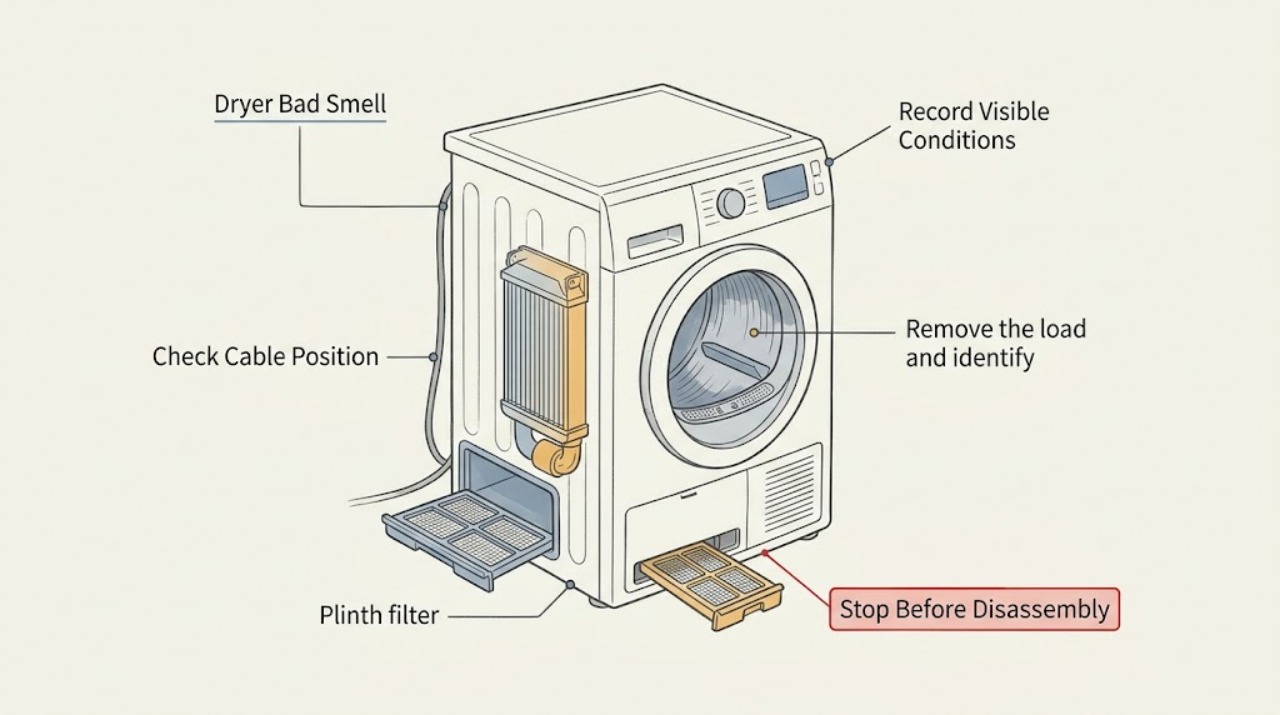
First separate a normal new-appliance rubber odor or a smell coming from the laundry from a burning, electrical, gas, or overheated-appliance odor. Stop immediately for smoke, flame, sparks, melting, a strong burning or electrical smell, unusual heat, a damaged cord, or a dryer that will not shut off. For a non-hazardous odor, remove the load and check whether wet fabrics were left inside, whether detergent was insufficient during washing, and whether the load contains feathers, oils, rubber, foam, solvents, or other materials not approved for heated drying. With the dryer off and cool, clean the lint filters and, on condenser or heat-pump models, the plinth filter, airways, and heat exchanger exactly as the Miele manual directs. Miele says a rubber odor on a new dryer may fade after several cycles; a persistent or safety-related odor needs qualified service.
Work through in order
Diagnostic checks
Use only checks that match the exact appliance or system and its official guide.
-
Check 1
Stop the dryer and check from a safe position for smoke, flame, sparks, melting, a sharp burning or electrical smell, unusual cabinet or outlet heat, a damaged cord, or a control that will not stop the appliance. Do not open the door if the drum or load is visibly burning, and do not touch a hot plug or cable.
Expected result: A fire, electrical, overheating, or loss-of-control warning is present, or the odor is mild and no hazard is visible.
Next step: Keep the dryer off. If safe, isolate power without touching wet or damaged equipment; for fire or smoke, leave and contact emergency help. Arrange qualified appliance or electrical service and do not restart to confirm the smell.
Why this matters
Why: A hazard is not a cleaning problem. Continuing to energize the dryer can increase fire or shock risk, while a mild laundry odor can be investigated after the appliance cools.
-
Check 2
Ask whether the dryer is new or has only a few cycles, and whether the smell is a mild rubber or manufacturing odor that is not accompanied by heat damage, smoke, or melting. Record the model and the number of cycles since installation.
Expected result: The appliance is new and the odor is mild rubber, or the odor is strong, persists beyond the early cycles, or is not rubber-like.
Next step: If the odor is mild and the appliance has no hazard sign, follow the model's normal use instructions and monitor without adding fragrance or unsuitable materials. If it persists or changes, stop use and arrange service.
Why this matters
Why: Miele says a rubber odor can be normal on a new tumble dryer and may subside after several drying cycles. Persistence, escalation, or a different smell needs more than a break-in explanation.
-
Check 3
Remove the load and identify whether the smell is in the fabrics rather than the dryer. Consider wet laundry left in the drum, insufficient detergent during washing, feathers or down warmed by drying, and residue from oils, cosmetics, solvents, or cleaning products. Check care labels and the model manual before drying the item again.
Expected result: The odor follows the laundry, is strongest from feathers or damp fabric, or remains in the empty drum and air path.
Next step: Air the affected laundry and correct the wash or fabric-care cause. Do not heat items contaminated with oil, flammable products, rubber, or foam. If the empty appliance still smells, continue with the cool filter and airflow inspection.
Why this matters
Why: Miele connects damp fabric, insufficient wash detergent, and warmed feathers with unpleasant laundry odors. A smell that remains with an empty drum keeps the dryer, filter system, and airflow in scope.
-
Check 4
With the dryer switched off, unplugged when the manual permits and the area is dry, remove visible lint from the door lint filters. Check the plinth filter or lower filter only if the model has one, and clean it as directed. Never operate the dryer without the complete filter system or with a filter that is damaged, misshapen, or still dripping wet.
Expected result: The filters contain lint, hair, detergent residue, or damage; the filters are clean and intact; or the filter area is hot, wet, or unsafe to access.
Next step: Clean and completely dry reusable filters exactly as the model instructions describe. If a filter is damaged, the area is unsafe, or the odor is burning or electrical, leave the dryer off and arrange service.
Why this matters
Why: Miele states that lint and residue can restrict airflow and heat exchange, while a damaged or wet filter can cause operational faults and require service. Filter condition can explain stale or overheated airflow but does not prove a part failure.
-
Check 5
For a condenser or heat-pump model, inspect the displayed cleaning prompt and the model manual for the plinth filter, filter insert, airways, and heat exchanger. Clean only the user-accessible areas and only by the specified method; do not use a water jet, open sealed panels, or scrape fins. For a vented model, check the visible air intake and exhaust path without dismantling ductwork.
Expected result: The heat exchanger or visible airway is linty or blocked, a cleaning prompt returns, the path is clear, or cleaning cannot be completed safely.
Next step: Complete the documented cleaning and let wet filters dry fully before reinstalling. If the prompt returns, the airflow remains restricted, or the odor returns, stop using the dryer and arrange Miele service.
Why this matters
Why: Miele links clogged filters and heat-exchanger airflow with insufficient heat flow, appliance faults, and a service requirement. A clear external path with persistent odor moves the problem toward internal heating, motor, wiring, or contamination diagnosis.
-
Check 6
Review the last load and drying program for an overloaded drum, oily or greasy textiles, rubber or foam items, flammable-product residue, fabric-softener sheet use on a model that forbids it, or a load that was removed before its cooling phase. After all safe causes are corrected, perform at most one short, supervised model-supported cycle only if there was no safety odor or damage.
Expected result: The smell is tied to a prohibited material or overloaded load, disappears after a correct cool-down and cleaning, or returns from an ordinary load.
Next step: Remove unsuitable items from future loads and follow the model's care-label and cooling instructions. If the odor returns, stop use and provide the model, load, program, odor description, and cleaning history to qualified service.
Why this matters
Why: Unsuitable residues and poor airflow can transfer odor or create a heat hazard. A returning odor from a normal load after filters and airways are clean is evidence for professional diagnosis, not more test cycles.
Use your observations
Decision map
Find the observation that best matches what you see, then follow the next safe action.
-
PATH 01Next step
What you see
The Miele dryer is new and has a mild rubber odor with no smoke, melting, unusual heat, or electrical signs.
Do this next
Use the dryer only as directed and monitor it. Stop if the odor persists, becomes sharp, or is accompanied by heat damage or smoke.
Why this path and its safety boundary
Why it matters: This can be a normal new-appliance odor that fades after several cycles.
-
PATH 02Next step
What you see
The smell follows wet laundry that sat inside, insufficiently washed fabric, or warm feathers or down.
Do this next
Air the laundry, correct the wash detergent or fabric-care issue, and avoid heating items that the care label or manual excludes. Arrange service if the empty dryer also smells.
Why this path and its safety boundary
Why it matters: The source is more likely the load than an appliance fault.
-
PATH 03Next step
What you see
Lint, hair, detergent residue, a damaged filter, or a recurring clean-airways prompt is present.
Do this next
Clean and dry the filters, plinth filter, airways, and heat exchanger only as the model instructions allow. Use service if the prompt or odor returns.
Why this path and its safety boundary
Why it matters: Restricted airflow or heat exchange may be contributing to the odor and overheating risk.
-
PATH 04Next step
What you see
The load contained oil, grease, solvents, flammable residue, rubber, foam, or another material not approved for heated drying.
Do this next
Keep the item out of the dryer and follow the care label and Miele safety instructions. Do not run another load to burn the odor away; use service if the drum or air path remains contaminated.
Why this path and its safety boundary
Why it matters: The material may be producing the odor or creating a fire risk.
-
PATH 05Next step
What you see
The odor is burning, electrical, melting-plastic, or associated with unusual heat, smoke, sparks, or a control that will not shut off.
Do this next
Leave the dryer off, isolate power only when safe, do not touch damaged equipment, and arrange qualified appliance or electrical service. Do not restart it.
Why this path and its safety boundary
Why it matters: This is an immediate stop condition.
-
PATH 06Next step
What you see
A non-hazardous odor returns from an ordinary load after correct filter, airflow, and heat-exchanger care.
Do this next
Stop further testing and provide the model, program, load, odor type, display messages, and cleaning history to qualified Miele service.
Why this path and its safety boundary
Why it matters: An internal contamination, heater, motor, airflow, or electrical fault remains possible.
Helpful context
Understand the symptom
Classify the smell before cleaning
A musty smell from laundry that sat wet, a warm feather or pillow odor, and a short-lived rubber smell on a new appliance have different next steps from a sharp burning, electrical, or melting-plastic odor. Smell alone cannot identify a failed component, so do not keep running the dryer to compare odors. Remove the load, let the appliance cool, and note whether the smell is strongest in the drum, at the lint-filter area, near the air outlet, or around the plug.
Keep lint and unsuitable materials out of the heat path
Miele manuals warn that lint accumulation and damaged filters can restrict airflow and create a fire risk. Do not use the dryer without its filter system. Do not dry items contaminated with oil, flammable products, or unsuitable rubber and foam materials, and do not use the dryer if the controls, cable insulation, or enclosure are damaged.
Safety boundary
Stop conditions
- Stop immediately for smoke, flame, sparks, melting, a sharp burning or electrical smell, severe heat, a damaged cord or control, or a dryer that will not shut off.
- Do not run another load to burn away an odor, repeatedly reset a protective device, or operate the dryer without its complete filter system.
- Do not dry oil-contaminated, solvent-contaminated, flammable, rubber, foam, or otherwise unsuitable items; follow the care label and Miele manual.
- Do not open sealed panels, probe live wiring, use a water jet, or dismantle the heater, motor, heat exchanger, gas path if fitted, or exhaust system as a household odor remedy.
Only after diagnosis
Potential parts
- lint or plinth filter
Only consider this after inspection shows a filter is damaged, misshapen, or cannot be restored to a clean functional condition.
Confirm the complete Miele model identifier and manufacturer fit information before ordering; odor alone does not identify a filter. - heat exchanger or airflow component
Only consider this after qualified service confirms restricted or damaged heat-exchange hardware after correct filter and airway care.
Heat-pump and condenser layouts vary by model; do not open sealed areas or infer compatibility from a cleaning prompt. - heater or thermal protection component
Only consider this after a qualified diagnosis confirms a heater or thermal fault and rules out lint, airflow, load, and control causes.
Use the exact model and a confirmed cause; never bypass thermal protection or replace it to conceal overheating. - motor, wiring, or control assembly
Only consider this when qualified service confirms an internal electrical or drive fault associated with the odor.
Confirm the exact model and professional diagnosis before ordering any assembly; do not infer fit from smell type.
When checks do not resolve it
Need a professional?
Arrange qualified Miele service when a burning, electrical, melting, or gas-related odor occurs; smoke, sparks, overheating, or a non-stopping control is present; the odor persists beyond the normal new-dryer period; a clean-airways prompt returns; filters or the heat exchanger are damaged or inaccessible; or a clean, ordinary load still makes the empty dryer smell. An electrician should assess a damaged cord, outlet, or household circuit, and qualified gas service should assess a gas odor on any applicable gas model.
Have this ready
- The complete Miele model identifier and whether the dryer is vented, condenser, heat-pump, or gas if applicable
- The exact odor description, when it begins, where it is strongest, and whether it remains with an empty drum
- Whether the appliance is new, whether wet laundry was left inside, and whether the load contained feathers, oil, rubber, foam, or chemical residue
- Filter, plinth-filter, airway, heat-exchanger, and exhaust-care steps already completed
- Any display prompt, smoke, spark, unusual heat, damaged cord, repeated protective-device trip, or failure to shut off
Common questions
FAQ
Why does my Miele dryer smell bad after drying?
The smell may come from damp laundry left inside, insufficient detergent, feathers warmed during drying, a dirty filter or heat exchanger, or a new-appliance rubber odor. Remove the load, let the dryer cool, and classify the smell before cleaning; burning or electrical odors require immediate service.
Is a rubber smell from a new Miele dryer normal?
Miele says a rubber odor can be normal on a new tumble dryer and may fade after several drying cycles. Stop if the odor is sharp, persists, or comes with smoke, melting, unusual heat, or electrical signs.
Can a dirty Miele dryer filter cause an odor?
Yes. Lint, hair, detergent residue, and a clogged or damaged filter can restrict airflow and heat exchange. Clean and fully dry the filters and any model-specific plinth filter as directed, and never operate without the complete filter system.
What loads should not go in a Miele dryer?
Do not heat items contaminated with oil, grease, flammable products, solvents, or unsuitable rubber or foam materials. Follow the care label and Miele manual; do not run another load to burn away a smell.
When should I stop using a Miele dryer because of smell?
Stop for smoke, flame, sparks, melting, a burning or electrical smell, severe heat, a damaged cord or control, a gas odor if applicable, or a dryer that will not shut off. Isolate power only when safe and arrange qualified appliance, electrical, or gas service.
Read the exact guide
Official sources
- Cleaning and careMiele · Miele dryer lint-filter, airflow, heater, interior cleaning, and professional-maintenance guidance
- IMPORTANT SAFETY INSTRUCTIONSMiele · Miele dryer fire, electrical, flammable-material, lint, unsuitable-load, and qualified-service safety boundaries
- Miele Tumble Dryer Operating Instructions 12125280-01Miele · Miele tumble-dryer filter, plinth filter, heat exchanger, airflow, lint, and cleaning instructions for the documented model family
- Laundry or pillows smell unpleasantMiele USA · Miele laundry and feather-filled pillow odor after drying
- Laundry/tumble dryer smells unpleasantMiele USA · Miele tumble-dryer unpleasant odors from wet fabric, insufficient detergent, filters, and heat exchanger
- Tumble dryer smells of rubberMiele USA · Miele new-tumble-dryer rubber odor behavior
Community feedback
Share a repair observation
Share a plain-text repair observation. Accepted observations are published automatically; this page may take a moment to update.