
On this page
Start here
Quick answer
First decide whether the Miele dryer is showing a normal time estimate or has actually stopped. Miele says a time display can pause at 10 minutes while drying continues, while an empty or nearly empty load can interrupt a sensor program. For a real interruption, record the exact model, program, display message and stage, then check the load and washer spin, lint and plinth filters, heat exchanger, ventilation, condensate container and drain hose, and the door. Clean only as the exact manual allows, dry filters fully, and use a time-controlled program only when the manual supports it for a small or already-dry load. One documented restart is reasonable; a recurring fault, persistent code, water problem, or a dryer that will not stop needs Miele service. Burning odor, smoke, sparks, abnormal heat, a damaged cord, or a tripped breaker is an immediate stop condition.
Before you begin
Safety first
- Only ordinary-access, dry, cool checks and manual-documented settings are described. Do not test live circuits, bypass the door, open panels, touch sharp fins, handle sealed-system parts, or repeatedly reset a hazardous appliance.
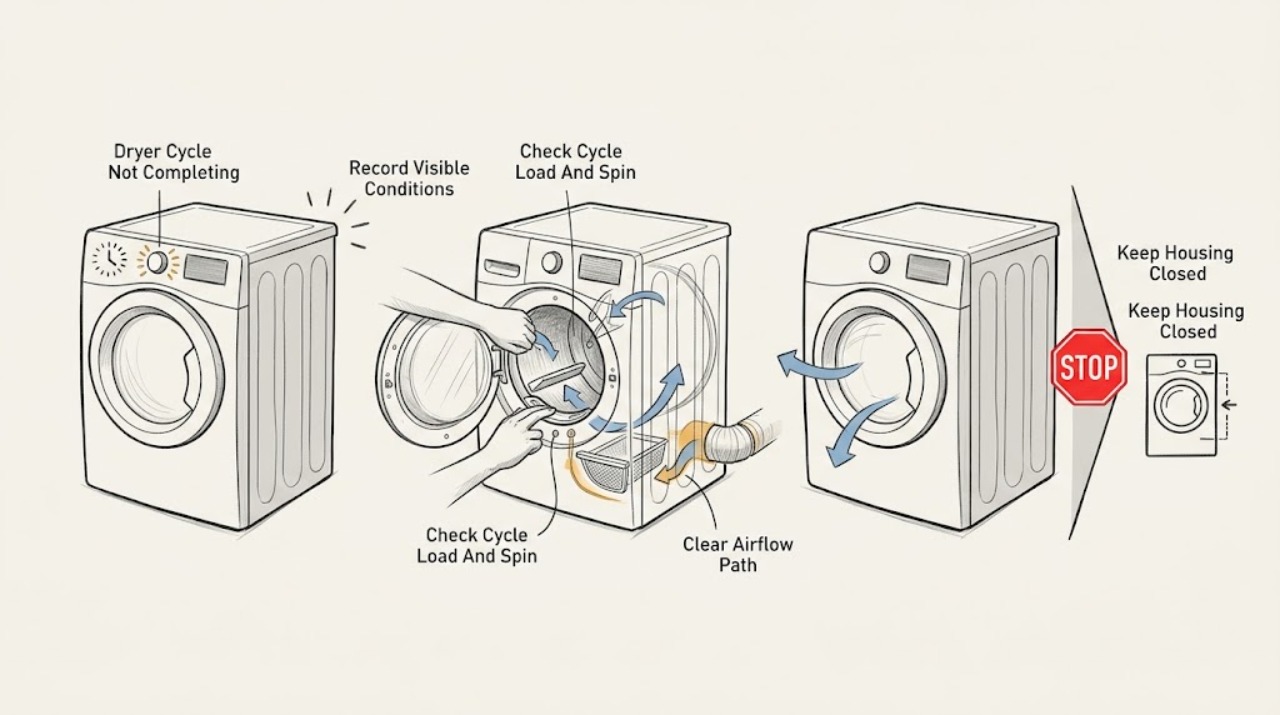
Work through in order
Diagnostic checks
Use only checks that match the exact appliance or system and its official guide.
-
Check 1
Record the exact Miele model, selected program, load type and size, displayed message or code, and the point at which the cycle stops. From a dry, safe position, note whether the drum turns, air moves, the load is warm or damp, and whether the display is counting down or showing a fault.
Expected result: The display may show a normal remaining-time estimate, a message about adjusting the load, a full-container or clean-filter prompt, dashes, three flashing indicators, or an F-code. The drum may continue turning, pause, or stop completely.
Next step: If there is no hazard, continue to the load and program check. If the dryer is smoking, sparking, unusually hot, or will not stop, stop using it and arrange urgent service.
Stop if: Stop immediately for burning odor, smoke, sparks, abnormal heat, a damaged cord or outlet, water near electrical parts, or a breaker that trips again.
Why this matters
Why: This separates a normal estimate behavior from an interrupted cycle and preserves the exact evidence needed for a model-specific diagnosis. A recurring F-code or a stopped drum with a safety symptom is not a cleaning-only issue.
-
Check 2
Identify whether the program is sensor-based or time-controlled. If the drum is empty, nearly empty, or contains one already-dry item, follow the manual's instruction for adjusting the load or use a documented time-controlled program for that item. Untangle rolled laundry, avoid overloading, and check that the washer used a suitable higher spin speed when the load is unusually wet.
Expected result: The load may be too small or dry for reliable residual-moisture sensing, tightly rolled or uneven, overloaded, or much wetter than usual. It may instead be a normal load with a stable failure at the same stage.
Next step: Redistribute or adjust the load once and run the appropriate model-documented program. If a single item remains damp, use a supported time-controlled option; if a normal load still stops, continue with filters and condensate checks.
Stop if: Do not continue if the drum makes violent impacts, there is metal scraping, a burning smell, smoke, sparks, or abnormal heat.
Why this matters
Why: Miele identifies empty or nearly empty loads as a reason for an adjust-load interruption and says uneven, rolled, overloaded or very wet laundry can extend drying. A normal, well-distributed load that repeatedly stops points to the air, water, door, sensor or control path.
-
Check 3
Switch the dryer off and let hot surfaces cool. Following the exact manual, clean the lint filters and plinth filter, inspect the visible air intake and lower grille, and clean the heat exchanger only by the permitted method. Refit filters completely and dry them fully; keep fingers and tools away from sharp cooling fins.
Expected result: Lint may be packed into the filters or plinth area, the lower grille or room air path may be obstructed, or the filters may be clean and dry with no visible airflow restriction. A damp filter or a dense blockage is a meaningful finding.
Next step: Clear only accessible lint and objects, restore ventilation, refit the filters, and run one suitable test cycle. If the prompt returns, airflow remains weak, or the heat exchanger needs disassembly, arrange Miele service.
Stop if: Stop if water reaches electrical parts, fins are damaged or inaccessible, the cabinet is hot, or cleaning reveals burning, smoke, sparks or a damaged wire. Never use high heat or sharp tools to remove buildup.
Why this matters
Why: Miele links blocked filters, plinth filter, heat exchanger, cool-air intake and poor ventilation with long drying or an interrupted program. Clean, dry filters with a clear air path make a moisture sensor, condensate, door, drive or control issue more likely.
-
Check 4
Check the condensate-container message, remove and empty the container if the manual permits, and inspect the accessible drain hose for a kink or crushed section. Close the door normally and check the visible seal and latch area for laundry or debris; do not force a locked door or open panels.
Expected result: The container may be full, the drain hose may be kinked, the door may not latch because of an obstruction, or none of these conditions may be visible. Water may remain in the drum or on the floor.
Next step: Correct only an accessible container or hose condition described by the manual, close the door without force, and clear the message using the documented method. If the message returns, water remains, or the door will not latch, stop and arrange service.
Stop if: Stop for a leak, standing water near electrical parts, a damaged seal or latch, a door that must be forced, or any burning odor, smoke, sparks or breaker trip.
Why this matters
Why: Miele says an empty-container message can mean a full condensate container or kinked drain hose, while a door or drainage condition can prevent a program from proceeding. Visible water near electrics or a recurring message requires service rather than repeated restarts.
-
Check 5
After the external checks are complete and no hazard is present, follow the exact model manual for one normal off/on reset and restart. Record whether the same stage, prompt or F-code returns; do not bypass a door switch, test live wiring, remove panels, or repeatedly cycle a failed appliance.
Expected result: The cycle may complete after a documented correction, stop again at the same point, show a service fault such as F XXX, or leave the drum and controls unresponsive.
Next step: Give Miele service the model, program, load, exact display, stage, filter and condensate findings, drum behavior and reset result. Keep the dryer out of service when the fault or a safety symptom recurs.
Stop if: Do not restore power after smoke, sparks, abnormal heat, water near electrics, a damaged cord, inability to stop, or repeated breaker operation.
Why this matters
Why: A one-time reset can clear a transient power interruption, but a recurring fault indicates an unresolved sensor, motor, pump, control, airflow or condensate condition. Miele's manual directs owners to technical service when a service fault returns after a restart.
Use your observations
Decision map
Find the observation that best matches what you see, then follow the next safe action.
-
PATH 01Safety boundary
What you see
The display stays at 10 minutes with bars flashing, while the drum and drying process continue and there is no safety symptom.
Do this next
Leave the program alone if it is operating safely; reduce future load size or improve spin and airflow according to the model manual. Arrange service if the drum stops, the prompt changes to a fault, or drying never completes.
Why this path and its safety boundary
Why it matters: Miele documents this as an electronic time estimate being exceeded by the load, not necessarily a stopped cycle.
Safety stop: Stop for burning odor, smoke, sparks, abnormal heat, water near electrical parts, or a breaker trip.
-
PATH 02Safety boundary
What you see
The dryer reports that the load should be adjusted, or a sensor program contains almost no laundry or an already-dry item.
Do this next
Open and close the door as the support instruction states, adjust the load, or use a documented time-controlled program for an individual item. If the message persists with a normal load, service may be needed for sensing.
Why this path and its safety boundary
Why it matters: Residual-moisture sensing may not have enough changing moisture to control that program.
Safety stop: Do not keep restarting if the message is accompanied by smoke, odor, sparks, abnormal heat or a damaged cord.
-
PATH 03Safety boundary
What you see
Lint or plinth filters are blocked, damp, incorrectly seated, or the lower grille, heat exchanger or room ventilation is obstructed.
Do this next
Clean and dry the accessible filters exactly as the model manual directs, clear only visible obstructions, and retest once. Recurrent restriction or a need to dismantle the heat exchanger belongs to Miele service.
Why this path and its safety boundary
Why it matters: Restricted air movement can lengthen drying and cause the program to interrupt.
Safety stop: Do not touch sharp fins, use high heat, insert tools into the air path, or continue when wiring, smoke, sparks or abnormal heat is visible.
-
PATH 04Safety boundary
What you see
An empty-container prompt appears, the container is full, the drain hose is kinked, or water remains after a cycle.
Do this next
Empty the container and correct an accessible hose kink only as described by the manual. If the prompt returns, water leaks, or the path is not externally clear, stop and arrange service.
Why this path and its safety boundary
Why it matters: Condensate cannot be stored or discharged normally, so the dryer may stop before completing.
Safety stop: Stop when water is near electrics, the floor is wet, or the container, hose or connection is damaged.
-
PATH 05Safety boundary
What you see
The door will not latch, controls are unresponsive, a power-interruption indication returns, an F-code recurs, or a normal load stops at the same stage after safe external checks.
Do this next
Record the exact code and model and arrange Miele technical service. Do not bypass interlocks or open electrical and sealed-system areas.
Why this path and its safety boundary
Why it matters: A door switch, control, motor, pump, sensor or other internal fault remains possible; the displayed code must be interpreted for the exact model.
Safety stop: Keep the dryer disconnected when safe to do so if it will not stop, overheats, smokes, sparks, leaks near electrics or trips protection.
-
PATH 06Safety boundary
What you see
There is a burning smell, smoke, sparking, an abnormally hot cabinet or outlet, a damaged cord, a suspected fire, a serious water leak, or repeated breaker operation.
Do this next
Stop using the dryer. Disconnect power only if it can be done without touching wet or damaged parts; leave the area and seek emergency help from a safe location for fire or electrical danger. Arrange qualified appliance service after the area is safe.
Why this path and its safety boundary
Why it matters: This is a fire, electrical or water-safety event, not a normal cycle-completion symptom.
Safety stop: Do not re-energize, keep testing, bypass a safety device or open panels.
Helpful context
Understand the symptom
Separate a display estimate from a stopped program
A heat-pump dryer calculates remaining time from moisture and load conditions, so a countdown is not always a direct clock. Miele describes a 10-minute display with flashing bars as a situation in which drying may continue while the estimate catches up. Note whether the drum is turning, air is moving, and heat is present before treating the display as a failure.
Small loads can confuse moisture sensing
A sensor program can end or interrupt when a single item is already dry or the drum is nearly empty. Balance the load according to the model manual, untangle rolled items, and use a documented time-controlled option for an individual item when appropriate. Do not repeatedly restart a program that is reporting a fault.
Air and condensate paths are part of the same diagnosis
Miele's guidance links interrupted programs and long drying to blocked lint or plinth filters, a blocked heat exchanger or air intake, poor room ventilation, a full condensate container, or a kinked drain hose. The filters must be fully dry before refitting, and heat-exchanger fins can be sharp; keep internal electrical and sealed-system work for service.
Safety boundary
Stop conditions
- Burning odor, smoke, sparks, abnormal heat, a damaged cord or outlet, inability to stop, or a breaker that trips again.
- Water or condensate near electrical parts, standing water, a damaged container or hose, or a leaking cabinet.
- A door or latch that will not close normally, a damaged seal, or any need to bypass an interlock.
- Sharp heat-exchanger fins, bonded debris, exposed wiring, or any need to use high heat, sharp tools or a panel removal.
- A recurring F-code, persistent clean-filter or container message, or a normal load that stops at the same stage after safe external checks.
Only after diagnosis
Potential parts
- lint or plinth filter
Consider only when the exact model's filter is damaged, missing, permanently deformed or unable to seal after cleaning.
Confirm the complete Miele model and manufacturer fit information before ordering. - condensate drain hose or pump
Consider only when service confirms a failed pump or damaged hose after the container is empty and the accessible drain route is clear.
Drain components vary by model and installation; verify model-specific fit and installation requirements. - moisture sensor
Consider only when qualified diagnosis links a recurring adjust-load or premature-stop symptom to the sensor or its wiring rather than load, airflow or condensate conditions.
Sensor design and fit vary by model; do not infer a replacement from the display message alone. - dryer door switch or control module
Consider only after service confirms a door-interlock or control fault and rules out an obstruction, power event, load issue and condensate or airflow restriction.
Electrical parts require exact model matching and qualified installation.
When checks do not resolve it
Need a professional?
Arrange Miele technical service when a normal load repeatedly fails to complete after the model-specific load, filter, airflow, condensate and door checks; when an F-code or other service fault returns; when residual-moisture sensing, a motor, pump, control, heater, fan or internal drain needs diagnosis; or when the dryer will not stop, overheats, leaks, smells of burning, smokes, sparks or trips protection. Give the technician the exact model, program, load, display, stage, filter and water-path observations and any reset result.
Safety scope: Only ordinary-access, dry, cool checks and manual-documented settings are described. Do not test live circuits, bypass the door, open panels, touch sharp fins, handle sealed-system parts, or repeatedly reset a hazardous appliance.
Common questions
FAQ
Why does my Miele dryer stay on 10 minutes?
Miele says the remaining-time display can stop at 10 minutes with bars flashing while drying continues. A larger or wetter load can exceed the electronic estimate. Treat it as normal only while the drum and drying process continue safely; a stopped drum, fault prompt or safety symptom needs further action.
Why does a Miele dryer stop with an adjust-load message?
The drum may be empty, nearly empty, or holding an item that is already dry, so residual-moisture sensing cannot control the selected program normally. Adjust the load or use a model-supported time-controlled option for an individual item. If it happens with a normal load, arrange service.
Can a full condensate container stop the cycle?
Yes. Miele identifies a full condensate container or a kinked drain hose as causes of an empty-container message. Empty the container and inspect only the accessible hose section as the exact manual directs. A returning prompt, leak or water near electrics requires service.
Which cleaning checks are safe before calling Miele?
With the dryer off and cool, follow the exact manual for lint and plinth-filter cleaning, clear visible air-intake obstructions, and clean the heat exchanger only by its permitted method. Refit filters fully and dry them; do not use high heat, sharp tools, panel removal or live electrical tests.
When should I stop using a Miele dryer immediately?
Stop for burning odor, smoke, sparks, abnormal heat, a damaged cord or outlet, a serious water leak, inability to stop, or repeated breaker operation. Disconnect power only if it is safe and dry to do so, keep people away from the hazard, and arrange qualified service.
Read the exact guide
Official sources
- Time left stops at 10 [symbol]Miele USA · Miele USA tumble dryer support; display behavior is model-dependent.
- TWI 180 WP-US-en Owner's ManualMiele USA · Opened Miele USA manual for TWI 180 WP; use the exact model manual for another dryer.
- Tumble dryer supportMiele USA · Miele USA support index for tumble dryers.
- Adjust the load and [symbol]Miele USA · Miele USA tumble dryer support; exact display symbols vary by model.
- 3 LEDs light up/flashMiele USA · Miele USA tumble dryer support; indicator combinations vary by model.
Community feedback
Share a repair observation
Share a plain-text repair observation. Accepted observations are published automatically; this page may take a moment to update.