
On this page
Start here
Quick answer
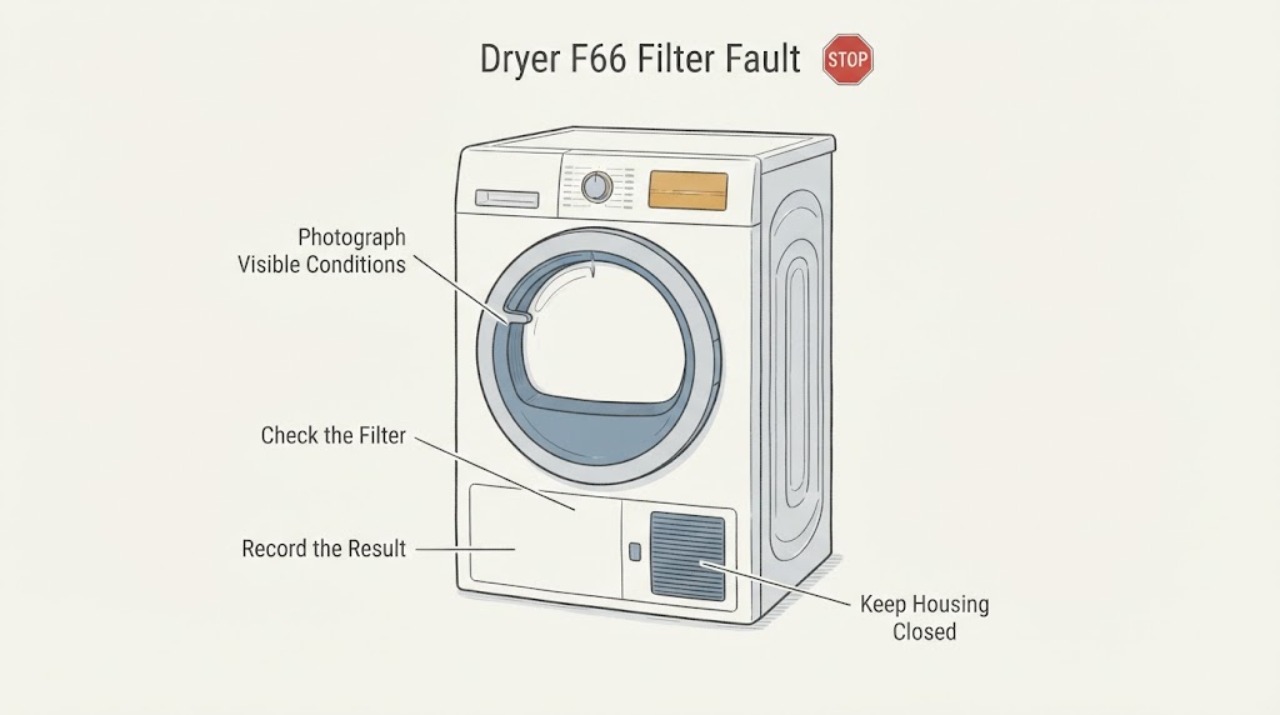
Do not choose a sensor from F66 alone. Miele USA's F66 guidance says the fault commonly appears when the lint filters or plinth filter are dirty or insufficiently cleaned, and it also directs you to check the air path, ventilation, load, filter condition, and heat exchanger. On a Miele T1, first photograph the exact display and the complete model number, then switch the dryer off and clean the model-specific door filters and plinth or toe-kick filter as described in the matching manual. Reinstall every filter fully and dry; a dripping-wet, deformed, or torn plinth filter can itself cause trouble and may need replacement. If F66 returns after that care, Miele's public guidance does not identify a replacement sensor: leave the dryer off and arrange service with the exact model, market, code, program, and cleaning results. Do not open the cabinet, bypass a filter or sensor, or repeatedly reset the dryer.
Work through in order
Diagnostic checks
Use only checks that match the exact appliance or system and its official guide.
-
Check 1
Stop the program and photograph or transcribe the display exactly, including F66 versus F 66 or another character sequence. Read the complete model and serial information from the rating plate, and record the market, selected program, load, and cycle stage. Do not clear the message before recording it.
Expected result: The display clearly repeats F66 on a Miele T1 dryer, the display is a different code or wording, or the appliance identity is only described as T1 with no complete model number.
Next step: If it is confirmed as F66, continue with the safe filter and airflow checks below while retaining the model photo. If the code or market is uncertain, locate the exact regional manual or give the complete identity to Miele Service before using a code-specific part list.
Stop if: Do not enter service diagnostics, remove panels, or repeatedly restart only to obtain a different code.
Why this matters
Why: Miele USA's F66 guidance applies to its tumble-dryer support path, while the USA T1 page shows that T1 contains multiple models. An incomplete model or different display cannot select a sensor or prove that another model's procedure fits.
-
Check 2
Switch the dryer off and let it cool. Remove and clean the upper and lower door lint filters and any visible lint at the documented air openings. If the matching manual permits washing the filters, rinse them as directed and let them dry completely before reinstalling them; do not run the dryer with wet filters.
Expected result: Lint, detergent residue, or a blocked air opening is present; the filters are clean and dry; or a filter cannot be removed or cleaned without force.
Next step: Reinstall the filters fully and continue to the plinth-filter check. If a filter is stuck, cracked, or cannot be cleaned safely, stop and request service rather than forcing it.
Stop if: Do not bypass, omit, or operate the dryer without its filters.
Why this matters
Why: Miele says insufficiently cleaned lint filters are a common reason for F66. A clean result makes an untreated surface blockage less likely but does not prove that a sensor, control, heater, or heat-pump assembly has failed.
-
Check 3
With the dryer off and cool, open the user-accessible heat-exchanger access panel only as the matching manual shows. Remove the plinth or toe-kick filter by its handle, wash it as documented, squeeze out the water, and allow it to dry. Check for detergent encrustation, tears, deformation, or a filter that no longer sits flush; inspect visible lint at the heat exchanger only with the light-vacuum method and do not touch the cooling fins.
Expected result: The plinth filter is dirty but intact, encrusted, dripping wet, torn or deformed, the heat exchanger has visible lint, or the access area cannot be serviced safely from the user side.
Next step: Clean and dry an intact filter and reinstall it in the correct orientation. Treat a damaged or deformed filter as a conditional filter replacement, not as evidence for a sensor. Arrange service if the heat exchanger is heavily blocked or the documented cleaning cannot be completed.
Stop if: Do not touch the cooling fins, bend them, probe behind the filter, remove panels, or install a dripping-wet or visibly damaged filter.
Why this matters
Why: Miele links F66 with plinth-filter and airway restriction. It says an encrusted filter can be washed, a deformed or damaged filter should be replaced, and a wet filter can cause a fault. Sharp heat-exchanger fins and forceful cleaning add injury or equipment-damage risk.
-
Check 4
Before one monitored test, confirm the user-accessible ventilation grille is not obstructed, the room has adequate ventilation, and the load is not excessive. Remove some laundry if overloaded. Keep the area around the outlet, cord, and controls dry and stop immediately for burning odor, smoke, sparks, abnormal heat, or a leak near electrical equipment.
Expected result: The grille or room ventilation was restricted, the drum was overloaded, the dryer shows no hazard and the filters are correctly fitted, or a hazard is present.
Next step: Correct only a plainly visible obstruction or load issue. If there is no hazard and all filters are clean, dry, intact, and correctly installed, run no more than one model-supported monitored program; stop if F66 returns.
Stop if: For smoke, sparking, burning smell, repeated breaker operation, overheating, water near electrical parts, or a damaged cord, disconnect power only if it is safe to do so and arrange qualified appliance or electrical service.
Why this matters
Why: Miele lists obstruction, insufficient ventilation, and overload as conditions that can contribute to F66. A hazard is a safety escalation, not a reason to run another cycle to identify a part.
-
Check 5
If F66 returns after the exact model's filters and air path have been cleaned, dry, intact, and correctly installed, stop trying to diagnose it by swapping sensors. Give Miele Service the model and serial information, market, exact display, program and stage, filter condition, heat-exchanger observation, load, and whether the message returned immediately or during drying.
Expected result: F66 clears after filter and airflow care, F66 returns on the monitored program, the filter is damaged, or another technical code appears.
Next step: Use the dryer only when the message has cleared and no hazard is present. For recurrence, a damaged filter, or another technical code, leave it off and request a model-matched diagnosis; ask the technician to identify the failed component and test result before authorizing a part.
Stop if: Do not open the cabinet, bypass a filter or sensor, probe live circuits, or repeatedly reset a recurring F66.
Why this matters
Why: A cleared message supports a maintenance or airflow contribution; recurrence after correct care leaves a technical fault possible but does not identify a specific temperature, moisture, airflow, or control sensor. Miele's public F66 guidance directs technical faults to service.
Use your observations
Decision map
Find the observation that best matches what you see, then follow the next safe action.
-
PATH 01Next step
What you see
The display is confirmed as F66, the complete appliance identity is available, and the door filters or air openings contain lint or residue.
Do this next
Clean and dry the door filters, then inspect the plinth or toe-kick filter before one monitored model-supported check.
Why this path and its safety boundary
Why it matters: This pattern matches Miele USA's documented common F66 pathway of insufficiently cleaned lint filtration and restricted airflow more closely than a sensor-parts conclusion.
-
PATH 02Next step
What you see
The plinth filter is encrusted, dripping wet, torn, deformed, or no longer sits flush, or lint is visible around the heat exchanger.
Do this next
Clean and fully dry an intact filter; replace only the correctly identified model-matched plinth filter when its condition requires it. Do not infer a sensor replacement from this branch.
Why this path and its safety boundary
Why it matters: A filter condition or airflow restriction remains a plausible direct contributor to F66. Miele specifically distinguishes cleaning an encrusted filter from replacing a damaged or deformed one.
-
PATH 03Next step
What you see
All user-accessible filters are clean, dry, intact, correctly seated, the grille and ventilation are unobstructed, and F66 returns during the next monitored program.
Do this next
Stop using the dryer and arrange Miele service with the complete model, code, timing, and cleaning record. Request a measured diagnosis before approving a sensor, control, heat-pump, or other component.
Why this path and its safety boundary
Why it matters: The obvious maintenance and airflow conditions have not resolved the fault. A recurring technical issue is more likely, but F66 still does not identify which sensor or control component has failed.
-
PATH 04Next step
What you see
The display is not actually F66, the full model is unavailable, or the dryer is from a market whose manual does not match the Miele USA T1 documentation.
Do this next
Keep the dryer off if the message is recurring, locate the exact regional manual, and provide the full model and display photo to Miele Service. Do not order a sensor from a generic F66 search.
Why this path and its safety boundary
Why it matters: The exact code interpretation and filter layout may differ; transferring another Miele series or market's code table could lead to an incompatible procedure or part.
Helpful context
Understand the symptom
T1 identifies a Miele compact heat-pump dryer family, not one complete appliance number. Miele USA lists multiple T1 models, including TXD160WP, TXI680WP, TXR860WP, and TWD 360 WP. Read the rating plate before using any manual or ordering any part; a part or procedure for one T1 model is not automatically correct for another.
For F66, the useful distinction is a filter or airflow restriction versus a recurring technical fault. Miele USA's F66 page specifically discusses the door lint filters, plinth filter, air openings, heat exchanger, ventilation, overload, and damaged or wet filter conditions. It does not tell the owner to identify or replace a sensor from F66, so the code is not a parts cross-reference.
This guidance is based on Miele USA material for US-market T1 compact heat-pump dryers. If the dryer was bought in another market, or the full model number and display format cannot be confirmed, use the matching regional manual and do not transfer an F66 meaning from another Miele product line.
Only after diagnosis
Potential parts
- plinth or toe-kick filter
Consider this only when the exact model's filter is torn, deformed, encrusted beyond the documented cleaning method, or no longer seals flush after cleaning and drying. Miele's F66 guidance does not support replacing it merely because F66 appeared.
T1 is a series with multiple models and markets. Confirm the complete model, rating-plate information, and manufacturer fit information before ordering; do not substitute a filter from another Miele dryer.
Common questions
FAQ
Does Miele T1 F66 mean I need a new sensor?
No. Miele USA's F66 guidance first points to lint filters, the plinth filter, airways, ventilation, load, and filter condition, and it does not identify a replacement sensor. If F66 recurs after correct cleaning and drying, service must test the model-specific system before naming a component.
Can I replace the Miele T1 filter when F66 appears?
Only conditionally. Clean and dry an intact filter as the exact manual describes. Replace a plinth or toe-kick filter only when it is damaged, deformed, torn, or no longer seats flush, and confirm the complete model before ordering.
What if F66 returns after I cleaned every filter?
Stop repeated resets and record the exact model, code, program, cycle stage, filter condition, ventilation, and timing of recurrence. Miele directs a technical fault to service; ask for a measured diagnosis rather than authorizing a guessed sensor or control part.
Read the exact guide
Official sources
- Compact Dryers | MieleMiele USA · Opened official US product-family page to establish that T1 is a series with multiple model identifiers and to constrain the article to US-market compact heat-pump dryers.
- Miele Tumble Dryer | Fault F66 appears on the tumble dryer display.Miele USA · Opened official US support page. It gives family-level F66 care guidance; the complete T1 model is still required for the exact filter layout and any model-specific service procedure.
Community feedback
Share a repair observation
Share a plain-text repair observation. Accepted observations are published automatically; this page may take a moment to update.