
On this page
Start here
Quick answer
The Miele WTF130 is a WT1 washer-dryer, not a standalone tumble dryer. A smooth spinning sound during a drying programme can be normal because Miele’s drying cycle uses thermospin. Grinding, scraping, banging, repeated impact, a burning smell, or severe movement is different: stop the programme, isolate power only when safe, and arrange Miele service. Check the load, drum and door seal for accessible foreign objects and note whether the noise is smooth spinning or mechanical grinding. Do not remove covers or test internal bearings, fan, belt or motor yourself.
Work through in order
Diagnostic checks
Use only checks that match the exact appliance or system and its official guide.
-
Check 1
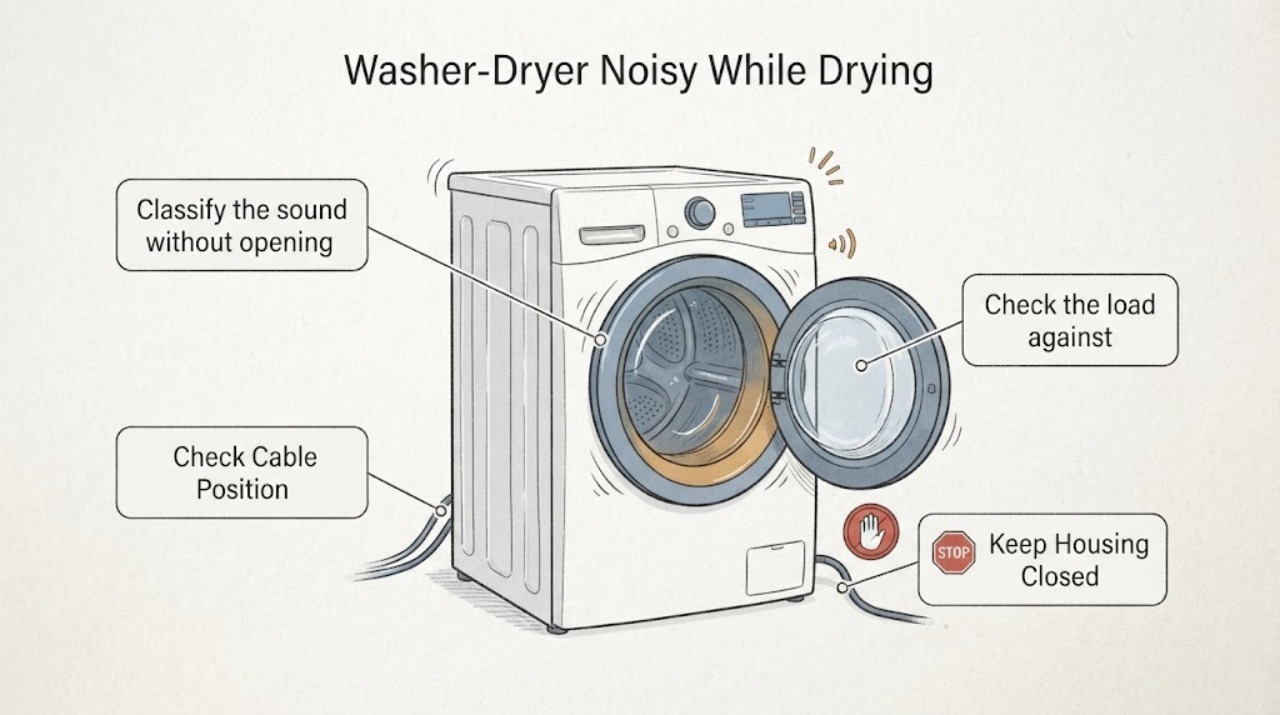
Classify the sound without opening the cabinet: listen for a smooth, even drum spin during the drying phase versus grinding, scraping, rattling, repeated impact, or a sudden harsh change.
Expected result: The sound is smooth and occurs only while the drying programme spins, or it is rough/metallic/impacting or continues with an abnormal pattern.
Next step: For smooth thermospin, continue with the external checks below or select Extra quiet where the programme offers it. For grinding, scraping or impact, stop the programme and arrange Miele service rather than repeating tests.
Why this matters
Why: Miele identifies spinning during drying as thermospin and not a fault; its support guidance treats grinding when the drum rotates as a technical fault.
-
Check 2
Stop the programme and allow the washer-dryer to cool. Check only the drum opening, laundry, door glass and door seal for coins, fasteners, bra wires, shoes, or another object that could be moving with the load.
Expected result: A loose object is visible and can be removed without tools, or nothing accessible is found.
Next step: Remove only an accessible object after the machine is stopped and safe; if the noise persists, the object is trapped, or the sound is grinding, leave the machine off and call Miele service.
Why this matters
Why: A visible foreign object can explain a load-related knock, but an object that is trapped behind the seal or drum is not a user-level clearance job.
-
Check 3
Check the load against the WTF130 drying limit and note whether the machine rocks, walks, or becomes unstable during the spin portion of drying. Do not push, tilt, or pull the machine to correct it.
Expected result: The load exceeds the documented 4 kg dry capacity, or the washer-dryer rocks and moves; otherwise it remains stable.
Next step: Stop an overloaded or severely unstable cycle, redistribute or reduce the load only when safe, and have installation/levelling checked if movement remains. Stop and arrange service for grinding or impact.
Why this matters
Why: Miele lists 4 kg as the drying load and states that unlevel feet can make the washer-dryer unsteady during a spin cycle. Overloading or instability can change the noise, but neither confirms an internal part failure.
-
Check 4
If the sound is only smooth thermospin and there is no rubbing, impact, smell, error message, leak or severe movement, compare the programme’s available Extra quiet setting rather than increasing the load or repeating a fault test.
Expected result: The quieter setting reduces the spin character, or the same harsh noise remains.
Next step: Use the quieter setting only for an otherwise normal spin. If harsh noise remains or returns, stop using the machine and book Miele service.
Why this matters
Why: The manual says Extra quiet limits thermospin to a lower speed; that can reduce normal spin noise but cannot validate a rough mechanical sound.
-
Check 5
Check for a stop condition: burning smell, smoke, water leak, damaged cord, electrical noise, severe shaking, or a drum that appears to strike the cabinet. Do not remove covers or reach behind the machine.
Expected result: Any stop condition is present.
Next step: Switch the machine off and isolate it from power only if this can be done without contacting a wet or damaged connection; close the water stopcock if a leak is present and arrange authorised Miele service.
Why this matters
Why: The symptom is no longer a normal drying-spin question and may involve an electrical, water, structural or rotating-component hazard.
Use your observations
Decision map
Find the observation that best matches what you see, then follow the next safe action.
-
PATH 01Next step
What you see
The sound is a smooth, steady spin only during drying, with no rubbing, impact, smell, leak or abnormal movement.
Do this next
Use the machine within the documented load limit; select Extra quiet if available and desired. Monitor for any change in sound or stability.
Why this path and its safety boundary
Why it matters: This matches Miele’s documented thermospin behavior for the WTF130 and is not, by itself, evidence of a failed component.
-
PATH 02Next step
What you see
The sound is grinding, scraping, repeated banging, or a newly harsh noise whenever the drum rotates.
Do this next
Stop the programme, keep the machine off, and contact Miele service. Do not diagnose or replace a bearing, belt, fan or motor from the sound alone.
Why this path and its safety boundary
Why it matters: Miele classifies grinding noises when the drum rotates as a technical fault, so the normal thermospin explanation does not apply.
-
PATH 03Next step
What you see
The machine rocks or walks during spin/drying, especially with a heavy or uneven load.
Do this next
Stop if movement is severe, reduce or redistribute the load only when safe, and have the feet and installation checked if the machine remains unstable.
Why this path and its safety boundary
Why it matters: Miele’s manual identifies unlevel feet as a cause of an unsteady washer-dryer during spin.
-
PATH 04Next step
What you see
There is smoke, burning smell, water leakage, damaged wiring, severe impact, or a hot/damaged electrical connection.
Do this next
Stop using the washer-dryer, isolate power only without touching a hazard, close the water stopcock for a leak, and arrange authorised service or emergency help as appropriate.
Why this path and its safety boundary
Why it matters: This is a safety stop condition rather than a normal drying noise.
Helpful context
Understand the symptom
First correct the appliance type
WTF130 is the model identifier for a Miele WT1 washer-dryer with a 7 kg wash capacity and 4 kg dry capacity. The drying process can include thermospin, so a smooth drum-spinning sound alone is not the same as a dryer fan or drum failure. The exact Reddit lead could not be retrieved reliably, so the article relies on the exact Miele product sheet and operating instructions for the model.
Use the character of the noise
Miele’s WTF130 manual separates normal spinning sounds during drying from grinding noises when the drum rotates. A steady, smooth spin without rubbing, impact, burning smell or abnormal movement can be normal thermospin. Scraping, grinding, repeated knocks, a sudden change, or violent movement should be treated as a fault rather than explained away as the drying cycle.
Keep user checks external
The user can stop the programme, let the hot door cap and laundry cool, check the drum and door seal for accessible foreign objects, confirm the load is within the drying limit, and observe whether the machine rocks. Miele’s safety instructions require isolation from the electricity supply for a fault and state that repairs should be undertaken by an authorised service technician.
When checks do not resolve it
Need a professional?
Arrange Miele service for grinding, scraping, repeated impact, a new harsh noise, persistent instability, smoke, burning smell, leakage, electrical damage or any need to open the appliance. A smooth spin sound during drying alone is documented as thermospin behavior.
Common questions
FAQ
Is the Miele WTF130 a normal standalone dryer?
No. Miele identifies WTF130 as a WT1 washer-dryer with washing and drying programmes, a 7 kg wash capacity and a 4 kg drying capacity. Its drying phase can use thermospin.
Is spinning noise during drying always a failure?
No. Miele’s exact WTF130 manual says the machine spins during a drying programme and treats that sound as normal thermospin. Grinding or scraping is a different symptom and requires service.
Can I remove the top or test the belt to find the noise?
No. Miele says the machine must be isolated from electricity for a fault and that repairs should be undertaken by an authorised service technician. Keep the checks external and provide the noise pattern to service.
Read the exact guide
Official sources
- Miele Washer Dryer | Grinding noises can be heard when the drum of the washing machine/washer-dryer rotates.Miele Great Britain · Miele classifies grinding when the drum rotates as a technical fault and directs the owner to customer service; it does not identify a specific component.
- Troubleshooting for Noises problem with Miele Washer DryerMiele Great Britain · Official Miele washer-dryer support category lists grinding, slurping and spinning sounds during drying and provides operating-instructions and technician routes.
- WTF130WPM GB LW PWash 2.0Miele · Official Miele product sheet identifies WTF130 WPM as a WT1 washer-dryer with 7 kg wash and 4 kg dry capacities, drying programmes and thermospin.
- Miele Washer Dryer | Spinning sounds can be heard in the washer dryer during the drying process.Miele Great Britain · Miele states that spinning during drying is not a fault because the machine uses thermospin; this applies directly to the WTF130 manual/product family.
- WTF 130 WPM en-GBMiele · Official Miele operating instructions for WTF130 WPM. The manual supports the thermospin noise distinction, load/drum checks, stability, Extra quiet and authorised-service boundary.
Community feedback
Share a repair observation
Share a plain-text repair observation. Accepted observations are published automatically; this page may take a moment to update.