
On this page
Start here
Quick answer
A Miele tumble dryer is not a pet-hair-specific vacuum, so hair left on clothes does not by itself prove a failed part. Treat the complaint as a lint and drying-performance check: record the exact model and program, clean only the lint filters and airflow openings that the model manual identifies, check the plinth filter if the dryer has one, and make sure any washed filter is completely dry before refitting. Miele specifically warns that hair and fine lint can clog filters and that a blocked or damaged plinth filter can obstruct the heat exchanger. Check the load, room ventilation, lower air intake, and drying program before considering service. Do not touch heat-exchanger fins, open the cabinet, or guess a fan, heater, sensor, or filter part from pet hair alone.
Before you begin
Safety first
- This no-model guide is limited to recording the symptom, cleaning accessible model-approved lint filters, checking visible airflow and load conditions, and inspecting a documented plinth-filter path without touching cooling fins. Do not open the cabinet, touch wiring or sharp fins, bypass a safety device, force a filter layout from another Miele model, or perform live electrical tests.
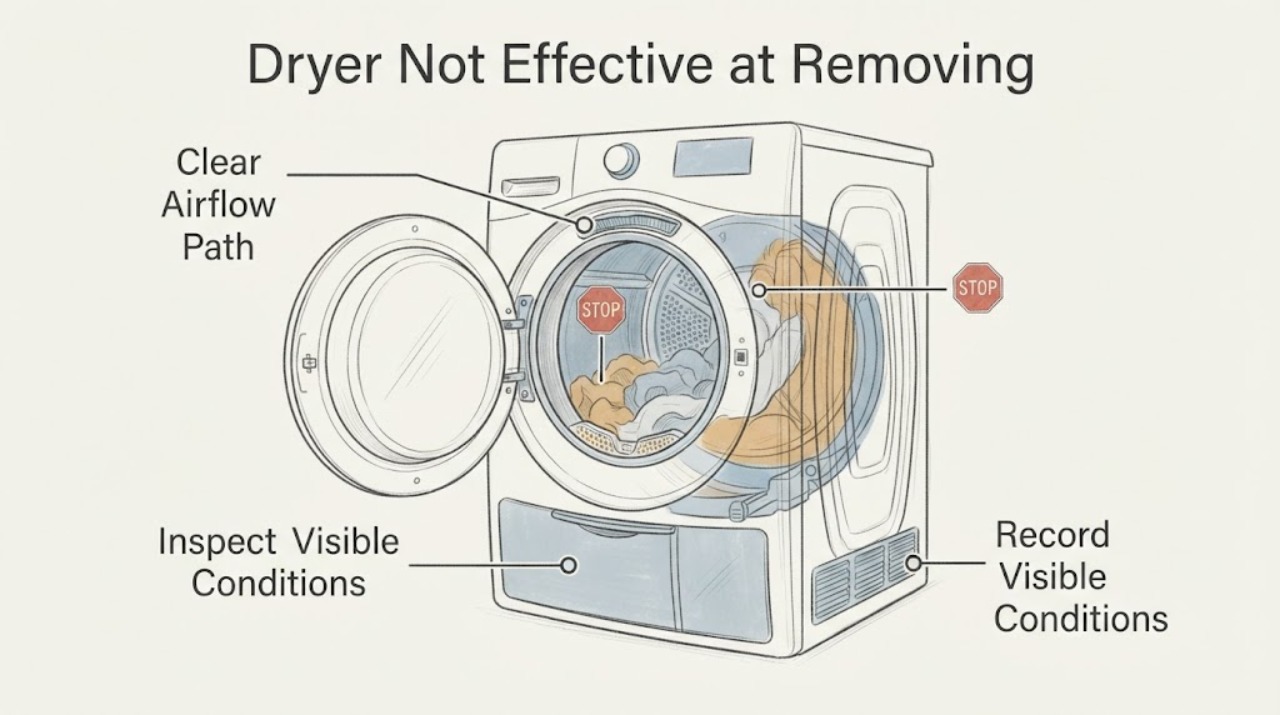
Work through in order
Diagnostic checks
Use only checks that match the exact appliance or system and its official guide.
-
Check 1
Record the complete Miele model number, selected program, fabric mix, load size, and whether the clothes are dry with hair remaining or still damp after the cycle. Note whether the problem follows one pet-hair-heavy load or occurs across ordinary loads.
Expected result: Hair remains on otherwise dry clothes, the load is still damp, the cycle is unusually long, or the result changes with load size or program.
Next step: Use the filter and airflow checks for a damp or long-cycle result. For dry clothes with residual hair, also review the load and fabric expectations; do not assume the dryer is designed to remove all pet hair.
Why this matters
Why: Visible hair alone does not diagnose a dryer failure. Dampness or a long cycle moves the investigation toward the lint/airflow and drying conditions that Miele documents; a load-specific result may reflect the load rather than a component.
-
Check 2
With the dryer stopped and cool, remove only the upper/lower or door lint filters shown for the exact model. Remove visible hair and lint, inspect the mesh and seating for tears or gaps, and vacuum visible airflow openings only where the Miele instructions allow it. If the manual permits washing, rinse as directed and let the filters dry fully before reinstalling.
Expected result: The filters are coated with hair, detergent residue, or fine lint; a filter is wet, damaged, missing, or not seated; or the accessible filter path is clean and intact.
Next step: Correct only the cleaning, drying, or seating condition supported by the exact manual. If a filter is torn, deformed, or cannot be identified for the model, stop using the dryer until Miele service confirms the correct filter and fit.
Why this matters
Why: Miele says hair and fine lint can clog filters, and warns that wet filters can cause drying faults. A damaged or poorly seated filter can let lint continue into the airflow path, but a clean filter does not identify a heater, fan, sensor, or control fault.
-
Check 3
If the exact model has a plinth or toe-kick filter, inspect and clean it only through the model's documented access panel. Check that it is the correct way round, intact, and completely dry. Look for visible lint at the heat exchanger without touching the cooling fins; use only the light dust-brush vacuum method that Miele documents for an applicable model.
Expected result: The plinth filter is clogged, wet, torn, deformed, or not flush; visible lint is present at the heat exchanger; the fins look damaged; or the model does not have this layout.
Next step: Dry and reinstall the model-approved filter only when the manual permits it. Stop and arrange Miele service for a damaged filter, bent fins, inaccessible buildup, or any uncertainty about the access path; do not open the cabinet or brush the fins by hand.
Why this matters
Why: Miele says a damaged or worn plinth filter can allow lint into the heat exchanger, and warns that sharp fins can injure a user and that bent fins can prevent drying. The absence of visible lint does not rule out an internal restriction, and a different model layout cannot be inferred from this page.
-
Check 4
Check that the drum is not overfilled and that clothing is not rolled together, move items away from the documented cool-air intake, ventilate an overheated room, and choose a program suited to the fabric mix. If the load entered unusually wet, use the washing machine's supported spin setting before drying; use Time Dry only when the exact Miele instructions make it appropriate.
Expected result: The drum was too full, the load was tangled, the lower intake was blocked, the room was hot, the fabric mix did not match the program, or the load entered unusually wet; or all these conditions were normal.
Next step: Run a modest, correctly sorted load only after the documented external conditions are corrected and no safety symptom exists. If hair remains across loads or the dryer still dries poorly, record the result and arrange model-specific service.
Why this matters
Why: Miele lists these conditions as reasons drying can take too long or stop, and says mixed fabrics may require a more suitable program or Time Dry. Correcting them can improve drying without identifying a failed part; unchanged symptoms after normal conditions need service assessment.
-
Check 5
If the complaint persists, give Miele the complete model number, program, load/fabric details, filter and plinth-filter condition, whether clothes were damp, cycle duration, and any visible damage or unusual heat/airflow behavior.
Expected result: The dryer remains ineffective across normal loads, drying stays slow or stops, a filter is damaged, heat-exchanger access is unclear, or investigation would require cabinet access or internal testing.
Next step: Stop using the dryer if there is smoke, burning odor, abnormal overheating, visible damage, or unsafe access; otherwise arrange Miele service for persistent symptoms. Do not open the cabinet, bypass a safety device, or perform live electrical tests.
Why this matters
Why: The no-model evidence supports filter, airflow, load, and program checks but cannot select a compatible part or confirm a fan, heater, sensor, heat exchanger, or control fault.
Use your observations
Decision map
Find the observation that best matches what you see, then follow the next safe action.
-
PATH 01Next step
What you see
Clothes are dry but retain hair mainly after pet-hair-heavy loads, while the dryer has no long-cycle or dampness symptom and the accessible filters are clean and intact.
Do this next
Review the load and fabric expectations, use the exact program guidance, and seek service only if the same result occurs across ordinary loads or a separate drying fault appears.
Why this path and its safety boundary
Why it matters: The opened Miele material supports a lint/airflow check but does not promise removal of all pet hair; this pattern does not establish a failed dryer component.
-
PATH 02Next step
What you see
Hair or fine lint coats the filters, the filters are wet, or the airflow openings are visibly restricted.
Do this next
Clean and fully dry the model-approved filters, vacuum only visible permitted openings, and reassess with a normal load; escalate if the filter is damaged or the symptom persists.
Why this path and its safety boundary
Why it matters: Miele identifies hair and fine lint as filter-clogging material, and wet filters as a cause of operational faults during drying.
-
PATH 03Next step
What you see
The plinth filter is torn, deformed, not flush, or visibly clogged, or lint is present at the heat exchanger.
Do this next
Follow the exact model manual for filter cleaning or replacement routing and arrange Miele service if access, fit, or fin condition is uncertain; do not touch the fins or open the cabinet.
Why this path and its safety boundary
Why it matters: Miele says a damaged or worn plinth filter can let lint reach the heat exchanger, and that incorrect cleaning can damage the fins and stop drying.
-
PATH 04Next step
What you see
The dryer still runs long, stops, or leaves clothes damp after the model-appropriate filter, load, program, intake, and room checks, or it shows smoke, burning odor, abnormal heat, or visible damage.
Do this next
Stop using the dryer for the safety symptoms and arrange qualified Miele service. Do not reproduce the fault, bypass protection, open panels, or test internal wiring.
Why this path and its safety boundary
Why it matters: The documented user-level causes have not explained the symptom, and the remaining cause cannot be identified safely without model-specific service assessment.
Helpful context
Understand the symptom
Pet hair left on laundry can be a load or lint-management complaint rather than proof that a Miele dryer has a failed component. Miele's support guidance explicitly discusses hair and fine lint clogging filters, while its drying guidance also points to program choice, load distribution, room temperature, air intake, and moisture-sensing conditions. The opened sources do not establish a universal Miele pet-hair-removal feature or a pet-hair-specific fault code, so use the exact model manual for the filter layout and treat the checks below as bounded observations.
Start by separating two observations: hair still visible on otherwise dry clothes, versus clothes remaining damp or a cycle becoming unusually long. The first can reflect the load and filter path; the second is the symptom Miele's drying guidance addresses directly. Record the model number from the rating plate, selected program, load size and fabric mix before changing settings.
Accessible lint filters and, on applicable models, the plinth filter are the appropriate first checks. Remove visible lint and vacuum visible airflow openings only as the exact manual permits. If a filter is washed, dry it completely before refitting; do not reach into the cabinet or touch heat-exchanger fins. A damaged or worn plinth filter needs model-confirmed replacement or service, not a guessed universal filter.
When checks do not resolve it
Need a professional?
Call Miele service when pet hair remains across normal loads after the model-approved filter and airflow checks, clothes remain damp or cycles stay unusually long, a lint or plinth filter is torn or deformed, heat-exchanger access is unclear, or diagnosis would require cabinet access or internal testing. Stop immediately for smoke, burning odor, abnormal overheating, or visible electrical damage.
Safety scope: This no-model guide is limited to recording the symptom, cleaning accessible model-approved lint filters, checking visible airflow and load conditions, and inspecting a documented plinth-filter path without touching cooling fins. Do not open the cabinet, touch wiring or sharp fins, bypass a safety device, force a filter layout from another Miele model, or perform live electrical tests.
Common questions
FAQ
Does a Miele dryer remove all pet hair from clothes?
The opened Miele support pages explain lint, hair, filters, airflow, load, and drying performance, but they do not establish a universal pet-hair-removal promise. Hair remaining on otherwise dry clothes is not enough to diagnose a failed component; check the load and the model-approved lint path first.
Can pet hair make a Miele dryer dry poorly?
Miele says hair and fine lint can clog filters, and its airway guidance explains how lint can reach the heat exchanger if a plinth filter is damaged or worn. Clean and dry the applicable filters according to the exact model manual, but do not infer a heater, fan, or sensor failure from hair alone.
Can I vacuum the heat exchanger?
Miele's opened guidance permits a light pass with a vacuum dust brush over an applicable heat exchanger, without pressure, and warns that the cooling fins are sharp and must not be touched. Confirm the exact model procedure first; stop and arrange service if the access path or fin condition is unclear.
Why is a Miele drying cycle taking too long when pet hair is present?
Miele lists clogged filters from hair or fine lint, a blocked cool-air intake, an overheated room, an overfull or tangled load, excessive incoming moisture, and unsuitable moisture-sensing conditions as possible checks. Correct only the visible, model-supported condition; persistent symptoms require service rather than a guessed part.
Read the exact guide
Official sources
- Miele Tumble Dryer | The drying process goes on too long or even switches off.Miele USA · Opened Miele USA's official support page. It addresses a general tumble-dryer symptom and identifies hair/fine lint, room temperature, filter condition, load distribution, cool-air intake, laundry moisture, and moisture-sensing conditions without selecting an internal part.
- Miele Tumble Dryer | At the end of the program, Information Clean out airways appears in the tumble dryer display. There is a build-up of lint.Miele USA · Opened Miele USA's official tumble-dryer support page. The page gives the applicable filter and airway-cleaning guidance for the layouts it documents and directs the reader to the exact manual for the appliance.
- Miele Tumble Dryer | The laundry is not sufficiently dry. The laundry is too damp.Miele USA · Opened Miele USA's official support page. It covers insufficiently dry laundry and recommends a suitable program, with Time Dry and residual-moisture settings only where the appliance supports them.
Community feedback
Share a repair observation
Share a plain-text repair observation. Accepted observations are published automatically; this page may take a moment to update.