
On this page
Start here
Quick answer
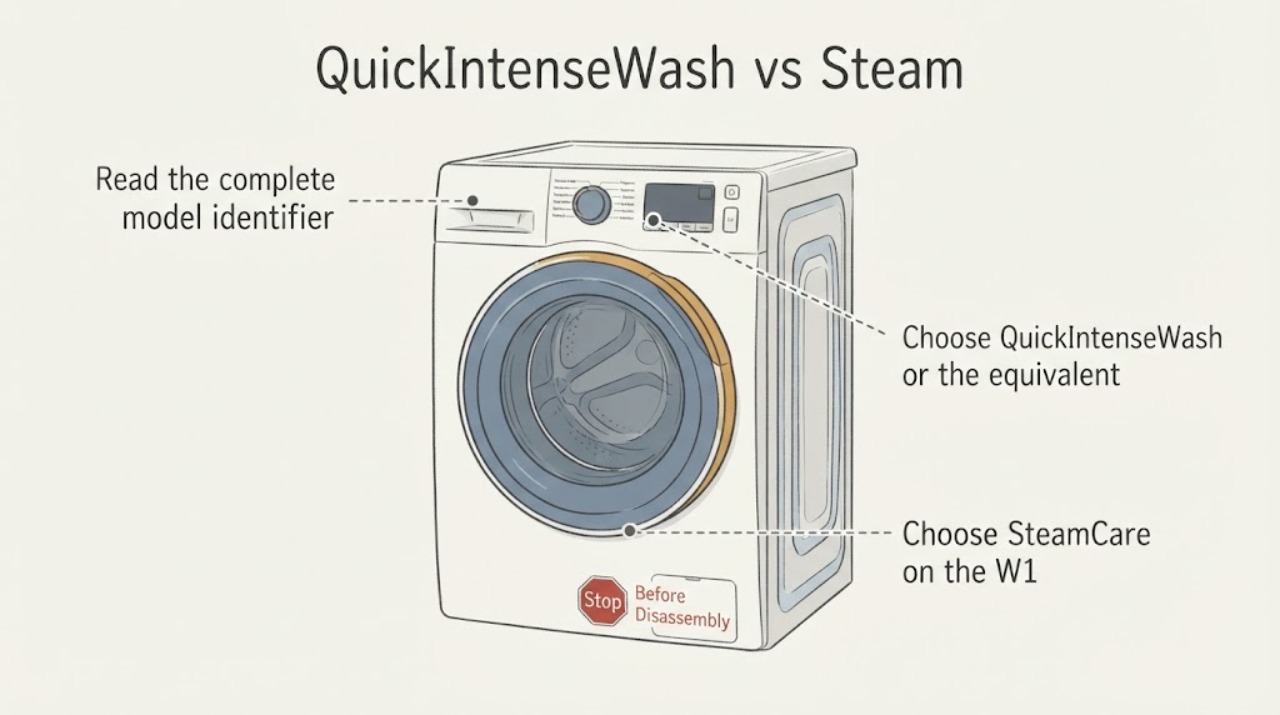
For one person with small, regular loads, QuickIntenseWash is the feature to match against a need for a faster wash with the cleanliness Miele documents for that programme. Miele's US product highlights describe QuickIntenseWash as using IntenseWash technology for excellent cleanliness in 49 minutes; current UK W1 models may display the closely related name QuickPowerWash and also list SteamCare. Steam is a different benefit: Miele describes SteamCare or SteamFinish as smoothing and freshening laundry to reduce ironing, rather than as a faster wash or a replacement for a hygiene programme. Check the exact W1 and T1 model documents before deciding because the feature name and availability vary by model and market. For limited laundry, choose QuickIntenseWash when turnaround matters, choose Steam when creasing and freshening matter, and choose the ordinary programme specified for heavily soiled, delicate, or hygiene-focused loads.
Work through in order
Diagnostic checks
Use only checks that match the exact appliance or system and its official guide.
-
Check 1
Read the complete model identifier for the W1 washing machine and T1 dryer, then compare the feature names and instructions in the matching Miele product documents.
Expected result: The panel says QuickIntenseWash, QuickPowerWash, SteamCare, SteamFinish, or does not list one of the requested features.
Next step: Use the exact model manual and programme list as the source of truth before choosing or comparing the feature.
Stop if: Do not apply a button sequence or operating assumption from a different W1 or T1 model.
Why this matters
Why: Miele uses different feature names and options across models and markets, so the family label W1/T1 alone cannot establish availability or operation.
-
Check 2
Choose QuickIntenseWash or the equivalent model-listed quick wash when the load is a suitable everyday load and the priority is a shorter wash with documented cleanliness.
Expected result: The model offers the feature, the load and garments are permitted by the manual, and the need is a quick turnaround rather than wrinkle reduction.
Next step: Follow the model's load, detergent, and garment-care limits, then judge the result by the actual soil and fabric requirements.
Stop if: Do not treat a short cycle as suitable for every soil level, fabric, or hygiene requirement.
Why this matters
Why: The quick wash addresses time and wash performance; it is the closer functional match for limited laundry that must be ready sooner.
-
Check 3
Choose SteamCare on the W1 or SteamCare/SteamFinish on the T1 when the laundry is suitable and the priority is freshening or reducing creases after or during care.
Expected result: The clothing is clean or only needs freshening, ironing is the recurring inconvenience, and the exact model documents the steam function.
Next step: Follow the model's permitted textiles and steam instructions and keep the ordinary wash or care programme for visible soil or a specified hygiene need.
Stop if: Do not use steam as proof that visibly dirty laundry was washed or that a hygiene requirement was met.
Why this matters
Why: Steam is a finishing benefit that can reduce ironing effort; it does not perform the same role as a wash programme.
-
Check 4
For a T1 SteamCare programme, check the condensate-container requirement in the exact manual before starting the programme.
Expected result: The manual requires a filled condensate container, the container is empty, or SteamCare is unavailable or reports a message.
Next step: Complete only the user preparation described by the manual; if the function still fails, use Miele support with the model and message.
Stop if: Do not add an improvised water feed, open the dryer, or continue if the appliance overheats, leaks, smokes, or shows damage.
Why this matters
Why: The T1 steam effect depends on the documented water path and model preparation; a missing requirement can prevent the feature from operating as expected.
-
Check 5
Review one or two weeks of actual laundry needs: how often loads are small and time-sensitive, how often clothes need freshening or ironing reduction, and whether any loads require a full or special programme.
Expected result: Most loads need fast everyday washing, most are already clean but creased, or the main need is heavy soil, delicate care, or a hygiene programme.
Next step: Prioritise the feature whose documented function matches the recurring need and verify that it is present on the exact model.
Stop if: Do not decide from the feature name alone or treat a marketing claim as a guarantee for every load.
Why this matters
Why: The dominant need identifies the better-matched feature: QuickIntenseWash for speed and wash performance, steam for finishing, and the specified full programme for special care.
Use your observations
Decision map
Find the observation that best matches what you see, then follow the next safe action.
-
PATH 01Next step
What you see
The exact W1 model lists QuickIntenseWash or QuickPowerWash, and the user's small loads are ordinary everyday laundry where a shorter turnaround matters.
Do this next
Use the model's documented quick programme within its load and textile limits.
Why this path and its safety boundary
Why it matters: The quick-wash feature matches the stated speed-and-cleanliness need more directly than a steam finishing feature.
-
PATH 02Next step
What you see
The exact W1 or T1 model lists SteamCare or SteamFinish, and laundry is already clean but often creased or needs freshening before wear.
Do this next
Use the steam function only for the textiles and preparation described in the exact manual.
Why this path and its safety boundary
Why it matters: Steam matches a finishing and ironing-reduction need rather than a wash-speed need.
-
PATH 03Next step
What you see
The feature is absent from the exact model documents, the name on the appliance differs, or the W1/T1 family label is the only identification available.
Do this next
Obtain the complete model identifier and use Miele's matching product page or manual before making a choice.
Why this path and its safety boundary
Why it matters: The feature comparison is not yet model-grounded; family naming cannot establish that QuickIntenseWash, QuickPowerWash, SteamCare, or SteamFinish is installed.
-
PATH 04Next step
What you see
The load is visibly dirty, requires a specified hygiene process, needs delicate-fabric care, or the T1 steam function has a preparation fault or warning.
Do this next
Follow the exact Miele care programme or preparation instructions and contact Miele support if the documented function still fails.
Why this path and its safety boundary
Why it matters: A quick or steam feature does not replace the programme or preparation requirement that addresses that specific need.
Helpful context
Understand the symptom
Confirm which feature your W1/T1 actually has
W1 and T1 identify product families, not one universal specification. Record the complete model name from the appliance and look it up in Miele's product page or operating instructions. Miele's US product highlights use the name QuickIntenseWash, while a current UK W1 product page lists QuickPowerWash with SteamCare. A T1 dryer page lists SteamCare but does not make it a washing programme. Use the exact model's wording when comparing features instead of assuming that every W1/T1 pair has the same options.
Use QuickIntenseWash for a small, time-sensitive wash
QuickIntenseWash is the closer match when the main need is to clean a normal, lightly or moderately soiled small load promptly. Miele describes IntenseWash as using Spin&Spray technology with less water and heating energy, and describes QuickIntenseWash as providing excellent cleanliness in 49 minutes. That description supports a speed-and-cleanliness choice; it does not mean every fabric, soil level, or load size should use the short programme. Follow the exact model's load and garment guidance.
Use SteamCare or SteamFinish for finishing and freshening
Steam addresses a different problem from a short wash. Miele's W1 product information describes SteamCare as freshening clothes and reducing ironing time, while the T1 manual explains that condensed water is sprayed into the drum and evaporated by drying heat to create the SteamCare effect. Treat it as a finishing or freshening function for suitable laundry. It is not evidence that a garment received a full wash, and it should not replace the programme or care label required for visible soil or a hygiene need.
Match the choice to one person's actual laundry pattern
If you normally wash a few everyday items and need them ready soon, QuickIntenseWash is the relevant feature to verify. If the clothes are already clean but creased or have picked up a stale smell, SteamCare or SteamFinish is the relevant feature to verify. If the main problem is heavy soil, delicate fibres, or a specified hygiene requirement, use the Miele programme and temperature guidance for that purpose rather than inferring that speed or steam is equivalent. A single user may benefit from one feature more often than the other because the two features solve different tasks.
Check the T1 preparation requirement before using steam
For a T1 dryer with SteamCare, follow the model manual's preparation instructions. Miele's T1 manual says that condensed water from the condensate container is sprayed into the drum and specifically notes that the container must be filled. If SteamCare is unavailable, stops, or does not behave as described, record the exact model, programme, display message, and condensate-container state and use Miele support rather than improvising a water supply or opening the dryer.
When checks do not resolve it
Need a professional?
Use Miele support when the exact model documentation is missing or a listed feature does not operate as documented. Stop using the appliance and seek qualified service for leaks, overheating, smoke, burning odor, visible damage, or a recurring electrical protection event. Feature selection alone does not identify an internal part or justify opening the washer or dryer.
Common questions
FAQ
Is QuickIntenseWash the same as SteamCare?
No. Miele describes QuickIntenseWash as a quick wash using IntenseWash technology, while SteamCare is described as smoothing and freshening laundry. Check the exact model because current UK materials may use QuickPowerWash for the quick-wash feature.
Which is the better fit for one person with small loads?
If the recurring need is fast everyday washing, verify QuickIntenseWash or QuickPowerWash on the W1. If the recurring need is less ironing or freshening already-clean clothes, verify SteamCare on the W1 or T1. Use the full programme specified for visible soil, delicate care, or a hygiene requirement.
Does T1 SteamCare need anything prepared first?
Miele's T1 manual says that condensed water is sprayed into the drum and notes that the condensate container must be filled. Follow the exact model's instructions and contact Miele support if the feature still does not work.
Read the exact guide
Official sources
- TQ1000WP GB-en-002Miele UK · Official Miele T1 manual opened for the documented SteamCare mechanism; use the exact model manual for variant-specific instructions.
- Product Highlights — Washers & DryersMiele USA · Official Miele USA product highlights opened for the documented QuickIntenseWash function; exact model availability remains model-specific.
- Compact Washing Machines | MieleMiele UK · Official Miele UK W1 series page opened to corroborate the UK naming and the small-load use case.
- Miele - TWL780WP Steam&9kg Lotus white – Tumble dryersMiele UK · Current UK T1 example used to distinguish dryer steam finishing from W1 washing features.
- Miele - WEE385 WCS PWash&Steam&8kg Lotus white – Washing machinesMiele UK · Current UK W1 example used to show that the local product label may be QuickPowerWash and that feature availability is model-specific.
Community feedback
Share a repair observation
Share a plain-text repair observation. Accepted observations are published automatically; this page may take a moment to update.