
On this page
Start here
Quick answer
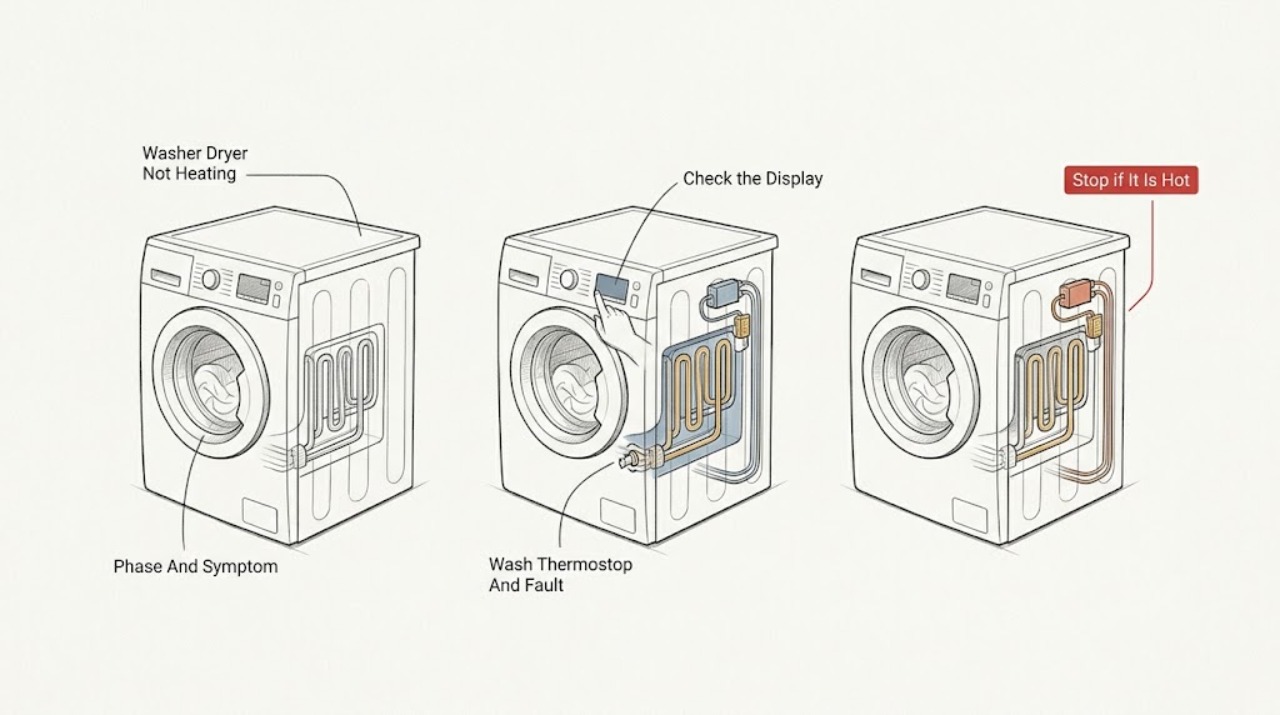
First determine whether your Miele washer-dryer is failing to heat the wash water, the drying air, or both. For a wash-heating problem, note whether F20 or a heating fault appears and whether the program pauses while Thermostop waits for temperature. For a drying problem, check the selected drying program, load, filters, and airflow using the exact model manual. If the display reports a technical heating fault, switch the appliance off, disconnect it for at least two minutes, and restart the program once as Miele describes. If the fault returns, the appliance overheats, the breaker trips, or there is a burning smell, stop using it and arrange Miele Service.
Work through in order
Diagnostic checks
Use only checks that match the exact appliance or system and its official guide.
-
Check 1
Identify where heat is missing: during the wash phase, during the drying phase, or in both. Record whether the drum or door remains cool, whether the laundry is only damp after drying, whether the time display pauses, and whether a fault message or indicator appears. Do not touch hot glass or open the appliance while steam is escaping.
Expected result: Only the wash water stays cold; only the drying phase produces damp laundry; both phases lack heat; the program pauses; or F20, a heating fault, or another technical message appears.
Next step: Follow the wash branch for F20 or a paused wash and the dry branch for damp laundry or a drying message. If steam, smoke, or a burning smell is present, stop immediately and keep the appliance off.
Why this matters
Why: A wash-only symptom points toward the wash heating sequence, while a dry-only symptom points toward the drying program, airflow, or drying heater. A shared display fault or both-phase failure needs model-specific service rather than a single filter adjustment.
-
Check 2
For a wash-phase problem, check the display and remaining-time behavior while the selected program is running. If Miele shows F20 or Heating fault, determine whether the time is temporarily paused for Thermostop or whether the same message remains after the appliance has had time to continue. Do not open panels or try to measure the heater.
Expected result: The time display resumes when the selected temperature is reached; the heating message persists; the program stops; or no heating message appears and the water remains cold.
Next step: If the program resumes normally, let it complete and recheck the result. If the fault persists or the program cannot heat, perform the one controlled power reset in the next action and then request service if it returns.
Why this matters
Why: Miele explains that Thermostop pauses the countdown until the set program temperature is reached. A persistent heating fault is treated by Miele as a technical fault, while a cold wash without that message requires the exact manual and service history for further diagnosis.
-
Check 3
If a Miele heating or technical fault remains, switch the washer-dryer off and disconnect it from the power supply as Miele instructs. Wait at least two minutes, reconnect it, and restart the same program once. Do not repeatedly reset a breaker or continue if the appliance smells hot, smokes, leaks, or trips the supply again.
Expected result: The program completes after the single reset; the heating fault returns; the display remains in a technical-fault state; or the breaker trips again.
Next step: If the fault returns or the supply trips again, leave the appliance off and contact Miele Service. Provide the exact message and the result of the single reset rather than repeating it.
Why this matters
Why: A one-time recovery can clear a temporary electronic state, but a returning fault indicates that the heating problem has not been resolved. A repeated breaker trip or heat/smoke symptom is an electrical or fire-safety stop.
-
Check 4
For a drying-phase problem, use the exact Miele manual to confirm that the selected program and temperature option suit the load, then check the load size, filter or airway indicators, and every user-accessible filter or airflow path named for that model. If the display says to adjust the load, check whether the drum is nearly empty or the laundry is already dry; do not remove covers or reach into a moving drum.
Expected result: The program is a low-heat or air option, the load is too small or packed, an airway or filter indicator is on, the filter path is blocked, or these visible conditions are normal.
Next step: Correct only the model-supported program, load, or user-cleanable filter condition and make one supervised test. If the dryer remains cold or the fault returns, stop using it and arrange service.
Why this matters
Why: A program choice, load-sensing condition, lint restriction, or airflow problem can make drying appear to have no heat or end before the laundry is dry. Normal load, settings, and airflow make an internal drying heater, sensor, or control fault more likely.
-
Check 5
Record the model and serial information, the affected phase, program and temperature, displayed message, time behavior, filter or airway condition, breaker result, and whether the appliance is unusually hot. Do not open the casing, bypass a thermal or door safety, test energized wiring, replace a heater, or access a refrigerant circuit.
Expected result: Heating fails again after the controlled reset and visible dry checks, F20 or another technical fault returns, the appliance overheats, the breaker trips, or smoke, burning odor, leakage, or visible damage appears.
Next step: Keep the washer-dryer off and book Miele Service or a suitably qualified appliance technician. If there is smoke or a burning odor, disconnect power only if safe and follow local emergency guidance.
Why this matters
Why: These results can involve a heating element, temperature sensor, electronic control, fan or heat-pump circuit, wiring, or another model-specific component. The symptoms do not identify a safe replacement part without service diagnosis.
Use your observations
Decision map
Find the observation that best matches what you see, then follow the next safe action.
-
PATH 01Next step
What you see
The wash program pauses and the selected temperature is eventually reached without a recurring fault.
Do this next
Treat the pause as the Miele-described Thermostop behavior and let the program continue; use the exact manual if the pause never clears.
-
PATH 02Next step
What you see
F20 or Heating fault remains after one two-minute power reset.
Do this next
Leave the washer-dryer off and request Miele Service; provide the fault message and the result of the reset.
-
PATH 03Next step
What you see
Only drying is affected and a load, program, filter, or airway condition is visibly wrong.
Do this next
Correct the model-supported setting, load, or user-cleanable airway and make one supervised test. Stop if heat does not return or the message reappears.
-
PATH 04Next step
What you see
Only drying is affected but load, program, filter, and airflow checks are normal.
Do this next
Do not open the dryer section or choose a heater or refrigerant part from the symptom; arrange Miele Service for a model-specific diagnosis.
-
PATH 05Next step
What you see
The appliance overheats, trips a breaker, leaks, smokes, smells of burning, or shows visible damage.
Do this next
Stop using it, disconnect power only if safe, keep away from the hazard, and arrange urgent qualified service. Do not restart it to reproduce the problem.
Helpful context
Understand the symptom
Separate wash heating from drying heat
A washer-dryer contains two user-facing heating experiences. The wash phase may remain paused while the selected water temperature is reached, while the dry phase may finish with damp laundry because of load, program, airflow, or an internal fault. The first useful observation is which phase fails and what the display says.
Use the model-specific Miele instructions
Miele's support pages point owners to the operating instructions for the exact appliance. Program names, drying options, messages, and safe access to filters vary by model. Treat the model manual as the authority for settings and user-cleanable areas rather than guessing from a similar washer-dryer.
A recurring heating fault is a stop condition
A single restart can distinguish a temporary control state from a recurring fault, but repeated resets do not repair a heater, sensor, or control. If the heating message returns, the appliance becomes unusually hot, the breaker trips, or there is smoke or a burning smell, keep it off and arrange qualified service.
Only after diagnosis
Potential parts
- wash heating element
Consider this category only when qualified service confirms a wash-heating circuit fault after the display behavior and controlled reset have been documented.
Confirm the exact Miele model and approved parts information; do not access or replace a heater from a cold-water symptom alone. - temperature sensor or thermostat
Consider this category only when service confirms that the appliance cannot sense or regulate the selected wash or drying temperature.
Sensor and thermostat designs vary by model and phase; qualified service must verify fitment and safe isolation. - drying heater or heat-pump component
Consider this category only when a qualified technician confirms an internal drying-heating fault after the program, load, filter, and airflow checks pass.
Drying systems differ by model; do not open the casing or select a heater or refrigerant component from symptoms alone.
When checks do not resolve it
Need a professional?
Request Miele Service when a heating fault returns after the one controlled reset, drying remains cold with normal visible checks, or any overheating, electrical, leakage, smoke, or burning symptom appears.
Have this ready
- Provide the model and serial information, affected phase, selected program and temperature, exact display message, whether the time paused, load and filter observations, and what happened after the single reset.
Common questions
FAQ
How do I know whether my Miele washer-dryer has a wash-heating or drying-heating problem?
Note which phase fails. A paused wash with F20 or Heating fault points to the wash temperature sequence, while damp laundry after a dry program points to the drying program, load, filter, airflow, or drying system. Record the display and time behavior before choosing a branch.
What does F20 or Heating fault mean on a Miele washer-dryer?
Miele says Thermostop can pause the program while it reaches the selected temperature. If the message represents a technical heating fault, Miele directs you to disconnect power for at least two minutes, restart once, and contact service if the fault persists.
Why is my Miele washer-dryer leaving clothes damp after drying?
Check the model-specific drying program, load size, filter or airway indicators, and user-accessible airflow path. An empty or nearly empty load can cancel some programs, and an unsuitable environment or technical dryer fault can also affect the result. If normal checks pass, request service.
Can I replace the heating element in a Miele washer-dryer myself?
Do not replace an internal heating part from the symptom alone. A no-heat condition can involve a sensor, control, wiring, or another model-specific circuit, and Miele treats several technical faults as service work. Keep the appliance off and provide the model and display message to qualified service.
Read the exact guide
Official sources
- Miele Tumble Dryer | The DryCare 40 Extra is not drying the laundry sufficiently.Miele USA · Miele tumble dryers and drying sections
- Miele Tumble Dryer | Fault F1 appears on the tumble dryer display.Miele USA · Miele tumble dryers and heat-pump drying systems
- Miele Tumble Dryer | Adjust the load and appear on the tumble dryer display. The program has been interrupted.Miele USA · Miele tumble dryers and drying sections
- WWH 860-US-enMiele USA · Miele washer-dryer operating and safety instructions
- Miele Washer | The washing machine does not work. The display remains dark and no indicator light comes on.Miele USA · Miele washing machines and washer-dryers
- Miele Washer | Fault F20 or Heating fault is shown on the display of the washing machine/washer-dryer.Miele USA · Miele washers and washer-dryers
- Miele Washer | Techn. fault, contact Service appears in the display on the washing machine/washer-dryer.Miele USA · Miele washers and washer-dryers
- Troubleshooting for All problem with Miele Tumble DryerMiele USA · Miele tumble-dryer sections and drying support
Community feedback
Share a repair observation
Share a plain-text repair observation. Accepted observations are published automatically; this page may take a moment to update.