
On this page
Start here
Quick answer
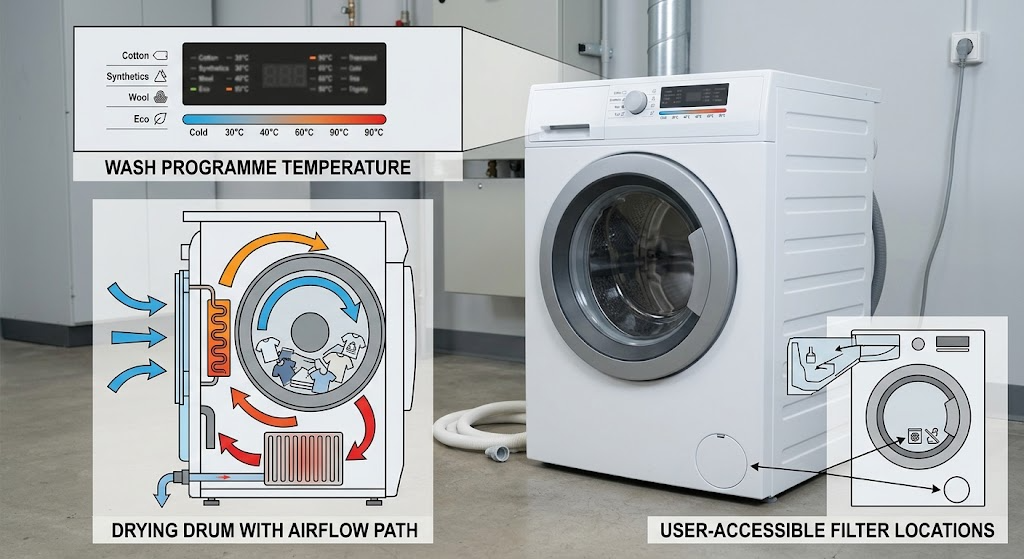
First identify which function is not heating: a wash may end cold because the final rinse is normally cold, while a heat-pump drying cycle may feel cool at the start and run at a lower temperature. For wash heating, verify that the selected programme and temperature are not a cold or low-temperature setting; for drying, turn on the water tap, use the correct drying load and programme, and clean only the model-approved air, lint, condenser, and drain filters. Test only as the exact manual allows. If a suitable wash programme never warms the door, a timed drying check stays cold, an E60/E6-type code appears, the appliance will not restart after drying, or there is a burning smell, smoke, unusual heat, repeated error, water leak, or electrical issue, stop using it and arrange authorised appliance service. Do not open the cabinet or test the heater, wiring, or heat-pump circuit yourself.
Work through in order
Diagnostic checks
Use only checks that match the exact appliance or system and its official guide.
-
Check 1
Run or review the most recent cycle from a safe position and identify whether the complaint is about wash water, drying air, or both; note the selected programme, temperature or dryness option, load, and whether the final rinse or cooling phase had already started.
Expected result: Only the wash feels cold at the end, only drying leaves clothes damp or cool, both functions are affected, or the appliance stops with a code or does not restart.
Next step: Use the wash-temperature check for a wash-only complaint, the water/filter/load check for a drying-only complaint, and the power/error/service branch for both functions, a returning code, or a restart failure.
Stop if: Stop for smoke, burning smell, abnormal heat, electrical noise, water near electrical parts, repeated trips, a damaged cord, or a washer-dryer that will not restart after a drying cycle.
Why this matters
Why: A cold final rinse is normal according to Electrolux, and heat-pump drying can start gently at a lower temperature. A failure in both functions, a persistent no-heat result during the active heating phase, or a technical shutdown is a different service route.
-
Check 2
For a wash-only complaint, select a programme and temperature that the exact Electrolux washer-dryer manual permits for the fabric, making sure a cold-wash option has not been selected; do not change a fixed programme temperature by guesswork.
Expected result: The display shows a cold or low-temperature setting, the selected programme has a documented temperature, or the programme cannot be changed as expected.
Next step: Use the documented programme and temperature once, with no or a small compatible load as the manual permits. Observe during the active wash phase rather than judging only the final cold rinse; if the programme remains cold, continue to the heating-code and service boundary.
Stop if: Do not select a temperature unsuitable for the fabric, force a programme change, open the door against a lock, or dismantle the appliance to inspect the heater.
Why this matters
Why: Electrolux says some programmes default to lower temperatures and a cold-wash symbol runs without heating the water. A cold final rinse is not evidence of a failed heater, but a correct higher-temperature wash that never warms requires a further check or service.
-
Check 3
If the model manual permits this check, run an appropriate cotton or service wash at the documented higher temperature and, from outside the appliance, observe the door during the active wash phase after the programme has had time to heat; do not open the door or touch it if it is unusually hot.
Expected result: The door becomes warm before the rinse, the door stays cold throughout the active heating phase, the programme ends with a cold final rinse only, or an E60/E6-type code appears.
Next step: If the active phase warms normally, treat the cold final rinse as normal. If it stays cold or a heating code appears, stop further tests, record the code and model, and request authorised service.
Stop if: Do not run repeated high-temperature tests, bypass a door lock, pour water onto the appliance, or measure live wiring or heater resistance.
Why this matters
Why: A warm door during the active wash phase supports that the wash heating system is operating; a cold final rinse is expected. A door that never warms on a suitable programme or an E60/E6-type heating code points to a heating fault and not a user-adjustable temperature issue.
-
Check 4
For a drying-only complaint, confirm the water tap is on, inspect and clean only the primary or secondary air filters, lint filters, condenser or heat exchanger, and drain filter that the exact model manual identifies as user-accessible, then compare the dry-load size with the smaller drying capacity.
Expected result: The tap is closed, an air or lint filter is clogged, the drain filter is obstructed, the load exceeds the drying limit, the programme does not match the fabric, or all permitted checks are clear.
Next step: Correct only the visible, manual-approved condition and run one suitable drying programme. If the appliance remains cold or damp despite a correct load and clean filters, use the timed-heat or service branch rather than cleaning deeper parts.
Stop if: Do not remove sealed covers, reach into a hot drum, clean an inaccessible heat exchanger, use unapproved chemicals, or operate with a missing or damaged filter.
Why this matters
Why: Electrolux states that washer-dryers need water during drying and identifies clogged filters, a blocked drain filter, excessive load, and an unsuitable cycle as causes of damp or poor drying. A clear filter and correct load do not prove that the internal heat source works.
-
Check 5
After the permitted filter and load checks, use the exact model manual to select a suitable timed or sensor-controlled drying programme and allow the cycle to run without repeatedly opening the door; for a model-specific no-heat test, inspect the drum only when the manual says it is safe.
Expected result: A heat-pump cycle warms slowly but eventually dries, the selected cycle is cooling or sensor-controlled, the drum remains cold through the documented test, or drying stops with an error.
Next step: Allow one correct cycle to complete when the appliance behaves normally and no hazard is present. If the drum remains cold, an E60/E6-type code appears, or the cycle repeatedly fails, stop using the drying function and arrange authorised service.
Stop if: Do not keep opening the door to chase warmth, run repeated empty tests, bypass a thermal cut-out, or open the heat-pump, heater, or electrical compartment.
Why this matters
Why: Electrolux explains that heat-pump dryers use lower temperatures and may appear not to heat at first; opening the door extends the cycle. A documented test that remains cold, persistent dampness, or a fault indication is consistent with an unresolved heating or airflow fault, not proof that a particular heater part has failed.
-
Check 6
If both functions fail, the appliance loses power, a code appears, or it does not switch on after drying, record the complete display or indicator sequence and check only the normal plug, socket, and circuit condition from a dry position; perform at most the model-documented restart.
Expected result: The socket or display is dead, a breaker or safety switch trips again, E60/E6 or another code returns, the appliance restarts once, or the washer-dryer remains unresponsive after drying.
Next step: Leave the appliance off and request authorised service for a returning code, no-heat result, restart failure, or repeated power loss. Include the model or PNC, code, affected function, load, filter result, and timing.
Stop if: Do not repeatedly reset a tripping circuit, use an extension or improvised supply, remove the rear panel, test live parts, or continue using the appliance after an electrical warning.
Why this matters
Why: Electrolux treats persistent E60/E6 codes as heating problems requiring service and says a washer-dryer that does not switch on after a drying cycle has a technical problem. A normal socket or one successful restart does not identify a safe internal cause.
Use your observations
Decision map
Find the observation that best matches what you see, then follow the next safe action.
-
PATH 01Next step
What you see
The wash door became warm during the active wash phase, but the clothes feel cold after the programme's final rinse.
Do this next
Use the appliance normally and judge wash heating by the programme's active phase and selected temperature, not by the final rinse alone.
Why this path and its safety boundary
Why it matters: Electrolux says the final rinse is generally cold, so this pattern does not by itself show a heating fault.
-
PATH 02Next step
What you see
The selected wash programme shows a cold-wash symbol or a lower temperature than expected for the fabric.
Do this next
Select a documented compatible programme and temperature once, then reassess during the active wash phase. If it remains cold, arrange service rather than increasing settings blindly.
Why this path and its safety boundary
Why it matters: The programme may intentionally avoid heating water or use a lower temperature.
-
PATH 03Next step
What you see
A suitable wash programme never warms during its active heating phase, or E60/E6 appears.
Do this next
Stop using the appliance until it is assessed and provide the complete code, model or PNC, selected programme, and mid-cycle temperature observation to authorised service.
Why this path and its safety boundary
Why it matters: Electrolux associates E60 and codes beginning with E6 with a heating problem and directs the user to service.
-
PATH 04Next step
What you see
Drying is weak or absent, but the appliance washes normally and the display has no persistent technical code.
Do this next
Turn on the tap, clean only manual-approved filters, reduce the load to the drying limit, choose the correct cycle, and run one uninterrupted cycle. Arrange service if it remains cold or damp.
Why this path and its safety boundary
Why it matters: Water supply, air or lint filters, drain filter, drying load, and programme selection remain the supported first checks for washer-dryers.
-
PATH 05Next step
What you see
A heat-pump drying programme feels cool at startup but eventually warms and dries the load without an error.
Do this next
Allow the correct programme to complete without repeatedly opening the door. If the drum stays cold through the model's documented test or drying remains consistently poor, request service.
Why this path and its safety boundary
Why it matters: Lower drying temperature and a slow startup can be normal for heat-pump technology.
-
PATH 06Next step
What you see
Neither washing nor drying heats, the appliance will not restart after a drying cycle, or a code returns after a documented restart.
Do this next
Stop using the washer-dryer and arrange authorised appliance service with the model, PNC, complete code, affected functions, power behavior, and checks already completed.
Why this path and its safety boundary
Why it matters: This is not explained by a single wash setting or drying load; Electrolux identifies restart failure as a technical problem and persistent heating codes as a service condition.
-
PATH 07Next step
What you see
There is a burning smell, smoke, sparking, abnormal heat, damaged cord, water at electrical parts, a repeated trip, or a leaking appliance near the supply.
Do this next
Stop the cycle and keep people away. Disconnect power only if it can be done without contact with water or damaged equipment, then arrange qualified appliance or electrical inspection.
Why this path and its safety boundary
Why it matters: This is a safety boundary, not a filter, programme, or temperature-selection issue.
Helpful context
Understand the symptom
Cold clothes do not always mean the washer-dryer failed to heat
A washer-dryer has two different heating decisions. Electrolux says the final rinse is generally cold, so clothes can feel cold at the end of washing even when the wash water was heated earlier. Drying performance also varies by design: heat-pump systems use lower temperatures and can seem not to heat at the beginning. Judge the wash by the selected temperature and a safe mid-cycle observation, and judge drying by the correct programme, filters, load, and whether the drum warms as the model guidance describes.
Use separate checks for washing and drying
If washing is cold but drying works, focus on the wash programme, temperature selection, and wash-heating fault route. If washing is normal but drying is cold or damp, check the water tap, air and drain filters, load size, fabric programme, and model-specific condenser or heat-pump maintenance. If both functions fail, or the display shows a heating code, an appliance-level or supply fault becomes more likely and repeated programme tests are not useful.
Keep the internal heating boundary clear
Electrolux's support guidance directs persistent heating problems and E60/E6-type indications to an authorised service engineer and warns against continued use until the problem is fixed. Cleaning a user-accessible filter or selecting the documented programme is maintenance; measuring a heater, opening the rear panel, bypassing a thermal device, or changing wiring is internal repair. Record the model, PNC or rating-plate information, code, function affected, load, and checks already completed for service.
Safety boundary
Stop conditions
- Stop using the washer-dryer for smoke, burning smell, sparking, abnormal heat, a hot or damaged cord, water near electrical parts, repeated circuit trips, or a leak that reaches the supply area.
- Do not open the cabinet, heater or heat-pump compartment, probe live wiring, measure heater resistance, bypass a thermal cut-out, or alter the grounding or supply connection.
- Do not repeatedly run high-temperature or empty drying tests, repeatedly reset a returning error, or keep opening a heat-pump cycle to chase warmth.
- Stop the affected function and arrange service when a suitable wash programme never warms, the drying drum stays cold through the model-approved test, E60/E6 or another fault returns, or the appliance fails to restart after drying.
- Do not continue loading or wearing laundry as a substitute for diagnosis when the appliance has lost heating, has stopped mid-cycle, or shows a persistent technical fault.
Only after diagnosis
Potential parts
- washer-dryer wash heating element
Consider this only after qualified diagnosis confirms a wash-water heating fault on the exact model, such as persistent cold active wash heating or a corresponding heating code.
Confirm the exact Electrolux model, PNC, electrical specification, and manufacturer fit information before ordering; a cold final rinse alone does not justify this part. - washer-dryer drying heater or heat-pump assembly
Consider this only if qualified diagnosis identifies an internal drying heat-source fault after water, load, programme, airflow, and user-accessible filter checks.
Confirm whether the exact washer-dryer uses a resistive heater or heat-pump design and verify manufacturer fit information; no-heat symptoms do not identify a compatible assembly. - washer-dryer air or drain filter
Consider this only when the exact model's user manual identifies a damaged or missing user-serviceable filter after a poor drying result.
Confirm the exact model and filter position with the manual; a clean or inaccessible filter should not be replaced by guesswork.
When checks do not resolve it
Need a professional?
Arrange authorised Electrolux appliance service when a suitable wash programme remains cold during its active heating phase, the drying function remains cold or damp after the model-approved filter, load, water, and programme checks, E60/E6 or another error returns, both functions are affected, the washer-dryer will not restart after drying, or any electrical, thermal, leak, or burning symptom is present.
Common questions
FAQ
Why are my clothes cold after an Electrolux washer-dryer finishes washing?
The final rinse is generally cold, so clothes can feel cold even when the wash water heated earlier. Check whether the door became warm during the active wash phase on a documented suitable programme; if it never warms or a heating code appears, arrange service.
Why does the drying function seem cold at the start?
Electrolux says heat-pump drying uses lower temperatures and may seem not to heat while the system warms and extracts moisture. Use the correct load and programme, keep the door closed during the cycle, and arrange service if the drum stays cold through the model-approved test or drying remains consistently poor.
What should I check when an Electrolux washer-dryer will not dry?
Confirm the water tap is on, clean the primary or secondary air filters and drain filter only as the manual permits, reduce the load to the drying capacity, and select a programme that matches the fabric. If those checks do not change the result, request service.
What does E60 mean on an Electrolux washer-dryer?
Electrolux wash guidance says E60 or a code beginning with E6 generally refers to a heating problem. Codes and meanings can vary by model, so record the complete code and use the exact manual; do not continue using the appliance or open it when the code returns.
When should I stop using an Electrolux washer-dryer that is not heating?
Stop for a persistent no-heat result, a returning heating code, failure to restart after drying, smoke, burning smell, sparking, abnormal heat, water near electrical parts, a damaged cord, or repeated power trips. Arrange authorised appliance or qualified electrical service and do not perform internal tests.
Read the exact guide
Official sources
- Washing machine does not heat up and does not display an error messageElectrolux · Electrolux washing-machine guidance used only for the wash function; washer-dryer programme names and timings must be checked in the exact manual.
- Washing machine displays error message E60Electrolux · Official wash-appliance code guidance; an individual washer-dryer may use different codes, so the complete model-specific code must be verified.
- What to check before contacting Electrolux consumer serviceElectrolux · General Electrolux appliance guidance that explicitly includes washer-dryers for water-supply checks.
- Drying cycle of washer dryer takes too long, too short or not drying at allElectrolux · Directly applies to Electrolux washer-dryers; exact filter access and programme limits remain model-specific.
- Washer - dryer does not switch on after a drying cycleElectrolux · Directly applies to Electrolux washer-dryers when the appliance does not restart after a drying cycle.
- Tumble dryer not drying, not drying properly, too long dryingElectrolux · Official Electrolux dryer guidance used to explain drying mechanics; washer-dryer models require their own manual for the exact test and accessible components.
Community feedback
Share a repair observation
Share a plain-text repair observation. Accepted observations are published automatically; this page may take a moment to update.