
On this page
Start here
Quick answer
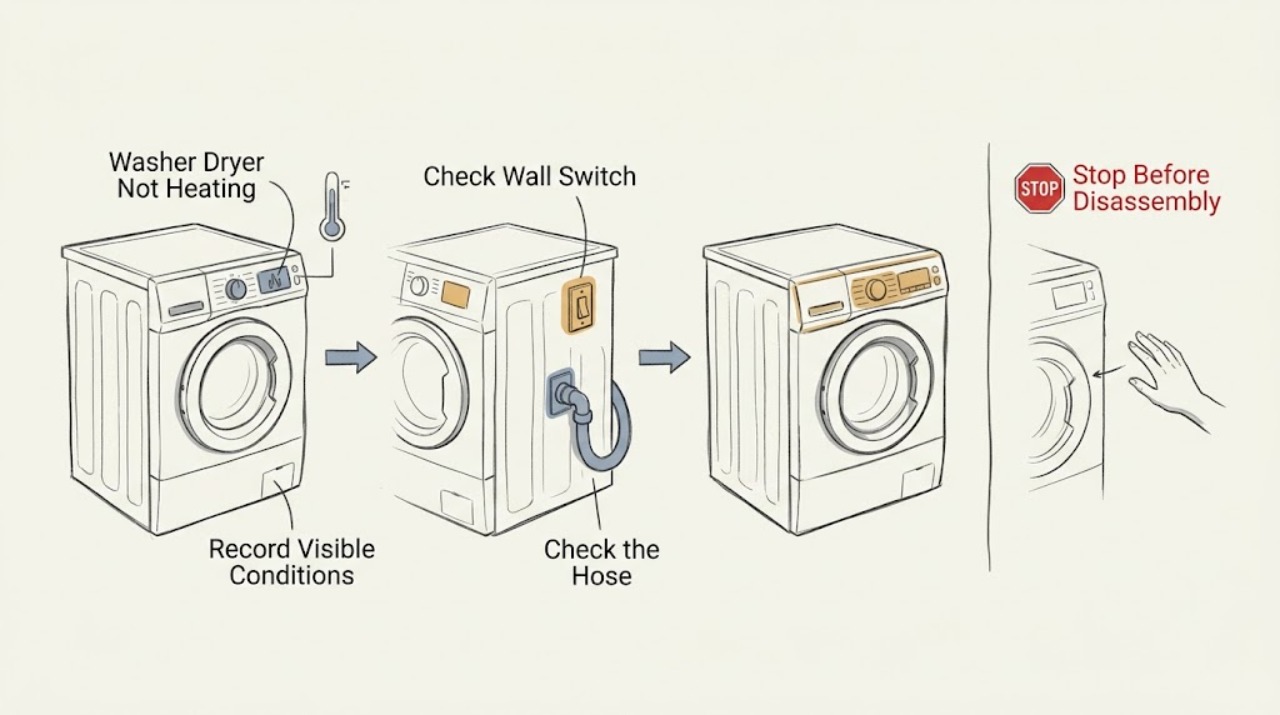
First identify which function is not heating: wash water that stays cold, drying air that never warms, or laundry that is warm but still damp. Check the selected wash or drying programme, the model-specific display symbols, water tap, load and airflow conditions, and the accessible filter or inlet guidance in the Bosch manual. Do not open the washer-dryer or test its heating circuit. Bosch states that a suspected heating-element fault and a washer-dryer that still does not dry require trained or expert service.
Work through in order
Diagnostic checks
Use only checks that match the exact appliance or system and its official guide.
-
Check 1
Run only the normal user controls for the affected function and record whether the wash water stays cold, the drying phase produces no warm air, or the laundry is warm but still damp; do not touch hot glass, steam, or internal surfaces to judge temperature.
Expected result: The wash function is cold, the drying function is cold, the appliance is warm but drying is poor, or the programme is not reaching its heating phase.
Next step: Keep the observation tied to the matching branch below and note the exact programme, load, and any displayed symbol or code for the manual or service technician.
Why this matters
Why: Wash-water heating, drying heat, and drying performance use different parts of the washer-dryer and different checks. Warm-but-damp laundry points toward load, airflow, or moisture-sensing conditions rather than proving a dead heater.
-
Check 2
Check that the selected cycle actually includes the expected washing temperature or drying function, that drying is not switched off, and that the door is closed; compare controls and symbols with the exact Bosch model manual.
Expected result: The programme is cold-only or drying is disabled, the door or a control indicator prevents the phase, or the correct programme is selected and the result remains cold.
Next step: Select a valid model-supported programme only if the manual confirms it, then observe one cycle. If the correct programme still does not heat or an error remains, stop user troubleshooting and arrange Bosch-qualified service.
Why this matters
Why: A programme or setting can make the appliance appear not to heat. Bosch manuals use model-specific symbols and options, so a generic button sequence cannot establish a control fault.
-
Check 3
If the wash side is affected, verify that the household water tap serving the washer-dryer is open and inspect the display for a tap, door, or fault indication without removing hoses or panels.
Expected result: The tap symbol indicates low or absent water pressure, the door symbol indicates an unclosed door, a fault code appears, or no relevant indicator is shown.
Next step: Follow only the exact manual guidance for a visible indicator. If the tap and door conditions are normal but wash water still does not heat, treat it as a service fault; do not test the heater yourself.
Why this matters
Why: The Bosch manual identifies water-supply and door states as programme conditions. A water-entry problem can prevent a normal wash sequence, while a persistent fault code needs model-specific interpretation rather than a heater diagnosis.
-
Check 4
If the wash cycle is normal but drying is the complaint, compare the load with the model manual's drying guidance, avoid overloading, and confirm the installation room's air inlet and outlet are not visibly blocked; do not remove the appliance cover.
Expected result: Laundry is warm but damp, the drying load is large or dripping wet, ventilation or the air filter needs the manual-specified attention, or the drum and airflow conditions look normal but no heat is produced.
Next step: Use only the manual's external care and filter instructions. If the correct load and airflow do not restore drying heat, stop and book trained service rather than opening the cabinet.
Why this matters
Why: Bosch explains that load, moisture, ventilation, and airflow affect drying performance. Warm-but-damp results do not prove a heating fault, while no heat on a correct cycle keeps a heater, sensor, or control fault in consideration.
-
Check 5
If there is no burning smell, smoke, scorching, damaged cable, water near electrics, or repeated trip, switch the programme to its normal stop state, disconnect the appliance using the plug, and retry once only after the manual's safety conditions are met.
Expected result: The heating function returns, the appliance runs but remains cold, a fault returns, or the appliance will not resume.
Next step: If heat does not return or the fault repeats, leave the washer-dryer off and arrange qualified Bosch appliance service. Do not continue with cabinet removal or electrical measurements.
Why this matters
Why: A restart can clear a temporary programme state but cannot prove that a heater, thermal protection, sensor, or control board is sound. A repeat failure is a service symptom, not a reason to keep cycling power.
-
Check 6
Prepare the appliance model identification, programme used, load condition, whether wash water or drying air was cold, any displayed code, and the result of the safe external checks for a trained service assessment.
Expected result: The technician can reproduce a no-heat symptom, identifies a heater or thermal component fault, finds a control or sensor issue, or finds that the appliance was heating and the problem was drying performance.
Next step: Use the technician's diagnosis and exact model documentation for any part decision. Do not order or fit an internal heating component from a symptom alone.
Why this matters
Why: The same symptom can arise from different internal components or from programme and airflow conditions. Bosch says model-specific manuals and expert diagnosis are the appropriate route when the appliance remains out of action or parts may be faulty.
Use your observations
Decision map
Find the observation that best matches what you see, then follow the next safe action.
-
PATH 01Next step
What you see
The wash programme runs but the water never heats or a persistent heating fault is shown.
Do this next
Confirm tap, door, programme, and manual indicators once. If those are normal, stop and arrange a trained Bosch engineer; do not access the heating element.
-
PATH 02Next step
What you see
Laundry or drum becomes warm, but clothes remain damp.
Do this next
Check the model's load, spin, ventilation, and accessible filter guidance. If airflow and loading are correct but drying remains poor, use professional service rather than assuming no heater.
-
PATH 03Next step
What you see
A correct drying programme produces no heat, or the appliance repeatedly stops before heating.
Do this next
Leave the washer-dryer off and arrange expert service. Bosch states that a dryer heating fault is not a user repair and that faulty washer-dryer parts require professional repair.
-
PATH 04Next step
What you see
A tap, door, or fault indicator is present during the affected cycle.
Do this next
Use the exact Bosch manual for that model and indicator. If the condition is normal but the heating symptom remains, escalate to qualified service instead of repeating resets.
-
PATH 05Next step
What you see
There is smoke, burning smell, scorching, damaged cable, water near electrics, repeated trips, overheating, or a hot interrupted drying load.
Do this next
Stop immediately, disconnect only if it is safe to reach the plug without touching a wet or damaged area, keep people away, and obtain qualified appliance or electrical help. Do not restart the appliance.
Helpful context
Understand the symptom
Do not confuse no heat with poor drying
A wash cycle that never warms, a drying cycle with no warm air, and warm laundry that remains damp are different observations. The last can be caused by load, ventilation, or airflow conditions even when the heater is working. Record the programme and the result before deciding that a heating element has failed.
Heating faults stop at the outer controls
Do not remove the cabinet, probe live parts, bypass a thermal or door safety, or replace an internal heater, fuse, sensor, or timer based only on symptoms. Unplug and stop if there is a burning smell, smoke, scorching, damaged cable, water near electrics, or repeated electrical trips.
Safety boundary
Stop conditions
- Stop user-level troubleshooting for smoke, burning smell, scorching, damaged cable, water near electrics, repeated electrical trips, overheating, a locked or hot interrupted load, or any need to remove the cabinet or test live parts. Do not bypass safety devices or replace an internal heater, thermal fuse, sensor, or control component yourself.
Only after diagnosis
Potential parts
- heating element
Consider this only after a trained technician confirms that the element is the cause of a wash-water or drying no-heat fault.
The correct component is model-specific and should be confirmed against the appliance identification and Bosch fit information; do not replace it yourself. - thermal protection component
Consider this only if professional diagnosis identifies a failed thermal protection component and also checks why it operated.
Do not bypass, reset, or substitute a thermal safety component; confirm exact model fit and the underlying cause with qualified service. - temperature sensor or control component
Consider this only when a technician confirms that sensing or control, rather than the heater or airflow, is preventing heat.
Fitment and diagnosis are model-specific; a temperature symptom alone is not enough to select this part.
When checks do not resolve it
Need a professional?
Arrange trained Bosch appliance service when the correct wash or drying programme remains cold, a heating-related code persists, the safe reset fails, or the dryer remains cold after the model-specific load and airflow checks. Use urgent electrical help for smoke, sparking, burning smell, damaged wiring, or water near electrical equipment.
Common questions
FAQ
How can I tell whether the wash heater or dryer heater is the problem?
Record whether wash water stays cold, the drying phase produces no warm air, or the laundry is warm but damp. Those observations lead to different checks, and warm-but-damp laundry does not by itself prove a heater failure.
Could a programme or load make my Bosch washer-dryer seem not to heat?
Yes. A cold-only or disabled drying setting, unsuitable load, excess moisture, poor ventilation, or a blocked model-specified filter can affect the result. Check the exact manual before diagnosing an internal fault.
Can I replace the Bosch washer-dryer heating element myself?
No. Bosch identifies suspected heating-element faults as requiring a trained engineer and advises that faulty washer-dryer parts be repaired by experts. Do not open the cabinet or bypass thermal or door safety devices.
When should I stop using the appliance?
Stop for smoke, burning smell, scorching, damaged cable, water near electrics, repeated trips, overheating, a persistent fault, or a no-heat result after the safe manual-based checks. Leave it off and arrange qualified service.
Read the exact guide
Official sources
- Washer dryer functionalityBosch UK · Bosch guidance on washer-dryer moisture and temperature sensing, load behavior, model manuals, and support escalation when the appliance remains out of action.
- Washer dryer repairBosch UK · Bosch guidance that complex washer-dryer repairs and faulty parts should be left to trained experts.
- Instruction Manual and Installation InstructionsBosch Home Appliances · Opened Bosch washer-dryer manual with programme, tap, door, drying, air-filter, safety, and fault-escalation information; the reader must use the manual for the exact model.
- Washer dryer not dryingBosch UK · Bosch guidance for laundry remaining damp, a washer-dryer heating but not drying, model manual use, and professional repair when parts may be faulty.
- Washing machine is not heating waterBosch UK · Bosch guidance linking cold wash water and a possible heating-element fault to trained Bosch-engineer repair rather than user repair.
Community feedback
Share a repair observation
Share a plain-text repair observation. Accepted observations are published automatically; this page may take a moment to update.