
On this page
Start here
Quick answer
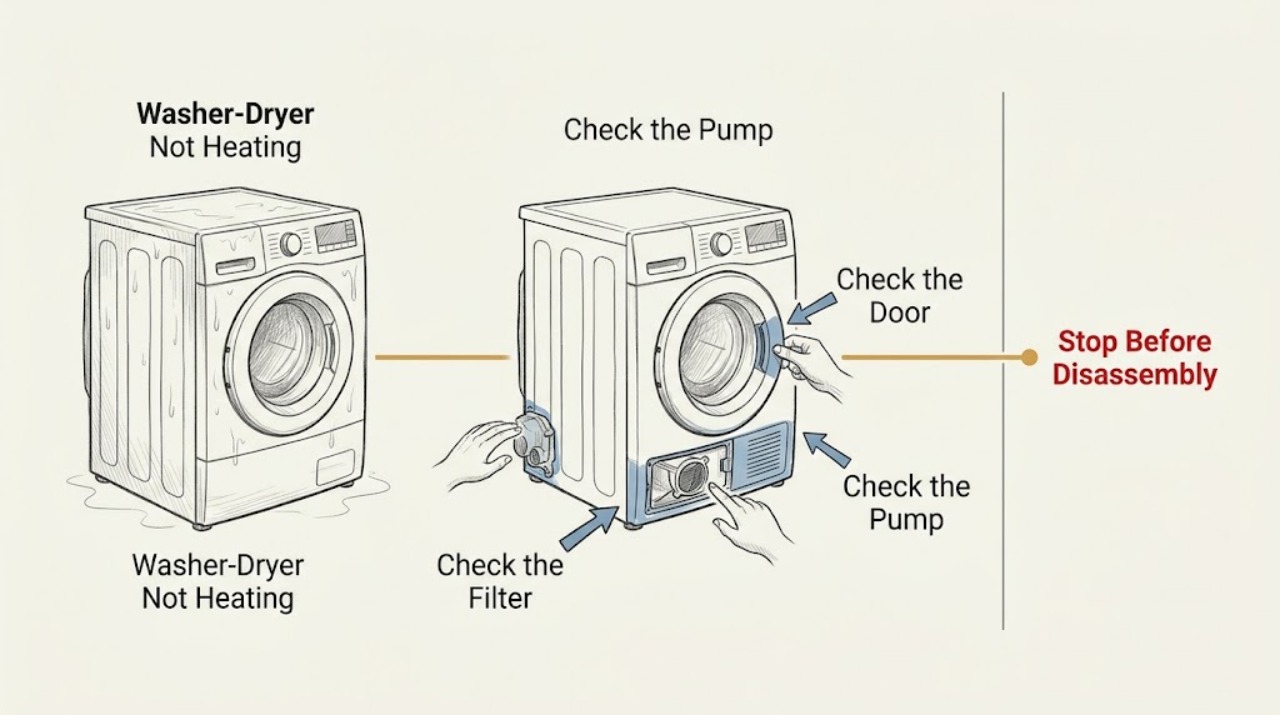
A GE washer-dryer may seem not to heat for two different reasons: a ventless GE Profile UltraFast Combo intentionally dries at a lower, consistent temperature, while a conventional electric dryer can tumble on only partial household power and still fail to heat. First identify which design you have, then choose a true drying cycle and check the load, drainage, visible airflow, and power symptoms that apply to that design. Slightly warm or humid clothes at the end of a ventless Combo cycle can be normal, but very wet clothes, no change in temperature, a fault message, overheating, smoke, burning odor, or a damaged cord is a reason to stop and arrange qualified service.
Work through in order
Diagnostic checks
Use only checks that match the exact appliance or system and its official guide.
-
Check 1
With the appliance idle, read the model label and identify whether this is a GE Profile UltraFast all-in-one Combo with ventless heat-pump drying or a conventional GE electric dryer paired with a washer. Note whether the machine has a normal external exhaust duct and whether the washer portion completes its cycle.
Expected result: The appliance is a ventless all-in-one Combo, or it is a separate or stacked electric dryer with an exhaust duct; the drum may turn even though clothes remain wet or cool.
Next step: Follow the Combo branch for an all-in-one ventless unit. Follow the electric-dryer branch only for a conventional vented electric dryer. If the label or design is unclear, stop at external observations and use the exact model support page before testing further.
Why this matters
Why: The two designs have different normal temperatures and different checks. GE describes the UltraFast Combo as a sealed, ventless low-heat system, while GE's electric-dryer guidance requires a dedicated higher-voltage supply for heat. Drum movement alone does not prove that the heating system is working.
-
Check 2
Select a documented dry cycle rather than a no-heat, air-only, or cool-down option, and avoid repeatedly opening the door during the test. On a ventless UltraFast Combo, allow the cycle to finish, then remove and shake out the clothes before judging their temperature or humidity.
Expected result: A ventless Combo leaves clothes only slightly damp or humid and they feel dry after being shaken, or the clothes remain very damp or wet; on a conventional dryer, the selected cycle may be an air or cool setting instead of a heated dry cycle.
Next step: For a slightly humid but otherwise dry Combo load, try the More Dry option if available and monitor one complete cycle. For very wet clothes, continue to the load, drain, and airflow checks. For a conventional dryer, correct the cycle or temperature setting once and retest.
Why this matters
Why: GE says the UltraFast Combo dries at lower heat in a sealed drum, so slightly cool or humid clothes at the door can be expected. Very wet clothes or a wrong cycle indicate a performance or setup issue rather than proving a failed heater. Opening the Combo repeatedly can also affect drying performance.
-
Check 3
For a GE Profile Combo that leaves laundry wet, inspect the finished load for an out-of-balance spin result and check only the user-accessible pump-filter and drain-hose areas described in the exact model manual. Redistribute a mixed or bulky load, run Rinse and Spin when appropriate, and make sure the visible hose is not kinked or pressed down too far.
Expected result: The spin indicator has reported an imbalance, the load is much wetter than normal, a pump-filter warning appears, the hose is restricted, or the visible drain path is clear but clothes remain wet.
Next step: Correct only the visible load or drain condition using the model-specific instructions, then run one complete supervised cycle. If the drain path is clear and the Combo still leaves clothes very wet, stop repeated tests and arrange service for the drying and drainage systems.
Why this matters
Why: GE explains that an unbalanced load can reduce final spin speed and leave more water in the clothes. It also identifies a clogged pump filter or poor drain installation as causes of wet laundry after drying. These findings can make the load seem as if it never heated, but they do not prove a heat-pump or control failure.
-
Check 4
Only for a conventional GE electric dryer, check from outside that it is on the correct dedicated circuit, then fully switch its supplying breaker off and back on once. With the dryer off and cool, inspect the visible exhaust hose, outside wall cap, front clearance, and lint path for kinks or obstruction; do not remove the rear terminal cover or probe wiring.
Expected result: The breaker was partially tripped, the dryer now heats, the selected circuit or installation does not match the model instructions, airflow is weak or obstructed, or the dryer still tumbles without heat after the external checks.
Next step: If the dryer heats after the single breaker reset or visible airflow correction, monitor one normal load. If the breaker trips again, the cord or connection looks burned or loose, airflow remains poor, or the dryer still does not heat, stop using it and arrange qualified service.
Why this matters
Why: GE states that an electric dryer can tumble on partial power without heating, and that restricted airflow affects drying and can build heat and humidity inside the drum. A restored breaker or cleared visible obstruction points to a supply or airflow condition; persistent no-heat operation needs service rather than internal testing.
-
Check 5
After the applicable external checks, run no more than one supervised cycle and record the model, cycle, load size, drum movement, temperature change, humidity, fault message, and any airflow or drain result. Watch from outside and do not remove panels, access the sealed system, bypass a door or safety device, or work on wiring.
Expected result: There is smoke, a burning odor, a damaged or hot cord, repeated breaker operation, a very hot cabinet, a fault message, a stalled drum, water remaining in the unit, or persistent no-heat or very-wet performance.
Next step: Stop using the appliance for any unsafe or persistent symptom and arrange qualified GE appliance service. Give the technician the model and serial details, cycle, load, symptom timing, fault message, and the checks already completed.
Why this matters
Why: These symptoms cannot be safely separated into a heater, heat-pump, motor, sensor, control, drain, or electrical fault by external observation. Continuing to cycle the appliance can increase damage or risk, while an ordinary low-temperature Combo result without wet clothes may be normal for its design.
Use your observations
Decision map
Find the observation that best matches what you see, then follow the next safe action.
-
PATH 01Safety boundary
What you see
Is this a GE Profile UltraFast all-in-one Combo with ventless heat-pump drying?
Do this next
Judge the result by dryness and cycle completion, not by whether the clothes feel hot. Slight humidity that clears after shaking can be expected; use the More Dry option for a genuinely dry load that needs extra time, then continue with the wet-load and drain checks if needed.
Why this path and its safety boundary
Safety stop: Treat it as a conventional dryer only after confirming the exact model and exhaust design, then follow the separate electric power and airflow branch.
-
PATH 02Safety boundary
What you see
Are clothes very wet rather than merely slightly humid after the Combo cycle?
Do this next
Check for an unbalanced load, a pump-filter warning, and visible drain-hose restrictions using the exact manual. Correct only those user-accessible conditions and run one complete cycle.
Why this path and its safety boundary
Safety stop: If clothes become dry after shaking and the cycle has no fault, the lower warmth of the ventless design is not by itself evidence of no heat.
-
PATH 03Safety boundary
What you see
For a conventional electric dryer, does a complete breaker reset restore heat?
Do this next
Monitor one normal load and have the circuit or appliance checked if the symptom returns.
Why this path and its safety boundary
Safety stop: Do not open the terminal area or measure live wiring; continue only with the visible airflow and setting checks, then arrange qualified service if no heat persists.
-
PATH 04Safety boundary
What you see
Is the visible exhaust path kinked, obstructed, or weak at the outside wall cap on a vented dryer?
Do this next
Stop the dryer, correct only the visible obstruction or arrange appropriate duct cleaning, and retest once after it has cooled. Persistent heat or drying problems need service.
Why this path and its safety boundary
Safety stop: A clear visible exhaust path does not rule out an internal fault; do not remove panels or continue repeated cycles if the dryer still tumbles without heat.
-
PATH 05Safety boundary
What you see
Is there smoke, burning odor, a hot or damaged cord, a repeated breaker trip, a fault message, a stalled drum, or persistent very-wet or no-heat performance?
Do this next
Stop using the appliance and arrange qualified service. Keep the model, serial details, symptom timing, and observations available for the technician.
Why this path and its safety boundary
Safety stop: If the appliance completes a cycle and the result matches the design's documented temperature behavior, monitor it and keep the exact model manual available.
Helpful context
Understand the symptom
Start by identifying the GE design
The words washer-dryer can describe an all-in-one GE Profile UltraFast Combo or a washer paired with a conventional vented dryer. The Combo uses a sealed-drum, ventless heat-pump system and does not behave like a high-heat vented dryer. A conventional electric dryer has a different power and exhaust path. Do not apply the vented-dryer electrical checks to a ventless Combo, and do not assume that clothes must feel hot to prove that the Combo is drying.
What a useful test can and cannot show
Use one supervised drying cycle after the safe external checks and record whether the drum turns, whether the load is slightly damp or genuinely wet, and whether the result changes with the appliance design. These observations narrow the next step; they do not identify a failed heater, compressor, sensor, or sealed-system component. Internal electrical and sealed-system diagnosis belongs to qualified service.
Safety boundary
Stop conditions
- Stop the cycle for smoke, burning odor, a hot or damaged cord, repeated breaker operation, a stalled drum, water leakage, a very hot cabinet, or a fault message.
- Do not remove panels, probe live wiring, access the sealed heat-pump system, bypass a door or safety device, or continue repeated tests to reproduce a fault.
When checks do not resolve it
Need a professional?
Call a qualified appliance technician when the applicable external checks do not restore drying, the conventional dryer still tumbles without heat, the Combo leaves clothes very wet after the drain and load checks, a fault returns, or any electrical, overheating, smoke, odor, cord, or drum-safety symptom appears.
Common questions
FAQ
Should a GE Profile UltraFast Combo feel hot while it dries?
Not necessarily. GE says the ventless Combo dries at a lower, consistent temperature in a sealed drum, so clothes may feel less warm or slightly humid at first. Shake the items out and judge whether they become dry; very wet clothing is a different symptom that warrants the load, drain, and service checks.
Can a conventional GE electric dryer tumble but not heat?
Yes. GE says an electric dryer may run with partial power but will not heat without the full supply required by its model. Check the dedicated circuit and cycle setting from outside, then arrange service if the symptom persists; do not access wiring yourself.
Why are clothes very wet after a GE washer-dryer cycle?
For the UltraFast Combo, an unbalanced load, reduced final spin, a clogged user-accessible pump filter, or a restricted drain installation can leave more water in the clothes. Correct only the visible condition using the exact model instructions and arrange service if the clothes remain very wet.
When should I stop using a GE washer-dryer that is not heating?
Stop for smoke, burning odor, a hot or damaged cord, repeated breaker operation, a very hot cabinet, a stalled drum, a fault message, or persistent no-heat or very-wet performance after the safe external checks. A qualified technician should diagnose internal heating, heat-pump, control, drain, and electrical faults.
Read the exact guide
Official sources
- GE Profile™ UltraFast Combo Washer/Dryer - InstallationGE Appliances · GE Profile UltraFast Combo ventless heat-pump design, dedicated outlet, and installation guidance
- GE Profile™ UltraFast Combo with Ventless Heat Pump Technology Washer/Dryer - FAQsGE Appliances · GE Profile UltraFast Combo normal low-temperature drying behavior and service boundary
- GE Profile™ UltraFast Combo Washer/Dryer - Clothes Not Dry When Drying Cycle is CompleteGE Appliances · GE Profile UltraFast Combo dryness expectations, More Dry option, door openings, spin balance, pump filter, and drain checks
- Electric Dryer - Runs But Does Not HeatGE Appliances · GE electric dryer no-heat power, cycle, airflow, cord, and service guidance
- Dryer - Things To Check For A Venting IssueGE Appliances · GE dryer external airflow, exhaust obstruction, location, heat setting, and performance-test guidance
- GE Profile™ UltraFast Combo Washer/Dryer - Will Not Start or RunGE Appliances · GE Profile UltraFast Combo power, controls, reset, and service-support guidance
Community feedback
Share a repair observation
Share a plain-text repair observation. Accepted observations are published automatically; this page may take a moment to update.