
On this page
Start here
Quick answer
If a Miele washer-dryer leaves clothes damp, first separate a normal moisture-sensing decision from a true drying fault. Check that the load was spun adequately, the drying program matches the fabric mix and load size, and the lint or plinth filters and visible airflow path are clean and completely dry. A small or already-dry load can end a sensor program early. If a fault returns, the appliance overheats, the filters or cooling fins are damaged, or drying remains ineffective after these external checks, stop and contact Miele Service rather than opening the cabinet.
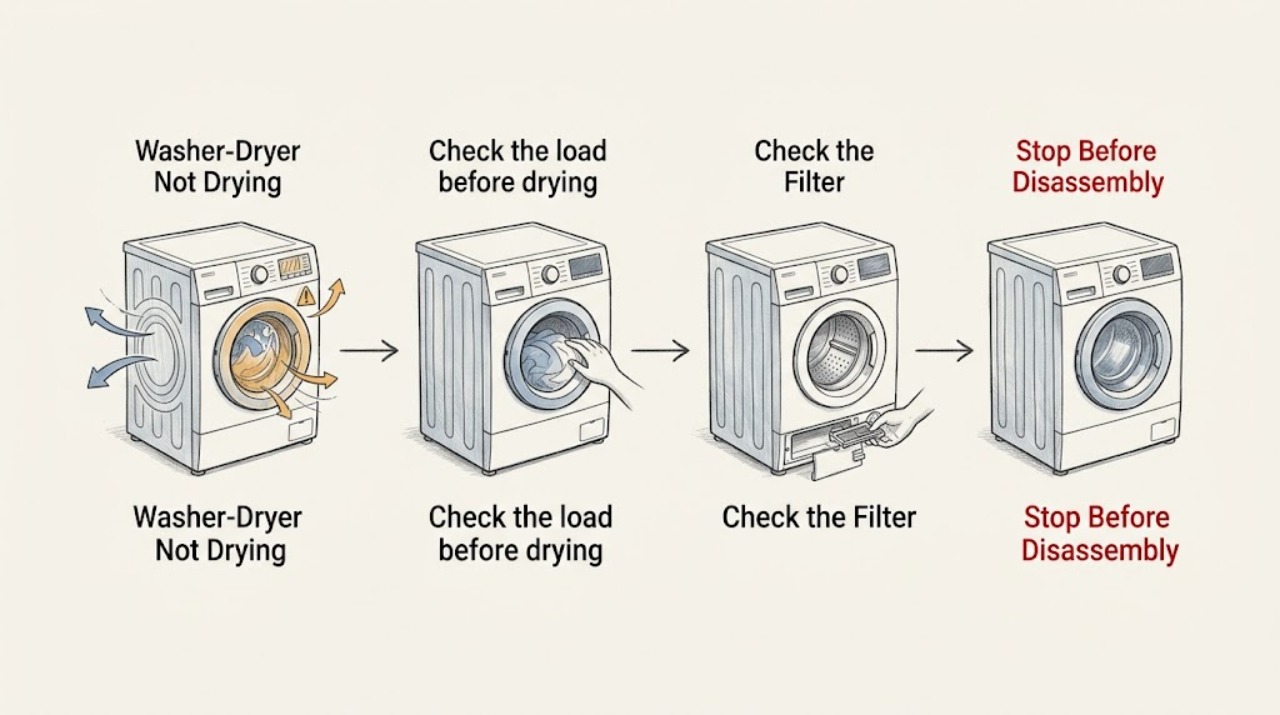
Work through in order
Diagnostic checks
Use only checks that match the exact appliance or system and its official guide.
-
Check 1
Classify the result: note whether the washer-dryer completes a cycle with clothes damp, cancels shortly after drying begins, runs for a long time, or shows a fault message.
Expected result: The program ends early with a small load, runs normally but leaves a full load damp, or stops with a displayed message.
Next step: Use the matching load, filter, airflow, or fault branch below instead of replacing a heater based only on damp clothing.
Why this matters
Why: Different results point toward moisture sensing and load selection, airflow or spin performance, or a technical fault respectively.
-
Check 2
Check the load before drying: separate unlike fabric types, avoid an overloaded drum, and confirm the wash portion extracted as much water as the selected program normally requires.
Expected result: The load is mixed, unusually full, or still very wet after washing, or it is a small load of items that may already be nearly dry.
Next step: Use a program suited to the fabric mix, improve the wash spin within the model's normal options, or use a timed or warm-air program for an individual item when the manual permits.
Why this matters
Why: Miele links insufficient drying to mixed fabrics, excessive load, insufficient spin, and sensor programs that cancel when little drying is needed.
-
Check 3
With the appliance switched off and cool enough to handle, remove and inspect the user-accessible lint or plinth filters. Remove lint, rinse washable filter surfaces as the manual directs, and reinstall every filter completely only after it is dry.
Expected result: A filter is clogged, damp, incorrectly seated, or clean and dry with no visible restriction.
Next step: Correct the filter condition and run one appropriate test load. If the filter is damaged or the fault returns, stop and arrange service rather than operating without it.
Why this matters
Why: Miele warns that soiled or wet filters can cause drying faults and that an incompletely fitted filter can affect operation.
-
Check 4
Check the visible ventilation path: keep the door-area grille and room air path clear, inspect only for accessible lint at the filter and heat-exchanger area, and use a soft vacuum brush lightly where the model instructions allow.
Expected result: Airflow openings are blocked, visible lint is present, the cooling fins look bent or damaged, or the path is clear.
Next step: Remove only loose visible lint using the model's cleaning instructions. Do not touch sharp fins or continue if the fins are damaged; arrange service for damage or persistent restriction.
Why this matters
Why: Miele states that insufficient ventilation, blocked openings, accumulated lint, or damaged cooling fins can prevent proper drying.
-
Check 5
Choose a drying program that matches the fabric and load, then compare a normal mixed load with one suitable test load. If the program cancels quickly, read the display and use the manual's prescribed small-load or timed-drying option.
Expected result: A suitable test load dries better, or the program cancels again even though the load is appropriately damp and sized.
Next step: Keep the successful program for similar loads. If the same cancellation or damp result returns, record the display and move to the service branch.
Why this matters
Why: Program selection and moisture sensing can create an early finish without a heater failure; recurrence with a suitable load suggests sensing or technical trouble.
-
Check 6
If the display names a fault or says to contact service, switch the washer-dryer off, follow the model manual's single power-disconnect and restart procedure, and make one retry only when the appliance is safe.
Expected result: The message clears and the test program completes, or the same message returns or drying remains ineffective.
Next step: Stop repeating resets and contact Miele Service with the exact message, model number, and test result.
Why this matters
Why: Miele documents a restart as a possible response to a technical fault, but a persistent message is not a user-replaceable-part diagnosis.
-
Check 7
Record the model number, drying program, load type and size, wash-spin setting, filter condition, displayed message, and whether the drum feels normally warm during a safe short observation without opening the cabinet.
Expected result: The washer-dryer repeatedly leaves a suitable load damp, stops, overheats, or displays a recurring fault.
Next step: Give the record to Miele Service or an authorized technician. Do not select a part from the symptom alone.
Why this matters
Why: The remaining possibilities include a moisture sensor, airflow or heat-exchanger issue, heater, fan, or control fault that requires model-specific diagnosis.
Use your observations
Decision map
Find the observation that best matches what you see, then follow the next safe action.
-
PATH 01Next step
What you see
A small or nearly dry load ends early without a persistent fault.
Do this next
Use a program intended for the load, such as the model's timed or warm-air option, and compare with a properly damp test load.
Why this path and its safety boundary
Why it matters: Miele explains that moisture-sensing programs can cancel when little drying is required.
-
PATH 02Next step
What you see
A full or mixed load remains damp.
Do this next
Improve the wash spin within normal settings, reduce or sort the load, and select a more suitable drying program.
Why this path and its safety boundary
Why it matters: Load moisture and fabric mix can change the drying result without an internal fault.
-
PATH 03Next step
What you see
Filters or visible airflow openings are dirty, wet, blocked, or damaged.
Do this next
Clean and dry user-accessible filters as directed; stop for damaged fins or a persistent restriction.
Why this path and its safety boundary
Why it matters: Airflow and filter condition directly affect drying and can also cause operational faults.
-
PATH 04Next step
What you see
A fault message or technical-fault message returns after one restart.
Do this next
Stop using the affected drying function and arrange Miele Service with the message and model information.
Why this path and its safety boundary
Why it matters: A recurring fault is beyond a safe user adjustment.
-
PATH 05Next step
What you see
The appliance becomes unusually hot, emits smoke or a burning smell, or a protective device trips.
Do this next
Stop immediately, leave the appliance out of use, and arrange qualified appliance or electrical service.
Why this path and its safety boundary
Why it matters: These are safety boundaries, not drying-performance checks.
Helpful context
Understand the symptom
Damp laundry does not always mean a failed heater
A Miele washer-dryer can finish with damp laundry because the wash load entered drying too wet, the fabric mix or load size does not suit the selected program, the moisture-sensing program decides the load is already dry, or lint and airflow restrictions reduce drying performance. Start with the load and program evidence. Only after those checks fail should an internal heating or sensor fault be considered.
Read the drying result
If a small load ends almost immediately, the sensor may be seeing little moisture rather than the heater failing. If a full mixed load remains damp, program choice, spin result, filters, or airflow are more useful first checks. If an explicit fault or technical-fault message remains after the model's reset procedure, the service boundary has been reached.
Clean only user-accessible areas
Switch the appliance off before removing a lint or plinth filter and avoid sharp cooling fins. Do not open the cabinet, touch internal heater parts, or run the machine with a damaged filter or visible electrical damage. Keep the appliance out of use for smoke, burning smell, unusual heat, or a recurring protective-device trip.
Safety boundary
Stop conditions
- Stop immediately for smoke, sparking, a burning smell, a hot plug or outlet, water near electrical parts, or a protective device that trips again.
- Do not open the cabinet, touch sharp cooling fins, run without a filter, bypass a safety device, or continue using damaged filters or cooling fins.
- Stop after one corrected-load or single restart test if the same damp result or fault returns; record the result and arrange service.
Only after diagnosis
Potential parts
- lint or plinth filter
Consider this category only if the user-accessible filter is damaged and the model manual identifies it as replaceable; a dirty filter should be cleaned first.
Confirm the exact model and filter type in Miele documentation before ordering. - moisture sensing or airflow component
Consider this category only after a suitable load, clean dry filters, clear visible airflow, and one documented restart fail and a technician confirms the fault.
Internal components require model-specific diagnosis and authorized fitment confirmation; do not order from damp laundry alone.
When checks do not resolve it
Need a professional?
Contact Miele Service when a correctly sized and spun load remains damp after clean, dry filters and a suitable program, a program repeatedly cancels, a fault message returns, or airflow components are damaged. Use qualified electrical help for persistent power or protective-device problems.
Have this ready
- Miele model number, program and load details, wash-spin setting, filter and airflow condition, displayed message, and the result of the one corrected test.
Common questions
FAQ
Why does my Miele washer-dryer finish with damp clothes?
Check the wash spin result, load size and fabric mix, drying program, and clean dry filters before assuming an internal heater fault. A suitable load that remains damp after those checks needs service.
Why does the drying program cancel shortly after it starts?
A small or already-dry load can cause a moisture-sensing program to end early. Try a suitable load or the model's timed option; a recurring cancellation with a suitable load needs service.
Can I clean the heat exchanger myself?
Only follow the exact model instructions for user-accessible filters and visible lint. Do not touch sharp cooling fins or continue if they are damaged; arrange service for persistent airflow or drying faults.
Read the exact guide
Official sources
- Miele Tumble Dryer | The tumble dryer program is canceled after a brief period.Miele USA · Miele dryer early program cancellation, load-size, restart, and service guidance
- Miele Washer | Techn. fault, contact Service appears in the display on the washing machine/washer-dryer.Miele USA · Miele washer-dryer technical-fault reset, fault-code, and service guidance
- Customer Assistance for LaundryMiele USA · Miele laundry manuals and service support for washers and tumble dryers
- Miele Tumble Dryer | The laundry is not sufficiently dry. The laundry is too damp.Miele USA · Miele dryer damp laundry, fabric mix, drying program, and residual-moisture setting guidance
- Miele Tumble Dryer | Fault F55 appears on the tumble dryer display. The laundry is still not dry after the maximum drying time of 180 minutes. Only with residual moisture drying program.Miele USA · Miele dryer load size, spin result, lint filter cleaning, filter dryness, and persistent-fault guidance
- Miele Tumble Dryer | --- appears in the tumble dryer display. The program has been interrupted.Miele USA · Miele dryer ventilation, lint filter, heat-exchanger cleaning, cooling-fin safety, and damp-laundry guidance
- Miele Tumble Dryer | Adjust the load and appear on the tumble dryer display. The program has been interrupted. The buzzer sounds.Miele USA · Miele dryer small-load, already-dry laundry, moisture sensing, and technical-fault guidance
Community feedback
Share a repair observation
Share a plain-text repair observation. Accepted observations are published automatically; this page may take a moment to update.