
On this page
Start here
Quick answer
Treat a bad smell from a Monogram oven as a safety-triage issue before a cleaning issue. If it smells like raw gas or rotten eggs, occurs while the oven is off, or comes with hissing, delayed ignition, an abnormal flame, smoke, carbon-monoxide symptoms, sparking, a burning-electrical smell, overheating, or repeated breaker trips, stop using it and leave the area when appropriate; do not light anything, operate electrical switches, or search for a leak, and contact gas or emergency help from a safe location. A slight first-use odor can come from new parts, insulation, or shipping materials, while food, grease, cleaner residue, foil, or a self-clean cycle can cause another odor. Identify the timing and source, let the oven cool, follow only the exact model's care instructions, and arrange qualified service for a persistent, recurring, or unexplained smell.
Work through in order
Diagnostic checks
Use only checks that match the exact appliance or system and its official guide.
-
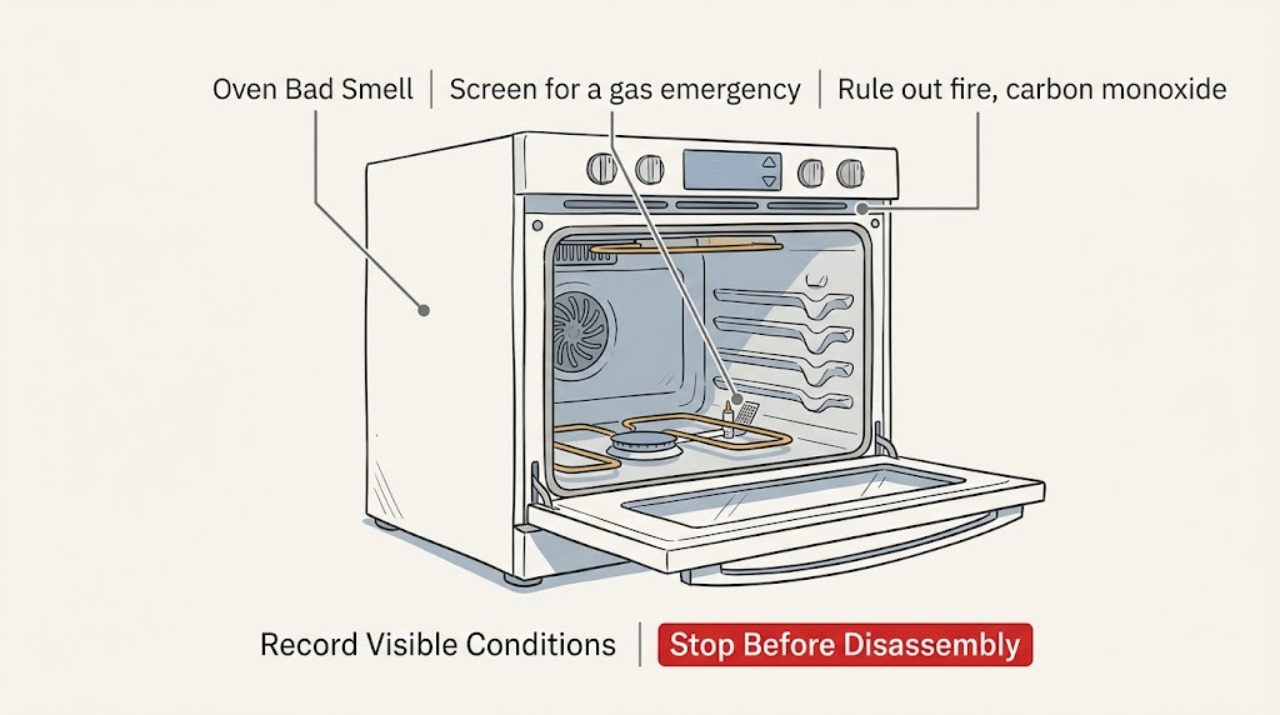
Screen for a gas emergency first
Ask whether the odor resembles raw gas or rotten eggs, is present while the oven is off, or is accompanied by hissing. Do not light the oven or another appliance, do not touch electrical switches, do not use a phone inside, and do not look for the leak. Leave the area and contact the gas supplier or fire department from a safe location.
Expected result: The odor is gas-like, persists with the oven off, is strong or spreading, or the source is uncertain; alternatively, a qualified responder has cleared the area.
Next step: For a suspected leak, stop here and do not re-enter or operate the appliance until the gas or emergency service has cleared it. Continue only after a safe clearance.
Stop if: Stop immediately for gas odor, hissing, an unexplained odor, or any instruction that would require ignition, an electrical switch, or leak searching.
Why this matters
Why: Unburned gas is not a normal oven odor and requires emergency handling rather than a user cleaning or ignition test.
-
Rule out fire, carbon monoxide, and electrical danger
From a safe position, note smoke, flame outside the intended burner area, visible arcing, a hot or damaged control, a burning-electrical smell, a damaged cord, or a breaker that trips again. Leave for fire, heavy smoke, possible carbon monoxide, or an electrical hazard; isolate power only from a dry, safe location if doing so does not approach the hazard.
Expected result: A warning sign is present, or there is no smoke, fire, spark, hot control, burning odor, suspected carbon monoxide, or repeated trip.
Next step: For any warning sign, keep the oven off and obtain emergency or qualified gas, electrical, or appliance help. If none is present, document the smell's timing and location without recreating it.
Stop if: Do not reset a repeatedly tripping breaker, touch damaged wiring, test live electrical parts, or continue a smoking, sparking, or overheating oven.
Why this matters
Why: A smell accompanied by combustion or electrical warning signs is not a normal first-use or cleaning condition.
-
Record the odor's stage and location
After any gas or fire concern is cleared, record whether the smell occurs before use, only during preheat, during Bake or Broil, near the cavity, vent, controls, or cooktop, after shutdown, or during Self-Clean. Record the model number and fuel type. Do not restart a hazardous appliance to reproduce the symptom.
Expected result: The odor is repeatable at a particular stage or location, or it is intermittent and cannot be localized safely.
Next step: Use the matching branch below. If the odor cannot be classified without operating the oven, keep it off and give the timeline to qualified service.
Why this matters
Why: Timing separates new-oven materials, food or grease, self-clean soil, gas combustion, and a heating or electrical fault without assuming a part.
-
Check the first-use and packaging branch
If the Monogram oven is new or has just been installed, wait until it is fully cool and inspect only the visible cavity for shipping tape, packing material, or residue intended to be removed. Ventilate the room and move birds to another well-ventilated room. Follow the exact model's first-use preparation; do not cook food until the manual says it is ready.
Expected result: The smell is slight, began on the first few uses, no gas or electrical warning exists, and it fades with ventilation and the documented preparation.
Next step: Continue only under the exact model manual. If the odor is strong, worsening, persists beyond the expected first-use context, or changes to gas-like or electrical, stop and arrange service.
Stop if: Stop for strong or worsening odor, smoke beyond the documented first-use condition, gas odor, electrical burning smell, abnormal flame, or symptoms.
Why this matters
Why: GE Appliances says a small amount of smoke or odor can come from new parts, insulation, or shipping tape and should dissipate after initial use; this applies to gas and electric ovens.
-
Inspect for food, grease, cleaner, foil, or liner residue
When the oven is completely cool and the safety screen is clear, use a light to inspect accessible cavity surfaces, racks, the door area, and the vent opening for spills, grease, cleaner residue, packaging, foil, or a liner. Do not reach into burners or vents, disturb the gasket, or spray products into openings.
Expected result: A visible residue matches the odor and there is no gas, combustion, or electrical warning; or the cavity is clean but the smell remains near the burner, vent, or controls.
Next step: For clearly identified residue, use the exact model's cool-oven cleaning method. If the source is hidden, recurring, or near controls or a vent, stop using the oven and request service.
Stop if: Do not use chemical cleaner to mask a gas odor, mix cleaning products, line the oven, or remove panels, burners, or the door assembly.
Why this matters
Why: GE Appliances warns that spills and cleaner residue can create smoke or odor and that foil or liners should not be used to catch spillovers; a recurring hidden odor needs service.
-
Handle Self-Clean smoke and odor as a separate branch
If the smell began during Self-Clean, switch the oven Off only through the documented control and ventilate if the room is safe. Do not open the locked door, add cleaner, or restart the cycle until the oven has cooled and the exact manual addresses the condition. If smoke is excessive or flames appear, leave the area as appropriate and obtain help.
Expected result: Only a slight odor or smoke occurred during Self-Clean and subsided with cooling and ventilation, or excessive smoke, flames, or odor continues into ordinary cooking.
Next step: Follow the exact model's Self-Clean preparation and ventilation instructions. For excessive smoke, flames, persistent odor, damaged gasket, or a smell outside Self-Clean, keep the oven off and arrange service.
Stop if: Stop for flames, heavy smoke, fire, gas odor, electrical burning smell, overheating, or a locked door that would require force.
Why this matters
Why: GE Appliances says a small amount of smoke and odor can occur as soil burns off during Self-Clean; excessive smoke is associated with heavy soil or an item left inside and requires stopping the cycle.
-
Separate normal gas combustion from an abnormal gas event
For a gas or dual-fuel Monogram model, use the model manual to identify whether a brief odor occurs only as the burner first ignites and then disappears. Do not treat rotten-egg odor, odor while Off, repeated odor, a boom, delayed ignition, an abnormal or completely yellow flame, soot, or odor that remains after ignition as normal. Do not repeat ignition to check it.
Expected result: A brief, isolated odor occurs only at normal ignition with no delayed combustion or recurrence; or the smell repeats, persists, or is paired with a flame or sound abnormality.
Next step: For any repeated or abnormal event, stop use and contact qualified gas or appliance service. For an active gas odor, leave and contact gas or emergency help from outside the home.
Stop if: Stop for raw-gas odor, hissing, delayed ignition, boom, flare, yellow or unstable flame, soot, smoke, or continuous odor.
Why this matters
Why: GE Appliances distinguishes temporary combustion odor at startup from unburned gas and says delayed ignition, a boom, or abnormal flame needs gas-professional review.
-
Prepare a qualified-service handoff
Keep the oven out of service when the odor persists, returns, or comes from behind the controls or vent. Give the technician the model number, gas or electric configuration, odor description, strongest location, whether the oven was on or off, cycle and stage, smoke or flame observations, recent cleaning or installation, and any code or breaker event. Do not replace a gas or electrical part based on odor alone.
Expected result: The smell cannot be safely classified, returns during ordinary cooking, follows installation or cleaning, or is accompanied by a gas, combustion, electrical, smoke, or heat symptom.
Next step: Request qualified Monogram or appliance service. Use emergency gas or fire help instead for an active gas odor, fire, heavy smoke, carbon-monoxide concern, or electrical hazard.
Stop if: Do not open gas fittings, remove panels, bypass safety devices, perform live electrical tests, or keep operating the oven for more evidence.
Why this matters
Why: Remaining causes can involve the gas supply, regulator, valve, igniter, burner, heating element, sensor, vent, wiring, or control system and require model-specific diagnosis.
Use your observations
Decision map
Find the observation that best matches what you see, then follow the next safe action.
-
PATH 01Next step
What you see
Raw-gas or rotten-egg odor, odor while Off, hissing, delayed ignition, boom, abnormal flame, or soot is present.
Do this next
Do not ignite anything, operate electrical switches, search for a leak, or re-enter to troubleshoot. Leave and contact the gas supplier or fire department from a safe location.
-
PATH 02Next step
What you see
Smoke, fire, visible arcing, burning-electrical odor, overheating, repeated breaker trips, or suspected carbon-monoxide symptoms are present.
Do this next
Stop use, leave as appropriate, and obtain emergency or qualified electrical, gas, or appliance help. Do not reset and retry.
-
PATH 03Next step
What you see
A new oven has a slight first-use odor that fades with ventilation and documented preparation, with no hazard sign.
Do this next
Follow the exact Monogram model instructions and keep food out until preparation is complete; service a strong, persistent, or changing odor.
-
PATH 04Next step
What you see
A cool cavity contains food, grease, cleaner residue, foil, or a liner and no gas or electrical warning exists.
Do this next
Use only the model-approved cleaning method. Do not mix chemicals, use commercial cleaner on a Self-Clean oven, or line the oven.
-
PATH 05Next step
What you see
A slight odor or smoke is limited to Self-Clean and subsides after cooling and ventilation.
Do this next
Treat it as the documented cleaning branch and follow the model manual; excessive smoke, flames, or recurrence outside Self-Clean requires service.
-
PATH 06Next step
What you see
A gas or dual-fuel oven has a brief isolated startup odor with normal ignition and no recurrence or abnormal flame.
Do this next
Follow the exact model manual and do not repeat ignition as a test; service any recurring or abnormal gas event.
-
PATH 07Next step
What you see
The odor persists, returns during ordinary cooking, comes from controls or a vent, or cannot be classified safely.
Do this next
Keep the oven out of service and request qualified Monogram or appliance service with the symptom timeline.
Helpful context
Understand the symptom
Monogram ovens can be gas, electric, or dual-fuel, and the same smell has different implications in each. First separate gas or combustion danger from a first-use, food, cleaner, or self-clean explanation. The installed model's owner manual controls fuel-specific operation, cleaning, and service details.
Do not use Self-Clean as a test for an unexplained odor, keep relighting a gas burner, or remove panels. If the smell is strong, changes character, returns during normal operation, or cannot be safely classified, keep the oven out of service.
When checks do not resolve it
Need a professional?
For an active gas odor, hissing, delayed ignition, abnormal flame, fire, heavy smoke, carbon-monoxide concern, arcing, burning-electrical smell, overheating, or repeated breaker trip, stop use, leave when appropriate, and contact the appropriate emergency, gas, or electrical help from a safe location. Request qualified Monogram or appliance service for any recurring or unexplained odor, an odor near controls or vents, an odor after installation or cleaning, or a smell that does not clear after the exact model's safe care instructions.
Common questions
FAQ
Is a smell from a new Monogram oven normal?
A slight first-use odor or small amount of smoke can come from new parts, insulation, or shipping materials and should dissipate. Follow the exact model preparation and ventilate; stop for gas-like, electrical, worsening, or unexplained odor.
What should I do if my Monogram gas oven smells like rotten eggs?
Do not ignite an appliance, touch electrical switches, search for the leak, or use a phone inside. Leave the area and contact the gas supplier or fire department from a safe location. Do not re-enter until it is cleared.
Can food or cleaner cause a Monogram oven odor?
Yes, but investigate that branch only after gas and combustion danger is ruled out. When cool, inspect accessible surfaces and follow the model-approved cleaning instructions. Do not mix cleaners, use commercial cleaner on a Self-Clean oven, or spray into openings.
Is smoke during Monogram Self-Clean normal?
A small amount of smoke or odor can occur as soil burns off, but excessive smoke or flames require stopping the cycle and allowing the oven to cool. Ventilate and follow the exact model manual; do not use Self-Clean to test an unexplained smell.
When should I stop using a Monogram oven that smells bad?
Stop for gas odor, hissing, delayed ignition, abnormal flame, smoke, fire, carbon-monoxide symptoms, arcing, burning-electrical smell, overheating, repeated breaker trips, or a persistent or unexplained odor. Arrange appropriate emergency or qualified service help.
Read the exact guide
Official sources
- Range & Wall Oven - Use of Commercial Oven Cleaner in Self-Cleaning OvenGE Appliances · Official GE Appliances cleaning guidance; use the exact Monogram model care instructions for manual cleaning.
- Range & Wall Oven - Smoke During Self CleanGE Appliances · Official GE Appliances self-clean guidance; exact Monogram model manual controls the cycle.
- Gas Range - Gas OdorsGE Appliances · Official GE Appliances gas-cooking guidance applied to a Monogram gas oven when the fuel branch is confirmed.
- Range & Wall Oven - Tips for Self CleanGE Appliances · Official GE Appliances self-clean support; exact Monogram model manual determines permitted racks and cycle details.
- Gas Range - What is Normal Operation vs What Requires ServiceGE Appliances · Official GE Appliances guidance used for gas-oven branch distinctions; exact model and fuel conversion still control.
- Range & Wall Oven - Smoke and Odor from a New OvenGE Appliances · Official GE Appliances support guidance covering gas and electric ovens; the exact Monogram model manual controls.
Community feedback
Share a repair observation
Share a plain-text repair observation. Accepted observations are published automatically; this page may take a moment to update.