
On this page
Start here
Quick answer
First confirm whether the Monogram appliance is a gas or dual-fuel range with a gas oven; a fully electric wall oven should not be treated as a gas appliance. A brief odor at startup can be combustion odor, but a rotten-egg or sulfur-like odor, hissing, an odor that persists after ignition, delayed ignition, an unusual flame, smoke, or suspected carbon-monoxide exposure is not a routine adjustment. Stop using the oven. Do not light anything, operate switches or controls, search for the leak, or repeat the test. Leave the area when the odor is strong or uncertain, then contact the gas supplier or emergency service from a safe location. A qualified technician must diagnose burners, igniters, valves, regulators, and combustion or venting faults; do not open the range or attempt a gas-line repair.
Before you begin
Safety first
- Keep the oven off for persistent or abnormal gas odor. Do not open the cabinet, move the range across a gas connection, test live gas fittings, use a flame to find a leak, repeat ignition, or restart after an emergency until cleared by the responsible qualified professional.
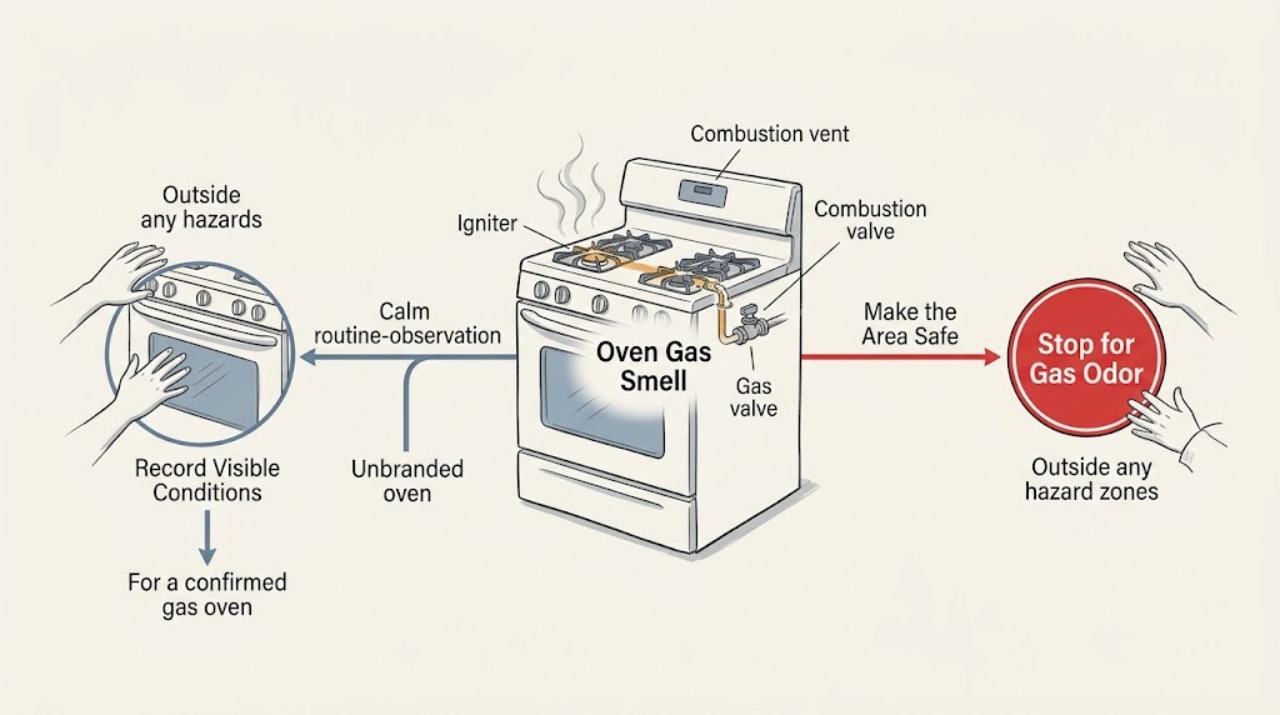
Work through in order
Diagnostic checks
Use only checks that match the exact appliance or system and its official guide.
-
Check 1
If any gas-like odor is present, stop the oven and do not ignite or relight anything. Without operating switches, controls, fans, or nearby equipment, note whether the odor is strong, whether you hear hissing, whether there is smoke or a boom, and whether anyone has headache, dizziness, nausea, confusion, or breathing trouble.
Expected result: The odor is strong or uncertain, hissing or smoke is present, there was a delayed ignition or boom, an unusual flame is visible, or anyone feels unwell.
Next step: Leave the building or affected area immediately, warn others without creating a spark, and call emergency services or the gas supplier from a safe location away from the odor. Do not re-enter until authorities or the gas supplier says it is safe.
Why this matters
Why: This may be an active gas, combustion, fire, or carbon-monoxide emergency rather than a short startup odor.
-
Check 2
If there is no emergency symptom, let the appliance remain off and cool. Read the model label and owner manual to determine whether the oven is gas, dual-fuel, or electric, and record the selected mode, whether the odor came from the oven cavity, vent, cooktop, or room, and when it began.
Expected result: The model has a gas oven burner, is dual-fuel, has no gas system, or the fuel type cannot be confirmed.
Next step: Use only the matching branch. If the model or fuel type is unclear, keep the appliance off and provide the full model number to Monogram or a qualified appliance technician.
Why this matters
Why: Fuel type controls whether ignition, burner, gas-valve, and combustion checks are relevant. An unconfirmed fuel system should not be tested by trial.
-
Check 3
For a confirmed gas oven with no strong or persistent odor, compare the event with the start sequence described by the exact manual: note whether ignition is prompt, the flame becomes stable, and the odor fades promptly as the oven heats. Do not repeat a failed ignition or continue operating merely to time the odor.
Expected result: A brief odor occurs only at startup and fades as a stable flame forms, or the odor persists, returns after the burner lights, or is accompanied by repeated clicking, delayed ignition, a boom, or an unstable flame.
Next step: Treat only the brief, fading pattern as a recordable observation and ask service to confirm it if it recurs. Stop using the oven and arrange qualified service for any persistent odor or abnormal ignition; do not adjust gas components.
Why this matters
Why: A brief startup odor can be a combustion behavior described by GE, but persistent unburned-gas odor or abnormal ignition indicates a burner, igniter, valve, supply, or combustion fault.
-
Check 4
With the appliance off and cool, inspect only visible, user-accessible surfaces for food or grease residue, recently removed packing material, a blocked oven vent opening, or a spill near the burner area. Do not remove burner assemblies, reach into the gas path, move the range, or use an open flame to locate a leak.
Expected result: The smell clearly follows a cool food or packing-material residue and stops after safe surface cleaning, or it comes from the gas path, returns with ignition, or cannot be located without disassembly.
Next step: Clean only cool visible surfaces using the exact manual's method and do not operate until all residue is removed. If the odor returns, persists, or requires moving or opening the appliance, stop and call qualified service.
Why this matters
Why: A residue smell may be non-gas contamination, but a recurring odor linked to ignition or an inaccessible source remains a gas or combustion concern.
-
Check 5
After the area has been cleared and only from a safe location, preserve evidence for the technician: record the exact model and fuel, the mode and ignition sequence, whether the cooktop burners were off, the odor character, flame appearance if safely observed before evacuation, any code, and whether the smell occurred with the oven off or only during operation.
Expected result: The record shows an odor with the oven off, a recurring startup failure, delayed ignition, an abnormal flame, a venting concern, or a one-time brief odor with no recurrence.
Next step: Give the record to the gas supplier or qualified appliance technician. Do not run another cycle to collect more evidence, and do not infer a failed part from the odor alone.
Why this matters
Why: Timing separates an external or supply-side odor from ignition and combustion behavior, but it does not prove that a gas component is safe for user repair.
-
Check 6
If there is no gas emergency but the odor is actually burning, hot plastic, electrical, or smoke-like, keep the oven off and inspect only from a distance for visible smoke, a hot control area, damaged cord or outlet, or an overheated cabinet; do not touch hot surfaces or operate an electrical control to test it.
Expected result: Smoke, arcing, a hot outlet, melting material, uncontrolled heating, or a repeated breaker trip is present.
Next step: Leave the appliance off, keep clear, and isolate power only if it can be done from a safe, dry location without entering the hazard. Arrange qualified service or emergency help; do not restart the oven.
Why this matters
Why: This is an electrical or fire hazard that can coexist with or be mistaken for a gas odor.
Use your observations
Decision map
Find the observation that best matches what you see, then follow the next safe action.
-
PATH 01Next step
What you see
A confirmed gas oven has a brief startup odor that fades as prompt ignition produces a stable flame, with no hissing, delayed ignition, smoke, symptoms, or recurrence.
Do this next
Follow the exact Monogram manual and local ventilation requirements. If the pattern becomes stronger, lasts longer, returns when the oven is off, or changes to a sulfur-like odor, stop immediately and escalate.
Why this path and its safety boundary
Why it matters: GE Appliances describes a short startup odor as possible combustion odor, but this observation does not authorize gas-component repair.
-
PATH 02Next step
What you see
The odor is rotten-egg or sulfur-like, strong, persistent, present while the oven is off, or accompanied by hissing.
Do this next
Do not light anything, operate electrical switches or appliance controls, search for the leak, or use the oven. Leave immediately when the odor is strong or uncertain, then contact the gas supplier or emergency service from a safe location.
Why this path and its safety boundary
Why it matters: Unburned gas or another gas-supply leak is possible and cannot be safely diagnosed by the user.
-
PATH 03Next step
What you see
The oven clicks repeatedly, ignites late, produces a boom, will not maintain a stable flame, or has an unusual flame color or pattern.
Do this next
Stop using the oven and arrange qualified appliance or gas service. Do not adjust shutters, remove burners, relight repeatedly, or continue operating to observe the flame.
Why this path and its safety boundary
Why it matters: An ignition, burner, gas-valve, supply, or combustion problem is possible; incomplete combustion can create carbon monoxide and soot.
-
PATH 04Next step
What you see
The smell is limited to a cool food spill, packing material, or cleaning residue and stops after safe visible-surface cleaning without any gas pattern.
Do this next
Remove the residue only when cool and with the exact manual's method. Stop and request service if odor returns during heating, comes from the vent or burner area, or cannot be separated from gas odor.
Why this path and its safety boundary
Why it matters: The source may be non-gas contamination, but the oven still requires a model-appropriate cleaning method and a cautious return to use.
-
PATH 05Next step
What you see
The appliance is electric or the fuel type cannot be confirmed, but a gas-like odor is reported nearby.
Do this next
Do not operate the oven or search for the source. Leave if the odor is strong or uncertain and contact the gas supplier or emergency service from a safe location; provide the oven model to service separately.
Why this path and its safety boundary
Why it matters: The odor may come from another gas appliance, supply line, or building source; the electric oven identity does not make the area safe.
-
PATH 06Next step
What you see
Smoke, burning or electrical odor, arcing, excessive heat, a hot outlet, carbon-monoxide symptoms, or a repeated breaker trip occurs.
Do this next
Stop immediately, leave or keep clear as the hazard requires, isolate power only from a safe location when possible, and obtain emergency or qualified service help. Do not restart to test.
Why this path and its safety boundary
Why it matters: Continued operation could cause fire, shock, poisoning, or equipment damage.
Helpful context
Understand the symptom
A Monogram oven may be gas, dual-fuel, or electric
The topic label alone does not identify the fuel system. Use the model label and the exact owner manual to confirm whether the oven burner is gas-fired, whether the range is dual-fuel, and whether a gas supply is present. Monogram model support pages identify specific all-gas ranges and their owner manuals, while wall ovens may be electric. Do not apply gas-burner checks to an electric model or assume that a surface-burner odor came from the oven.
Separate brief startup odor from an unsafe gas odor
GE Appliances says an unusual odor can be noticed when a gas oven first starts and should go away within a few minutes as the oven heats. That does not make an unburned-gas odor safe. A rotten-egg or sulfur-like smell, hissing, repeated clicking without a stable flame, delayed ignition or a boom, an abnormal flame, smoke, or symptoms such as headache, dizziness, nausea, or confusion requires immediate stop and escalation. Carbon monoxide has no odor, so do not use the absence of a smell as proof that combustion is safe.
Do not find a gas leak by testing the appliance
Monogram's manual says finding a gas leak is not a do-it-yourself procedure and warns against using an open flame. Do not remove panels, loosen fittings, test a valve, relight a burner, or use a meter or detector as a substitute for qualified diagnosis. The safe user task is to recognize the pattern, stop operation, preserve the model and symptom details, and obtain help.
Safety boundary
Stop conditions
- For a strong, persistent, or uncertain gas odor, hissing, delayed ignition, a boom, or an abnormal flame, stop immediately, leave the area, and call the gas supplier or emergency service from a safe location. Do not use flames, switches, appliance controls, or any device that could create a spark.
- Do not search for a gas leak, use an open flame, remove panels, loosen fittings, adjust burner air settings, bypass an ignition safety device, or repeatedly relight the oven.
- Stop for smoke, burning or electrical odor, arcing, carbon-monoxide symptoms, uncontrolled heating, a hot outlet, or a repeated breaker trip. Keep clear and isolate power only from a safe, dry location when possible.
- Do not return to a gas-odor area until the gas supplier or emergency authority says it is safe. Do not rely on the absence of odor to rule out carbon monoxide, and do not treat an unconfirmed electric or dual-fuel identity as permission to test.
Only after diagnosis
Potential parts
- oven igniter or spark ignition component
Consider this only after qualified diagnosis links delayed ignition, repeated clicking, or failure to ignite to the model-specific ignition component.
Ignition systems differ across Monogram gas and dual-fuel models. Confirm the exact model and service diagnosis before any part selection. - oven burner assembly
Consider this only when qualified inspection identifies a damaged, blocked, or incorrectly operating burner as the source of the abnormal flame or combustion symptom.
Do not clean, adjust, or replace a gas burner from appearance alone. Verify the exact model, fuel conversion, and professional installation requirements. - oven gas valve or regulator
Consider this only when qualified diagnosis identifies a valve, regulator, or pressure-control fault after the supply and ignition sequence are assessed.
Gas-path components are safety-critical and model-specific. Do not order or fit one without qualified diagnosis and exact manufacturer fit confirmation.
When checks do not resolve it
Need a professional?
Request service when the smell recurs, lasts beyond the startup event, appears while the oven is off, follows abnormal ignition, or requires access behind panels or to gas components. Use emergency gas help for a strong or uncertain gas odor, hissing, smoke, or symptoms.
Safety scope: Keep the oven off for persistent or abnormal gas odor. Do not open the cabinet, move the range across a gas connection, test live gas fittings, use a flame to find a leak, repeat ignition, or restart after an emergency until cleared by the responsible qualified professional.
Common questions
FAQ
Is a smell when a Monogram gas oven starts always a leak?
No. GE Appliances describes a short startup odor that fades as a gas oven heats, but a rotten-egg or sulfur-like odor, persistence, hissing, delayed ignition, or an abnormal flame is not a normal user-adjustment issue. Stop and escalate rather than repeating the start test.
Can I test a Monogram oven gas leak with a flame or by removing a panel?
No. The Monogram manual says gas-leak finding is not a do-it-yourself procedure and prohibits using an open flame to locate a leak. Leave the area for a strong or uncertain odor and contact the gas supplier or emergency service from a safe location.
Could a gas odor come from another appliance if my Monogram oven is electric?
Yes. Confirm the oven fuel type from its model label and manual; a gas-like odor near an electric oven may come from another appliance or the building supply. Do not search for the source. Use the gas-emergency procedure if the odor is strong or uncertain.
Read the exact guide
Official sources
- User Manual & Care for ZGP486NDNSSGE Appliances · The listed ZGP486NDNSS model only; use the exact model page for another Monogram appliance.
- Gas Supply DisruptionsNew York City Emergency Management · General household gas and carbon-monoxide safety guidance; local emergency procedures control.
- 49-80073 Monogram Range Owner's ManualGE Appliances · Specific Monogram professional range manual; fuel system, controls, and service steps vary by model.
- Gas Range - Gas OdorsGE Appliances · Gas range guidance; apply only when the Monogram appliance has a gas oven or gas range system and confirm the exact manual.
- What To Do If You Smell Natural GasConnecticut Public Utilities Regulatory Authority · General gas-safety guidance; local gas supplier and emergency procedures control.
- Recognizing and Responding to Pipeline EmergenciesU.S. Department of Transportation Pipeline and Hazardous Materials Safety Administration · General natural-gas emergency guidance in the United States; local emergency and gas-supplier instructions also apply.
Community feedback
Share a repair observation
Share a plain-text repair observation. Accepted observations are published automatically; this page may take a moment to update.