
On this page
Start here
Quick answer
A Monogram refrigerator that trips a breaker may have a household circuit problem or an appliance fault. Note when the trip occurs, inspect only the plug and outlet for visible damage, and reset the breaker no more than once if it can be done safely. If it trips again, smells hot, shows smoke, or has water near electricity, leave it off and call a qualified electrician or appliance technician.
Before you begin
Safety first
- Do not increase breaker size, bypass grounding, use an adapter, remove covers, or repeatedly reset a tripping circuit.
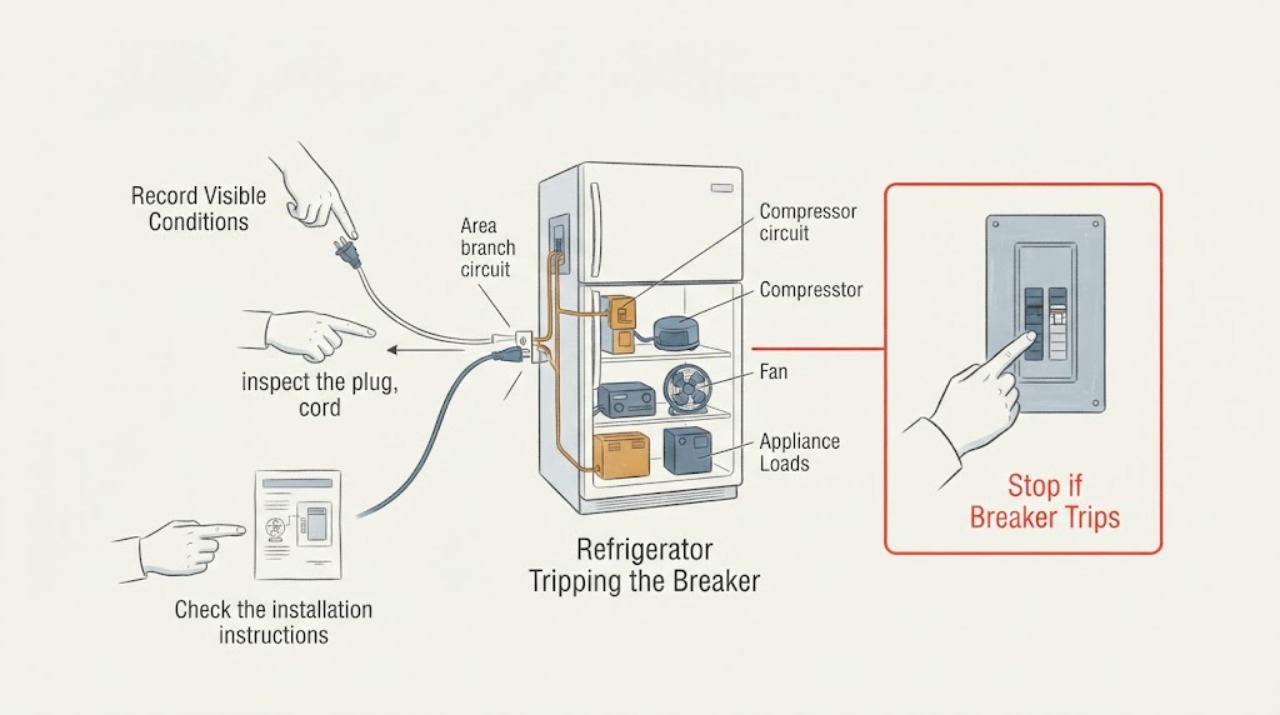
Work through in order
Diagnostic checks
Use only checks that match the exact appliance or system and its official guide.
-
Check 1
Record whether the breaker trips immediately when the refrigerator is connected, when cooling starts, after a delay, or only when another appliance runs on the same circuit.
Expected result: The trip is immediate, delayed during operation, or tied to other household loads.
Next step: Do not repeat the test. Continue only with a visual inspection and the circuit documentation.
Why this matters
Why: An immediate trip can indicate supply or appliance-side fault; a load-dependent trip raises circuit capacity concerns; timing alone cannot identify a component.
-
Check 2
From a dry position, inspect the plug, cord, and receptacle face for scorching, looseness, cracking, moisture, or heat. Do not remove the receptacle cover or use an adapter.
Expected result: Damage, moisture, or heat is present, or the exterior looks normal.
Next step: Leave the circuit off for damage or moisture and arrange qualified electrical service; do not touch wet components.
Why this matters
Why: Visible damage or moisture is an immediate safety condition; a normal exterior does not rule out an internal fault.
-
Check 3
Check the installation instructions or rating plate for the required individual grounded circuit and compare it with the household circuit label, without opening the panel.
Expected result: The refrigerator shares a circuit, the rating information is unavailable, or the installation matches the documented supply.
Next step: Have an electrician verify the circuit rather than changing breaker size yourself.
Why this matters
Why: A shared or incorrect circuit can overload or nuisance-trip; matching supply shifts attention to appliance diagnosis.
-
Check 4
If power is restored safely, note whether the refrigerator cools normally, makes repeated clicks, or trips again as the compressor or fan runs. Stop immediately for smoke or burning odor.
Expected result: It runs without another trip, trips on startup, or shows a safety warning.
Next step: Arrange service for any repeat or warning and provide the timing pattern; do not bypass the breaker.
Why this matters
Why: A stable run after one event does not prove the issue resolved; repeat trip or warning means the protection boundary remains active.
Use your observations
Decision map
Find the observation that best matches what you see, then follow the next safe action.
-
PATH 01Next step
What you see
The breaker trips immediately even with the refrigerator disconnected
Do this next
Leave the circuit alone and have an electrician diagnose it.
Why this path and its safety boundary
Why it matters: The household circuit or breaker is more likely than the appliance.
-
PATH 02Next step
What you see
The breaker trips only when the refrigerator starts or runs
Do this next
Do not keep resetting it; arrange appliance and electrical diagnosis.
Why this path and its safety boundary
Why it matters: An appliance-side fault or circuit interaction remains possible.
-
PATH 03Next step
What you see
The plug or outlet is hot, wet, scorched, or loose
Do this next
Keep away from the affected area and call a qualified electrician.
Why this path and its safety boundary
Why it matters: The external supply is unsafe regardless of refrigerator operation.
Helpful context
Understand the symptom
When the breaker trips matters
A trip at plug-in, during compressor startup, or after running for a while narrows the observation, but none proves a particular failed part. Protection devices should be treated as a boundary, not bypassed.
When checks do not resolve it
Need a professional?
Arrange qualified electrical or Monogram service after any repeat trip, immediate trip under a verified circuit, cord/outlet damage, smoke, burning odor, or water near electrical parts.
Safety scope: Do not increase breaker size, bypass grounding, use an adapter, remove covers, or repeatedly reset a tripping circuit.
Have this ready
- Provide model number, trip timing, circuit-sharing details, visible plug/outlet condition, and any click, odor, heat, or leak.
Common questions
FAQ
Can I reset the breaker one more time to see if the refrigerator works?
Only one safe reset may be documented. If it trips again, stop; repeated resets can hide an electrical fault and are not a repair.
Does a refrigerator always cause the breaker to trip if its compressor is bad?
No. Trip timing can suggest where to investigate, but it cannot prove a compressor fault. Qualified electrical and appliance diagnosis is required.
Read the exact guide
Official sources
- GE Appliance - Circuit Breaker TripsGE Appliances · Refrigerators and other household appliances
- Refrigerator - Electrical Requirements and Breaker SizeGE Appliances · Refrigerators, compact refrigerators, wine chillers, beverage centers, and standalone icemakers
- Refrigerator - Unusual NoisesGE Appliances · Refrigerators with compressor and fan systems
- Monogram Site MapMonogram · Monogram appliances; exact manual and feature set are model-specific
Community feedback
Share a repair observation
Share a plain-text repair observation. Accepted observations are published automatically; this page may take a moment to update.