
On this page
Start here
Quick answer
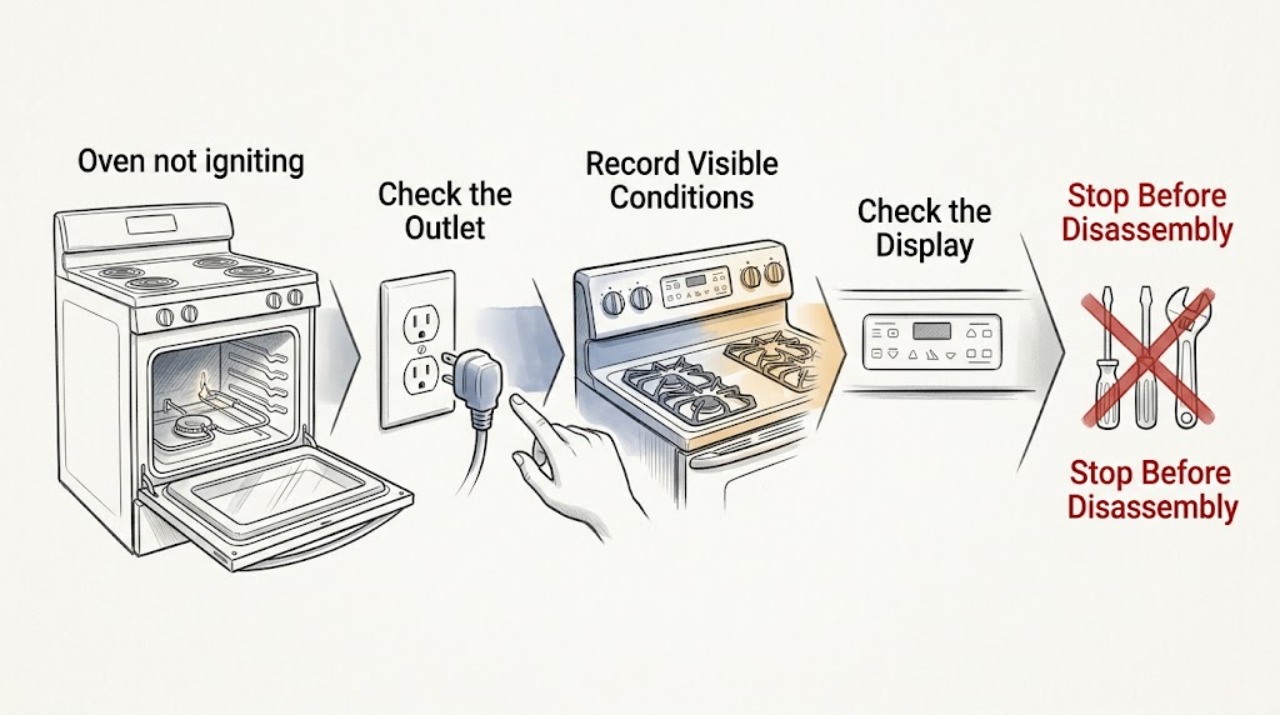
First confirm that this is a gas oven and separate no power, no start command, no gas or ignition response, and delayed ignition. If you smell gas, hear a delayed bang, see an abnormal flame, smoke, soot, arcing, or a carbon-monoxide alarm, turn the control off only if safe, leave the area, and contact gas or emergency help from outside; do not use a match, test for a leak, or retry the oven. If there is no hazard, verify the documented mode, temperature, door and power state, note whether surface burners respond, and make no more than one normal start observation from a safe position. A gas oven depends on electricity for controls and ignition, and a burner that does not ignite promptly or repeatedly needs qualified service.
Work through in order
Diagnostic checks
Use only checks that match the exact appliance or system and its official guide.
-
Check 1
Before another start, check from a safe position for gas odor, smoke, soot, a loud pop, an unusual flame, continuous clicking without ignition, visible arcing, a hot cord or outlet, or a carbon-monoxide alarm. If any is present, stop the check.
Expected result: A persistent odor, delayed bang, smoke, soot, abnormal flame, arcing, or alarm is a hazard rather than a normal ignition symptom. No hazard sign permits only limited external observation.
Next step: Turn the control off only if safe, do not use a flame or operate switches in the hazard area, leave if needed, and contact gas or emergency help from outside. Do not test for a leak or retry the oven.
Why this matters
Why: Unburned gas, abnormal combustion, fire, electric shock, or carbon-monoxide exposure can worsen when ignition is repeated.
-
Check 2
Confirm the appliance type from its rating label or manual: this article applies to a gas oven, not a purely electric or induction appliance. Record the brand, model, fuel type, cavity, and whether the display, clock, or preheat indicator responds.
Expected result: A dark display or absent control response supports a power or control-state branch. A responsive control with no flame supports an ignition or gas-supply branch. An electric oven has different heating hardware and should follow its own manual.
Next step: Keep the model information with the service request and do not apply a gas procedure to an electric oven or vice versa.
Why this matters
Why: Fuel and model identity determine which ignition sequence and safety instructions apply; guessing can lead to an unsafe test.
-
Check 3
With no odor, smoke, moisture, damage, or repeated breaker trip, verify the documented Bake or Broil function, temperature, Start control, and fully closed door from outside the appliance. Do not force a knob, bypass a lock, or open a panel.
Expected result: A valid mode and preheat response mean the control is calling for heat. No response after the documented sequence points toward power, control, door, lock, or model-specific state rather than proving an ignitor fault.
Next step: Record the mode, display, indicator, door state, and any code. Use the exact model manual or arrange service rather than improvising a start method.
Why this matters
Why: A gas oven cannot ignite safely if the controls or electrical supply have not initiated the normal sequence.
-
Check 4
If power is stable and no hazard sign is present, check the normal external power connection and clearly labeled breaker or fuse from a dry, safe position. If the circuit has tripped, restore it only once if the appliance and outlet show no damage; do not open the electrical panel.
Expected result: A blank display or absent ignition after an outage supports a power or control-state branch. A breaker that trips again, a hot outlet, or a damaged cord is an electrical fault, not a normal reset condition.
Next step: Leave the oven off and arrange electrician or appliance service for repeated trips, heat damage, arcing, or a dead circuit. Never manually light an oven because power is unavailable.
Why this matters
Why: Gas-oven controls and ignition commonly depend on electricity, while repeated interruption can indicate an appliance or wiring fault.
-
Check 5
From outside the appliance, note whether surface burners work, whether only Bake or only Broil fails, whether the oven was recently installed or reconnected, and whether the gas supply or fuel conversion changed. Do not adjust a regulator, disconnect a line, or move the range.
Expected result: Cooktop burners working while the oven fails can still be consistent with an oven-specific shutoff or ignition problem. Failure of all burners suggests a wider gas or power issue; recent installation or conversion makes configuration and supply verification important.
Next step: Record the affected functions and installation history. Give them to a qualified appliance professional or gas-safety provider; do not continue testing a suspected supply problem.
Why this matters
Why: Scope and history narrow the professional handoff without exposing the user to gas-line or internal electrical work.
-
Check 6
When there is no gas odor or other hazard, make one normal documented start observation from a safe position and note whether an ignition glow or flame appears promptly, whether clicking continues, and whether a flame is delayed or abnormal. Do not add a flame, hold a valve open, or repeat the start.
Expected result: A prompt normal flame supports a normal start sequence. No flame, persistent clicking, gas without prompt ignition, a delayed bang, or an unusual flame supports an ignition, valve, control, or supply fault and requires stopping.
Next step: Turn the control off if safe and leave the oven unused if ignition does not occur promptly or any abnormal sign appears. Arrange qualified appliance service and report the timing and sound.
Why this matters
Why: Timing and sound distinguish a commanded-but-unlit burner from a simple control issue without repeated gas release.
-
Check 7
Prepare a service handoff with the model and serial information, gas or dual-fuel identity, selected function, display response, breaker or outage history, surface-burner response, ignition timing, clicks or bang, flame appearance, odor, smoke, and any recent installation work.
Expected result: A precise record can distinguish no-power, no-command, supply, ignition, delayed-ignition, door, and function-specific patterns without the user naming an unverified part.
Next step: Arrange qualified appliance service. For odor, smoke, abnormal combustion, fire, a carbon-monoxide alarm, or immediate electrical danger, obtain emergency or gas-safety clearance first and do not reuse the oven.
Why this matters
Why: Internal gas and electrical diagnosis requires model-specific tools and training, and the exact safe repair cannot be chosen from symptoms alone.
Use your observations
Decision map
Find the observation that best matches what you see, then follow the next safe action.
-
PATH 01Next step
What you see
There is gas odor, gas release without ignition, a delayed bang, smoke, soot, an abnormal flame, a carbon-monoxide alarm, visible arcing, or a hot damaged cord.
Do this next
Arrange qualified service and follow the exact model guidance.
Why this path and its safety boundary
Why it matters: Treat it as an emergency: turn the control off only if safe, avoid flames and electrical switches in the hazard area, leave, and contact gas or emergency help from outside. Do not retry or search for the leak.
-
PATH 02Next step
What you see
The display is blank, no controls respond, or the circuit trips.
Do this next
Arrange qualified service and follow the exact model guidance.
Why this path and its safety boundary
Why it matters: Treat it as a power or control branch. Perform only the safe external check and one permitted reset; if power does not return or the breaker trips again, leave the oven unused and arrange electrical or appliance service.
-
PATH 03Next step
What you see
The display responds but the oven does not begin the documented Bake or Broil sequence.
Do this next
Arrange qualified service and follow the exact model guidance.
Why this path and its safety boundary
Why it matters: Check mode, temperature, Start, door, and model-specific lock or timer state. If the normal sequence still does not begin, stop and arrange qualified service.
-
PATH 04Next step
What you see
The oven calls for heat but no flame appears, clicking continues, or ignition is delayed.
Do this next
Arrange qualified service and follow the exact model guidance.
Why this path and its safety boundary
Why it matters: Turn the control off if safe, do not repeat the attempt, and leave the oven unused. Arrange qualified gas-appliance service for the ignition, control, valve, or supply path.
-
PATH 05Next step
What you see
Only Bake, only Broil, or the oven fails while surface burners respond.
Do this next
Arrange qualified service and follow the exact model guidance.
Why this path and its safety boundary
Why it matters: Record the affected function and arrange service. A working cooktop does not prove the oven ignition path is safe, and the user should not adjust a regulator or open the appliance.
Helpful context
Understand the symptom
“Not igniting” can mean the display is dark, the controls do not call for heat, the oven has power but no burner response, or gas is released without prompt ignition. The safe diagnosis starts with the appliance identity and visible behavior, not with removing a burner or changing a gas setting. Surface burners may have a different supply path from the oven, so a working cooktop does not prove that the oven ignition path is safe.
Do not open the oven, control panel, regulator, burner path, or electrical enclosure to inspect an ignitor or valve. Fuel-burning equipment can create carbon monoxide when it is faulty or improperly used; the CPSC says fuel-burning appliances should be serviced by people with the proper knowledge, skill, and tools.
Safety boundary
Stop conditions
- Stop immediately for gas odor, failed ignition after gas release, delayed bang, abnormal flame, smoke, soot, carbon-monoxide alarm or symptoms, arcing, electric shock, hot or damaged cord, fire, or repeated breaker interruption.
- Do not use a match or lighter, test for a leak, manually light the oven, hold a gas valve open, adjust gas pressure, disconnect a gas line, move the appliance, open a panel, remove the burner or ignitor, or repeatedly cycle the control.
- Keep the oven out of service when it fails to ignite promptly, ignition is delayed, the display or circuit is abnormal, a code returns, fuel type is uncertain, or any internal gas or electrical fault is suspected.
Common questions
FAQ
Why does my gas oven not ignite when the cooktop works?
The oven has its own control and ignition path, and some ranges can have an oven-specific gas shutoff or ignition fault while surface burners work. Record the mode, timing, sound, and flame response, then stop and arrange service if ignition fails or is delayed.
Can I light a gas oven with a match?
Do not improvise manual lighting or use a flame to test it. The safe procedure depends on the exact model and fuel system; keep the oven off and follow the manual or qualified service guidance.
What should I do if the oven clicks but does not light?
Do not keep cycling the control. If there is odor, a bang, smoke, an abnormal flame, or continued gas release, leave and seek gas-safety or emergency help from outside. Otherwise turn the control off, keep the oven unused, and arrange qualified service.
Read the exact guide
Official sources
- Oven Not Working - Gas and Dual Fuel RangeWhirlpool Product Help · Manufacturer troubleshooting examples for gas and dual-fuel oven power, door, gas supply, and ignition context
- Gas Oven Bake Burner Not WorkingSub-Zero, Wolf, and Cove · Manufacturer examples for gas oven no-ignition causes, ignition observation, and stop-use boundary
- Oven Not Working - Cooktop Working - ClickingWhirlpool Product Help · Manufacturer troubleshooting examples for clicking, oven-specific gas supply, and combustion-air boundaries
- Carbon Monoxide Fact SheetU.S. Consumer Product Safety Commission · Fuel-burning appliance, carbon-monoxide, and qualified-service safety
- Gas Oven Burner OperationSub-Zero, Wolf, and Cove · Manufacturer example for normal gas-oven ignition timing and delayed-ignition escalation
- Introduction to electrical safetyHealth and Safety Executive · Electrical shock, arcing, fire, wet conditions, and competent-person service boundaries
Community feedback
Share a repair observation
Share a plain-text repair observation. Accepted observations are published automatically; this page may take a moment to update.