
On this page
Start here
Quick answer
Remove only an obvious package or drawer obstruction, then inspect the Panasonic refrigerator gasket and cabinet level. The door should meet the frame evenly without force. If the gasket is torn, the hinge is bent, or the door remains misaligned after the external checks, arrange Panasonic service; a poor seal can also cause frost and temperature problems.
Before you begin
Safety first
- Do not force the door, remove hinges, or improvise gasket repairs.
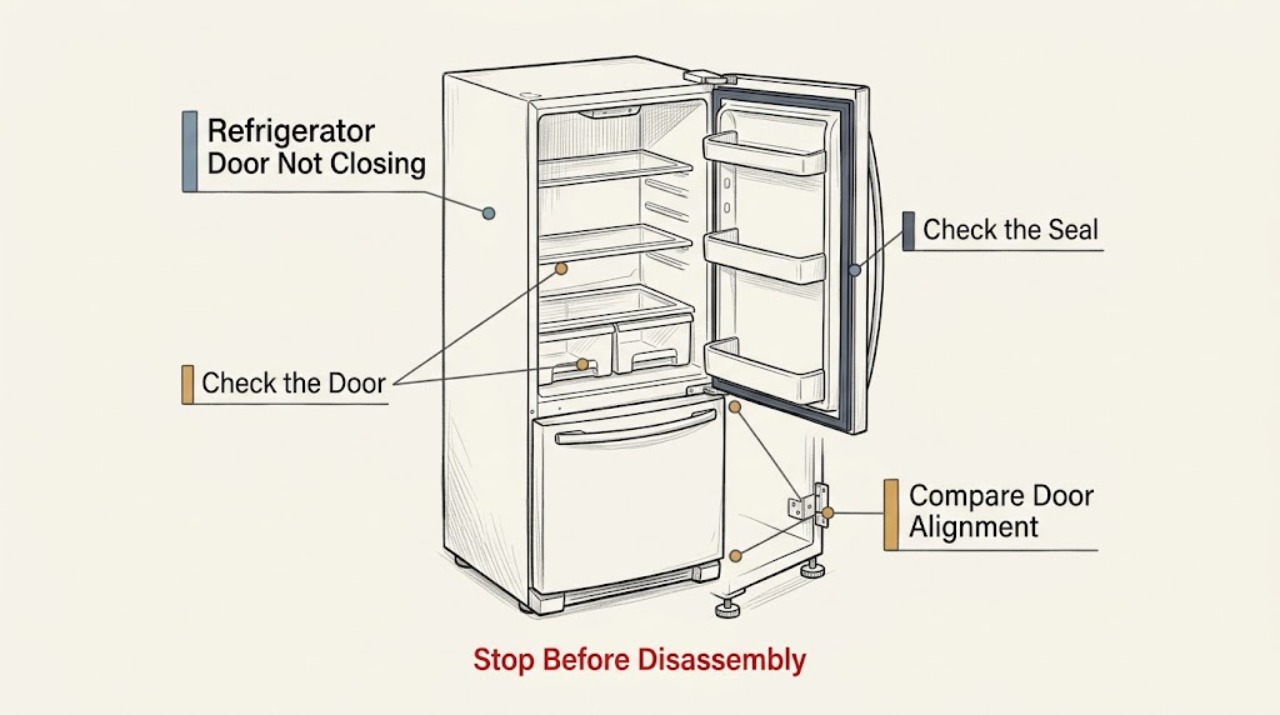
Work through in order
Diagnostic checks
Use only checks that match the exact appliance or system and its official guide.
-
Check 1
Open the door fully and check bins, shelves, drawers, and tall food packages for anything projecting into the closing path.
Expected result: A package, bin, or drawer blocks closure, or the path is clear.
Next step: Reposition only the obstruction and close the door gently; do not overload bins.
Why this matters
Why: A physical obstruction is the simplest cause; a clear path shifts attention to seal and alignment.
-
Check 2
Inspect the gasket around the full perimeter for dirt, folds, gaps, tears, or a section pulled out of its channel; wipe it with a soft damp cloth and dry it.
Expected result: The gasket is dirty/distorted, visibly damaged, or clean and evenly contacting.
Next step: Do not glue, cut, or heat the gasket; use the model manual for a replacement or call service.
Why this matters
Why: Debris or distortion can prevent a seal; damage or a persistent gap needs replacement/service assessment.
-
Check 3
From a safe position, check whether the refrigerator rocks or leans and whether the door is higher/lower than the cabinet; do not dismantle hinges.
Expected result: The cabinet is tilted or stable, and the hinge area is intact or visibly bent.
Next step: Use only the model's leveling instructions and request service for hinge damage.
Why this matters
Why: Tilt can change door alignment; a bent hinge is not an adjustment for a user to force.
-
Check 4
After correcting one external cause, close the door and observe whether the interior light goes out and whether frost or condensation changes over subsequent use.
Expected result: The door seals and light behavior is normal, or a gap/light-on/frost symptom remains.
Next step: Arrange service for a persistent gap, damaged gasket, or misaligned hinge.
Why this matters
Why: A sealed door supports resolution; persistent gap or light-on behavior can admit warm air and requires further diagnosis.
Use your observations
Decision map
Find the observation that best matches what you see, then follow the next safe action.
-
PATH 01Next step
What you see
A package or drawer prevents closure
Do this next
Rearrange the load and verify the gasket contacts the frame.
Why this path and its safety boundary
Why it matters: Storage interference is supported.
-
PATH 02Next step
What you see
The path is clear but the gasket has a gap or tear
Do this next
Keep the door closed as much as possible and arrange service or model-approved gasket replacement.
Why this path and its safety boundary
Why it matters: The seal is not maintaining the door boundary.
-
PATH 03Next step
What you see
The gasket is intact but the cabinet/door is visibly misaligned
Do this next
Do not force hinges; request qualified service.
Why this path and its safety boundary
Why it matters: Leveling or hinge alignment remains unresolved.
Helpful context
Understand the symptom
Find the point of interference
A door that rebounds from a package needs a storage correction; a door that sits unevenly with a clear frame needs a gasket, hinge, or leveling assessment. Do not force the door against a misaligned part.
When checks do not resolve it
Need a professional?
Arrange service when the door remains misaligned after clearing storage, the gasket is torn or pulled out, a hinge is bent, or the light stays on with the door closed.
Safety scope: Do not force the door, remove hinges, or improvise gasket repairs.
Have this ready
- Provide model number, obstruction, gasket condition, cabinet level, hinge appearance, and whether light/frost symptoms remain.
Common questions
FAQ
Can a dirty gasket keep a refrigerator door open?
Yes. Debris or distortion can prevent full contact. Clean and dry it gently; a damaged or persistent gap needs service.
Should I adjust a refrigerator hinge myself?
Do not force or dismantle hinges. Use only model instructions for accessible leveling and call service for misalignment or damage.
Read the exact guide
Official sources
- Panasonic NRC387 Operating InstructionsPanasonic · Only models covered by the NRC387 manual family; use the exact model manual for other refrigerators
- Panasonic - ManualsPanasonic · Panasonic consumer products
Community feedback
Share a repair observation
Share a plain-text repair observation. Accepted observations are published automatically; this page may take a moment to update.