
On this page
Start here
Quick answer
If a Panasonic refrigerator trips the breaker, leave it off when the trip repeats, smells hot, or shows cord/outlet damage. Record whether the breaker trips immediately or only when cooling starts, then check the plug and dedicated outlet visually. Panasonic's refrigerator instructions warn against self-repair and direct unresolved electrical faults to an authorised engineer; do not substitute a larger fuse or use an extension cord.
Before you begin
Safety first
- Do not open panels, bypass protection, change breaker/fuse ratings, use an extension cord, or work on live wiring.
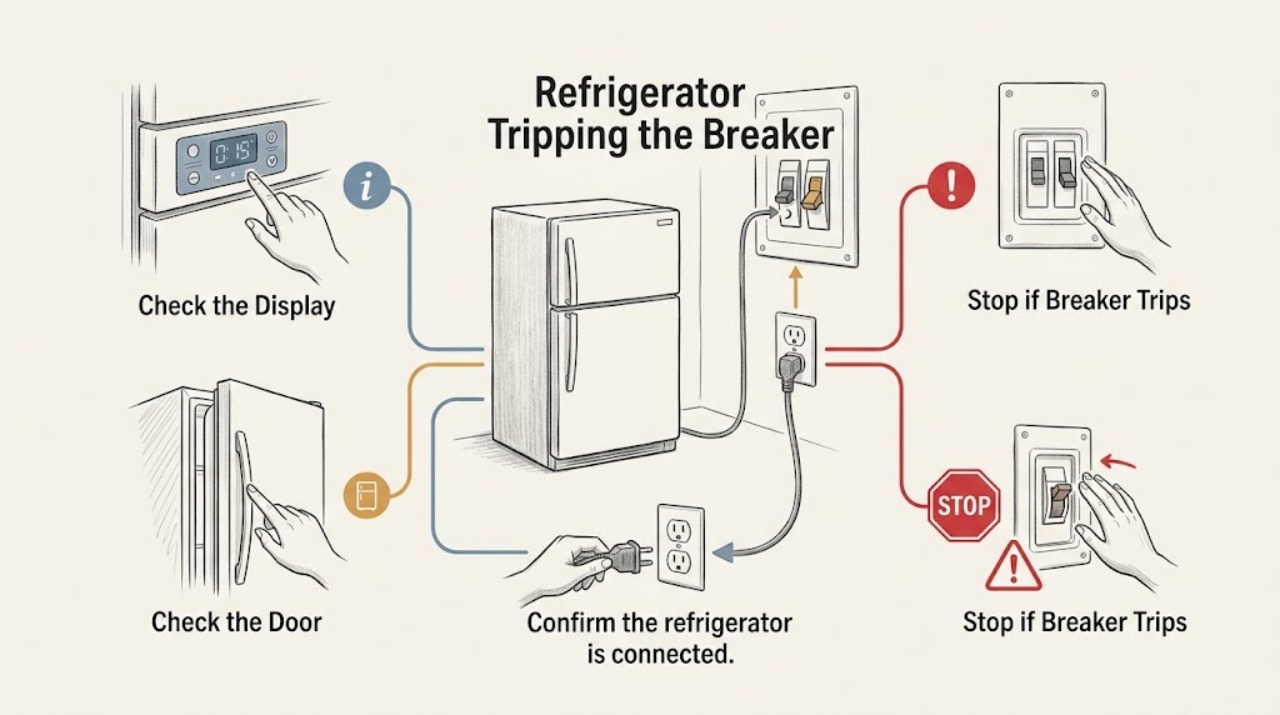
Work through in order
Diagnostic checks
Use only checks that match the exact appliance or system and its official guide.
-
Check 1
Turn the refrigerator control off if the model permits and inspect the cord, plug, receptacle, and surrounding area without touching exposed conductors.
Expected result: There is heat, charring, a damaged cord/plug, moisture at the receptacle, or no visible damage.
Next step: Keep the refrigerator disconnected and call an electrician/service provider for damage. Do not plug it into another random outlet.
Why this matters
Why: Visible electrical damage or moisture is an immediate safety boundary; an intact exterior does not rule out an internal fault.
-
Check 2
Note when the breaker trips: immediately on connection, when cooling starts, after a door opening, or after a period of running. Do not reset it more than once for observation.
Expected result: The trip is immediate or start-related, or it occurs only after extended operation.
Next step: Record the timing and leave the unit off after a repeat trip.
Why this matters
Why: Timing helps the technician distinguish supply/start-load symptoms from heat or intermittent faults, but it does not identify a replaceable part by itself.
-
Check 3
Confirm the refrigerator is connected directly to the model-required grounded receptacle, not an extension cord or shared power strip, and check whether other appliances lose power.
Expected result: An extension/shared circuit is involved, or the refrigerator has a dedicated direct supply.
Next step: Have a qualified electrician assess the circuit rather than changing protection rating.
Why this matters
Why: Panasonic states that power requirements vary by model and its guidance warns against unsuitable supply arrangements; circuit overload can be external to the appliance.
-
Check 4
If power remains stable and the refrigerator restarts only after a cool-down, observe display, interior light, and cooling without moving panels or bypassing a protector.
Expected result: It runs normally until another trip, or it cannot restart and stays warm/dark.
Next step: Protect perishable food and arrange Panasonic service; do not continue cycling power.
Why this matters
Why: A repeat trip or failure to restart indicates a service-level power/control/compressor issue, not a safe user adjustment.
Use your observations
Decision map
Find the observation that best matches what you see, then follow the next safe action.
-
PATH 01Next step
What you see
The breaker trips immediately and there is heat, moisture, or visible cord/outlet damage
Do this next
Leave power off and contact a qualified electrician; do not test again.
Why this path and its safety boundary
Why it matters: A hazardous supply condition is possible.
-
PATH 02Next step
What you see
The breaker trips when the refrigerator starts cooling on an intact dedicated circuit
Do this next
Keep it off and request Panasonic service with the timing record.
Why this path and its safety boundary
Why it matters: An appliance start/load fault remains possible and cannot be isolated safely from outside.
-
PATH 03Next step
What you see
The refrigerator runs without another trip after a single controlled reset
Do this next
Monitor without changing protection and arrange service if it repeats.
Why this path and its safety boundary
Why it matters: The event may have been an external transient, but recurrence is not cleared.
Helpful context
Understand the symptom
The timing of the trip matters
An immediate trip, a trip at compressor start, and a trip after hours of operation point to different paths, but none justifies repeated resetting. Capture the timing without opening the appliance.
When checks do not resolve it
Need a professional?
Keep power off after a repeat trip and protect food while arranging service.
Safety scope: Do not open panels, bypass protection, change breaker/fuse ratings, use an extension cord, or work on live wiring.
Have this ready
- Provide the model, trip timing, breaker/circuit details, cord/plug condition, whether other appliances share the circuit, and display/cooling status.
Common questions
FAQ
Can I use a stronger breaker for a Panasonic refrigerator that trips?
No. Do not change the breaker or fuse rating. Have the circuit and appliance assessed by a qualified professional.
Why does the Panasonic refrigerator trip only when cooling starts?
The timing is useful evidence for service, but it does not prove a compressor fault. Leave the unit off after a repeat trip and provide the timing and model details.
Read the exact guide
Official sources
- Troubleshooting - Microwave power, fan or motor problems.Panasonic North America · Panasonic appliance electrical-supply safety principles including dedicated outlet, breaker, no extension cord, and stop-use service boundary
- How to defrost and maintain the refrigeratorPanasonic · Panasonic refrigerator power-cord, plug, maintenance-disconnect, and authorised-service safety guidance
Community feedback
Share a repair observation
Share a plain-text repair observation. Accepted observations are published automatically; this page may take a moment to update.