
On this page
Start here
Quick answer
When a Performa refrigerator door will not close, remove anything projecting from the shelves or bins, check that the gasket is clean and continuous, and look for a cabinet or hinge alignment problem. Do not force the door or loosen hinge hardware without the exact manual. Whirlpool-family refrigerator guidance says obstruction, level, alignment, and gasket condition affect closure; persistent gaps need service.
Before you begin
Safety first
- Do not force the door, lift it alone, loosen hinges without the manual, or work around pinch points.
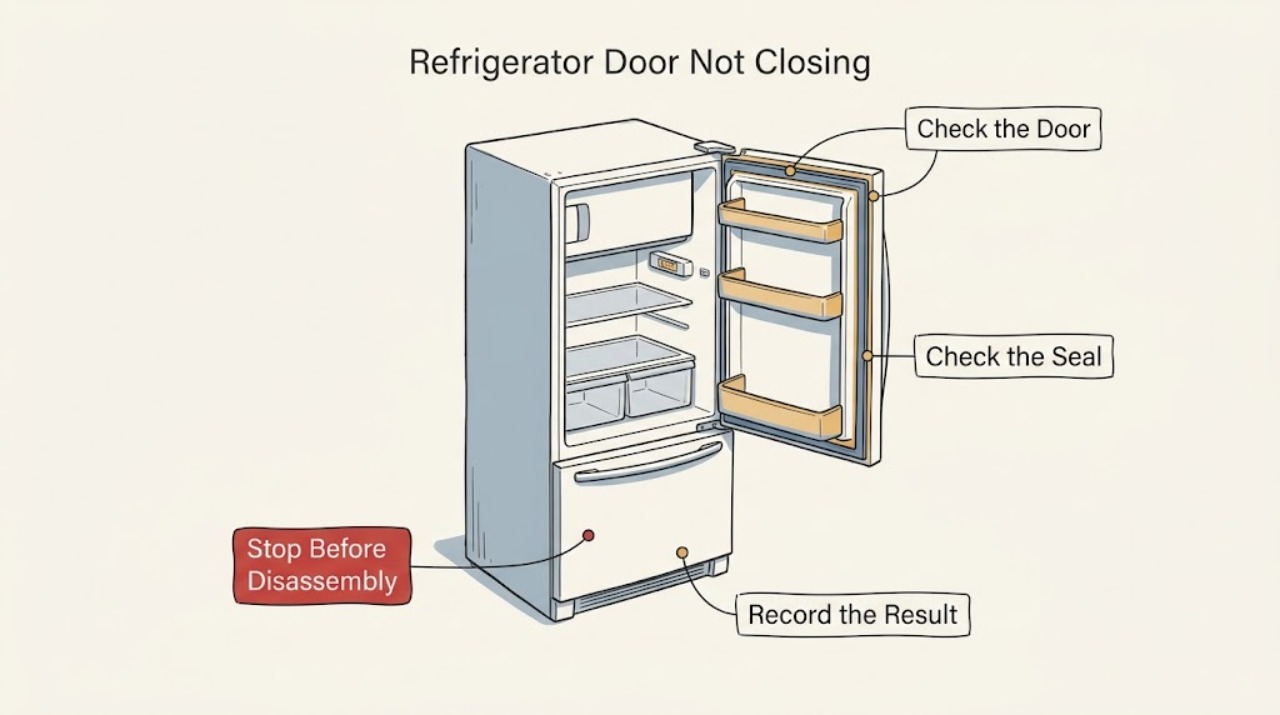
Work through in order
Diagnostic checks
Use only checks that match the exact appliance or system and its official guide.
-
Check 1
Remove tall containers, bins, shelves, and packages near the door edge, then close the door without force.
Expected result: The door closes after one obstruction is moved, or it still stops at the same point.
Next step: Rearrange the load and monitor the gasket contact; do not overload the door.
Why this matters
Why: A package or rack can physically prevent closure; a repeatable stop with a clear interior points to alignment, hinge, or seal.
-
Check 2
Inspect the gasket around the full perimeter for dirt, folds, tears, or a section pulled out of its channel; wipe accessible residue with a soft damp cloth and dry it.
Expected result: The gasket is dirty/distorted/damaged, or it contacts evenly.
Next step: Do not glue, cut, or heat the gasket. Use the exact model manual for replacement/service.
Why this matters
Why: A damaged or distorted gasket can leave a closure gap and admit warm air; an even gasket shifts diagnosis to hinges or cabinet level.
-
Check 3
View the refrigerator from the front and check whether the cabinet rocks or the door sits visibly high/low; do not move the loaded appliance alone.
Expected result: The cabinet is unstable or the door is visibly misaligned, or both appear level and aligned.
Next step: Use the Performa manual or a qualified installer for leveling/hinge adjustment.
Why this matters
Why: Level and alignment affect self-closing and gasket contact; a stable aligned cabinet makes a simple loading issue less likely.
-
Check 4
After one correction, close the door and check for a continuous seal without placing fingers in a pinch point; observe whether condensation or frost increases.
Expected result: The seal is continuous and the door stays shut, or a gap remains/condensation returns.
Next step: Keep the door closed and arrange service for a returning gap, frost, or warming.
Why this matters
Why: A continuous seal supports a resolved external cause; a persistent gap can overwork cooling and needs service.
Use your observations
Decision map
Find the observation that best matches what you see, then follow the next safe action.
-
PATH 01Next step
What you see
The door closes after a package or bin is repositioned
Do this next
Maintain clearance and monitor the seal.
Why this path and its safety boundary
Why it matters: An internal obstruction caused the immediate symptom.
-
PATH 02Next step
What you see
A torn or distorted gasket leaves a continuous gap
Do this next
Use the exact Performa part/manual information and request service if replacement is not owner-accessible.
Why this path and its safety boundary
Why it matters: The sealing surface cannot be restored by loading changes alone.
-
PATH 03Next step
What you see
The cabinet/door is misaligned or a clear door still will not close
Do this next
Do not force or lift the door; arrange qualified service.
Why this path and its safety boundary
Why it matters: Level, hinge, or structural service is more likely.
Helpful context
Understand the symptom
A small gap can become a cooling symptom
Start with the simplest observation: where does the door first stop? Record whether the obstruction is inside the cabinet, the gasket is folded, or the door sits unevenly before changing anything.
When checks do not resolve it
Need a professional?
Keep the door closed and protect food while arranging service.
Safety scope: Do not force the door, lift it alone, loosen hinges without the manual, or work around pinch points.
Have this ready
- Provide the model, obstruction result, gasket condition, alignment/level observation, and any frost or temperature change.
Common questions
FAQ
Can a Performa refrigerator door gap cause frost?
Yes, a gap can admit warm humid air and contribute to condensation or frost. Check obstructions and gasket contact first, then arrange service for a persistent gap.
Should I adjust Performa refrigerator hinges myself?
Only if the exact owner's manual provides an owner procedure. A loaded or misaligned door can be heavy and a forced adjustment can damage the seal.
Read the exact guide
Official sources
- Refrigerator - Interior MoistureWhirlpool Product Help · Refrigerator door closure, obstruction, level, gasket, moisture, and frost principles applicable to Performa-family diagnosis
- Performa Refrigerator Owner's ManualWhirlpool Corporation / Performa · Performa refrigerator model-specific operation, troubleshooting, and service boundary
Community feedback
Share a repair observation
Share a plain-text repair observation. Accepted observations are published automatically; this page may take a moment to update.