
On this page
Start here
Quick answer
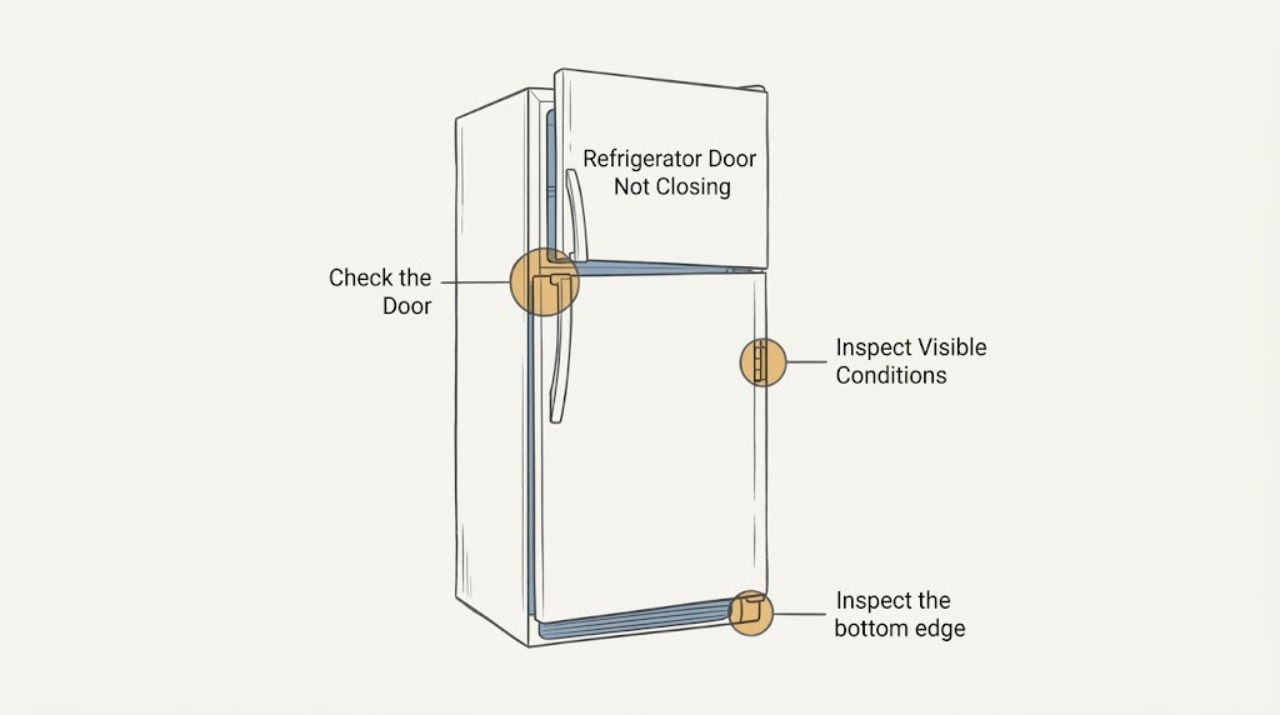
Empty the door opening of protruding food, close every bin, and check for ice or packing material at the bottom edge. If the door still will not close or will not swing shut when partly open, check leveling and gasket contact using the model instructions. A broken hinge or persistent gap needs service.
Before you begin
Safety first
- Do not remove a loaded door, disassemble hinges, or force a gasket or hinge into position.
Work through in order
Diagnostic checks
Use only checks that match the exact appliance or system and its official guide.
-
Check 1
Remove any package, tray, or heavy door item that protrudes into the closing path, close each shelf bin, and check the freezer edge for a loose ice cube.
Expected result: The door closes flush after the load is rearranged, or it still stops at the same point.
Next step: Keep the closing path clear. Continue to the leveling and seal checks if the gap remains.
Why this matters
Why: A local obstruction is the likely cause when the door closes after rearranging; a repeat stop suggests alignment, leveling, gasket, or hinge trouble.
-
Check 2
Inspect the bottom edge for blue tape or shipping foam left on a newer side-by-side model, removing it only if it is clearly packing material and the model instructions permit it.
Expected result: The packing material is present and the door closes after removal, or no packing material is present.
Next step: If there is no clear packing material, do not pry at the door; check leveling next.
Why this matters
Why: Unremoved shipping material can physically block closure; its absence shifts attention to installation or the door assembly.
-
Check 3
With the door partly open, observe whether it moves toward closed on its own and inspect the gasket for a folded, torn, or non-contacting section.
Expected result: The door does not swing shut or the gasket visibly fails to contact the cabinet.
Next step: Use the model's installation instructions for leveling or gasket adjustment; do not force the hinge.
Why this matters
Why: Poor leveling can prevent self-closing, while a damaged or displaced gasket can leave a persistent air gap.
-
Check 4
Close the door slowly and look around the complete perimeter for a continuous seal, then confirm that the door remains shut without being held.
Expected result: A continuous seal is present, or a corner springs back open or a hinge looks damaged.
Next step: Arrange service for a broken hinge, warped door, or a gap that remains after external adjustments.
Why this matters
Why: A continuous seal supports a loading/leveling explanation; spring-back or visible hinge damage indicates a mechanical repair need.
Use your observations
Decision map
Find the observation that best matches what you see, then follow the next safe action.
-
PATH 01Next step
What you see
The door closes after removing a protruding package, open bin, or ice cube.
Do this next
Rearrange the load and monitor that the gasket remains sealed.
Why this path and its safety boundary
Why it matters: The appliance was physically obstructed rather than suffering an immediate hinge failure.
-
PATH 02Next step
What you see
The door stays open when partly opened and the gasket contacts unevenly, without an obstruction.
Do this next
Follow the Profile model's installation instructions for leveling and alignment; stop if adjustment requires hinge disassembly.
Why this path and its safety boundary
Why it matters: Leveling or alignment is more likely than a control issue.
-
PATH 03Next step
What you see
A hinge is visibly broken, the door is warped, or a gap persists after the external checks.
Do this next
Keep the door closed as much as possible and arrange appliance service.
Why this path and its safety boundary
Why it matters: The door assembly cannot be restored safely by rearranging food.
Helpful context
Understand the symptom
A door gap is a cooling problem
An unsealed door admits warm, humid air and can lead to frost or temperature loss. Diagnose what physically prevents the seal before changing temperature settings.
Only after diagnosis
Potential parts
- refrigerator door gasket
Consider only if the gasket has a tear or remains out of contact after the door is correctly aligned.
Confirm the exact refrigerator model and fit information before ordering.
When checks do not resolve it
Need a professional?
Use service for a broken hinge, warped door, persistent seal gap, or leveling/alignment that cannot be completed from the model instructions.
Safety scope: Do not remove a loaded door, disassemble hinges, or force a gasket or hinge into position.
Have this ready
- Provide the model, door style, location of the gap, obstruction findings, and whether the door swings shut when partly open.
Common questions
FAQ
Can an open bin keep a Profile refrigerator door from closing?
Yes. GE Appliances identifies open bins, protruding food, heavy door items, and ice as possible physical blockers.
Why does a door gap sometimes cause frost?
A door left slightly ajar admits warm, humid air, which can create frost; inspect closure and the gasket before pursuing internal repairs.
Read the exact guide
Official sources
- Refrigerator - Frost in FreezerGE Appliances (GE Profile) · GE Profile refrigerator frost, door gasket, door alignment, and leveling guidance
- Refrigerator - Door Will Not CloseGE Appliances (GE Profile) · GE Profile refrigerator door obstruction, leveling, packing foam, and hinge guidance
Community feedback
Share a repair observation
Share a plain-text repair observation. Accepted observations are published automatically; this page may take a moment to update.