
On this page
Start here
Quick answer
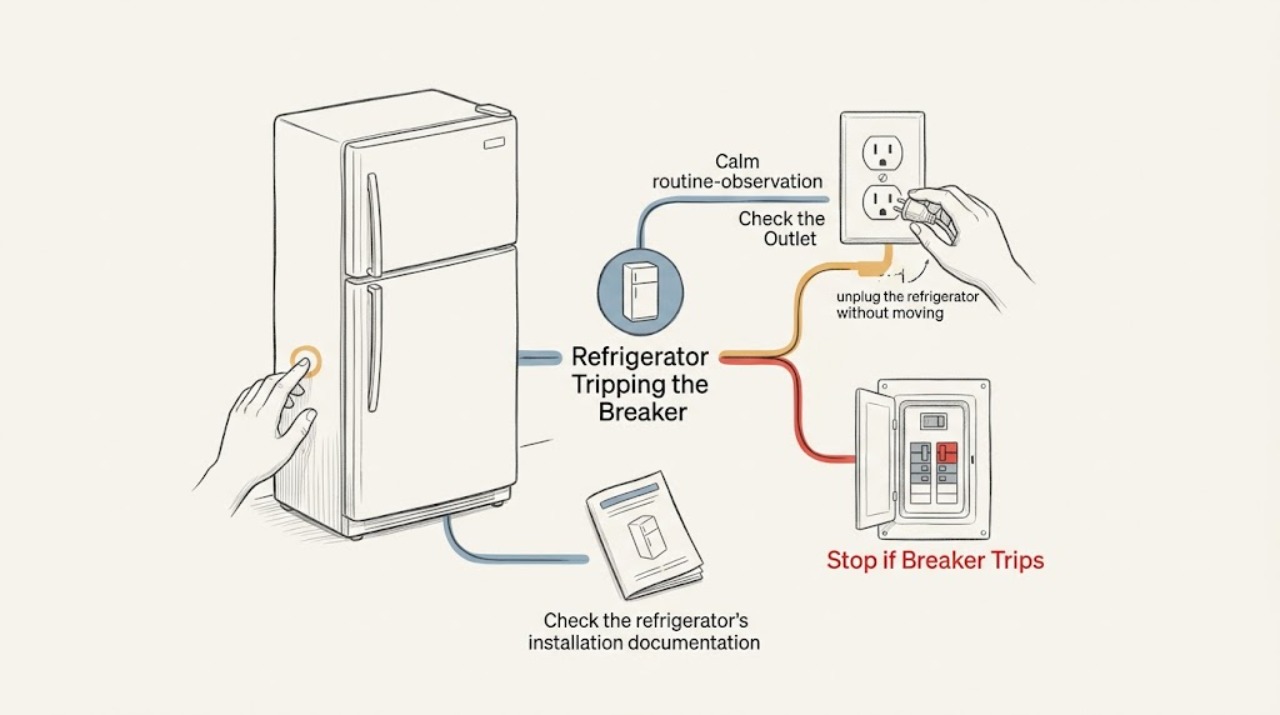
Do not repeatedly reset a breaker that trips for a Profile refrigerator. Unplug the refrigerator only if the area is dry and it is safe to reach, then reset the breaker once. If it trips with the refrigerator disconnected, call an electrician; if it holds but trips again when the refrigerator is connected, leave the refrigerator unplugged and arrange appliance service. Do not open panels or test live wiring.
Before you begin
Safety first
- Never open panels, test live wiring, bypass the breaker, install a larger fuse, or repeatedly reset a trip; do not handle electrical connections when wet.
Work through in order
Diagnostic checks
Use only checks that match the exact appliance or system and its official guide.
-
Check 1
Stop using the refrigerator and look only for smoke, burning odor, scorch marks, water near the outlet, or a hot plug; do not touch wet or damaged electrical parts.
Expected result: A safety warning is present, or the exterior looks dry and normal.
Next step: For any warning, keep power off and call an electrician or appliance technician; do not reset the breaker.
Why this matters
Why: Smoke, heat, water, or scorching raises an immediate electrical hazard; no visible warning permits only the limited disconnect test.
-
Check 2
If the floor and outlet area are dry, unplug the refrigerator without moving it more than necessary, then reset the breaker once from the electrical panel.
Expected result: The breaker trips immediately while the refrigerator is unplugged, or it holds.
Next step: Call an electrician for the first result. For the second, leave the refrigerator unplugged until appliance service.
Why this matters
Why: Immediate tripping with the appliance disconnected points toward the household circuit or breaker; a stable breaker shifts suspicion to the refrigerator or its connection.
-
Check 3
Check the refrigerator's installation documentation for the required circuit and confirm only that no other high-load appliance was recently added to the same circuit; do not change breaker size.
Expected result: The circuit appears undersized/shared or its rating is unknown, or it matches the installation requirements.
Next step: Have an electrician evaluate an unknown or shared circuit; do not install a larger fuse or breaker.
Why this matters
Why: An incorrectly sized or overloaded circuit can trip independently of a refrigerator component; a correctly specified circuit makes appliance diagnosis more likely.
-
Check 4
Note whether the trip happened at startup, during a cooling cycle, or after the refrigerator had run normally, and provide that timing to service.
Expected result: The trip is immediate on connection, intermittent during operation, or follows a specific function.
Next step: Keep the unit disconnected and arrange the appropriate electrical or appliance service based on the unplugged-breaker result.
Why this matters
Why: Timing helps a technician distinguish a connection/startup issue from an intermittent component fault, but it does not make internal testing safe.
Use your observations
Decision map
Find the observation that best matches what you see, then follow the next safe action.
-
PATH 01Next step
What you see
The breaker trips immediately even while the Profile refrigerator is unplugged.
Do this next
Leave the circuit off and call an electrician.
Why this path and its safety boundary
Why it matters: The household circuit, wiring, or breaker is the leading concern.
-
PATH 02Next step
What you see
The breaker holds with the refrigerator unplugged but trips again when the refrigerator is connected.
Do this next
Leave the refrigerator unplugged and arrange appliance service.
Why this path and its safety boundary
Why it matters: A refrigerator cord, heater, wiring, or other appliance component may be faulted.
-
PATH 03Next step
What you see
There is smoke, burning odor, scorching, water near the outlet, or a hot plug.
Do this next
Do not reset or touch the area; call an electrician or emergency service as appropriate.
Why this path and its safety boundary
Why it matters: The situation has an immediate electrical safety risk regardless of which component caused it.
Helpful context
Understand the symptom
The first priority is electrical safety
A breaker trip can result from household wiring, an incorrectly sized circuit, a shorted heater, loose wiring, or a failed appliance component. The external test separates those paths without requiring panel access.
When checks do not resolve it
Need a professional?
Call an electrician when the breaker trips with the refrigerator disconnected or the circuit rating is unknown; call appliance service when only the connected refrigerator causes the trip.
Safety scope: Never open panels, test live wiring, bypass the breaker, install a larger fuse, or repeatedly reset a trip; do not handle electrical connections when wet.
Have this ready
- Provide the breaker behavior with the refrigerator unplugged, circuit rating if known, trip timing, outlet/cord condition, and any smell, heat, scorch, or water.
Common questions
FAQ
Should I keep resetting the breaker for a Profile refrigerator?
No. GE Appliances advises unplugging the appliance and treating an immediate retrip as a circuit or breaker issue requiring an electrician; repeated resets are unsafe.
What does it mean if the breaker holds when the refrigerator is unplugged?
The refrigerator or its connection becomes more likely than the household circuit; leave it unplugged and arrange appliance diagnosis.
Read the exact guide
Official sources
- GE Appliance - Circuit Breaker TripsGE Appliances (GE Profile) · GE Profile refrigerator circuit-breaker, circuit-sizing, unplugged test, and service-safety guidance
Community feedback
Share a repair observation
Share a plain-text repair observation. Accepted observations are published automatically; this page may take a moment to update.