
On this page
Start here
Quick answer
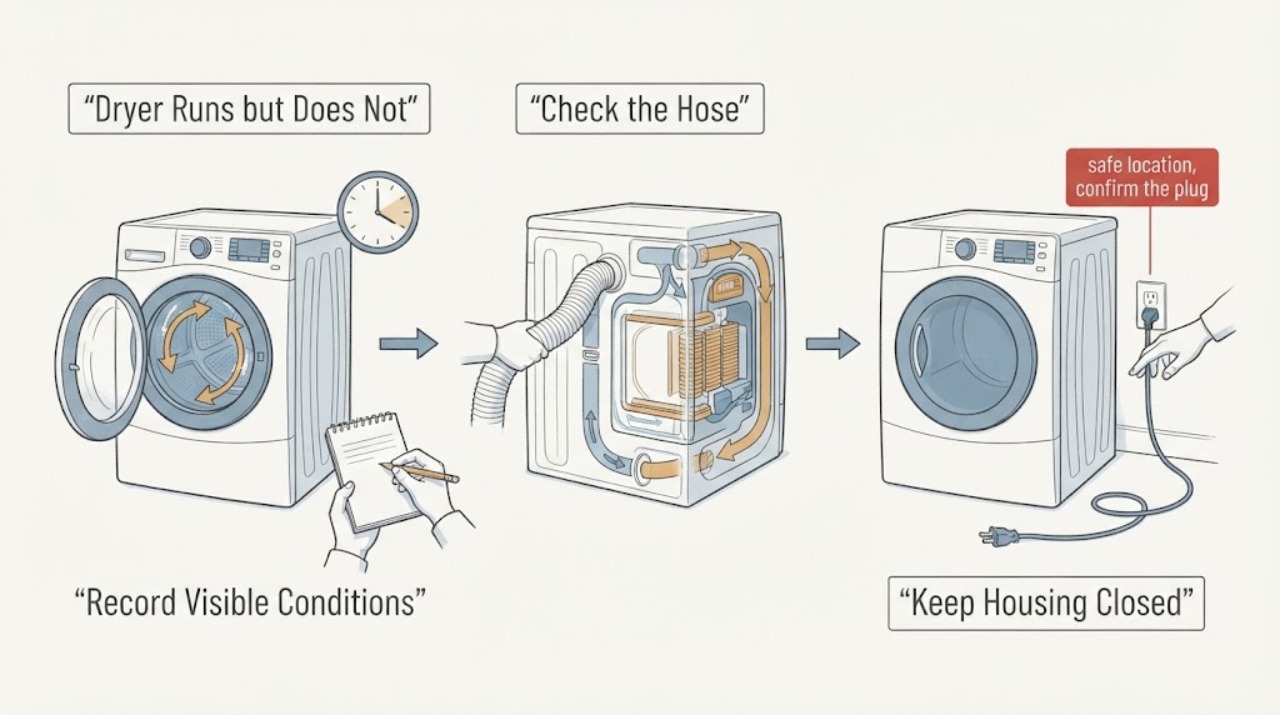
The opened report identifies a Roper REX6634PQ0 that tumbles but does not heat and whose timer remains at the selected mark; no repair outcome is verified. First separate an expected automatic-cycle pause from a real timer fault: the opened Roper guide says the automatic knob may not move until the load is almost dry, while timed and heated operation are separate observations. Check the selected cycle, heat setting, lint screen and accessible exhaust path without opening the cabinet. If a heated timed cycle still produces no heat and the timer remains stationary, stop repeated testing and arrange qualified service; do not infer a timer, heater, fuse or thermostat failure from continuity checks or replace parts at random.
Work through in order
Diagnostic checks
Use only checks that match the exact appliance or system and its official guide.
-
Check 1
Record the exact cycle and temperature setting used when the knob appears not to move. If the dryer has No Heat/Fluff, do not use it to judge heating; for a safe comparison, use a heated timed or automatic setting without opening the cabinet.
Expected result: The knob is stationary only on Automatic, only on No Heat/Fluff, or it is stationary on a heated Timed cycle as well.
Next step: Write down the cycle, temperature, load and elapsed time. If the heated timed cycle still has no heat and the timer does not advance, stop testing and arrange service rather than turning the knob repeatedly.
Why this matters
Why: The Roper guide says Automatic control may not move until the load is almost dry and No Heat/Fluff is intentionally unheated. A stationary knob on a heated timed cycle is a stronger service symptom, but not proof of a failed timer.
-
Check 2
With the dryer off and cool, clean the lint screen and inspect the accessible exhaust hose and outside hood for lint, a crushed or kinked metal hose, a blocked flap or another obvious obstruction. Do not remove cabinet panels or dismantle a concealed wall/roof run.
Expected result: The screen or hood is blocked, the hose is crushed/kinked, airflow history is unknown, or the accessible route appears open.
Next step: Leave the dryer off if a restriction is found or if no heat persists, and have the full vent route assessed or cleaned by qualified service. Do not run a hot load to test whether the restriction is gone.
Why this matters
Why: The Roper guide warns that lint accumulation and improper venting affect drying and can create a fire hazard. An open-looking accessible section does not clear the entire exhaust route or prove the heating circuit is safe.
-
Check 3
From a dry, safe location, confirm the plug is seated and check the home's dryer breakers/fuses only as an external household check; do not remove the dryer terminal cover or open the dryer electrical compartment. Electric dryers can tumble while one supply leg is unavailable.
Expected result: A household breaker/fuse is tripped, the appliance outlet/cord looks damaged or hot, or the household supply appears normal.
Next step: If a breaker/fuse is tripped, do not repeatedly reset it; have an electrician or qualified appliance technician investigate if it trips again. If supply is normal but no heat/timer movement remains, keep the dryer out of service and arrange appliance service.
Stop if: Do not touch a hot/discolored cord, open a terminal block, bridge a breaker or perform energized electrical testing.
Why this matters
Why: The Roper guide lists two household fuses/breakers for electric dryers and notes that the drum may turn without heat when one supply side is unavailable. A normal-looking panel does not clear the appliance's internal wiring or controls.
-
Check 4
Document whether the drum tumbles, whether any warmth appears in a properly selected heated cycle, whether the timer remains fixed on Timed versus Automatic, whether the change began suddenly, and whether the issue began with a vent or power event. Do not reproduce the fault with repeated loads.
Expected result: The fuse opens immediately, after one cycle, only after consecutive loads, with poor airflow/long dry time, or without an unusual heat symptom.
Next step: Give the timeline and exact model label to a qualified technician. Keep the dryer disconnected if there is smoke, burning odor, a hot connection or repeated breaker action.
Why this matters
Why: Timing helps service distinguish an airflow/heat event from a cycle-control or electrical issue, but it does not identify the failed component. Smoke, burning odor or abnormal heat is a safety stop, not a diagnostic branch.
-
Check 5
Request qualified service to verify the exact REX6634PQ0 documentation, supply, exhaust, heat circuit and timer/cycle-control behavior with power safely isolated. Tell the technician that the user already checked continuity but did not establish a repair outcome.
Expected result: External settings, airflow and household supply are normal but the dryer still does not heat and the timer remains fixed, or diagnosis needs console/cabinet access or electrical measurement.
Next step: Keep the dryer out of service until the technician identifies the cause and restores all panels, guards and safety devices. Do not order a timer, heater, fuse or thermostat solely from the symptom.
Why this matters
Why: The combined symptom exceeds safe user checks. The Roper guide says not to service or replace parts unless user instructions specifically cover the work and the person has the necessary skill; the report has no confirmed component diagnosis.
Use your observations
Decision map
Find the observation that best matches what you see, then follow the next safe action.
-
PATH 01Next step
What you see
The timer is stationary only on an Automatic cycle, while the dryer is otherwise heating and drying normally.
Do this next
Use the exact model guide and observe the complete cycle without repeatedly turning the knob. If it never reaches cool-down/off or also fails on a heated timed cycle, arrange service.
Why this path and its safety boundary
Why it matters: The Roper guide says the automatic knob may not move until the load is almost dry; this can be normal cycle behavior.
-
PATH 02Next step
What you see
On a correctly selected heated Timed cycle, the drum tumbles, no heat appears, and the timer remains at the selected mark.
Do this next
Stop using the dryer and arrange qualified service. Do not file timer contacts, bypass a fuse, or test inside the energized cabinet.
Why this path and its safety boundary
Why it matters: This is a combined no-heat/timer symptom, not an established timer diagnosis. Supply, heat controls, wiring, cycle contacts and airflow still need model-matched assessment.
-
PATH 03Next step
What you see
The exhaust path is visibly restricted, or one household dryer breaker/fuse is tripped while the drum can still turn.
Do this next
Correct the external condition through qualified vent/electrical service and keep the dryer off until the no-heat/timer symptoms are reassessed safely.
Why this path and its safety boundary
Why it matters: Restricted venting can create overheating/fire risk; incomplete electric supply can allow tumbling without heat. Neither result identifies an internal part.
-
PATH 04Next step
What you see
Smoke, burning odor, a hot/discolored cord or terminal, sparks, repeated breaker action or abnormal cabinet heat is present.
Do this next
Leave the area if necessary and seek emergency help or qualified service from a safe location. Do not reset power, open the cabinet or run another cycle.
Why this path and its safety boundary
Why it matters: This is an immediate fire/electrical stop condition, not a routine timer or heater replacement decision.
Helpful context
Understand the symptom
Do not treat every stationary knob as the same fault
The source reports both no heat and a stationary timer on an old Roper REX6634PQ0. The Roper guide explains that an automatic-cycle knob can remain still until the load is almost dry, so the cycle and heat setting must be recorded before calling the timer defective. A timer that stays put on a timed cycle while a properly selected heated cycle also fails to heat is a different service signal, but it still does not identify the failed internal part.
Start with settings and airflow that can be checked safely
Confirm the control is on a heated timed or automatic setting rather than No Heat/Fluff, which the guide describes as unheated. Clean the lint screen and inspect only the accessible metal exhaust hose and outside hood for crushing, kinks or lint. Roper warns that poor venting creates a fire hazard and says the interior and exhaust vent should be cleaned periodically by qualified service personnel; a clear visible hose does not prove the concealed run or internal heater is sound.
Keep continuity results separate from diagnosis
The original poster says three fuses and the heating coil showed continuity, but continuity alone cannot establish correct voltage, temperature control, timer contacts, wiring integrity or safe airflow. Do not open the console, probe energized terminals, file timer contacts, bypass a fuse or run the dryer with covers removed. Give the technician the model label, cycle used, whether the drum turns, whether any heat is present, and exactly when the knob stops.
When checks do not resolve it
Need a professional?
Arrange qualified appliance service when a correctly selected heated timed cycle produces no heat and the timer remains fixed, when the issue persists after safe external setting/airflow checks, or when diagnosis requires cabinet access or electrical measurement. Treat smoke, burning odor, sparks, hot/discolored connections and repeated breaker action as urgent safety issues.
Common questions
FAQ
Is a stationary timer always a failed timer?
No. The Roper guide says an Automatic-cycle knob may not move until the load is almost dry. The relevant comparison is the cycle: a stationary knob on a heated Timed cycle together with no heat is a service symptom, but it does not prove the timer itself is defective.
Can the dryer tumble if it has lost part of its power?
Yes, for an electric dryer the Roper guide says two household fuses or breakers are used and the drum may turn while heat is unavailable. Check only the external household panel safely; do not open the dryer terminal block or perform energized electrical testing.
Could a blocked vent explain the no-heat report?
A restricted vent can cause poor drying and a fire hazard, so inspect the accessible screen, hose and outside hood. It does not by itself explain or prove a stationary timer, and a clear visible section does not rule out a concealed restriction or internal fault.
What should I do after checking continuity on fuses and the coil?
Treat continuity as information for service, not a clearance to keep testing. It does not establish correct supply, temperature control, timer contacts, wiring or airflow. Keep the dryer off if both no-heat and timer symptoms remain and give the technician the exact test history.
Read the exact guide
Official sources
- Use & Care — Electric and Gas DryersRoper / Whirlpool Corporation · Opened official Roper-branded Use & Care PDF hosted by Whirlpool. It is a general electric/gas dryer guide and is used for safe operating and external-check boundaries; it does not expose an REX6634PQ0 service schematic or authorize internal repair.
- Roper Dryer - timer doesn't move once on / doesn't heatReddit r/appliancerepair · Opened the exact Reddit post. It supports only the reported Roper model, tumbling/no-heat symptom, stationary timer and simultaneous onset; continuity checks and comments do not establish a repair outcome or component cause.
Community feedback
Share a repair observation
Share a plain-text repair observation. Accepted observations are published automatically; this page may take a moment to update.