
On this page
Start here
Quick answer
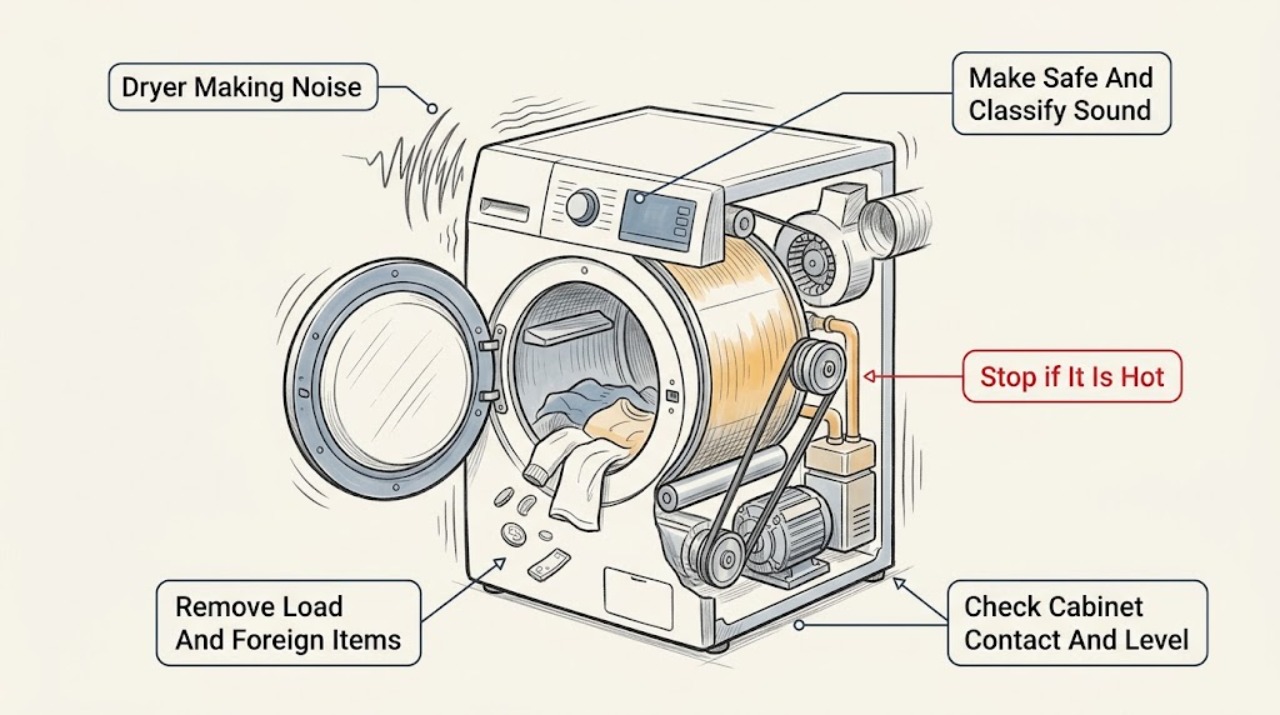
A noisy Roper dryer should be identified by sound, timing, and location before any part is considered. Stop it immediately for smoke, a burning smell, abnormal heat, sparks, a harsh metal-on-metal scrape, violent movement, or a breaker that trips. With power off and the drum cool, empty the load and check pockets, the drum edge, objects on or against the cabinet, the vent contact, lint-screen area, and the dryer legs. A light thump after installation or a long period unused can settle as rollers conform, while a balled load, loose item, or unlevel cabinet can create thumping, rattling, or vibration. Squealing or grinding that persists, a rumble tied to the blower, a motor that runs while the drum does not turn, or a noise from inside the cabinet needs qualified service. A repeating click can be normal on a gas model when its valve cycles; a compressor-related sound should be considered only if the exact Roper model is a heat-pump design.
Work through in order
Diagnostic checks
Use only checks that match the exact appliance or system and its official guide.
-
Check 1
Stop the dryer, disconnect power from a dry position, and let the drum cool. Classify the sound and record where it is loudest: front, rear, lint-screen area, cabinet, floor, or inside the drum. Note whether it occurs at start-up, during tumbling, when air moves, or only with a load.
Expected result: The noise is a light thump, rattle, click, scrape, squeal, grind, rumble, buzz, or violent impact, and it is tied to a particular stage or location.
Next step: Keep the dryer off for any hazard. If it is cool and safe, continue with an empty-drum and external-cabinet inspection; do not remove panels.
Stop if: Stop for smoke, burning smell, sparks, abnormal heat, violent movement, harsh metal scraping, a damaged cord, or a gas odor on a gas model.
Why this matters
Why: Sound type and timing separate load or contact causes from rotating-support, blower, belt, motor, or model-specific gas-system causes. A violent or heat-related sound is a stop condition rather than a clue for more testing.
-
Check 2
With power off, remove the laundry and check every pocket, zipper, buckle, button, rivet, coin, clip, and other loose item. Inspect the visible front and rear drum seams and the lint-screen opening for an object without inserting fingers or tools into the blower housing.
Expected result: The noise disappears when empty, an item is loose in the drum or seam, the lint-screen area contains a visible object, or the same noise remains with no visible item.
Next step: Remove only a loose item that is plainly accessible without reaching into the housing. Keep the lint screen installed for operation; request service if the item is trapped or the noise remains.
Stop if: Stop for a sharp object that cannot be safely reached, a damaged drum seam, a blower obstruction, a metal scrape, or any need to remove a cover.
Why this matters
Why: A load item or foreign object can cause rattling, tapping, clicking, thumping, or scraping. A persistent empty-drum noise shifts suspicion toward installation, rotating supports, blower, belt, motor, or another internal area.
-
Check 3
With the dryer empty and off, check that nothing rests on top or leans against it, the vent is not pressed against the cabinet, a nearby washer has clearance, and the dryer stands on all legs without rocking. Do not pull or tilt the dryer across a floor while it is connected to gas or electricity.
Expected result: An object contacts the cabinet, the vent vibrates against the dryer, the pedestal or nearby washer transfers vibration, a leg is missing or loose, or the cabinet is stable and clear.
Next step: Remove a loose external object and maintain the clearance described by the installation manual. Do not adjust or move a gas dryer if doing so would disturb its connector; request qualified help for unstable installation.
Stop if: Stop for severe rocking, a missing leg, a damaged vent or gas connector, a stacked unit that shifts, or any need to move the appliance while connected.
Why this matters
Why: External contact and an unlevel installation can create buzzing, rattling, knocking, pounding, or vibration without an internal part failure. A stable, clear cabinet makes an internal rotating or support issue more likely.
-
Check 4
If the sound is a light thump or vibration and no object or contact cause is found, record whether the dryer is newly installed, has been unused for a while, or contains sheets, curtains, bedding, shoes, or another load that can bunch together. Do not add an oversized load to test the noise.
Expected result: The sound appears only in the first minutes after non-use, follows a balled or uneven load, occurs with shoes, or persists with a normal loose load.
Next step: Stop and redistribute or remove the load only after the dryer is off and cool. If the sound persists with a normal load or worsens, arrange service rather than extending the test.
Stop if: Stop for violent vibration, the dryer walking, hot or damaged clothing, smoke, burning odor, or a thump that becomes a bang or scrape.
Why this matters
Why: Official dryer guidance describes a light initial thump after non-use as a roller condition that may reduce, while a balled load or shoes can create vibration. Persistence with a normal load makes the support or drive system more concerning.
-
Check 5
Identify whether a repeating click occurs only while a gas dryer heats, or whether a rumble or buzz follows the blower or airflow stage. Apply the gas-click explanation only if the exact Roper model is gas; do not access the gas valve or blower wheel.
Expected result: A regular click occurs during heat operation on a gas model, a rumble follows airflow, a buzz comes from the lint-screen area, or the sound is irregular and harsh.
Next step: For a clearly normal repeating gas click with no other symptom, record it and monitor only under normal operation. For rumble, obstruction, or persistent harsh sound, stop and request service; do not run without the lint screen.
Stop if: Stop for gas odor, delayed ignition, abnormal flame, smoke, burning smell, abnormal heat, sparks, or a blower-area object that cannot be removed without disassembly.
Why this matters
Why: A gas-valve click can be a normal operating sound. A rumble can involve the blower wheel or an obstruction, and a lint-screen-area buzz can follow a foreign object. Irregular or harsh noise needs a professional diagnosis.
-
Check 6
Without opening the cabinet, note whether the drum turns smoothly by hand only when the dryer is disconnected and cool, and whether a running sound occurs with a stalled drum. Do not force the drum, apply lubricant, or reach under the drum.
Expected result: The drum is difficult to turn, a motor-like sound occurs without drum movement, the drum scrapes at an edge, or it turns freely but the noise persists during operation.
Next step: Keep the dryer out of service for a stalled, stiff, scraping, or persistent noisy drum and arrange qualified diagnosis. Do not remove panels or replace a belt, roller, pulley, or bearing from this observation alone.
Stop if: Stop for a stalled drum, harsh scrape, seized movement, a belt slap, smoke, burning odor, abnormal heat, or any need to access the drive system.
Why this matters
Why: A motor sound without drum movement can accompany a belt or drive problem. Scraping at the drum edge can be a trapped object or support issue. Free movement does not rule out a bearing, pulley, blower, or motor fault once the dryer runs.
-
Check 7
Only when the dryer is cool, empty or correctly loaded, stable, externally clear, and free of odor or electrical hazards, perform one brief normal cycle observation with the lint screen installed. Stay nearby and stop at the first abnormal sound, heat, smell, or movement.
Expected result: The noise disappears, returns only as a documented normal click or brief thump, or returns as a persistent squeal, grind, rumble, scrape, bang, or vibration.
Next step: Turn the dryer off after the brief observation. If the noise returns or its source is unclear, keep it out of service and arrange qualified repair with the sound recording and test conditions.
Stop if: Stop immediately for smoke, burning odor, abnormal heat, sparks, gas odor, violent vibration, loud impact, stalled drum, or a breaker trip.
Why this matters
Why: A sound that disappears after an accessible load or contact correction supports that branch. A persistent or worsening rotating noise suggests an internal support, drive, blower, motor, or model-specific component that needs service.
Use your observations
Decision map
Find the observation that best matches what you see, then follow the next safe action.
-
PATH 01Next step
What you see
Smoke, burning odor, sparks, abnormal heat, gas odor, delayed ignition, or an abnormal flame is present.
Do this next
Arrange qualified service and follow the exact model guidance.
Why this path and its safety boundary
Why it matters: Turn the dryer off if safe, isolate power from a dry position, leave the area for any gas symptom, and arrange emergency, gas, electrical, or appliance help as appropriate. Do not restart it.
-
PATH 02Next step
What you see
The sound is a rattle, tap, click, or scrape and a pocket item or object is visible in the drum or lint-screen opening.
Do this next
Arrange qualified service and follow the exact model guidance.
Why this path and its safety boundary
Why it matters: Remove only the plainly accessible item with power off and the drum cool. If it is trapped or the sound remains, arrange service rather than reaching into the blower or drum housing.
-
PATH 03Next step
What you see
The cabinet, vent, nearby washer, pedestal, or an object on top is vibrating against the dryer.
Do this next
Arrange qualified service and follow the exact model guidance.
Why this path and its safety boundary
Why it matters: Remove the external contact and restore the manual's clearance without moving a connected gas dryer. Persistent vibration or instability needs installation or appliance service.
-
PATH 04Next step
What you see
A light thump follows a period of non-use or an uneven, balled, bulky, or shoe load.
Do this next
Arrange qualified service and follow the exact model guidance.
Why this path and its safety boundary
Why it matters: Stop the dryer, cool it, and correct the load. A brief sound that reduces may be consistent with this branch; a persistent or worsening thump needs service.
-
PATH 05Next step
What you see
A regular click occurs during heating and the exact dryer model is confirmed as gas, with no odor or abnormal flame.
Do this next
Arrange qualified service and follow the exact model guidance.
Why this path and its safety boundary
Why it matters: The click may be a normal gas-valve operating sound. Stop if it becomes irregular, loud, accompanied by odor or flame trouble, or joined by another fault.
-
PATH 06Next step
What you see
A rumble follows airflow, the drum stalls while a motor sound continues, or a squeal or grind persists with an empty drum.
Do this next
Arrange qualified service and follow the exact model guidance.
Why this path and its safety boundary
Why it matters: Keep the dryer off and arrange qualified repair. The blower, belt, rollers, pulley, bearing, or motor may require internal diagnosis; do not remove panels or guess a part.
-
PATH 07Next step
What you see
The noise persists after the load, pocket, clearance, and external level checks, or its source cannot be located safely.
Do this next
Arrange qualified service and follow the exact model guidance.
Why this path and its safety boundary
Why it matters: Stop using the dryer and request qualified service with the sound type, timing, location, model, and conditions that reproduce it.
Helpful context
Understand the symptom
Describe the noise before diagnosing it
Record whether the sound is a click, rattle, thump, scrape, squeal, grind, rumble, buzz, or violent bang. Note whether it begins at start-up, only with a load, when the drum turns, when the blower runs, or when a gas model cycles its valve. A sound from the front, rear, lint-screen area, cabinet, or floor points to different checks.
Start with the low-risk causes
With power disconnected and the drum cool, empty the dryer, check every pocket, look along the front and rear drum edges, remove objects resting on or against the cabinet, and check that the dryer has all legs in contact with a level floor. Do not reach into a blower housing, remove panels, or run the dryer with the lint screen removed.
Normal sound is model-dependent
A light thump after installation or a period of non-use can reduce as support rollers settle. A gas dryer may click as its valve cycles. These explanations apply only when the exact sound and appliance configuration match. A persistent, worsening, or mechanically harsh noise should not be normalized because another dryer makes a similar sound.
Stop conditions
Stop immediately for smoke, burning odor, sparks, abnormal heat, a damaged cord, violent shaking, a harsh scrape, a belt-like slapping sound with stalled drum, or any gas odor. Do not keep restarting the dryer to reproduce a dangerous noise.
Safety boundary
Stop conditions
- Smoke, burning odor, sparks, abnormal heat, gas odor, delayed ignition, or abnormal flame is present.
- The dryer moves violently, bangs hard, stalls, scrapes metal, or the drum becomes difficult to turn.
- The breaker trips, the cord or outlet is hot or damaged, or water is near electrical equipment.
- A gas dryer would need to be moved or its connector, gas valve, burner, or internal panel accessed.
- A blower, belt, roller, pulley, bearing, motor, compressor, or other internal component would need disassembly.
- The noise persists or worsens after one safe external inspection and brief permitted recheck.
Only after diagnosis
Potential parts
- drum roller, glide, or bearing
Consider this category only when qualified diagnosis links a persistent rotation-related squeal, grind, or thump to a worn support component.
Confirm the complete model and service documentation; similar-looking dryers may use different support components. - drive belt or idler pulley
Consider this category only when a technician confirms a drive symptom such as a stalled drum or belt-related squeal.
Confirm the exact model, belt path, pulley configuration, and safe installation procedure before selecting a component. - blower wheel or motor component
Consider this category only after a qualified inspection confirms a rumble, obstruction, or motor fault in the airflow or drive path.
Confirm the model and whether the component is accessible under approved service instructions; do not operate without the lint screen.
When checks do not resolve it
Need a professional?
The noise is a persistent squeal, grind, rumble, scrape, bang, or vibration after the load and external checks., The drum does not turn, is stiff, or a motor-like sound occurs without drum movement., The blower or lint-screen area appears obstructed but safe removal is not possible without disassembly., The dryer is a gas model with gas odor, delayed ignition, an abnormal flame, or a connector that would need inspection., Smoke, burning odor, sparks, abnormal heat, a breaker trip, or water near electricity is present.
Common questions
FAQ
Why is my Roper dryer making a thumping noise?
Stop it and check whether the load is balled, bulky, or includes shoes, and whether the dryer has been unused for a while. Also check that the cabinet is level and stable. A persistent or violent thump with an empty or normal load needs service.
What causes rattling or buzzing in a Roper dryer?
With power off, check pockets, the drum edges, objects on or against the cabinet, the vent contact, pedestal items, and the lint-screen area. Do not reach into a blower housing; arrange service if the object is trapped or the noise persists.
Is a clicking sound normal on a Roper dryer?
A regular click during heating can be normal on a gas dryer when its valve cycles. It does not apply to an electric model, and it is not normal when joined by gas odor, delayed ignition, abnormal flame, smoke, or a harsh new sound.
What if the dryer motor runs but the drum does not turn?
Turn the dryer off and do not open the cabinet. A drive belt or another internal drive component may need diagnosis, but the symptom alone does not identify a compatible part. Arrange qualified repair.
When should I stop using a noisy Roper dryer?
Stop for smoke, burning odor, abnormal heat, sparks, gas odor, an abnormal flame, violent movement, a harsh scrape or bang, a stalled drum, a breaker trip, or a noise that persists after one safe external check.
Read the exact guide
Official sources
- Squealing or Squeaking Sound - DryerWhirlpool Product Help · Official Whirlpool dryer squealing, level, foreign-object, lint, belt, pulley, and service guidance used for model-neutral Roper checks
- Sounds or Noises in a DryerWhirlpool Product Help · Official Whirlpool dryer sound patterns used as model-neutral Roper guidance for clicking, thumping, scraping, rattling, leveling, and gas-model operation
- 6 Reasons a Dryer is Making Loud NoisesWhirlpool · Official Whirlpool dryer noise reference used for model-neutral Roper checks covering squeal, rumble, rattle, thump, click, and a stalled drum
- Buzzing Sound - DryerWhirlpool Product Help · Official Whirlpool dryer buzzing, cabinet contact, loose-item, lint-chute, and service guidance used for model-neutral Roper checks
- Thumping Sound - DryerWhirlpool Product Help · Official Whirlpool dryer thumping, non-use, load, shoe, roller, and level guidance used for model-neutral Roper checks
Community feedback
Share a repair observation
Share a plain-text repair observation. Accepted observations are published automatically; this page may take a moment to update.