
On this page
Start here
Quick answer
Do not plug in or run the Roper REL3612BW2 after water has gone down the lint-filter opening, even if the outside looks dry. Turn the controls off and disconnect power only from a dry, safe position; if the plug or surrounding area is wet or unreachable, switch off the correct breaker without touching wet electrical parts. Keep the dryer out of service, do not remove panels or use a high-heat test, and arrange evaluation through Roper support or a qualified appliance/electrical professional. The exact Reddit report confirms the model and spill but does not confirm how far the water traveled or a successful repair. CPSC says not to use wet or damaged appliances, and ESFI warns that water-damaged equipment can remain a shock or fire hazard after drying unless properly evaluated.
Work through in order
Diagnostic checks
Use only checks that match the exact appliance or system and its official guide.
-
Check 1
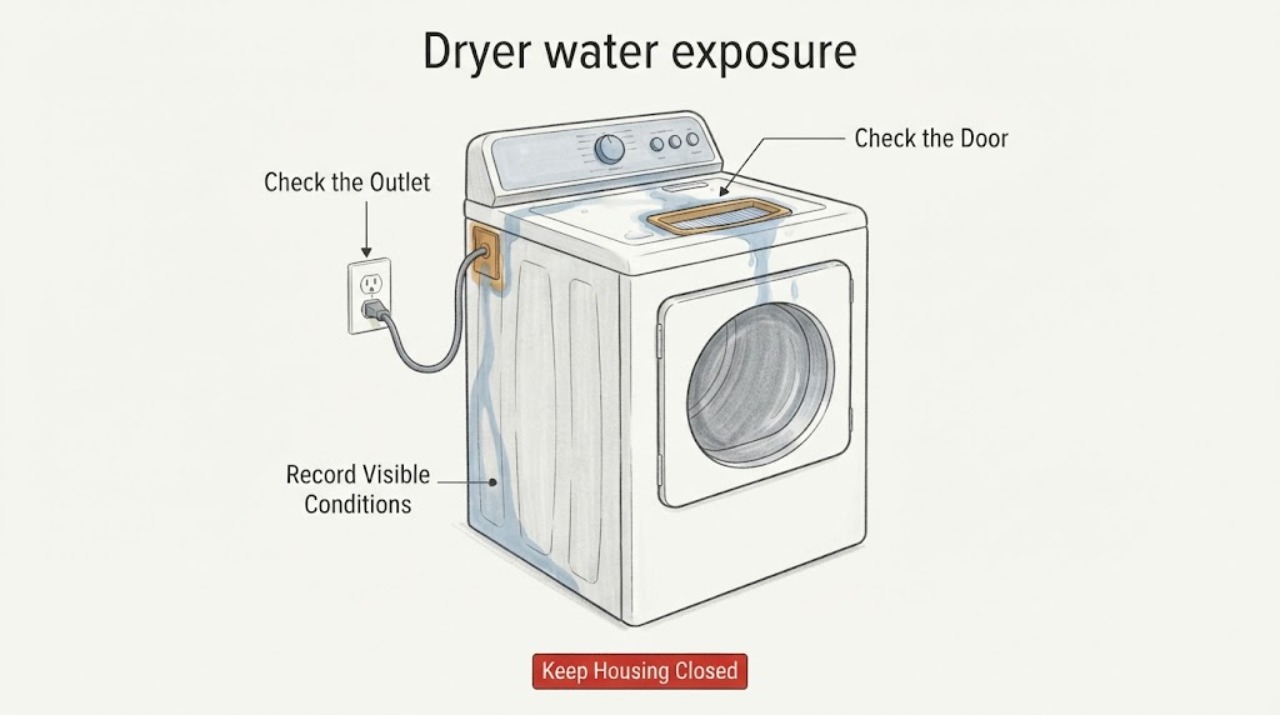
Stop the dryer immediately and do not press Start or reconnect it. From a dry, stable position, check whether the plug, outlet area or floor around the dryer is wet.
Expected result: The plug/outlet/floor is dry and power can be disconnected without contact with water, or any part of the power area is wet/unreachable.
Next step: If everything needed for the disconnect is dry and reachable, disconnect power without touching wet parts. Otherwise stay clear and switch off the correct breaker or call a qualified professional; do not reach through water or handle the plug while wet.
Why this matters
Why: A wet power area creates an electrical-contact hazard. A dry, accessible disconnect is a condition for a normal unplug action; it does not prove the dryer's interior is safe.
-
Check 2
Record the exposure without opening the cabinet: where the water entered, whether it ran below the lint screen, the approximate amount, and whether the dryer was powered, running or idle when the spill occurred.
Expected result: Only the lint-filter opening appears wet, or water was visible below the opening or near controls, wiring, the motor area or the floor.
Next step: Photograph the dryer's exterior and lint opening from a safe, dry position and give the exposure details to service. Do not remove panels or probe inside the opening.
Why this matters
Why: The visible entry point does not reveal how far water traveled inside a dryer. Water near electrical components or a powered appliance raises the service urgency; the absence of visible water does not clear hidden parts.
-
Check 3
Keep the lint screen and door accessible only for passive observation and remove no cabinet parts. Do not apply a hair dryer, heat gun, compressed air, or a high-heat cycle to force evaporation, and do not use the dryer to test whether it recovered.
Expected result: The exterior and accessible lint screen can be left undisturbed, or there is visible moisture, residue, scorching, odor, a tripped breaker or other damage sign.
Next step: Keep the appliance de-energized in either case. If any damage sign is present, report it as urgent to qualified service; do not attempt internal drying or cleaning.
Why this matters
Why: Surface dryness is not an electrical safety evaluation. ESFI warns that water-damaged equipment can remain hazardous even after drying and that re-energizing without proper evaluation can cause shock, fire or further damage.
-
Check 4
Find the model and serial label without moving or opening the dryer, and use Roper's owner-support manual/service route for REL3612BW2. Provide the exposure history rather than ordering a generic electrical or heating part.
Expected result: The label confirms REL3612BW2 and the service route accepts the model, or the model/serial information cannot be read safely.
Next step: Submit the confirmed model, serial number and spill details to Roper support or a qualified appliance/electrical professional. If the label cannot be reached safely, stop and let service identify it.
Why this matters
Why: Roper directs owners to model-specific manuals and factory-authorized service. A part list or generic dryer diagram cannot determine the condition of water-exposed internal components.
-
Check 5
Before any future service visit, check from outside whether there was smoke, sparking, a shock, a burning smell, a breaker trip, unusual noise or a damaged cord/outlet after the spill. Do not restore power to look for these symptoms.
Expected result: Any electrical or fire warning occurred, or no warning is known because the dryer has remained disconnected.
Next step: Report every warning to service and keep the dryer out of use. If there was smoke, fire or an electrical injury, follow emergency procedures and do not touch the appliance until the area is safe.
Why this matters
Why: A warning increases the likelihood of damage but does not identify a failed component. No warning while disconnected is not evidence that energizing is safe.
Use your observations
Decision map
Find the observation that best matches what you see, then follow the next safe action.
-
PATH 01Next step
What you see
Water entered the lint-filter opening but the dryer has remained disconnected, with no smoke, sparking, shock, burning smell or visible cord/outlet damage.
Do this next
Keep it out of service and arrange a qualified evaluation using the exact Roper model and spill details. Do not perform a test cycle.
Why this path and its safety boundary
Why it matters: The absence of a warning while de-energized does not prove that hidden electrical parts are dry or safe to energize.
-
PATH 02Next step
What you see
The plug, outlet, floor or controls are wet, or power cannot be disconnected without contacting water.
Do this next
Stay clear, switch off the correct breaker only if it can be done without entering a wet area, and call a qualified electrician or appliance professional.
Why this path and its safety boundary
Why it matters: This is an active electrical-contact hazard, so the owner should not reach for the plug or touch the appliance.
-
PATH 03Next step
What you see
There was smoke, sparking, a shock, burning odor, breaker trip, abnormal noise or visible damage after the spill.
Do this next
Keep power off, leave the area if there is smoke or fire, use emergency services as appropriate, and arrange qualified inspection. Do not open the cabinet or re-energize the dryer.
Why this path and its safety boundary
Why it matters: The water exposure may have affected electrical safety or fire protection, and the symptom does not identify a user-replaceable part.
-
PATH 04Next step
What you see
The spill details and REL3612BW2 model are confirmed, but no professional has evaluated the interior.
Do this next
Give the complete history to Roper-authorized service or a qualified appliance/electrical professional and follow the exact model documentation they provide.
Why this path and its safety boundary
Why it matters: The Reddit thread establishes the incident and model, not a safe drying interval, internal condition or successful repair.
Helpful context
Understand the symptom
Water through the lint opening is an exposure event, not a normal lint-filter cleaning step
The exact report says water from a wall-mounted lint trap fell into the top lint-filter opening of a Roper REL3612BW2. That confirms the incident and model, but it does not show whether moisture reached wiring, controls, the motor or heater. Do not convert forum comments into a clearance time or a high-heat test. CPSC and ESFI both support keeping a wet electrical appliance de-energized until it has been properly evaluated.
Use Roper's model support route for the next decision
Roper's owner-support page provides a model-manual lookup and factory-authorized service route. Give the service provider the complete REL3612BW2 model, serial number, approximate amount of water, entry point and any later symptoms. The public Roper support page does not authorize opening this dryer or prove that drying alone makes the appliance safe to energize.
When checks do not resolve it
Need a professional?
Keep the dryer off and arrange qualified evaluation after any water enters the lint-filter opening. Call an electrician or appliance professional urgently if the plug/outlet is wet, power cannot be isolated safely, or there was smoke, sparking, shock, burning odor, breaker trip or visible damage. Do not re-energize the dryer merely because the surface appears dry.
Common questions
FAQ
Can I run the Roper dryer briefly to see whether it still works?
No. CPSC says not to use wet or damaged appliances, and ESFI warns that returning power to water-damaged equipment without proper evaluation can cause shock, fire or further damage. Keep the REL3612BW2 disconnected and arrange evaluation.
Does leaving the lint opening open for a day prove the dryer is safe?
No. Passive drying may change what is visible, but it is not an electrical safety inspection. ESFI says water-damaged equipment can remain hazardous even after drying unless it is properly evaluated or reconditioned.
What model information should I give Roper service?
Give the complete REL3612BW2 model and serial number, the amount and source of water, the lint-filter entry point, whether the dryer was powered, and any odor, smoke, sound, breaker or outlet symptoms. Roper's owner-support page provides model-manual lookup and factory-authorized service.
Should I remove the dryer cabinet or lint duct to dry it?
Do not open the cabinet or probe into the lint duct for this water exposure. Internal access and electrical evaluation should be handled by qualified service; the spill alone does not identify a safe component or repair procedure.
Read the exact guide
Official sources
- Surviving the Aftermath of a Hurricane, Tornado, or Flood: CPSC Warns of Post-Storm Hazards from Generators, Candles, and Wet AppliancesU.S. Consumer Product Safety Commission · Opened CPSC consumer-safety guidance. It applies as a general wet-appliance safety boundary, not as a model-specific Roper repair manual.
- Please help, I spilled water down the lint filter of my dryerReddit r/appliancerepair · Opened the exact Reddit post. Lines 17-23 identify the water spill through the top lint filter and the Roper REL3612BW2 model. The post and comments do not establish the internal water path or a verified repair outcome.
- Owner SupportRoper Appliances · Opened Roper's official owner-support page. It directs owners to the model manual library and factory-authorized Roper technicians. It does not publish an internal water-exposure clearance or cabinet-repair procedure for REL3612BW2.
- Water-Damaged Electrical EquipmentElectrical Safety Foundation International · Opened ESFI electrical-safety guidance. It says water-damaged equipment can remain hazardous after drying, recommends qualified evaluation and warns against returning power without proper evaluation. It does not diagnose a Roper dryer component.
Community feedback
Share a repair observation
Share a plain-text repair observation. Accepted observations are published automatically; this page may take a moment to update.