
On this page
Start here
Quick answer
A locked Roper washer door may be normal while a cycle is active, while the tub is still tumbling, while water or hot wash liquid remains, or while a model-specific fresh-air or anti-crease option is running. First wait for motion and heat to end, then note whether water remains and whether the display shows a lock, control-lock, or error message. Use the exact Roper model manual for the cancel, drain-and-spin, and unlock procedure; Whirlpool family guidance is useful only as a cross-reference because Roper controls and models vary. Do not pry the door, bypass the interlock, reach into a moving drum, or force a hot door. If water remains, use only the documented drain path. A leak near electrics, smoke, burning odor, arcing, overheating, violent movement, a damaged door or latch, or a returning error requires stopping use and qualified service.
Before you begin
Safety first
- Keep the washer off for a locked mechanism with water, hot water, leaks near electrics, smoke, burning or electrical odor, arcing, overheating, violent movement, or repeated breaker operation. Do not pry the door, bypass the lock, open the cabinet, or repeat unsafe tests.
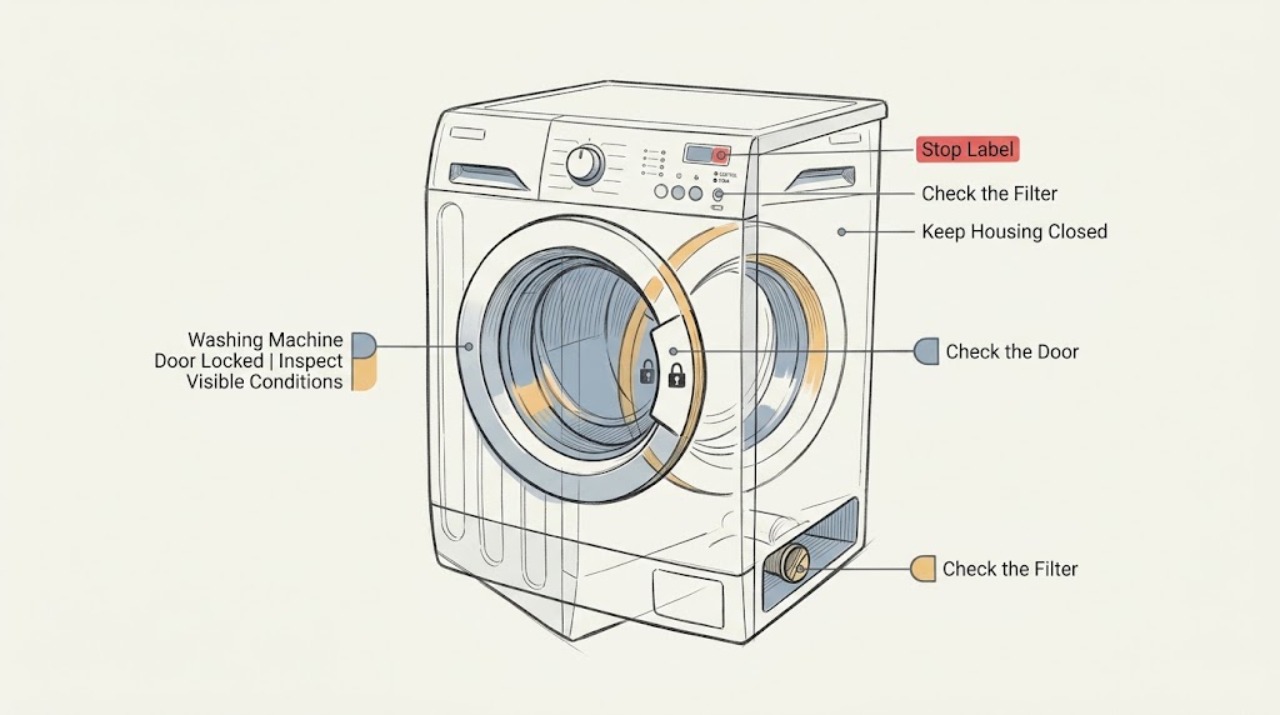
Work through in order
Diagnostic checks
Use only checks that match the exact appliance or system and its official guide.
-
Check 1
Stop pressing buttons and observe the washer from a safe position. Record the model, washer style, cycle stage, lock indicator or code, whether the drum or tub is moving, and whether water or hot suds are visible. Check for smoke, burning odor, a hot plug or outlet, arcing, a leak near electrics, violent movement, or a damaged door or lid; do not continue an unsafe cycle.
Expected result: The drum is moving, water is hot, smoke or burning odor is present, a connection is hot, a leak reaches electrics, the machine walks or strikes, or the door or lid is damaged.
Next step: Stop immediately. Keep clear, close the water supply if it is safe and dry to reach, and isolate power only from a safe dry location. Arrange qualified or emergency help as appropriate; never pry or restart the washer.
Why this matters
Why: The lock is protecting against motion, heat, flooding, shock, or injury, or the washer has an active safety fault.
-
Check 2
If the cycle is active but there is no hazard, use the exact Roper manual to pause or cancel it and wait for the tub to stop. Check whether the lock releases after the cycle, drain, and cool-down, without pulling on the door or lid.
Expected result: The lock releases normally after the cycle or cooling phase, the lock stays on while an anti-crease or fresh-air option runs, or it remains locked after the documented end state.
Next step: Cancel only the model-documented option. If the lock remains after the cycle and any water is removed, continue with the water and code checks; do not force the latch.
Why this matters
Why: A cycle or option can intentionally keep the door locked. A lock that remains after the safe end state may involve drainage, control logic, or the lock mechanism.
-
Check 3
Look through the door or lid only after the tub is stationary and cool enough to handle safely. If water remains, select the model-documented Drain, Drain and Spin, or equivalent function; supervise the first drain and keep a suitable container ready if the manual calls for filter access. Do not open a drain filter against resistance or reach into standing hot water.
Expected result: Water drains and the lock releases, the pump runs but water does not leave, the drain hose or filter is visibly restricted, or water remains after the documented drain cycle.
Next step: Correct only the visible hose routing or model-documented filter condition. Stop for hot water, a leak, a stuck filter, wastewater backup, or a returning drain fault and arrange service.
Why this matters
Why: Whirlpool guidance ties a locked door at cycle end to water remaining and directs a drain cycle; a restricted pump, filter, hose, or household drain can prevent release.
-
Check 4
If the display shows Control Lock, LOC, LC, Child Lock, or a similar message, compare the exact text with the Roper manual and use only its unlock key or key combination. Keep the control area dry and clean; do not hold random buttons or bypass the lock.
Expected result: The lock indicator clears and the controls respond, the door remains locked with no water, or the message is not documented for the exact model.
Next step: Run a cycle only if the door latches and there is no hazard. If the lock or message returns, leave the washer off and arrange service rather than trying repeated combinations.
Why this matters
Why: A control lock can make the washer appear unresponsive without a mechanical door failure. An undocumented message needs model-specific diagnosis.
-
Check 5
Inspect the cool, accessible door or lid edge and gasket for clothing, debris, soap buildup, a displaced seal, or a bent strike. Clean only the visible area with the manual-approved method and close the door or lid firmly; do not remove the lock or gasket.
Expected result: An obstruction clears and the latch engages, the gasket or strike is damaged, or the door appears closed but the lock will not engage or release.
Next step: Attempt one normal start only if the latch is intact and the washer is safe. Arrange qualified service for a damaged seal, strike, latch, or lock, and never bypass the interlock.
Why this matters
Why: Whirlpool family guidance identifies an obstruction or soap buildup as a cause of a lock problem, while damage or a persistent latch failure points to service.
-
Check 6
Read the complete error code and note when it appears: at startup, during water fill, while draining, during spin, or at the end of a cycle. Use the exact Roper manual and do not transfer a Whirlpool code meaning or timing to Roper without confirmation.
Expected result: The code points to water supply, drainage, door or lid, control lock, imbalance, or a service-required condition, or it is absent from the manual.
Next step: Perform only the corresponding visible check in the Roper manual. If the code returns, is undocumented, or the washer remains locked, leave it off and arrange service.
Why this matters
Why: A lock can be a consequence of another fault, especially water remaining or a failed interlock. Code meanings and reset procedures are model-specific.
-
Check 7
Only when the washer is cool, dry, stationary, and free of smoke, odor, leak, or electrical symptom, perform at most one model-documented power reset. Disconnect power from a safe location for the manual-specified interval, reconnect once, and do not repeat the reset if the lock or code returns.
Expected result: The lock clears and the washer completes a safe drain or cycle, the same fault returns, or the control remains unresponsive.
Next step: Leave the washer off and arrange service for a returning lock, code, or unresponsive control. Do not use an emergency release unless the exact manual authorizes it and the drum is stationary and safe.
Why this matters
Why: A reset may clear a temporary control state, but it cannot repair a blocked drain, damaged latch, failed sensor, or internal leak.
Use your observations
Decision map
Find the observation that best matches what you see, then follow the next safe action.
-
PATH 01Next step
What you see
The cycle is active, the drum is tumbling or spinning, or the washer is cooling after a hot cycle.
Do this next
Wait for motion, draining, and cooling to finish. Do not pull the door or reach inside.
Why this path and its safety boundary
Why it matters: The lock is operating as a safety interlock.
-
PATH 02Next step
What you see
A fresh-air, anti-crease, or similar hold option is active and the washer is otherwise safe.
Do this next
Cancel the option only with the exact model's control. If the lock persists after cancellation and draining, arrange service.
Why this path and its safety boundary
Why it matters: Some models intentionally keep the door locked while the load is periodically moved or aired.
-
PATH 03Next step
What you see
Water remains in the drum or a drainage message is shown.
Do this next
Use the model-documented drain function and inspect only the safe, documented drain path. Stop for hot water, leaks, backup, or a returning drain fault.
Why this path and its safety boundary
Why it matters: The lock may be preventing flooding because the washer has not completed drainage.
-
PATH 04Next step
What you see
Control Lock, LOC, LC, or a similar control message is displayed with no active water hazard.
Do this next
Use the exact Roper manual's unlock command. If it does not clear or returns, leave the washer off and arrange service.
Why this path and its safety boundary
Why it matters: The controls may be intentionally disabled rather than the door lock being mechanically broken.
-
PATH 05Next step
What you see
The door or lid is obstructed, the gasket or strike is damaged, or the lock will not engage or release after a safe drain and documented reset.
Do this next
Do not pry or bypass the interlock. Keep the washer off and arrange qualified appliance service with the model and code.
Why this path and its safety boundary
Why it matters: A latch, lock, sensor, wiring, or control fault is possible.
-
PATH 06Next step
What you see
The washer is a top-load model and the lid remains locked, or the Roper model cannot be matched to the Whirlpool family guidance.
Do this next
Use only the exact Roper model manual. Do not insert tools into the lid lock or apply front-load emergency-release instructions.
Why this path and its safety boundary
Why it matters: The mechanism and controls may differ substantially from front-load guidance.
-
PATH 07Next step
What you see
Smoke, burning or electrical odor, arcing, overheating, a leak near electrics, hot water exposure, violent movement, a damaged door or lid, or a repeated breaker trip occurs.
Do this next
Stop immediately, keep clear, close the water supply if safe, isolate power only from a dry safe location, and obtain qualified or emergency help. Do not restart.
Why this path and its safety boundary
Why it matters: Continued operation could cause injury, scalding, shock, fire, or water damage.
Helpful context
Understand the symptom
A locked door is often a safety state
A front-load door normally locks during tumbling, spinning, draining, or a hot cycle. Some models keep the door locked during a fresh-air or anti-crease option. A top-load Roper washer may use a lid lock rather than a front door. Do not assume a Roper model has the same button labels, countdown, emergency release, or option names shown in a Whirlpool article.
Water and heat determine whether the lock can release
If water remains, the washer may keep the door locked to prevent flooding. A hot load can also keep the door locked until it cools. Wait for the tub to stop and use the exact model's drain or cancel procedure. Never pull the door open against the latch or reach into a moving drum.
Roper model identity comes first
Record the full model number, whether the washer is top-load or front-load, the exact display text, the selected cycle, and whether a fresh-air, delay, or control-lock option is active. Whirlpool family support pages and manuals can show the decision pattern, but only the Roper manual for the appliance controls the actual key sequence and emergency-release method.
Safety boundary
Stop conditions
- Do not pry, pull, drill, or bypass a locked door or lid. Never reach into a moving drum, and do not use an emergency release while the tub is moving or hot.
- Stop for hot water, a leak near electrics, wastewater backup, a stuck drain filter, a damaged door or lid, smoke, burning or electrical odor, arcing, overheating, violent walking, or repeated breaker trips. Isolate power only from a safe dry location.
- Do not transfer a code, key sequence, timing, drain procedure, or emergency-release instruction from a Whirlpool or another Roper model without matching the exact Roper manual.
- Do not bypass the interlock, open the cabinet, remove the lock, disconnect hidden hoses, or repeat power resets after a lock, code, leak, or unsafe symptom returns.
Only after diagnosis
Potential parts
- washer door or lid-lock assembly
Consider this only after qualified diagnosis confirms a correctly aligned door or lid, safe water state, and a failed model-specific lock or sensor.
Roper lock assemblies differ by top-load or front-load design and model. Confirm the exact model and diagnosis before selecting a part. - door latch, strike, or gasket
Consider this only when visible damage or qualified inspection links the latch, strike, or gasket to a lock that will not engage or release.
Fit and replacement procedure are model-specific; do not substitute a latch or gasket by appearance alone. - drain pump, filter, or drain hose
Consider this only when water remains, a drain fault returns, or qualified diagnosis identifies a blocked or failed drain component after the documented user check.
Drain access and components vary by model. Confirm the exact model and safe service procedure before ordering or fitting a part.
When checks do not resolve it
Need a professional?
Request service for a persistent locked door or lid, returning error, failed drain, damaged latch or gasket, unresponsive lock, or any internal leak or electrical symptom.
Safety scope: Keep the washer off for a locked mechanism with water, hot water, leaks near electrics, smoke, burning or electrical odor, arcing, overheating, violent movement, or repeated breaker operation. Do not pry the door, bypass the lock, open the cabinet, or repeat unsafe tests.
Common questions
FAQ
Why is my Roper washer door locked after the cycle ends?
Wait for the tub to stop and check whether water remains. A drain or spin function may be required before the lock releases. A fresh-air or anti-crease option can also keep the door locked on some models. Use the exact Roper manual and never pry the door.
Can I force open a locked Roper washing-machine door?
No. The lock may be protecting against motion, heat, or flooding. Wait for the drum to stop and water to drain, then use only the exact model manual's safe procedure. Do not insert tools, bypass the interlock, or reach into a moving or hot drum.
What does Control Lock mean when my Roper washer door is locked?
It may mean the controls are intentionally disabled rather than that the door mechanism has failed. Match the displayed text to the exact Roper manual and use its unlock command. If the message returns or the latch will not engage, arrange service.
Should I reset a Roper washer with a locked door?
Only if the exact manual documents a reset and there is no water, heat, leak, smoke, odor, movement, or electrical hazard. Perform it once after safe checks. If the lock or code returns, leave the washer off and request qualified service.
Read the exact guide
Official sources
- Owner's ManualWhirlpool · Specific Whirlpool owner manual used for family-level mechanics only; use the exact Roper manual for operation and service.
- Unlocking a Front Load Washer Door When it is Locked at InstallWhirlpool Product Help · Whirlpool front-load installation guidance; use only as a family reference for a matching Roper design.
- Door Will Not Lock or Unlock - Front Load WasherWhirlpool Product Help · Whirlpool front-load family guidance; Roper model and option names must be confirmed in the exact manual.
- Front Load Washer Door Will Not OpenWhirlpool Product Help · Whirlpool family front-load guidance used as a cross-reference only; Roper model controls and procedures may differ.
- Not Starting or Not Operating - Front Load WasherWhirlpool Product Help · Whirlpool front-load family article; key combinations, controls, and water requirements vary by Roper model.
- Latching a Front Load Washer DoorWhirlpool Product Help · Whirlpool front-load family article; do not generalize to a Roper top-load lid lock or another model.
Community feedback
Share a repair observation
Share a plain-text repair observation. Accepted observations are published automatically; this page may take a moment to update.