
On this page
Start here
Quick answer
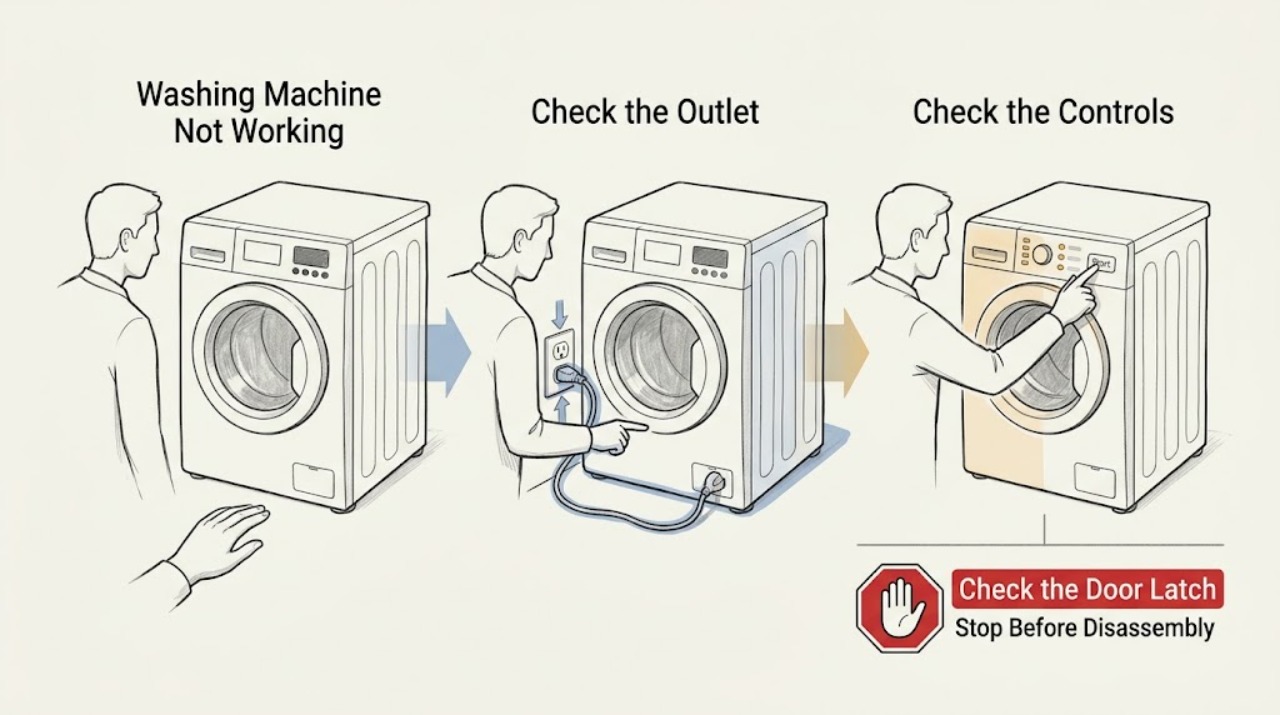
Start by separating a completely dead Roper washer from one that has power but will not start, fill, drain, spin, or stay dry. Identify the exact model and the last stage that worked, then check the outlet and controls, the closed lid, both water faucets and inlet hoses, the visible drain hose and household drain, and the load balance. Roper manuals and Whirlpool-family guidance vary by model, so use the matching manual before applying a control-lock, reset, pump-filter, or hose instruction. Stop immediately for water near electrical parts, smoke, sparks, a burning odor, a hot or discolored outlet, a shock, a repeated breaker trip, uncontrolled filling, or severe movement; do not open or tilt the cabinet.
Work through in order
Diagnostic checks
Use only checks that match the exact appliance or system and its official guide.
-
Check 1
Stop the washer and inspect from a dry position for smoke, flame, sparks, a burning or hot-insulation odor, a hot or discolored outlet, a shock, water near the cord or outlet, a repeated breaker trip, or uncontrolled filling.
Expected result: Any electrical warning, water at the electrical connection, or rapidly increasing leak is present.
Next step: Do not touch a wet plug, walk through standing water, reset repeatedly, or run another cycle. From a dry and safe location, close the water supply or isolate power only if that can be done without contact with water; otherwise keep clear and obtain qualified help.
Why this matters
Why: This is a safety or flood condition, not a normal no-start troubleshooting branch; operating or repeatedly resetting the washer could increase injury or fire risk.
-
Check 2
With the floor dry and the washer stopped, identify the exact Roper model, check whether the outlet supplies power to another safe appliance, and note whether the washer has lights, sounds, or a displayed code.
Expected result: The outlet is dead, the washer has no lights or sound, or the washer has power but the controls do not respond; alternatively, an error or flashing indicator appears.
Next step: Do not use an extension cord or open the cabinet. If the outlet and cord are safe but the washer remains dead, arrange service; if the controls respond, continue to the lid and Start checks.
Why this matters
Why: No power points first to the household supply or cord path; power with no response points to a model-specific control lock, control, or service issue. An error or light pattern must be read from the exact manual rather than guessed across models.
-
Check 3
Confirm the selected cycle is appropriate, the lid is fully closed and latched, any control lock is cleared by the model's instructions, and the Start control is pressed or held exactly as the model manual specifies.
Expected result: The washer starts after the lid is latched or Start is held, or a lid/control-lock light remains on and the cycle will not engage.
Next step: Let the washer proceed only if it starts normally and there are no safety warnings. If the lid will not latch or the lock indicator persists, stop and request service rather than bypassing the interlock.
Why this matters
Why: Lid and control interlocks intentionally prevent some models from filling, washing, draining, or spinning; control behavior and Start timing vary by model.
-
Check 4
If the washer does not fill, inspect the visible hot and cold faucets and inlet hoses for closed valves or kinks; then inspect the visible drain hose for a kink, clog, or installation that allows water to siphon away, without removing internal screens unless the exact manual authorizes it.
Expected result: A faucet is closed, an inlet hose is kinked or disconnected, the washer reports a fill alert, or water enters and immediately drains away.
Next step: With water off and hands dry, correct only an obvious external hose position or faucet setting, then check for leaks. If the fill alert returns or the hose and plumbing are not safely accessible, arrange qualified service.
Why this matters
Why: Restricted supply, missing water, or incorrect drain-hose installation can make the washer appear not to work or prevent the cycle from reaching its next stage.
-
Check 5
If water remains in the tub or the washer will not drain, observe whether the drain hose is kinked or clogged and whether the household drain or utility sink backs up; do not reach into standing water or open a pump area unless the model manual gives a safe procedure.
Expected result: The drain path is restricted, water backs up, a long-fill or drain-related message appears, or the tub remains full after the cycle stops.
Next step: Keep the washer out of service if water is pooling. Correct only a clearly visible external hose position when safe; have a persistent blockage, pump, or inaccessible filter assessed by a qualified technician.
Why this matters
Why: The washer may stop before spin when it cannot discharge water; a drain installation or household plumbing problem can imitate a failed pump or control.
-
Check 6
If the washer reaches spin but leaves clothes wet or stops moving, check that the load is not tightly packed or unbalanced, the cycle does not select low or no spin, and the cabinet is level from outside.
Expected result: The load is uneven or bulky, the spin setting is low or off, the washer is not level, or the machine makes severe noise or movement.
Next step: Stop a violently moving washer, redistribute or reduce the load only after motion stops, and use the model-recommended cycle. If movement, scraping, leaking, or failure returns with a balanced load, request service.
Why this matters
Why: An imbalance, cycle choice, or leveling issue can reduce or stop spin without proving that the motor or drive has failed; severe movement can damage the appliance or surroundings.
-
Check 7
If water appears on the floor, record the first wet point and cycle stage, then inspect only visible supply, drain, lid-area, and floor connections; do not assume a puddle under the washer identifies the source.
Expected result: The leak starts during fill, drain, or spin, continues while the washer is idle, or comes from underneath with no visible external source.
Next step: Close the water faucets while waiting for service, keep the area dry and clear, and arrange a qualified appliance inspection for an internal or persistent leak.
Why this matters
Why: Fill-time, drain-time, splash, and idle leaks require different checks; an internal or continuing leak needs service and should not be reproduced by repeated cycles.
Use your observations
Decision map
Find the observation that best matches what you see, then follow the next safe action.
-
PATH 01Next step
What you see
The washer has no lights or sound and a safe outlet check shows no power, or the cord/outlet is hot or damaged.
Do this next
Stop using the circuit or appliance and obtain qualified electrical help; do not use an extension cord or open the washer.
-
PATH 02Next step
What you see
The controls have power but the cycle does not engage, the lid is not latched, a control lock is active, or Start was not held as required.
Do this next
Follow the exact Roper model instructions for the lid, control lock, cycle, and Start command. A lid that will not latch needs service, not a bypass.
-
PATH 03Next step
What you see
The washer does not receive water, displays a fill alert, or fills and drains at the same time.
Do this next
Check both faucets, visible inlet-hose kinks, and the visible drain-hose installation; use the exact manual for model-specific screens or codes.
-
PATH 04Next step
What you see
Water remains in the tub, the washer stops before spin, or clothes are wet after an otherwise completed cycle.
Do this next
Check only the visible drain path and load/level conditions. A persistent blockage, pump, lid interlock, or internal drive problem needs qualified service.
-
PATH 05Next step
What you see
Water appears on the floor, the tub gains water while idle, or the first wet point is under the cabinet.
Do this next
Close the water faucets, keep electrical connections dry, and arrange appliance service without tilting or opening the washer.
Helpful context
Understand the symptom
“Not working” describes several different failures. A washer with no lights needs a power check; a washer with lights but no action may be waiting for a closed lid, a control-lock release, a Start command, or a water-supply condition. A washer that fills but stops later has a different decision path from one that never fills. Record what the machine does and does not do before changing settings.
The linked Roper manual covers specific older top-load models. Roper designs and controls vary, so locate the model number under the lid and follow its own instructions for cycle names, lid behavior, hose arrangement, and any reset. The checks below are limited to safe external observations and model-authorized controls.
Only after diagnosis
Potential parts
- lid latch or lid switch
Consider this category only when the exact model's lid will not latch or the model-specific diagnosis identifies the lid interlock as the cause of a no-start or no-spin condition.
Confirm the complete Roper model and the manufacturer's fit information before ordering any part. - water inlet valve
Consider this category only after both household water supplies, hose routing, and visible restrictions are correct and a qualified diagnosis identifies the washer's inlet valve.
Match the complete Roper model and valve configuration; do not infer compatibility from the brand alone. - drain pump or drain hose
Consider this category only when the visible drain path is clear or correctly installed and a model-specific diagnosis points to the pump or hose.
Verify the complete model and installation requirements before ordering or attempting replacement.
When checks do not resolve it
Need a professional?
Have this ready
- Give the technician the exact Roper model, whether the machine has power, the last completed stage, display or light pattern, lid behavior, water and drain observations, load and spin setting, first wet point if leaking, and any electrical warning signs.
Common questions
FAQ
What should I check first when my Roper washer stops working?
First rule out a safety hazard, then identify whether the washer is completely dead or has power. Next check the closed lid and model-specific Start or control-lock behavior, followed by water supply, drain, and load/spin conditions.
Why will my Roper washer fill but not finish?
A drain restriction, incorrect drain-hose installation, excessive suds, lid condition, unbalanced load, or model-specific error can stop the washer after filling. Record the stage and check only the visible drain and load conditions before arranging service.
Can I reset a Roper washer that is not working?
Only use a reset if the exact Roper manual authorizes it and there is no leak, burning odor, smoke, spark, hot outlet, shock, or repeated trip. A reset cannot make an unsafe appliance safe and should not replace diagnosis of a persistent fault.
Read the exact guide
Official sources
- Leaking from Behind - Top Load WasherWhirlpool Corporation · Whirlpool-family top-load rear-leak guidance for inlet hoses, drain hose, and household plumbing; apply to matching Roper configuration
- Owner's ManualWhirlpool Corporation / Roper Appliances · Roper AL4132V, AL5143V, AL6245V, AX5133V, and AX6245V washers; operation, water and drain connection, lid and cycle use, safety, maintenance, and qualified service boundaries
- Leaking from Front or Top - WasherWhirlpool Corporation · Whirlpool-family washer front/top splash guidance; apply to a matching Roper top-load configuration
- CPSC Guide to Home Wiring HazardsU.S. Consumer Product Safety Commission · General household electrical hazard recognition and qualified-professional boundary
- Not Spinning - Washer - Product HelpWhirlpool Corporation · Whirlpool-family top-load spin, load-balance, drain, and leveling guidance; apply to Roper only when the model matches
- Not Starting - Washer - Product HelpWhirlpool Corporation · Whirlpool-family top-load washer no-start and control guidance; apply to Roper only where the exact model behavior matches
- Not Filling or Long Fill - Washer - Product HelpWhirlpool Corporation · Whirlpool-family washer fill and drain-hose installation guidance; apply to Roper only where the model and installation match
- Leaking Inside the Tub - WasherWhirlpool Corporation · Whirlpool-family guidance for water entering the tub while not in use; use conditionally for a matching Roper configuration
- Washer Not Draining or Spinning? Troubleshooting GuideWhirlpool Corporation · Whirlpool-family washer drain and spin troubleshooting; use conditionally for a matching Roper configuration
- Checking the Fill Hoses if the Washer is not FillingWhirlpool Corporation · Whirlpool-family washer water-supply, hose, and inlet-screen checks; use only where the Roper configuration matches
- LF - Error Code - Product HelpWhirlpool Corporation · Whirlpool-family top-load long-fill and drain-hose installation guidance; do not interpret LF as a Roper code without exact model evidence
- Lid Locking on a Top Load High Efficiency Washer - Product HelpWhirlpool Corporation · Whirlpool-family top-load lid interlock behavior; use only for a matching Roper top-load configuration
Community feedback
Share a repair observation
Share a plain-text repair observation. Accepted observations are published automatically; this page may take a moment to update.