
On this page
Start here
Quick answer
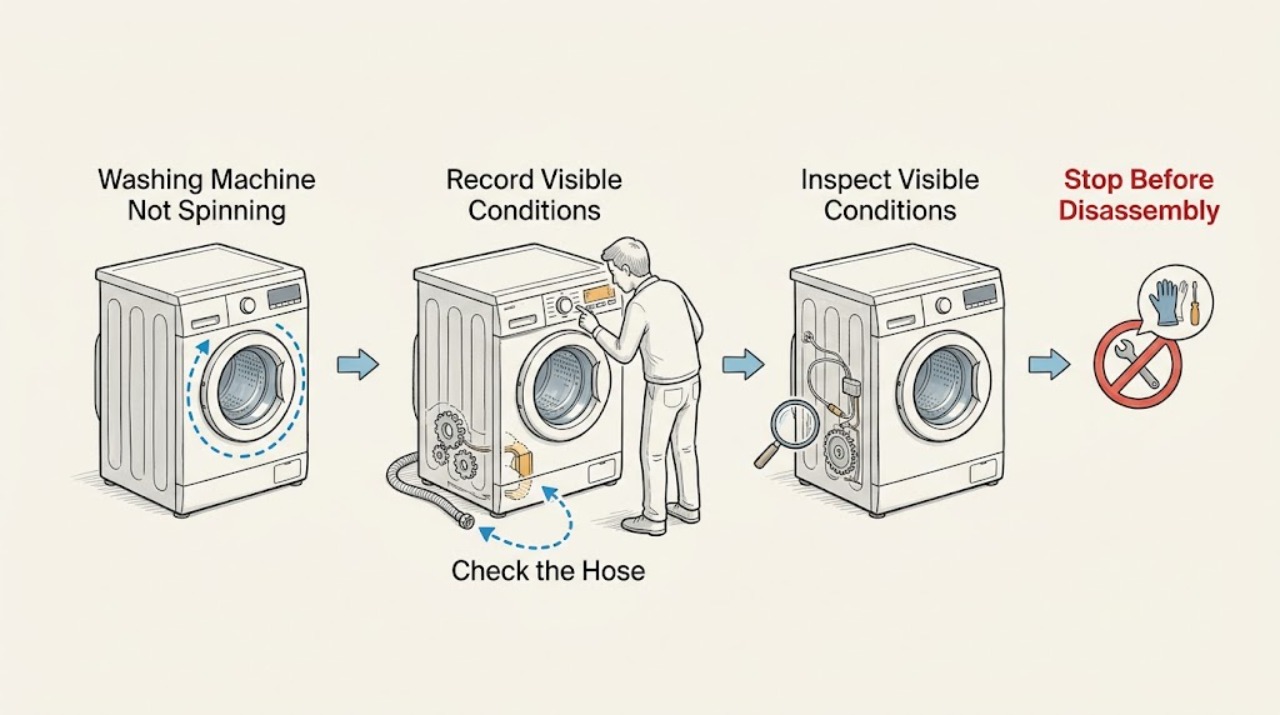
If a Russell Hobbs washing machine is not spinning, first note whether the drum contains water, whether the cycle stopped before or during spin, and whether the display shows a code. The washer may hold spin when it cannot drain, when the load is uneven or unsuitable for the selected program, or when the door is not locked. With the machine off, check the visible outlet hose for kinks, crushing, clogs, incorrect height, or an extension, then use the exact manual to identify any pump filter. A filter check is model-dependent and can release residual water. Do not force the door, tilt the washer, reach into a live appliance, or keep restarting a noisy pump; stop for hot water, leaks near electricity, smoke, burning odor, sparks, or a repeated electrical trip and arrange qualified service.
Work through in order
Diagnostic checks
Use only checks that match the exact appliance or system and its official guide.
-
Check 1
Record the exact Russell Hobbs model, front-load or other design, selected program, chosen spin speed, display symbols or code, and the stage at which the drum stopped. Note whether water is visible, the door or lid is locked, and whether the clothes are dripping wet or only damp.
Expected result: The drum is full or partly full, the tub is empty but clothes are wet, the cycle stopped before drain, or a code or flashing symbol appears.
Next step: Keep the model and event sequence for the manual and service record. If water is hot, the door cannot be safely managed, or there is a leak near electricity, stop and arrange service before further checks.
Why this matters
Why: Visible water shifts the first check toward drainage. An empty tub with wet clothes can result from a low-spin program or unbalanced load, while a code or locked door requires the exact model manual rather than a generic interpretation.
-
Check 2
Switch the washer off using its normal control and disconnect power before touching the visible drain hose or any manual-approved filter access. Close the water tap if a hose is leaking; do not tilt or move a water-filled machine across a wet floor.
Expected result: The floor, cabinet, plug, receptacle, cord, or lower access area is wet, hot, discolored, damaged, or dry and intact.
Next step: For moisture near electricity, a hot or damaged connection, smoke, burning odor, sparks, or a breaker trip, leave the washer off and contact qualified electrical or appliance help. Otherwise continue with visible drain routing checks from a dry position.
Why this matters
Why: Water or heat near electrical parts changes this from a spin problem to a shock or fire risk. A dry exterior does not prove that an internal pump or wiring area is safe to open.
-
Check 3
Inspect the visible outlet hose and its receiving standpipe or sink without removing a cabinet panel. Look for a kink, crushing, clog, extension, taped or sealed connection, an end routed too low or too high, or a hose forced back into the washer; compare the arrangement with the exact installation guide.
Expected result: The hose is bent or blocked, the drain is sealed, the hose has been extended, the end is outside the documented height, or no external restriction is visible.
Next step: Correct only visible routing that the exact manual supports and remove only an accessible external obstruction with power off. If the route cannot be confirmed, the hose is damaged, or the sink or standpipe backs up, arrange plumbing or appliance service.
Why this matters
Why: Russell Hobbs documentation states that a bent, buckled, crushed, extended, or badly routed outlet hose can prevent correct drainage. A drain restriction can keep a washer from reaching spin even when the motor itself is healthy.
-
Check 4
Use the exact manual to determine whether this model has a pump filter and whether it provides a residual-water procedure. If it does, place a broad shallow container and cloth below the access point, drain slowly, and inspect only the removable filter described by the manual; do not open an unlisted access panel.
Expected result: The filter contains lint or a small object, the filter is clear, water will not drain into the container, or the model manual does not identify a user-accessible filter.
Next step: Reinstall a model-approved filter exactly as documented. If water cannot be controlled, the filter is damaged, or the blockage is beyond the access point, stop and arrange qualified service rather than tilting the machine or dismantling it.
Why this matters
Why: Russell Hobbs manuals identify a pump filter on some front-load designs and link a clogged filter to discharge problems. A clear filter does not rule out a pump, hose, control, or internal obstruction, and a missing access procedure means the check is not user-facing for that model.
-
Check 5
Review the program, spin-speed selection, load size, and detergent amount against the Russell Hobbs manual. With the door or lid correctly closed and the tub safe, redistribute a tightly packed or single bulky load and select the documented spin or drain-and-spin option once; do not add more water or detergent.
Expected result: The program uses a low spin, the load is under-loaded, over-loaded, bulky, or uneven, excessive foam is present, or the washer spins after the load is redistributed.
Next step: If the washer spins normally after the correction, monitor a normal load with the manual's settings. If it leaves water, fails again, or makes an abnormal sound, keep it off and arrange diagnosis.
Why this matters
Why: Russell Hobbs states that low spin removes less water, an uneven load can delay spin while the machine tries to spread laundry, and excess foam can slow or stop discharge and spinning. A repeat failure with a balanced load points beyond loading practice.
-
Check 6
Check the door or lid status and the program controls without bypassing a lock. Confirm that the chosen program is not stopped, paused, or waiting for a required drain phase, and record any error pattern; do not force a door that remains locked with water inside.
Expected result: The door is not latched, a lock symbol remains, a program is paused or cancelled, water remains, or the controls report a fault.
Next step: Use only the model manual's cancellation or drain-and-spin procedure once when the area is safe. If the door remains locked, water remains, or the code returns, leave the washer off and arrange qualified service.
Why this matters
Why: The Russell Hobbs manual uses door status and program selection as operating conditions, and a locked door can be a consequence of retained water. A lock or control fault cannot be safely bypassed to make the drum spin.
-
Check 7
During one manual-approved spin or drain attempt from a safe, dry position, note whether the pump runs, water exits, the drum slowly redistributes, the motor is silent, or the machine makes humming, grinding, scraping, or repeated clicking sounds. Do not repeat a harsh-sounding cycle or test live wiring.
Expected result: Water drains and the drum spins, water flow is weak, the pump hums without flow, the drum never accelerates, or a severe sound or smell appears.
Next step: Stop immediately for grinding, smoke, burning odor, leakage, sparks, a hot connection, severe movement, or a breaker trip. Otherwise record the sound and water behavior and arrange qualified service if spinning remains unavailable.
Why this matters
Why: Successful drainage and spin after a load or hose correction supports an operating-cycle issue. Weak flow, no flow, persistent no-spin, silence, or abnormal sound can involve the pump, filter, hose, lock, control, or drive system; observation alone cannot name the failed part.
-
Check 8
If the washer shows a complete error code, copy it and note the cycle stage, water level, door status, and recent installation or transport history. Check the exact manual and use one reset only when its instructions permit it and no water or electrical hazard is present.
Expected result: The code clears but spin remains unavailable, returns during drain or spin, changes after a hose correction, or no code appears despite repeated failure.
Next step: Leave the washer off for a returning code or persistent no-spin event and provide the model, code, load, hose route, filter status, and sound to service. Do not open the control area or use a generic code table.
Why this matters
Why: Russell Hobbs documentation lists model-specific pump, filter, door, water, and excess-water conditions and directs persistent faults to an authorized or qualified engineer. A cleared code does not prove that the drain or drive path is safe.
-
Check 9
For a recently installed or moved washer, inspect only the visible installation history: note whether transport bolts may remain, whether the cabinet is level and stable, and whether the floor or surrounding sides allow the documented clearance. Do not remove rear hardware or level a wet, energized, or unstable machine.
Expected result: The problem began after installation or movement, transport hardware is suspected, the washer rocks, or the floor and clearances appear sound.
Next step: Keep the machine off if it rocks, moves severely, or still has suspected transport hardware, and arrange qualified installation or appliance service. Do not add improvised packing beneath the cabinet.
Why this matters
Why: Russell Hobbs documentation says transport bolts can cause severe vibration or malfunction and that an unsuitable or unlevel surface can interfere with operation. These findings explain vibration-related spin refusal but do not justify dismantling a full washer.
Use your observations
Decision map
Find the observation that best matches what you see, then follow the next safe action.
-
PATH 01Next step
What you see
The machine stopped with visible water before or during spin.
Do this next
Keep power off, check the visible outlet hose and household drain, and use a pump-filter procedure only when the exact manual identifies one. Do not force the door or tilt the washer.
-
PATH 02Next step
What you see
Water has left the machine, but the load is wetter than expected and the drum did not reach a fast spin.
Do this next
Check spin speed, program, load balance, bulky items, and detergent amount, then use the documented spin option once. Arrange service if a balanced load still will not accelerate.
-
PATH 03Next step
What you see
The outlet hose is kinked, crushed, extended, badly routed, or the standpipe or sink backs up.
Do this next
Correct only visible routing supported by the exact guide and have a household backup assessed by a plumber. Do not push tools into the washer or dismantle the cabinet.
-
PATH 04Next step
What you see
The manual identifies an accessible pump filter and it contains lint or a small object.
Do this next
With power off and a container ready, follow the manual's gradual drain and filter procedure once, reseat the filter, and stop if water cannot be controlled or the obstruction is beyond access.
-
PATH 05Next step
What you see
The door is not latched, a lock remains because water is present, the program is paused, or a code returns.
Do this next
Use only the exact manual's control or drain procedure. Never bypass the lock; keep the washer off and arrange service for a persistent lock, code, or no-spin condition.
-
PATH 06Next step
What you see
The cabinet rocks, moves, bangs, or the symptom began after installation or transport.
Do this next
Stop the cycle, keep the machine off, and arrange qualified installation or appliance service if transport hardware, leveling, or an internal drive issue is suspected. Do not stabilize it with improvised materials.
-
PATH 07Next step
What you see
There is hot water, a leak near electricity, smoke, burning odor, sparks, a hot connection, a shock, or a repeated electrical trip.
Do this next
Stop using the washer, do not touch wet electrical equipment or restore power to retest, keep people away from the hazard, and contact qualified electrical, plumbing, appliance, or emergency help as appropriate.
Helpful context
Understand the symptom
A washer that will not spin may be waiting for drainage
Start by separating a true no-spin event from a drain problem. Record whether water is visible, whether clothes are merely wet, when the cycle stopped, and whether the drum tried to redistribute the load. Russell Hobbs documentation describes a spin cycle being delayed by its unbalanced-load control, and a washer can also prevent high-speed movement while water remains.
Model and loading design matter
Russell Hobbs has front-load and other washer designs, and its manuals show that features and drawings can vary by model. A pump filter may be accessible on one design and absent or inaccessible on another. Find the exact model manual before opening a filter cover, changing a program, or interpreting a code.
Keep water away from live equipment
Turn the machine off before handling a hose or approved filter access and keep the floor, plug, receptacle, and controls dry. Have a shallow container and cloth ready only when the manual describes a residual-water procedure. Do not tilt a full washer, force a locked door, or pull on a rear hose connection to make room.
A part is not identified by sound alone
A silent pump, a hum, and a grinding sound can each have more than one cause. The drain hose, pump filter, pump, door lock, control, load sensing, and installation can overlap in their symptoms. Record the observation and let a qualified technician determine whether an internal part is involved.
Safety boundary
Stop conditions
- Stop immediately for hot water, a leak toward a plug or receptacle, water inside electrical areas, smoke, burning or electrical odor, sparks, a hot or discolored cord or connection, electric shock, severe cabinet movement, or a repeated electrical trip.
- Do not tilt a washer full of water, force a locked door, bypass a lid or door lock, remove cabinet or control covers, reach into live equipment, or use improvised packing or an extension as a repair.
- Do not keep restarting a blocked, silent, or harsh-sounding pump, repeatedly reset a code or breaker, or run another load to see whether the no-spin symptom disappears. Leave the washer off until a qualified professional identifies the cause.
Only after diagnosis
Potential parts
- drain pump or pump filter assembly
Consider this category only after the exact manual and qualified diagnosis link retained water or weak discharge to a pump or model-specific filter fault rather than the hose or household drain.
Pump and filter arrangements vary by Russell Hobbs model and washer design. Confirm the complete model and manufacturer fit information; do not access the pump in a water-filled or energized cabinet. - door lock or drive component
Consider this category only when a qualified technician confirms that drainage is clear and the persistent no-spin or lock symptom comes from the identified component.
Lock and drive parts are model-specific and require safe appliance access. Do not bypass a lock or select a component from a code or sound alone.
When checks do not resolve it
Need a professional?
Arrange qualified Russell Hobbs or appliance service when the washer still will not spin after the model-appropriate drain, hose, filter, program, load, and door checks; when a code persists; when the pump is silent or abnormal; or when the machine moves severely. Use a plumber for a household drain backup and an electrician for a hot or damaged connection, shock, repeated electrical trip, or wiring concern. Provide the exact model, cycle stage, water level, load, hose routing, filter result, code, and sound.
Common questions
FAQ
Why is my Russell Hobbs washer not spinning?
Check whether water remains first. A drain restriction, pump filter, uneven load, low-spin program, excess foam, door status, or installation condition can prevent or delay spin. Use the exact model manual and stop if water or electrical hazards are present.
Can a blocked drain stop a Russell Hobbs washer from spinning?
Yes. If water cannot leave the washer, the machine may not proceed to high-speed spin. Check the visible hose and household drain, then use a filter procedure only when the exact manual identifies one.
How do I check the pump filter?
First confirm from the exact manual that your model has an accessible filter. With power off, use the manual's residual-water procedure and a broad shallow container; do not open an unlisted access point or tilt the washer.
Why does the spin cycle start late?
Russell Hobbs documentation says its unbalanced-load control may try to spread laundry before spinning. A low spin setting, bulky or uneven load, excess foam, or incomplete drainage can also leave clothes wet or delay spin.
Should I force the locked door open?
No. Water may remain in the washer, or the lock may be protecting a moving drum. Use only the exact manual's safe drain or cancellation guidance; if the door stays locked or water remains, arrange service.
When is a no-spin problem a service call?
Arrange service when the washer still fails after model-specific hose, filter, load, program, and door checks; when a pump is silent or harsh, a code returns, the cabinet moves severely, or there is a leak, smoke, burning odor, spark, shock, or electrical trip.
Read the exact guide
Official sources
- 52044679 RUSSELHOBBS(RHLF1) FRZ390 KAPAKRussell Hobbs · Russell Hobbs washing-machine door, pump filter, drain hose, foam, load balance, error, and spin troubleshooting for the named manual example
- Russell HobbsRussell Hobbs · Russell Hobbs model manual lookup and support routing
- Users ManualsRussell Hobbs Europe · Russell Hobbs Europe model and product manual search
- Washer Not Draining or Spinning? Troubleshooting GuideWhirlpool Product Help · Whirlpool-family washer drain, spin, hose, pump-filter, suds, and manual-specific troubleshooting context
- Cleaning the Drain Pump FilterWhirlpool Product Help · Front-load washer model-dependent residual-water and pump-filter safety procedure
Community feedback
Share a repair observation
Share a plain-text repair observation. Accepted observations are published automatically; this page may take a moment to update.