
On this page
Start here
Quick answer
If the Samsung ice maker itself is covered by a sheet of ice, Samsung says to request service and not to defrost the ice maker yourself. Do not force out a stuck bucket or use a hair dryer. For frost limited to the bucket or surrounding compartment, check the bucket, door and dispenser seals for warm-air gaps, clear only light or medium frost with the documented external method, and check whether an overly cold setting or Power Freeze is active. If the frost returns, or the ice maker does not pass its model-appropriate test, arrange service.
Work through in order
Diagnostic checks
Use only checks that match the exact appliance or system and its official guide.
-
Check 1
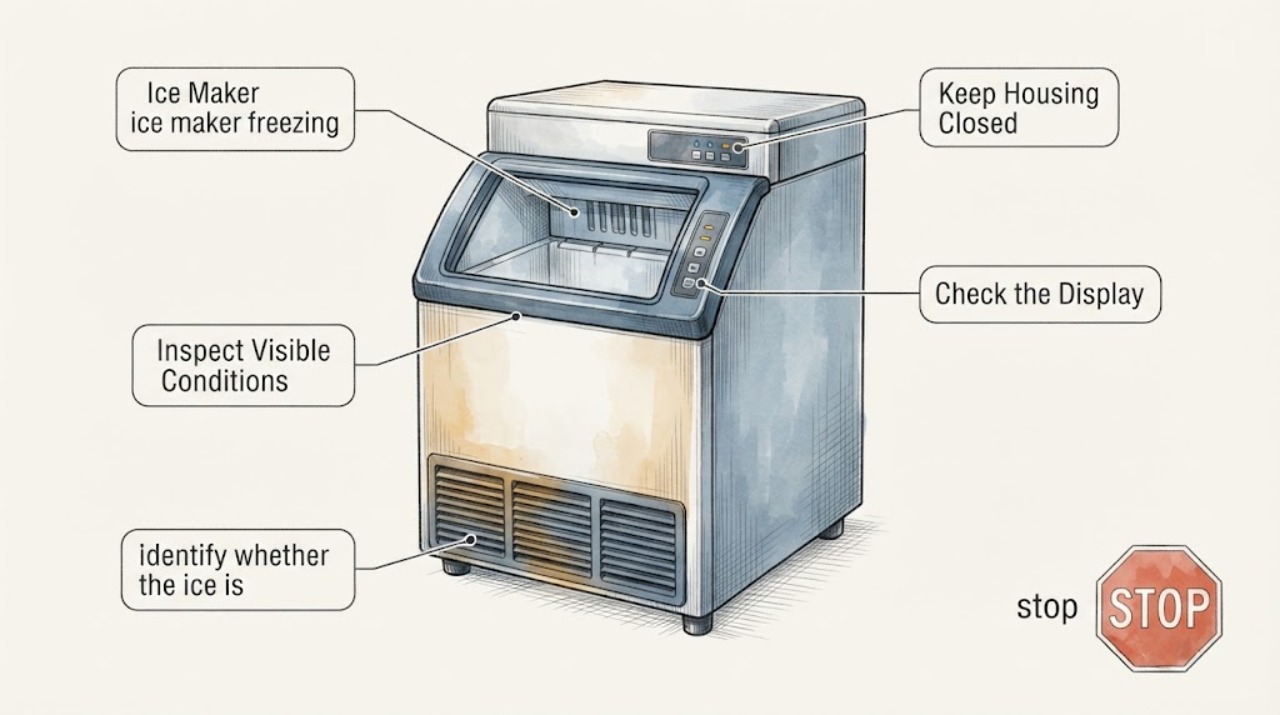
With the refrigerator powered normally and without reaching into an ice-bound mechanism, identify whether the ice is a thin or medium layer on the bucket/nearby surfaces, a stuck bucket or block in the bucket, or a sheet covering the ice-maker assembly itself.
Expected result: The ice is limited to the bucket or nearby surfaces; the bucket cannot be removed without force; or the ice maker assembly is covered by a sheet of ice.
Next step: If a sheet covers the ice maker, stop and request Samsung service. If the bucket is stuck, do not pull harder or use a hair dryer; request service. Only continue with the external seal and setting checks when the frost is limited to accessible surfaces.
Why this matters
Why: Samsung permits external frost handling for the bucket and compartment, but says an ice maker frozen over with a sheet of ice needs service. A stuck bucket is also not a reason to force or heat the assembly.
-
Check 2
Check that the ice bucket is fully seated, the bucket seal is clean and undamaged, the refrigerator/freezer door closes fully, and the ice-dispenser flap sits flush against its housing. Look for a visible gap, debris, a torn seal, or an obstruction preventing closure.
Expected result: The bucket or flap does not seal, the door has a gap, the seal is damaged, or all of these surfaces close flush and cleanly.
Next step: Remove only visible debris, reseat the bucket, and correct an obvious external alignment issue. Do not disassemble the door or ice maker. If a seal is torn or the frost returns after the external correction, request service.
Why this matters
Why: Samsung says a gap allows warm air into the ice-maker compartment and can create frost or wet/slushy ice. A pulled-away seal may be pressed back into its channel, while a damaged seal or a frost pattern that returns requires service.
-
Check 3
Read the freezer setting and check whether Power Freeze is lit or enabled in the panel or Family Hub/SmartThings controls. If the refrigerator has no connected water line, check whether the ice maker is still enabled.
Expected result: Power Freeze is active, the setting is colder than intended, the refrigerator is in an environment below Samsung's stated 50°F threshold, or no water line is connected while the ice maker remains on.
Next step: Turn off Power Freeze using the model's documented control, return the freezer to the intended setting, and turn off the ice maker if no water line is connected. Do not invent a model-specific temperature or control sequence; if overcooling continues, request service.
Why this matters
Why: Samsung says Power Freeze drives the freezer as cold as possible and may run for up to 72 hours on some models. It also says an unconnected water line should be paired with turning off the ice maker to prevent damage, and a location below 50°F adds to overcooling.
-
Check 4
If the frost is only on the ice bucket or surrounding compartment and is light or medium, wipe it with a damp cloth and dry it, or gently use a plastic scraper as Samsung describes. Keep the ice maker assembly itself out of a DIY defrost attempt.
Expected result: The accessible frost clears without force, or it is heavy, hard to remove by hand, or returns after the area is dry.
Next step: Stop if the frost is hard to clear, if water could reach electrical parts, or if the ice maker assembly is covered. Do not chip at the mechanism or use heat; follow the exact model manual or request service. If the frost returns, arrange service.
Why this matters
Why: Samsung says light frost can be wiped away and medium frost gently scraped, but warns against using a hair dryer. Heavy frost may require refrigerator defrosting, while a sheet over the ice maker is specifically a service condition.
-
Check 5
Only after no sheet of ice covers the ice maker and the bucket is correctly seated, locate the model's Test button and press it once as Samsung describes; do not repeat the test while the tray is filled with ice or water.
Expected result: The test chimes and the ice maker moves, it does not chime or move after the documented power cycle, or an error code appears.
Next step: If the test gives no response after the model-appropriate power cycle or an error code appears, stop troubleshooting and request service. If it passes, re-seat the bucket and monitor for recurring frost; do not use the test button as a defrost method.
Why this matters
Why: Samsung says the test result varies by ice-maker location, and repeated tests may overflow water or jam ice. An error code or a test with no response can require service; a successful test does not prove that a recurring freeze condition is fixed.
Use your observations
Decision map
Find the observation that best matches what you see, then follow the next safe action.
-
PATH 01Next step
What you see
A sheet of ice covers the Samsung ice-maker assembly itself.
Do this next
Stop, do not apply heat or chip at the assembly, and request Samsung support or qualified appliance service.
Why this path and its safety boundary
Why it matters: Samsung treats an ice maker frozen over with a sheet of ice as a service condition and warns against attempting to defrost the ice maker.
-
PATH 02Next step
What you see
Frost is limited to the bucket or compartment, and a bucket, door, or dispenser seal has a visible gap or does not close flush.
Do this next
Remove visible debris, reseat the bucket, or correct an obvious external alignment issue. Request service for a damaged seal or frost that returns.
Why this path and its safety boundary
Why it matters: The observed pattern is consistent with warm moist air entering the ice-maker compartment, which Samsung identifies as a frost cause.
-
PATH 03Next step
What you see
Power Freeze is active, the freezer setting is colder than intended, or the refrigerator is in a location below 50°F.
Do this next
Turn off Power Freeze, restore the intended setting, and move the refrigerator to a temperature-controlled location if applicable. If overcooling continues, request service.
Why this path and its safety boundary
Why it matters: Samsung says these conditions can add cooling or keep the freezer at its coldest setting, so the setting/environment needs to be corrected before blaming an internal part.
-
PATH 04Next step
What you see
The bucket cannot be removed without force, the ice maker test does not respond after the documented power cycle, or an error code appears.
Do this next
Leave the mechanism intact, avoid hair dryers and repeated test presses, record the model and displayed code, and request Samsung service.
Why this path and its safety boundary
Why it matters: Samsung directs service for a frozen or stuck bucket, a nonresponsive test, and error-code conditions rather than a guessed sensor, heater, or valve replacement.
Helpful context
Understand the symptom
First separate a frozen ice maker from frost on the bucket
The safe next step depends on where the ice is. Samsung distinguishes an ice maker covered by a sheet of ice from frost on the ice bucket or surrounding compartment. A sheet over the ice-maker assembly is a service condition; a light frost pattern on a bucket or seal can be inspected externally. This guide does not assign a failed heater, sensor, valve, or other internal part without a model-specific diagnosis.
Treat recurring frost as an air-sealing or service problem
Warm moist air can enter through a misaligned door, a bucket that is not seated or sealed, or a dispenser flap that does not close flush. Correcting a visible external gap can stop the frost from returning, but a damaged seal, a sheet over the ice maker, or frost that returns after the check needs Samsung support.
When checks do not resolve it
Need a professional?
Request Samsung service when the ice maker is covered by a sheet of ice, the bucket is stuck, a seal is damaged, frost returns after external sealing checks, the test gives no response, or an error code appears.
Common questions
FAQ
Can I use a hair dryer to thaw a Samsung ice maker that is frozen up?
No. Samsung warns against using a hair dryer and says not to defrost an ice maker covered by a sheet of ice; request service instead.
What should I check if the frost is on the ice bucket rather than the ice-maker assembly?
Check that the bucket is seated and sealed, the door closes fully, and the dispenser flap closes flush. Samsung says warm air entering through these gaps can create frost; clean only light or medium accessible frost as documented and request service if it returns.
Could Power Freeze make the freezer or ice maker too cold?
Samsung says Power Freeze sets the freezer as cold as possible and may remain active for up to 72 hours on some models. Turn it off using the documented model control and restore the intended setting before escalating.
Should I reset the ice maker while it is frozen up?
Do not use Test as a defrost method. First stop if the ice maker is covered by a sheet of ice or the bucket is stuck. Only after the mechanism is accessible and safe should you perform the model-appropriate test once; repeated tests may overflow or jam ice.
Read the exact guide
Official sources
- Freezer too cold on Samsung refrigeratorSamsung Support · Samsung refrigerator guidance for a freezer that is too cold. Model controls can differ, so it supports checking the displayed setting and Power Freeze state rather than a universal button sequence.
- Samsung ice maker is not workingSamsung Support · Samsung refrigerator ice-maker support page with branches for temperature, seals, settings, bucket condition, testing, water pressure, and frozen or frosty ice. It does not identify an internal failed component for an unspecified model.
- Frost forms in the Samsung freezer, refrigerator, or ice bucketSamsung Support · Samsung guidance for frost on refrigerator/freezer areas and ice buckets. It supports external seal, alignment, flap, and accessible frost checks; it does not authorize opening or repairing the ice-maker assembly.
- Reset the ice maker in the fridge compartment or Side-by-Side freezerSamsung Support · Only used for the general single-test safety and result meaning; the exact button location and test behavior vary by configuration and model.
Community feedback
Share a repair observation
Share a plain-text repair observation. Accepted observations are published automatically; this page may take a moment to update.