
On this page
Start here
Quick answer
A Samsung induction cooktop can make a normal low hum, cookware-dependent buzz, or cooling-fan whir during use and for a while after cooking. A report of rattling should first be classified by timing: with a pan on one zone, as power changes, during cool-down, or while the cooktop is off and cool. Turn the controls off and let the surface cool before checking that the pan, lid, and nearby loose items are stable and that the accessible surface is dry. If the noise is repeated, unusually loud, present with no cookware, or accompanied by smoke, sparks, burning odor, cracked glass, overheating, or a breaker trip, stop using the cooktop and arrange Samsung or qualified appliance service. Do not open the cooktop or reach for an internal fan or wiring.
Work through in order
Diagnostic checks
Use only checks that match the exact appliance or system and its official guide.
-
Check 1
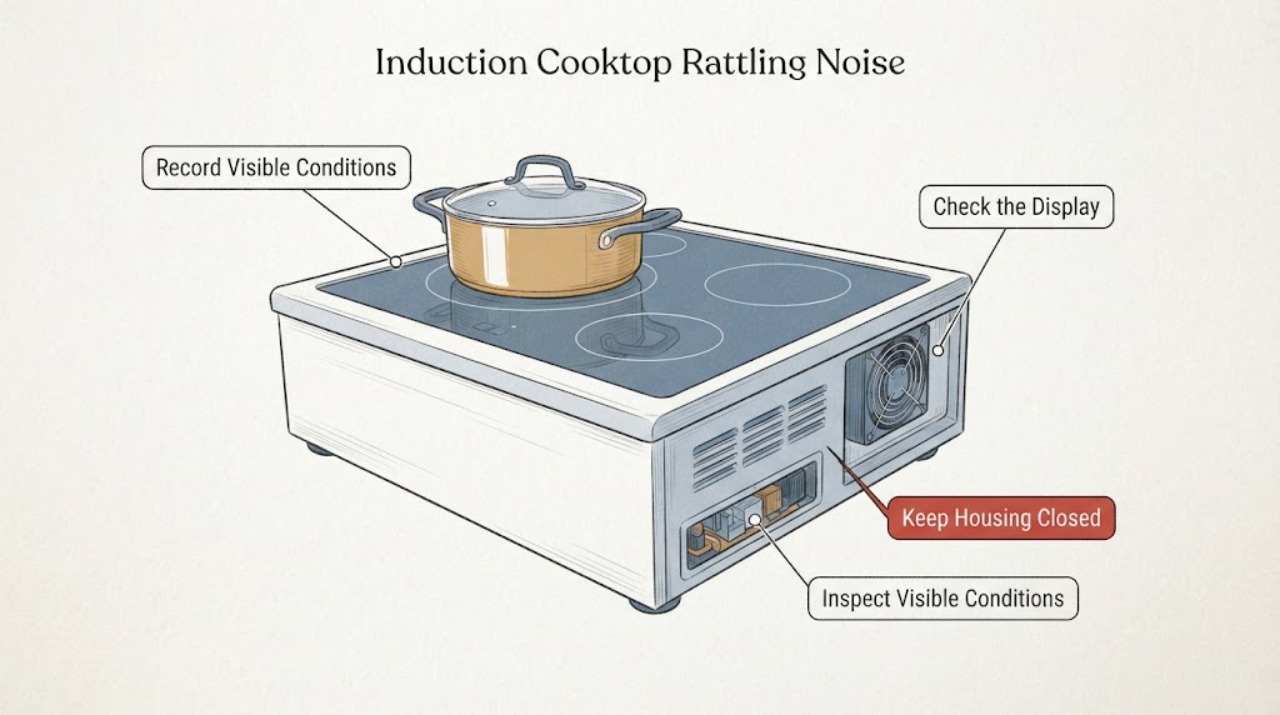
Turn every zone off, remove cookware only when it is safe to handle, and let the cooktop cool. From a safe position, record whether the rattling occurred with a pan on one zone, while another zone was active, during a power change, after shutoff, or while the cooktop was otherwise unused.
Expected result: The noise is tied to a pan or power level, continues briefly during cool-down, appears only at start or stop, or repeats while the cool cooktop has no cookware.
Next step: Use the matching cookware, fan, or heat-cycle check below. If the noise is very loud, persistent, or unrelated to operation, keep the cooktop off and arrange service.
Stop if: Do not touch a hot pan or glass, place an ear or hand near the rear vent, or remove a panel to locate the sound.
Why this matters
Why: Timing separates documented cookware hum, power-related induction hum, cooling-fan operation, and heat-cycle movement from a noise that is not explained by normal cooking conditions. A noise with no cookware and no active heat or cool-down is less consistent with those normal sound classes.
-
Check 2
With the cooktop switched off and cool, inspect only the accessible pan, lid, utensils, and surrounding counter for a loose item that could vibrate. Check that the pan base is stable and flat, then make one controlled comparison using one suitable pan on one zone at a moderate setting; do not deliberately heat an empty pan.
Expected result: The sound follows one pan or lid, changes when that item is removed or replaced, remains a normal low hum or buzz while water heats, or continues with no loose cookware involved.
Next step: If the sound is cookware-dependent and the cooktop heats normally, use cookware the manufacturer identifies as suitable and monitor it. If it persists without cookware, stop testing and request service.
Stop if: Do not hold the pan down, use a warped or damaged pan, touch the glass to judge heat, or use an empty pan as a sound test.
Why this matters
Why: A cookware-dependent change is consistent with Samsung's guidance that induction buzzing varies with cookware material. A persistent rattling that does not change when accessible cookware is removed is not explained by the pan alone.
-
Check 3
If the rattling starts after a zone is turned off, leave the controls off and observe from a safe distance whether it fades as the appliance cools. If it changes with the selected power level during cooking, record the setting and whether the sound is a low hum, buzz, whir, or a distinct mechanical rattle.
Expected result: The sound fades during cool-down, varies with power, is a steady fan-like whir, or remains a distinct and increasingly loud rattle.
Next step: Allow a normal fan or heat-cycle sound to finish without intervention. For an abnormal, repeated, or significantly louder rattle, keep the cooktop off and contact Samsung support or qualified appliance service.
Stop if: Do not block vents, spray cleaner into openings, remove the underside, or attempt to tighten an internal fan or metal assembly.
Why this matters
Why: Samsung says the cooling fan may run after use, induction hum can become louder at higher power, and metal parts can move as they heat and cool. A distinct sound that is significantly louder than normal or does not follow those conditions needs professional assessment.
-
Check 4
Record the exact model, affected zone, cookware material, power setting, sound timing, and any display code. Stop the test immediately if the rattle occurs with smoke, sparks, burning odor, cracked glass, uncontrolled heat, liquid near electrical parts, shock, or a tripped breaker.
Expected result: The sound is repeatable without a clear cookware or cooling explanation, a single zone behaves differently, a code or power fault appears, or a safety symptom is present.
Next step: Leave the cooktop off and provide the recorded details and a short safe audio or video observation to Samsung or qualified appliance service. Isolate power only from a dry, safe external control when appropriate.
Stop if: Do not open the cooktop, test live terminals, bypass a safety control, or restart it to reproduce smoke, sparks, burning odor, cracked glass, overheating, or a breaker trip.
Why this matters
Why: A repeatable unexplained sound may involve a fan, mounting, power, or control condition that cannot be identified safely from the outside. Safety symptoms override sound classification and require immediate escalation.
Use your observations
Decision map
Find the observation that best matches what you see, then follow the next safe action.
-
PATH 01Next step
What you see
The sound follows one pan or cookware material, changes with the power level, or is a low hum or buzz while the induction zone heats normally.
Do this next
Use suitable, stable cookware and monitor the sound. Use the exact model guide if it gives cookware requirements, and arrange service if the sound becomes significantly louder or the heating behavior changes.
Why this path and its safety boundary
Why it matters: This pattern is consistent with Samsung's documented cookware-dependent or power-related induction sounds and does not by itself identify a failed internal part.
-
PATH 02Next step
What you see
The sound continues for a while after cooking and fades as the appliance cools, or it is a steady fan-like whir rather than a mechanical rattle.
Do this next
Leave the controls off and keep vents unobstructed while the fan finishes. Request service if the fan never stops, becomes abnormal, or is accompanied by overheating or an electrical symptom.
Why this path and its safety boundary
Why it matters: Samsung identifies post-use cooling-fan operation as normal and says the fan can sound like buzzing, hissing, or whirring while internal components cool.
-
PATH 03Next step
What you see
The rattling is repeated or significantly louder than the appliance's normal sound, occurs with no cookware during neither cooking nor cool-down, or does not change after accessible cookware is removed.
Do this next
Keep the cooktop off and request Samsung or qualified appliance service with the model, zone, timing, power setting, and recording. Do not remove the glass or underside to investigate.
Why this path and its safety boundary
Why it matters: The reported noise is not adequately explained by the normal cookware, power, fan, or heat-cycle classes in Samsung's guidance. The sound alone cannot safely select a fan, mount, coil, or control part.
-
PATH 04Next step
What you see
Smoke, sparks, burning odor, cracked glass, uncontrolled heating, liquid near electrical parts, shock, or a repeated breaker trip accompanies the noise.
Do this next
Stop using the cooktop, keep people away, and isolate power only through a safe external control if possible. Contact qualified appliance or electrical help, and use emergency procedures for active fire or shock danger.
Why this path and its safety boundary
Why it matters: This is an electrical, fire, glass, or heat safety event; normal sound classification and cookware comparisons must stop.
Helpful context
Understand the symptom
Classify the sound before looking for a part
Rattling is a description, not a diagnosis. Samsung's sound guide separates induction cookware buzz and hum from the cooling fan and from metal parts expanding or contracting. Note whether the sound starts when a zone is selected, changes with the power level, follows a particular pan, continues after the controls are off, or happens when the cooktop is cool and unused. This timing is more useful than guessing that a fan, coil, or control board needs replacement.
Why cookware can sound like a vibration
Induction energy can make a low hum or buzz that depends on the cookware material. Samsung also describes a higher-pitched hum when different cookware materials are used on different zones at the same time, and a louder low hum at higher power. With the cooktop off and cool, check that the pan base is flat and that a lid or utensil is not vibrating against it. If changing to one suitable pan changes the sound while the heat response remains normal, keep the observation with the appliance model information rather than treating it as proof of a failed internal part.
Fan and heat-cycle sounds
The internal cooling fan can continue after cooking while the electronics cool, and Samsung describes that as normal fan noise, buzzing, hissing, or whirring. Metal parts can also make a thumping or banging sound as they heat and cool. A rattling that is clearly mechanical, repeated, or much louder than the normal sound for the appliance needs service assessment rather than an attempt to reach the fan through the underside.
When checks do not resolve it
Need a professional?
Arrange Samsung or qualified appliance service for a persistent or significantly louder rattle, a noise unrelated to cookware or normal cooling, a fan that never stops, a repeatable single-zone difference, or an unexplained power or display problem. Stop immediately for smoke, sparks, burning odor, cracked glass, uncontrolled heat, liquid near electrical parts, shock, or a repeated breaker trip. Do not open the cooktop or work on live electrical parts.
Common questions
FAQ
Is a buzzing or humming sound normal on a Samsung induction cooktop?
It can be. Samsung says induction cookware material can cause buzzing, a low hum can become louder at higher power, and different cookware materials on separate zones can create a higher-pitched hum. A sound that is significantly louder than normal, mechanically rattling, or unrelated to cooking and cool-down should be assessed by service.
Why does the sound continue after I turn off the Samsung cooktop?
The internal cooling fan may continue running until the electronics cool. Samsung describes this as normal fan noise, buzzing, hissing, or whirring. If the sound is abnormal, the fan never stops, or overheating or an electrical symptom appears, leave the cooktop off and request service.
Should I replace the fan or induction coil when my Samsung cooktop rattles?
Do not choose a part from the sound alone. First record the timing, cookware, zone, power level, and cool-down behavior. A persistent or unusually loud rattle needs model-specific service diagnosis, and the cooktop should not be opened by an ordinary user.
Read the exact guide
Official sources
- Samsung cooktop and range: common sounds and operational noisesSamsung · Opened Samsung US support article for general Samsung cooktop and induction-range sound guidance; exact model documentation controls where model behavior differs.
Community feedback
Share a repair observation
Share a plain-text repair observation. Accepted observations are published automatically; this page may take a moment to update.