
On this page
Start here
Quick answer
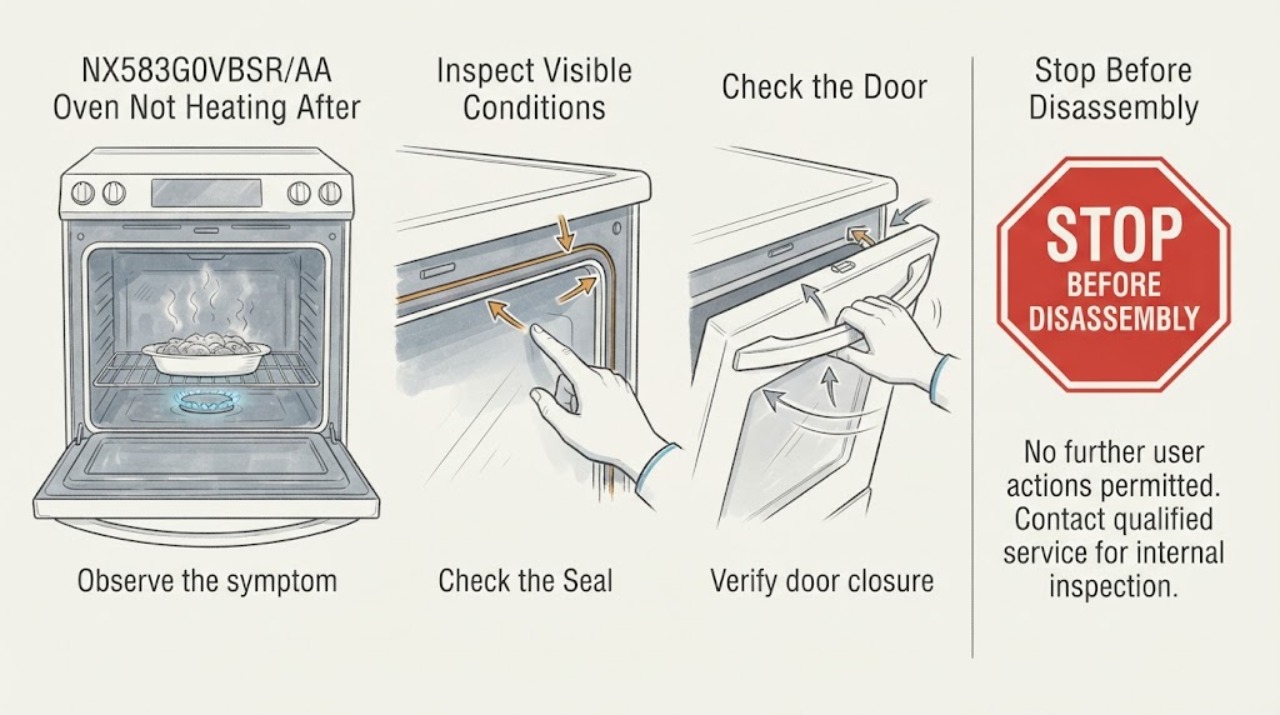
Meat juices on the bottom of a Samsung NX583G0VBSR/AA do not by themselves mean an igniter, valve, or control part needs replacement. Let the gas range cool completely, wipe away the excess spill with a soft damp cloth using the model's cleaning guidance, and keep foil and commercial oven cleaners out of the cavity. If the oven still does not heat, first note the display and any error, whether the cooktop burners operate normally, and whether there is smoke, a gas odor, an abnormal flame, or a damaged oven surface. Use Self Clean only if the complete model manual permits it and only after heavy spill has been removed; persistent no-heat or any gas or fire symptom needs qualified Samsung service.
Work through in order
Diagnostic checks
Use only checks that match the exact appliance or system and its official guide.
-
Check 1
Read the complete rating label, including the /AA suffix and serial information, and record whether the oven display is normal, blank, locked, or showing a code. With the oven fully cool, look at the bottom for a thin residue, pooled grease, chipped or cracked enamel, warped metal, or a spill that reached a burner or vent opening.
Expected result: The model label differs from NX583G0VBSR/AA, the bottom has only removable residue, or the surface, burner area, door, or vent is damaged or contaminated.
Next step: Use the exact /AA manual if it matches the label. If the bottom, burner area, door, or vent is damaged or the suffix is uncertain, leave the oven off and ask Samsung service to identify the correct procedure.
Why this matters
Why: Samsung's model page provides model-specific manuals and support, but its opened page is the /AC market variant. The visible condition separates a cleaning decision from a damaged-surface or gas-heating service decision; it does not identify an igniter or valve.
-
Check 2
When the oven and racks are cool, wipe up all loose meat juice and grease that is reachable without removing panels or disturbing the burner. Use a soft damp cloth and a mild method allowed by the exact manual; keep moisture away from openings, the gasket, and controls.
Expected result: The spill lifts away, only a baked-on film remains, or there is a crack, flaking finish, pooled grease near a burner opening, or residue that cannot be reached safely.
Next step: If the spill is safely removed, allow the cavity to dry and reassess heating. If damage, pooled grease near a burner, or unsafe access is present, do not heat the oven; arrange qualified service.
Why this matters
Why: Samsung directs users to clean excess spillage before a high-temperature cleaning cycle and says normal-use smoke or odor can come from an uncleaned spill. A damaged or inaccessible area is not a consumer parts-replacement decision.
-
Check 3
Do not start Self Clean while heavy grease or meat juice remains. If the complete NX583G0VBSR/AA manual confirms that Self Clean is available, remove the racks and other items specified by that manual, remove any foil, wipe away excess spill first, and follow its cycle instructions once; never add commercial oven cleaner or force the locked door.
Expected result: The manual permits Self Clean and the remaining residue is light, or heavy soil, smoke, a fault, or a door-lock problem remains.
Next step: Use the manual's cleaning path only when all warnings are satisfied. If Self Clean malfunctions, smoke becomes excessive, the door or lock behaves abnormally, or the cavity is damaged, turn the range off and request qualified service.
Why this matters
Why: Samsung warns that heavy soil can create excessive smoke or fire risk during Self Clean and that the cycle reaches very high temperatures. Self Clean is a cleaning choice, not a repair for a gas oven that remains cold.
-
Check 4
After the cavity is clean, cool, and free of a gas odor or visible damage, select the normal Bake setting and start it once using the ordinary controls. Observe the display and preheat behavior without opening the door repeatedly; do not use foil or reach toward the burner.
Expected result: The oven begins heating normally, the display remains at its initial preheat state, the oven never ignites, or smoke, an abnormal flame, or a new code appears.
Next step: If it heats normally, monitor it and clean future spills after cooling. If it remains cold or shows a code, stop repeated attempts and provide the exact label and observations to Samsung service.
Why this matters
Why: A normal heat cycle after cleanup makes residue the more likely explanation. A persistent cold oven is a separate heating or gas-supply fault; the observation cannot distinguish an igniter, valve, sensor, or control component.
-
Check 5
Only when there is no gas odor, smoke, abnormal flame, or other hazard, use the ordinary control for one existing cooktop burner as a comparison; do not loosen a fitting, adjust pressure, or repeatedly try to ignite the oven.
Expected result: The cooktop burners also fail, the cooktop works but the oven remains cold, or the oven lights and then cannot sustain normal heating.
Next step: If all burners are affected, stop ignition attempts and contact the gas provider or an appropriately qualified professional. If only the oven is affected, stop using it and request qualified Samsung appliance service.
Why this matters
Why: Samsung uses the cooktop comparison to separate a possible household gas-supply issue from an oven-only heating or ignition fault. It does not prove which gas component needs replacement.
-
Check 6
Record whether smoke or odor stops after the spill is cleaned and the oven is cool. If smoke or unusual odor continues during normal use, or the cavity is clean but the oven still produces an odor, do not run another cycle.
Expected result: The smell disappears with cleanup, returns from a clean cavity, or is accompanied by flame, a boom, soot, or a gas odor.
Next step: For persistent odor or any unsafe gas or fire symptom, turn the oven off, leave the area by the safest route if gas is suspected, and use qualified service or local emergency guidance from a safe location.
Why this matters
Why: Samsung distinguishes residue-related smoke from smoke or odor that persists when the oven is clean. Flame, soot, a boom, or gas odor is a safety boundary rather than evidence for a consumer-replaceable part.
Use your observations
Decision map
Find the observation that best matches what you see, then follow the next safe action.
-
PATH 01Next step
What you see
The oven bottom has a removable spill, and the oven heats normally after the cool, manual-approved cleanup.
Do this next
Use the oven normally, clean future spills after cooling, and do not order a part from the original spill alone.
Why this path and its safety boundary
Why it matters: Food residue and its smoke or odor were more likely than a failed heating component.
-
PATH 02Next step
What you see
Heavy grease remains or the user is considering Self Clean on the soiled bottom.
Do this next
Wipe away excess spill first and follow only the exact /AA manual. Do not use commercial oven cleaner, foil, or a forced door operation.
Why this path and its safety boundary
Why it matters: Starting a high-temperature cycle before removing excess spill increases smoke and fire risk; Self Clean is not a substitute for removing heavy soil.
-
PATH 03Next step
What you see
The cavity is clean and undamaged, but the oven remains cold while the cooktop burners operate normally.
Do this next
Stop repeated ignition or Bake attempts and request qualified Samsung appliance service with the model, display, and preheat observations.
Why this path and its safety boundary
Why it matters: An oven-only heating or ignition path is more likely, but the symptom does not identify an igniter, valve, sensor, or control board.
-
PATH 04Next step
What you see
The cooktop burners also fail, or there is gas odor, a delayed ignition, a boom, soot, abnormal flame, smoke from a clean cavity, a damaged bottom, or a repeated electrical trip.
Do this next
Stop using the range. For suspected gas leakage, avoid flames and electrical switches and follow local emergency or gas-provider guidance from a safe location; otherwise arrange qualified service.
Why this path and its safety boundary
Why it matters: A household gas-supply concern or an unsafe appliance condition takes priority over cleaning or parts selection.
Helpful context
Understand the symptom
The first decision is whether this is a removable food spill that needs safe cleaning or a genuine heating failure that merely happened after the spill. A spill can smoke or smell as it burns, but a clean cavity that remains cold is not evidence for one replaceable part. The model support page identifies the NX583G0VBSR family and links its manual; verify whether the appliance is the assigned /AA version before using a control or cleaning sequence.
This is a gas range. Keep the door, burner area, gas connections, and control panel intact. Do not lift the cooktop, adjust gas pressure, remove an igniter or valve, or open electrical covers. The checks below are limited to a cool cavity, normal external controls, visible spill cleanup, and a single safe comparison of the existing cooktop burners when there is no gas odor or other hazard.
Only after diagnosis
Potential parts
- model-matched oven igniter or burner component
Consider this class only after a qualified diagnosis confirms an oven-only no-heat or ignition fault and excludes residue, gas supply, control mode, and door or safety issues.
The opened Samsung support source identifies the NX583G0VBSR family and /AC market resources; confirm the complete /AA label, market, and exact part fit before ordering. - model-matched oven temperature sensor or control component
Consider this class only if service testing ties the persistent no-heat or temperature-control symptom to that component; a meat spill alone is not a parts diagnosis.
Do not select a component from a similar Samsung range. Use the exact model literature and qualified service diagnosis.
When checks do not resolve it
Need a professional?
Stop and arrange qualified Samsung service if the oven remains cold after the spill is removed and one normal Bake observation, if a code returns, or if the bottom, burner area, door, gasket, or vent is damaged. Stop immediately for gas odor, delayed ignition, a boom, abnormal flame, soot, smoke from a clean cavity, fire, a hot or damaged connection, or repeated breaker trips. Do not lift the cooktop, adjust gas pressure, remove an igniter or valve, open electrical covers, or perform live testing.
Common questions
FAQ
Does meat juice on the oven bottom mean I need to replace a part?
No. If the cavity is cool and undamaged, clean the spill using the exact model guidance and reassess. A persistent cold oven after cleanup needs service, but the spill does not identify an igniter, valve, sensor, or control component.
Can I run Self Clean over a greasy spill?
Not while heavy excess soil remains. Samsung says to wipe off excess spillage first, remove items and foil, and follow the model manual. Self Clean reaches very high temperatures and may produce excessive smoke or fire when heavily soiled.
Why does the oven stay cold when the cooktop works?
That pattern points to an oven-only heating or ignition path, but it does not specify which internal part. Stop repeated attempts and request qualified Samsung service, especially if there is delayed ignition, a boom, soot, an abnormal flame, or gas odor.
Read the exact guide
Official sources
- NX583G0VBSR | Samsung Support CASamsung Canada · Samsung NX583G0VBSR AA assigned model scope and family support lookup; the opened official page is the /AC market variant, lists the base model, and provides the user manual and support resources, so the /AA suffix and market require confirmation.
- Samsung oven temperature issuesSamsung US · Samsung oven no-heat user-level triage, including door and Demo mode, gas-range cooktop comparison, one circuit reset, and service escalation; it does not identify an internal part.
- There is smoke or an odor coming from Samsung ovenSamsung US · Samsung oven smoke and odor distinction between normal-use residue, Self Clean, and persistent odor from a clean oven; includes ventilation and service boundary.
- How to clean your Samsung ovenSamsung US · Samsung oven cleaning and Self Clean safety guidance, including wiping excess spillage, removing racks and foil, avoiding commercial oven cleaners, and allowing the cavity to cool.
- Home Appliance Terms and ConditionsSamsung US · Samsung range safety boundaries for heavy oven-bottom soil, foil, fire, gas and electrical hazards, and qualified repair; not a substitute for the exact model manual.
Community feedback
Share a repair observation
Share a plain-text repair observation. Accepted observations are published automatically; this page may take a moment to update.