
On this page
Start here
Quick answer
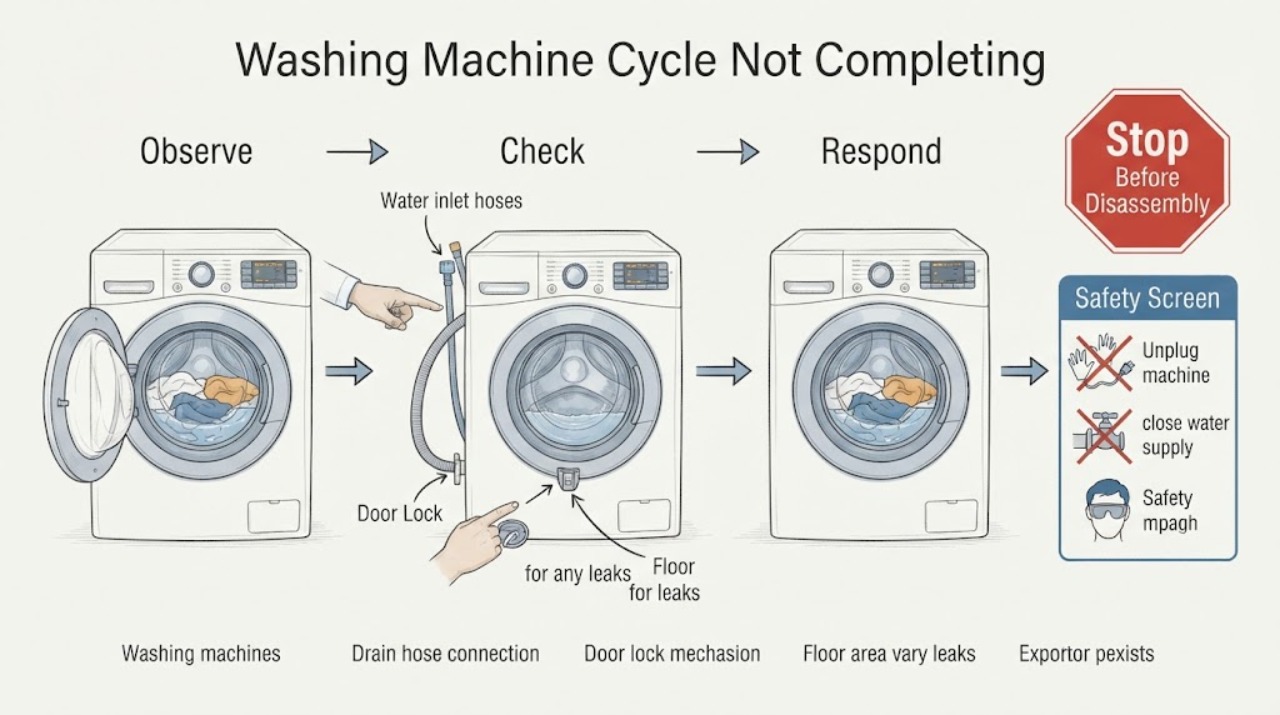
Start by recording the exact stage where the Samsung washer stops: filling, washing, rinsing, draining, or final spin. A timer that pauses or returns to a higher value near spin often reflects an unbalanced load, while water left in the drum points toward a drain path or pump-filter issue and a fill pause points toward water supply. Samsung says a washer may stop or extend the cycle when it detects imbalance, and its error guidance identifies model-dependent fill, drain, door, motor, temperature, and communication codes. Check the visible hoses, load distribution, door or lid, detergent amount, and exact display without opening the cabinet. If water is near electricity, the machine leaks, shakes violently, smells hot or burnt, smokes, sparks, or repeatedly trips protection, stop immediately. After one safe, model-authorized reset, a cycle that still will not finish needs qualified Samsung appliance service rather than repeated restarts or a guessed part.
Work through in order
Diagnostic checks
Use only checks that match the exact appliance or system and its official guide.
-
Check 1
From a dry, stable position, look at the washer, floor, plug, receptacle, hoses, and cabinet before pressing any control or moving the machine.
Expected result: Record water near electricity, an active leak, smoke, burning or melting odor, sparks, a hot or discolored plug, a repeated breaker/GFCI trip, violent movement, or a hot locked drum.
Next step: If a hazard exists, stop the cycle if it is safe to do so, isolate power only from a dry safe position, close water valves for an active leak when safely reachable, and arrange qualified service. Otherwise continue without moving or opening the washer.
Stop if: Do not touch a wet plug or outlet, move a leaking or violently shaking washer, operate a smoking machine, or keep resetting a protection device that trips again.
Why this matters
Why: These conditions make a normal cycle test unsafe. A clean, dry, stable machine permits only external checks; it does not prove that an internal fault is safe to access.
-
Check 2
Read the full Samsung model number and identify front-load versus top-load; when the cycle stops, photograph the display and record the minute remaining, selected cycle, water level, lock state, and last action heard.
Expected result: Classify the stop as before filling, during wash, during rinse, while draining, at spin, during a long pause, or after an error; note whether the drum is empty, partly full, or full of water.
Next step: Use the matching Samsung manual and error-code page for the recorded model; do not clear the display before documenting it.
Stop if: Do not infer a failed component from a time display alone, enter service mode, or use a procedure for a different model or load configuration.
Why this matters
Why: The stage separates fill, drain, balance, door-lock, suds, control, and motor branches. Model identity determines whether a code, pump filter, door/lid behavior, or reset instruction applies.
-
Check 3
If the cycle stops before or during filling and the machine is dry and powered, inspect the visible hot and cold hoses and faucet valves without disconnecting a pressurized hose.
Expected result: Record whether both valves are open, hoses are attached to the correct inlets and free of kinks, water enters, an nF/4C/4E-style code appears, or the washer hums without filling.
Next step: Correct only an obvious closed valve or external kink, then observe one normal fill attempt. If the problem returns, stop and provide the exact model, code, and hose observations to service.
Stop if: Do not remove a pressurized hose, reach into an inlet valve, use a chemical cleaner, or continue if water leaks toward the plug or controls.
Why this matters
Why: An absent or restricted water supply can keep a cycle from progressing. Samsung notes that fill codes and hose-screen conditions are model-dependent; a powered washer that still cannot fill after visible checks may need inlet, pressure, or control diagnosis.
-
Check 4
If water remains when the washer stops or it is stuck before spin, observe the visible drain hose and standpipe from outside the cabinet; for a front-load model, use the pump-filter procedure only if the exact manual authorizes it and the water is cool.
Expected result: Record an empty drum, slow or absent discharge, a kinked or displaced hose, a 5C/5E/Nd-style drain code, a pump hum, a blocked filter indication, or water that leaks while draining.
Next step: Correct only an obvious external hose placement issue. If the model manual authorizes filter access, cool and safely drain the water into a suitable container before cleaning and resealing it; otherwise leave the machine off and arrange service.
Stop if: Do not open a filter with hot or pressurized water, reach into a pump, tilt the washer, run a flooded machine, or continue after a leak, pump smell, or repeated drain code.
Why this matters
Why: The washer normally cannot complete spin until it drains. A drain restriction, pump-filter issue, hose installation problem, or pump fault can therefore look like a cycle that never completes. A top-load model may not have the same accessible filter as a front-load model.
-
Check 5
If the time pauses or resets near rinse or spin and the drum is not dangerously moving, pause once, redistribute a tangled large item, and use a load size and cycle appropriate to the model; do not add water or climb around the machine.
Expected result: Record whether the load is a single heavy item, a small bundle gathered on one side, a tightly packed load, or an evenly distributed load; note whether the tub rotates slowly and repeatedly repositions it.
Next step: Run one appropriate test only when the washer is stable and dry. If it still cannot reach or complete spin, stop and arrange service with the load and time behavior recorded.
Stop if: Do not hold the tub, reach into a moving drum, add heavy objects as a blind fix, or continue a cycle that walks, strikes the cabinet, or shakes violently.
Why this matters
Why: Samsung says imbalance can cause slow spinning, extended time, mid-cycle stops, or an unbalanced-load code. If the load is even but the machine continues to stop, balance is less likely to be the only cause.
-
Check 6
From outside the operating area, observe whether all visible feet contact a stable floor and whether the washer or floor is slippery, damaged, or contacting a wall; do not reach under a running machine.
Expected result: Record rocking when the machine is idle, a shifted cabinet, a damaged or slippery floor, insufficient clearance, or a stable level-looking installation.
Next step: Stop the cycle and arrange installation or appliance service if the machine is unstable, displaced, or damaged. Do not adjust feet or move a heavy washer while it is connected to water or power unless the model instructions and a safe setup explicitly allow it.
Stop if: Do not put hands under the washer, lift or tilt it, continue with cabinet impact, or use a temporary wedge or loose mat as a repair.
Why this matters
Why: Samsung identifies floor stability and leveling as factors in spin balance. A machine that rocks while idle or contacts its surroundings can repeatedly abort spin even with a reasonable load, while a stable installation sends the diagnosis back to drain, lock, motor, or control behavior.
-
Check 7
If the washer stops at a door or lid stage, remove only visible loose clothing from the seal or latch area, close the door or lid firmly once, and verify that the selected cycle is not paused or locked.
Expected result: Record whether the lock indicator engages, the door/lid is recognized, a dC/dE/door-style code appears, the controls are locked, or the machine remains paused with water inside.
Next step: Use only the matching manual's documented control-lock or pause action. If the lock is not recognized or remains locked with water, leave the machine off and arrange service.
Stop if: Do not force or bypass the door/lid lock, insert tools or magnets, open a hot or water-filled door against resistance, or repeatedly cancel the cycle.
Why this matters
Why: A washer may not proceed or spin when its closure interlock is not recognized. A persistent lock or door code can require service; water inside also makes forcing the door unsafe.
-
Check 8
If the washer repeatedly pauses during wash or rinse and excess foam is visible, record the detergent type and amount, then use the model's approved rinse or recovery cycle only when there is no leak or electrical hazard.
Expected result: Record heavy suds, normal water with no foam, a Suds/Sd-style code, an overloaded or unsuitable cycle, or a return to the same stage after the foam clears.
Next step: Use the detergent amount specified for the exact model and product, avoid adding more detergent, and arrange service if the cycle still will not complete or the code returns.
Stop if: Do not add chemicals, mix detergents, run with overflowing foam, or continue if water reaches electrical parts or the machine overheats.
Why this matters
Why: Samsung's error guidance notes that excess or unsuitable detergent can cause a water-level-related error and that error codes are starting points rather than automatic part diagnoses. A persistent stop with normal detergent and no foam needs another branch.
-
Check 9
Photograph or transcribe every display code or flashing-light pattern with the stage and water state, then perform one power reset only if the washer is dry, stable, and free of abnormal odor, heat, leak, or noise.
Expected result: Record whether the code clears and the cycle completes, the same code returns, the timer still loops, or the machine becomes unresponsive after power is restored.
Next step: Use the exact model's documented reset duration, then attempt one normal cycle only if no hazard exists. If the failure returns, leave the machine off and arrange service.
Stop if: Do not reset after a leak, hot water, smoke, burning smell, spark, violent vibration, or repeated breaker trip; do not erase the code by repeated restarts.
Why this matters
Why: Samsung describes a short power-off and restart as basic troubleshooting for unlisted errors, but a returning code or unchanged cycle identifies a service condition rather than a reason for endless resets.
-
Check 10
After the safe external checks and one authorized reset, classify the failure by its stopped stage and prepare the service handoff instead of opening the washer.
Expected result: Choose the strongest branch: fill failure; standing water or drain code; imbalance or violent spin; door/lid lock; suds; recurring code; no response; or a cycle that remains incomplete despite normal water, balance, and controls.
Next step: Provide the model, load type, cycle, minute and stage, water level, code, lock state, hoses, detergent, reset result, and any noise, odor, heat, leak, movement, or trip event. Keep the washer disconnected if a hazard occurred.
Stop if: Do not remove panels, test live components, bypass locks, access a pump or motor, or replace a part based only on the cycle-not-completing symptom.
Why this matters
Why: This classification tells a technician whether to begin with inlet, drain, balance/installation, interlock, motor, sensor, or control diagnosis. It does not identify a replacement part by itself.
Use your observations
Decision map
Find the observation that best matches what you see, then follow the next safe action.
-
PATH 01Safety boundary
What you see
Water is near electricity, there is smoke, burning or melting odor, a spark or arc, a hot connection, violent movement, uncontrolled leaking, or a repeated protection trip.
Do this next
Keep clear, isolate power and water only from a dry safe position when possible, and arrange qualified appliance or electrical service based on the observed hazard.
Why this path and its safety boundary
Why it matters: The washer must not be tested as an ordinary incomplete-cycle problem.
Safety stop: Do not touch wet electrical parts, move the machine, run another cycle, or restore power after a repeat trip.
-
PATH 02Safety boundary
What you see
The washer stops before or during filling, shows a fill-style code, or hums without taking in water.
Do this next
Check both visible valves and hoses for the exact model, then arrange service if fill does not resume or the code returns.
Why this path and its safety boundary
Why it matters: Water supply, hose routing, inlet screens, pressure, valve, or control conditions are more likely than a spin-balance fault.
Safety stop: Do not disconnect pressurized hoses or continue with any leak or water near electricity.
-
PATH 03Safety boundary
What you see
Water remains in the drum, the washer repeats draining, or a 5C/5E/Nd-style code appears before spin.
Do this next
Check the visible drain hose and use a model-authorized, cool-water pump-filter procedure only where applicable; arrange service if water remains or the code returns.
Why this path and its safety boundary
Why it matters: A drain hose, standpipe, pump filter, pump, or related sensor/control path may be preventing completion.
Safety stop: Do not open a hot filter, reach into a pump, tilt the washer, or run it with a leaking drain path.
-
PATH 04Safety boundary
What you see
The timer pauses or increases near rinse/spin, the washer slowly redistributes the load, or a dc/UE/Ub-style code appears.
Do this next
Redistribute a tangled load only when safe, verify the machine is stable, and run one appropriate test; persistent imbalance needs service.
Why this path and its safety boundary
Why it matters: The machine is detecting a balance or installation problem and may be withholding high-speed spin.
Safety stop: Do not continue a washer that walks, strikes the cabinet, shakes violently, or cannot remain stable.
-
PATH 05Safety boundary
What you see
A door/lid warning appears, the lock does not engage, the cycle pauses with water inside, or a door code returns.
Do this next
Remove only visible loose obstruction and close once; if the lock is not recognized or water remains, leave the washer off and arrange service.
Why this path and its safety boundary
Why it matters: The closure interlock or its control path may be preventing the next stage.
Safety stop: Do not force, tape, magnet, or bypass the interlock, and do not open a locked door against resistance.
-
PATH 06Safety boundary
What you see
Heavy foam, a Suds/Sd-style indication, or detergent-related water-level behavior appears during wash or rinse.
Do this next
Use the exact model's detergent guidance and an approved rinse/recovery cycle once if safe; arrange service if the stop returns.
Why this path and its safety boundary
Why it matters: Excess or unsuitable detergent may be extending sensing or rinsing, but a recurring code can also require model-specific diagnosis.
Safety stop: Do not add detergent or chemicals, allow foam to overflow, or continue near a wet electrical connection.
-
PATH 07Safety boundary
What you see
An exact code or flashing pattern returns after the documented external check and one authorized reset, or its meaning cannot be confirmed for the model.
Do this next
Leave the evidence intact and provide the model, code, stage, water state, lock state, load, and reset result to qualified Samsung appliance service.
Why this path and its safety boundary
Why it matters: The code is a diagnostic starting point and does not identify a universal failed part.
Safety stop: Do not guess the code, enter service mode, repeatedly erase it, or keep running the washer with a persistent fault.
-
PATH 08Safety boundary
What you see
Water, drain path, load, installation, door/lid, detergent, and controls appear normal but the washer still loops, stops, or never reaches completion.
Do this next
Stop testing and arrange qualified service with the full timeline, exact stage, code, and observations.
Why this path and its safety boundary
Why it matters: An internal pump, motor, sensor, interlock, wiring, or control problem remains possible and cannot be safely identified from the outside.
Safety stop: Do not open the cabinet, test energized components, or replace a pump, motor, sensor, lock, or board by symptom alone.
Helpful context
Understand the symptom
The stopped stage is more useful than the word ‘stuck’
Note the minute remaining, water level, lock state, sound, and code when the cycle stops. A washer that is redistributing clothes and slowly turning near spin is making a balance decision; a washer that repeatedly drains or leaves water has a different path. A long fill pause has a different meaning again. Do not add more laundry, detergent, or water until the stage is clear.
Samsung's front-load and top-load checks are not interchangeable
Record whether the machine is front-load or top-load, whether it has a door or lid, and whether the model has a user-accessible pump filter. Samsung's guidance identifies the pump filter as a front-load-only feature on the spin troubleshooting page, while other models use a different drain arrangement. Do not force a filter cover or apply an error-code procedure from a different model.
Detergent, water, and balance can all extend the cycle
Excess suds can interfere with sensing and rinsing, and too little or too much laundry can prevent a safe spin. Samsung's guidance recommends matching load size and cycle, redistributing large or tangled items, and addressing drain or pump-filter conditions before judging a spin fault. Correct only an obvious external condition and observe whether the same stage returns.
When troubleshooting ends
A single documented reset can clear a temporary control state, but it does not prove that a pump, inlet valve, door lock, motor, sensor, or control is healthy. Stop after a recurring code, a failed drain, a locked door with water inside, a leak, a hot electrical connection, violent movement, smoke, a burning smell, or a repeated trip. Give service the model number and your stage-by-stage observations.
Safety boundary
Stop conditions
- Stop for water near the plug, outlet, controls, or a wet floor around electricity; isolate power only from a dry safe position and do not touch wet electrical parts.
- Stop for smoke, burning or melting odor, sparks, a hot or discolored connection, damaged cord, violent movement, uncontrolled leaking, or a repeated breaker/GFCI trip.
- Do not force, tape, magnet, or bypass a door or lid lock; do not open a locked door against resistance or reach into a moving drum.
- Do not open a hot or pressurized drain filter, tilt the washer, disconnect a full hose without a safe drain plan, or use chemicals in the washer path.
- Do not repeatedly restart, reset, enter service mode, or replace internal parts after a recurring code, drain failure, abnormal noise, or unresolved incomplete cycle.
Only after diagnosis
Potential parts
- drain pump or pump filter assembly
Consider only when the model is applicable, water remains after the visible hose path is clear, and qualified diagnosis identifies a pump or filter fault.
Pump-filter access and part fit vary by Samsung model; confirm the exact model and manual before any replacement. - door or lid lock assembly
Consider only when the door or lid closes but the exact model does not recognize the lock after visible obstruction and alignment checks.
Confirm the complete model and professional diagnosis; never bypass the interlock. - water inlet valve
Consider only when the washer has power but cannot fill after the visible faucets, hose routing, and applicable inlet checks are correct.
Verify exact model, inlet configuration, and manufacturer fit information before selecting a part. - washer control or motor-sensing assembly
Consider only after a recurring motor, sensor, communication, or persistent incomplete-cycle symptom is diagnosed by a qualified technician.
A cycle that does not complete does not identify a control or motor part; confirm model, revision, and diagnostic evidence.
When checks do not resolve it
Need a professional?
Arrange qualified Samsung appliance service when a safe external fill, drain, load-balance, door/lid, detergent, and control check does not restore completion; when water remains or a drain code returns; when a door or lid stays locked; when an exact code recurs; or when the washer repeatedly loops or stops with normal conditions. Use qualified electrical service for a failed or repeatedly tripping household circuit. Treat leaks, water near electricity, smoke, burning odor, sparks, hot connections, violent movement, and uncontrolled water as immediate stop conditions.
Common questions
FAQ
Why does my Samsung washer keep adding time or stopping near spin?
Samsung says an unbalanced load can make the washer redistribute clothes, spin slowly, stop mid-cycle, extend the time, or show an error. Redistribute a tangled load only when safe and check stable installation; standing water or a drain code points to a different branch.
Why does my Samsung washer stop with water inside?
The washer may be unable to complete draining, so it will not proceed to spin. Record the water level and exact code, check the visible drain hose, and use a pump-filter procedure only if the exact model manual authorizes it and the water is cool. Persistent water needs service.
Can too much detergent keep a Samsung washer from completing?
Yes. Excess suds can affect sensing and water-level behavior. Record any Suds/Sd or related code, follow the exact model's detergent guidance, and do not add more detergent. If the cycle still stops, arrange service.
Should I keep restarting my Samsung washer when the cycle does not finish?
No. Photograph the stage and code first. One safe, model-authorized reset may clear a temporary control state, but a returning stop, code, leak, abnormal movement, odor, or noise needs qualified diagnosis rather than repeated restarts.
What should I do if my Samsung washer is shaking violently during a cycle?
Stop the cycle if it is safe, keep clear, and do not hold the tub or move the machine while connected. A load, leveling, floor, or internal balance problem may be involved; arrange service if the movement persists or any leak, impact, heat, or electrical symptom occurs.
Read the exact guide
Official sources
- Washer Runs Continuously, keeps resetting the time, jumping the time, jumps time, never finish the cycle, stuck on rinse and spinSamsung · Samsung washers with a looping timer or cycle that remains stuck at rinse or spin; exact model behavior still controls
- Samsung washing machine information and error codesSamsung · Samsung washers when an exact code or flashing pattern appears during an incomplete cycle
- Samsung range or wall oven panel is blank, blinking, or incorrectSamsung · Used only for the general principle that a control panel can be power-cycled; washer-specific timing and instructions come from the washer manual
- Samsung washing machine spins poorlySamsung · Samsung washers that pause, stop, extend time, or fail near rinse/spin; confirm the exact model
- Samsung SupportSamsung · Samsung washers when the exact model manual or support route is needed
- Error CodesSamsung · Samsung washer models covered by the linked Samsung error-code guidance; confirm model and code before applying any step
Community feedback
Share a repair observation
Share a plain-text repair observation. Accepted observations are published automatically; this page may take a moment to update.