
On this page
Start here
Quick answer
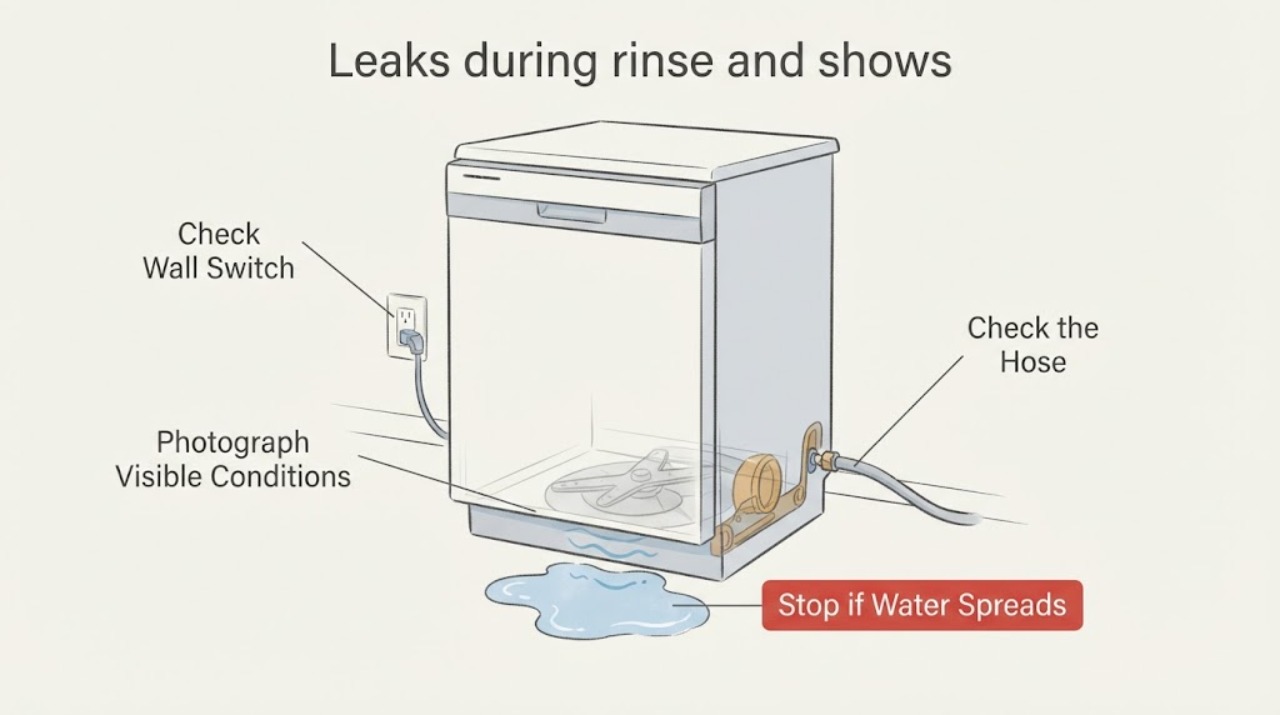
For the Siemens SN45M503SK/43, E15 means the dishwasher's water-protection system has activated. If water is actively leaking, stop the programme, close the water tap, and switch the dishwasher off; isolate power only if it can be done safely and the local instructions permit it. Do not tilt the machine, bypass the base-tray protection, open the bottom, or run another cycle to reproduce a rinse-phase leak. From a safe, dry position, record the exact E15 display, the phase when the leak was observed, and whether water was visible at the door edge, a reachable hose connection, or beneath the unit. Siemens does not support resolving E15 as a home repair, so arrange service rather than choosing a seal, pump, or hose from the symptom.
Work through in order
Diagnostic checks
Use only checks that match the exact appliance or system and its official guide.
-
Check 1
Stop the dishwasher when E15 appears or water is seen. Close the water tap and switch the appliance off at its normal control; if power must be isolated, use only an accessible safe isolator or breaker without touching water or pulling the built-under machine. Do not restart, tilt, or open the base.
Expected result: The leak is still active, the floor or cabinet is wet, the water tap is inaccessible, or the area contains water near an electrical connection.
Next step: Keep the tap closed and the dishwasher off. If safe isolation is not accessible, do not reach behind the unit; arrange qualified appliance service or emergency help for immediate electrical or flooding danger.
Why this matters
Why: E15 is the water-protection system being activated, and active water plus an electrical connection is a safety boundary rather than a cleaning or reset problem.
-
Check 2
Read and photograph the appliance identification label only if it is safely visible, and preserve the complete display as E15, E:15, F15, or another form. Record the full E-Nr as SN45M503SK/43 rather than relying on the front badge or series name.
Expected result: The label confirms SN45M503SK/43, the suffix is different or missing, or the display includes additional characters or a different code.
Next step: Give the exact E-Nr and complete display to Siemens service. Do not apply an E15 procedure from another Siemens or Bosch platform when the identity is uncertain.
Why this matters
Why: Siemens lists SN45M503SK/43 as its own E-Nr and shows E15 among the model's troubleshooting categories. A different suffix or display changes which manual and code guidance apply.
-
Check 3
After the tap is closed and the appliance is off, inspect from outside without moving the dishwasher: look at the front door edge and lower corners, the visible supply and drain hose areas under the sink, and the floor or cabinet for fresh water, a trail, a kink, or a loose-looking external connection. Do not disconnect a hose or remove the plinth.
Expected result: Water is visible at the door edge, near a reachable hose connection, only below the unit, or nowhere accessible even though E15 remains.
Next step: Photograph the safe visible evidence and leave the machine off. Have a technician inspect any leak below the unit or any source that cannot be reached without moving or dismantling the dishwasher.
Why this matters
Why: The location helps the technician distinguish a visible external route from a concealed base-tray or internal leak, but it does not identify a failed seal, pump, valve, or hose by itself.
-
Check 4
Use the user's existing observation to record the phase and conditions without running another cycle: note whether the leak was first seen during the normal rinse phase, whether the water was hot or cold, whether the drain pump then ran, and whether the leak stopped when the programme stopped. Do not open the door during operation or deliberately reproduce the leak.
Expected result: The leak was limited to the normal rinse phase, occurred after the water became hot, stopped when draining began, or also occurred while idle or during a short programme.
Next step: Include the timing in the service request and keep the dishwasher out of use. Do not use a short or cold programme as a comparison test because E15 has already activated water protection.
Why this matters
Why: Phase, temperature, and pump timing are valuable service clues. A rinse-only pattern can narrow the technician's inspection sequence, but it cannot prove that temperature or one pump caused the leak.
-
Check 5
Prepare a service handoff with the E-Nr, full display, date and programme phase of the observed leak, approximate visible location, whether standing water remained, whether the tap was closed, and any prior installation or repair history. Do not select a replacement part from the leak location or code.
Expected result: The record shows E15 recurring, water under the appliance, an external hose or door-edge clue, or no accessible leak source.
Next step: Book Siemens or qualified appliance service and leave the dishwasher unused until assessed. Do not tilt the machine, bypass water protection, open the base, or perform a hidden leak test.
Why this matters
Why: A recurring E15 or concealed water source requires professional diagnosis; the official Siemens model page notes that the user manual is not available there, so the service team must use the correct documentation and inspect safely.
Use your observations
Decision map
Find the observation that best matches what you see, then follow the next safe action.
-
PATH 01Next step
What you see
E15 remains with active water, water under the dishwasher, or a leak near an electrical connection.
Do this next
Keep the water tap closed and the appliance switched off. Isolate power only through a safe accessible means; do not touch water, move the machine, or open its base. Arrange qualified service.
Why this path and its safety boundary
Why it matters: The water-protection event is unresolved and presents a flooding or electrical hazard.
-
PATH 02Next step
What you see
Water is visibly concentrated at the door edge or a reachable external hose area, with no need to move the built-under unit.
Do this next
Photograph the location, keep the tap closed, and have a technician verify the source. Do not tighten, disconnect, or replace the visible part while the appliance is installed and wet.
Why this path and its safety boundary
Why it matters: A visible door or connection clue is available, but E15 still does not identify the seal, hose, clamp, or internal cause.
-
PATH 03Next step
What you see
No source is visible from outside, or water appears only beneath the appliance and the leak was observed during a normal rinse phase.
Do this next
Leave the dishwasher off and give service the exact phase, water temperature impression, display, and whether draining changed the leak. Do not tilt, bypass, or dismantle the base.
Why this path and its safety boundary
Why it matters: A concealed leak or base-tray water-protection event remains possible; the rinse timing is a diagnostic clue rather than a part diagnosis.
-
PATH 04Next step
What you see
The appliance label or display does not confirm SN45M503SK/43 and E15, or additional characters do not match the recorded code.
Do this next
Keep the water closed and appliance off, photograph the label and complete display, and ask Siemens or a qualified technician to identify the correct platform before any further action.
Why this path and its safety boundary
Why it matters: The supplied identity is not sufficient to apply the exact E-Nr and code guidance safely.
Helpful context
Understand the symptom
Why the rinse phase matters without proving a part
A leak first noticed during the rinse portion of a normal cycle is useful timing evidence, especially if no leak was seen during an earlier cold or short programme. It is not proof of a sump gasket, circulation pump, inlet valve, or any other part: water temperature, the active pump, pressure, and the point where water escapes can all change together. E15 is a water-protection response, not a component identification.
Keep the inspection outside the machine
Only inspect what is visible without moving the built-under dishwasher or removing a panel. A dry door edge and apparently sound external connections do not clear an internal leak, and a wet floor does not identify where the water began. Preserve the display and the observation record for the Siemens technician.
When checks do not resolve it
Need a professional?
Contact Siemens service for E15, especially when it accompanies active leakage, water under the dishwasher, a rinse-phase recurrence, or an inaccessible source. Use an electrician or emergency service for immediate danger involving energized equipment, smoke, or flooding.
Common questions
FAQ
What does E15 mean on the Siemens SN45M503SK/43?
Siemens says E15 or F15 means the dishwasher's water-protection system is activated. Close the water tap, switch off the appliance, and arrange service rather than trying to resolve the fault at home.
Does a leak only during the rinse phase prove the sump gasket is bad?
No. The phase and temperature are useful clues for a technician, but they do not identify a sump gasket, pump, valve, hose, or other component. Do not reproduce the leak or select a part from timing alone.
Should I tilt the Siemens dishwasher to clear E15?
No. Keep the water tap closed and the dishwasher switched off, and arrange qualified service. Tilting or bypassing the water-protection system can turn an unresolved leak into a larger water or electrical hazard.
Read the exact guide
Official sources
- Model SN45M503SK/43: User manuals, spare parts, accessoriesSiemens Home Appliances · Exact Siemens E-Nr identity and support page for the assigned SN45M503SK/43 built-under dishwasher.
- Results for all SN45M503SKSiemens Home Appliances · Siemens model-family index confirming SN45M503SK/43 is one of the listed E-Nr variants; not a substitute for the exact model page.
- E15 error on my dishwasherSiemens Home Appliances · Siemens dishwasher E15/F15 water-protection guidance; general code guidance that must be combined with the exact E-Nr page.
- Siemens dishwasher installation instructionsBSH Home Appliances · Installation instructions reached from the exact Siemens SN45M503SK/43 support page; use for installation-specific access and connection boundaries.
Community feedback
Share a repair observation
Share a plain-text repair observation. Accepted observations are published automatically; this page may take a moment to update.