
On this page
Start here
Quick answer
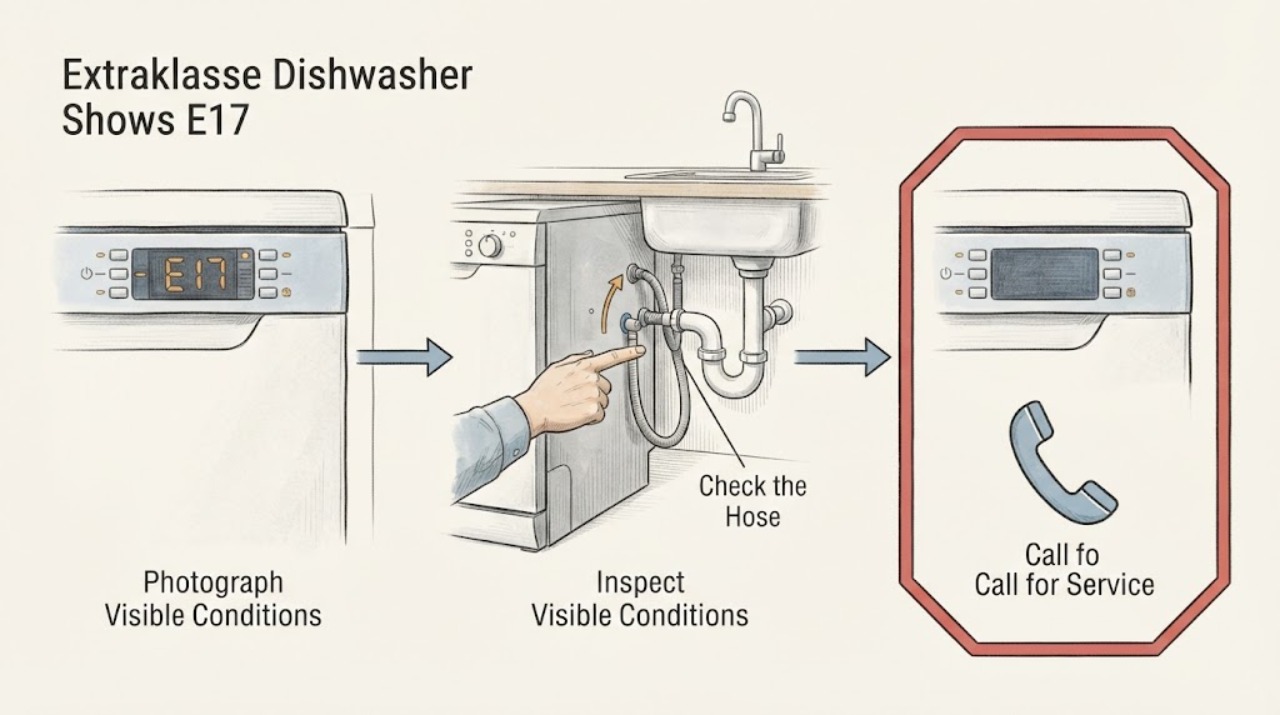
Do not treat E17 as a universal Siemens dishwasher drain code. Siemens's German dishwasher error list shows E17/E3300/E33-01 as a service-contact case without giving a general drain diagnosis, while Siemens's dishwasher guidance identifies E23 as a waste-water-pump fault and E24/E25 as the separate drain-code family. Siemens's washing-machine page uses E17/F17 for water-supply time exceeded, which is a different appliance family. First photograph the complete display, find the dishwasher's full E-Nr/model and market, and confirm whether water is actually standing in the tub. If the code returns, water remains, there is a leak, or the exact manual is unavailable, close the water tap, stop using the used appliance, and arrange Siemens or qualified dishwasher service. Do not buy a pump or apply washing-machine E17 instructions from the code alone.
Work through in order
Diagnostic checks
Use only checks that match the exact appliance or system and its official guide.
-
Check 1
Photograph the complete display exactly as shown, including any digits or symbols after E17, and copy the dishwasher's full E-Nr/model from its rating plate. Record the country or market, programme, point at which it stopped, whether the tub contains standing water, and what the earlier repair changed.
Expected result: The display is a complete E17 variant with an identifiable E-Nr and market, the display is partial or inferred from lights, or the model cannot be identified.
Next step: Use the exact Siemens manual/support record for the E-Nr and market. If the code or model remains unclear, stop repeated cycles and give the photo and rating-plate details to Siemens Service or a qualified dishwasher technician.
Stop if: Stop if the display is not clearly E17, the code contains extra characters that cannot be read, or the E-Nr is missing; do not substitute another Siemens appliance's code table.
Why this matters
Why: Siemens warns that its dishwasher code list and recommended actions may not apply to every model, and the Extraklasse label covers a range rather than one device. A partial code or range name cannot establish a drain fault or part fit.
-
Check 2
With the dishwasher switched off and the door opened normally, look at the visible tub floor and note whether water remains, whether it is only a shallow residual film, and whether there is water outside the appliance or around the plinth. Do not reach into the pump area or move an integrated unit to make this observation.
Expected result: There is substantial standing water, a leak or wet plinth, only a small residual film, or no visible water despite the reported “not draining” symptom.
Next step: If there is a leak or water near the base, close the water tap, leave the dishwasher off, and request service. If the tub is dry or nearly dry, preserve the code record and follow only the exact E-Nr manual; do not force a drain cycle to reproduce the problem.
Stop if: Stop immediately for a leak, water near electrical connections, a damaged cord, smoke, burning odor, or an appliance that trips power.
Why this matters
Why: Standing water confirms a drainage symptom but does not identify E17 as its cause. Water at the plinth changes the risk toward a leak or water-protection issue. No standing water means the complaint may be a programme or code interpretation issue rather than a blocked drain.
-
Check 3
Compare the full display with the exact Siemens dishwasher documentation before attempting any drain check. In particular, see whether the machine instead reports E23, E24, or E25, and whether the manual authorizes cleaning the user-accessible filter system or checking a visible drain hose.
Expected result: The code is E23, E24, or E25, the code remains E17, or the code table/manual cannot be matched to the E-Nr.
Next step: For a matched E24/E25 manual path, perform only the documented user-level filter or visible-hose check with power off and cool water. For E23, recurring E17, or an unmatched code, stop and arrange service instead of opening the pump area or ordering a part.
Stop if: Do not force a pump cover, probe an obstruction, dismantle the hose, open panels, or perform electrical tests as a user procedure.
Why this matters
Why: Siemens identifies E23 with a waste-water-pump fault and places E24/E25 in the drainage family; the public E17 entry does not establish that same meaning. An unmatched E17 must remain unresolved rather than being converted into a pump diagnosis.
-
Check 4
Create a recurrence handoff for the previously repaired, second-hand appliance: attach the E17 photograph, E-Nr and market, standing-water and leak observations, programme and timing, the date and scope of the earlier repair, and any invoice or replaced-part description.
Expected result: The earlier repair and the current symptom are documented, or the prior repair is unknown and the current code cannot be reproduced safely.
Next step: Ask Siemens or a qualified technician to identify the code for this exact E-Nr, explain whether E17 is service-only for that platform, and state what was tested before proposing a pump, filter, hose, control, or replacement. Keep the appliance off if water remains or the code returns.
Stop if: Stop troubleshooting when the technician cannot identify the model-specific code, proposes a cross-model part without fit confirmation, or recommends continued operation with a leak.
Why this matters
Why: A recurrence record lets the technician distinguish an unresolved original fault, a new drainage symptom, and an installation or hose issue. It is stronger evidence than assuming the prior part failed again, and it avoids choosing a generic E17 part.
Use your observations
Decision map
Find the observation that best matches what you see, then follow the next safe action.
-
PATH 01Next step
What you see
The display is E17/E3300/E33-01, the E-Nr and market are still unknown, and the tub has no confirmed substantial standing water.
Do this next
Stop code-based troubleshooting, obtain the rating-plate E-Nr and full display, and request the exact manual or service interpretation.
Why this path and its safety boundary
Why it matters: The code is not enough to prove a drain failure; Siemens's dishwasher list sends this E17 family to service, and the range name does not identify a platform.
-
PATH 02Next step
What you see
Standing water is visible and the matched manual or display shows E24/E25, while there is no leak or electrical hazard.
Do this next
Follow only the exact E-Nr manual's user-level check with the machine off. If drainage or the code returns, arrange service rather than reaching into the pump or buying a generic part.
Why this path and its safety boundary
Why it matters: This pattern is consistent with Siemens's separate drainage-code family, but it still does not prove that a pump is failed; an approved accessible filter or hose check may be the first step.
-
PATH 03Next step
What you see
E17 returns after a previous repair, the visible drain symptom persists, or the technician cannot map E17 to the exact E-Nr documentation.
Do this next
Leave the dishwasher off and request a model-specific diagnosis. Supply the prior invoice and ask for the failed component, supporting test or observation, repair scope, and warranty in writing before authorizing work.
Why this path and its safety boundary
Why it matters: This is a recurring or model-unresolved fault. Siemens's public E17 dishwasher entry does not justify assigning the drain pump, filter, hose, inlet, or control as the failed component.
-
PATH 04Next step
What you see
Water is leaking, the floor area or plinth is wet, the appliance smells burnt or smokes, or power trips occur.
Do this next
Close the water tap and switch the appliance off if safe; do not run another cycle or open panels. Use qualified service, and leave the area and contact emergency services for smoke or fire.
Why this path and its safety boundary
Why it matters: The immediate issue is a water or electrical safety risk, not a suitable home drain-code experiment.
Helpful context
Understand the symptom
The words “Extraklasse” and “E17” are not enough to identify the repair path. Extraklasse is a Siemens range that includes several appliance types and products. The dishwasher's rating-plate E-Nr, complete display, and market determine which manual and code table apply. A used machine that was repaired before should be treated as a recurrence to document, not as proof that the same part failed again.
The symptom and the code also need to be kept separate. If water is left in the tub, that is an observed drainage symptom. It does not prove that E17 is a drain code. Siemens's public dishwasher pages distinguish E23 (waste-water pump) and E24/E25 (drainage) from the E17 entry, which only directs the reader to service on the German list. Use the exact E-Nr documentation before choosing a filter, hose, pump, or reset procedure.
When checks do not resolve it
Need a professional?
Contact Siemens Service or a qualified dishwasher technician for an unresolved or recurring E17, a model-specific code that cannot be matched, standing water, a leak, or a previously repaired used appliance that fails again.
Have this ready
- Provide the complete E17 display photo, full E-Nr/model, market, programme and timing, standing-water and leak observations, prior repair date and invoice, any replaced-part description, and whether E23/E24/E25 ever appeared.
Common questions
FAQ
Does E17 mean a Siemens dishwasher drain pump is bad?
Not from the code alone. Siemens's German dishwasher page sends E17/E3300/E33-01 to service without a universal drain explanation, while it identifies E23 as a waste-water-pump fault and E24/E25 as drainage codes. Confirm the E-Nr and the actual standing-water symptom before any part decision.
Can I use Siemens washing-machine E17 instructions on this dishwasher?
No. Siemens's washing-machine page defines E17/F17 as water-supply time exceeded. That is a different appliance family and is not a verified interpretation for an unidentified dishwasher.
Is Extraklasse the dishwasher model?
No. Siemens describes Extraklasse as an exclusive appliance range containing multiple product categories. Use the dishwasher's rating-plate E-Nr and market to locate the correct manual and parts information.
What should I give a technician when this second-hand dishwasher fails again?
Give the complete display photo, E-Nr/model and market, programme and timing, whether water remains or leaks, the previous repair invoice and replaced-part description, and any other code such as E23, E24, or E25. Ask for a written model-specific diagnosis before authorizing a generic pump, hose, or control part.
Read the exact guide
Official sources
- Siemens Geschirrspüler Fehlercodes | Siemens Hausgeräte DESiemens Hausgeräte · Siemens German-market dishwasher error-code list, including E17/E3300/E33-01 service routing and model-specific caveat
- Siemens ExtraKlasse: Mehr Extras, mehr Klasse | Siemens Hausgeräte DESiemens Hausgeräte · Siemens Extraklasse range identity and its multiple appliance categories
- Error codes on Siemens Dishwashers | Siemens HomeSiemens Home Appliances · Siemens Ireland dishwasher code families and model-specific support/service guidance
- Error codes and messages of washing machines | Siemens HomeSiemens Home Appliances · Siemens washing-machine E17/F17 water-supply-timeout meaning, explicitly used only as a cross-appliance warning
Community feedback
Share a repair observation
Share a plain-text repair observation. Accepted observations are published automatically; this page may take a moment to update.