
On this page
Start here
Quick answer
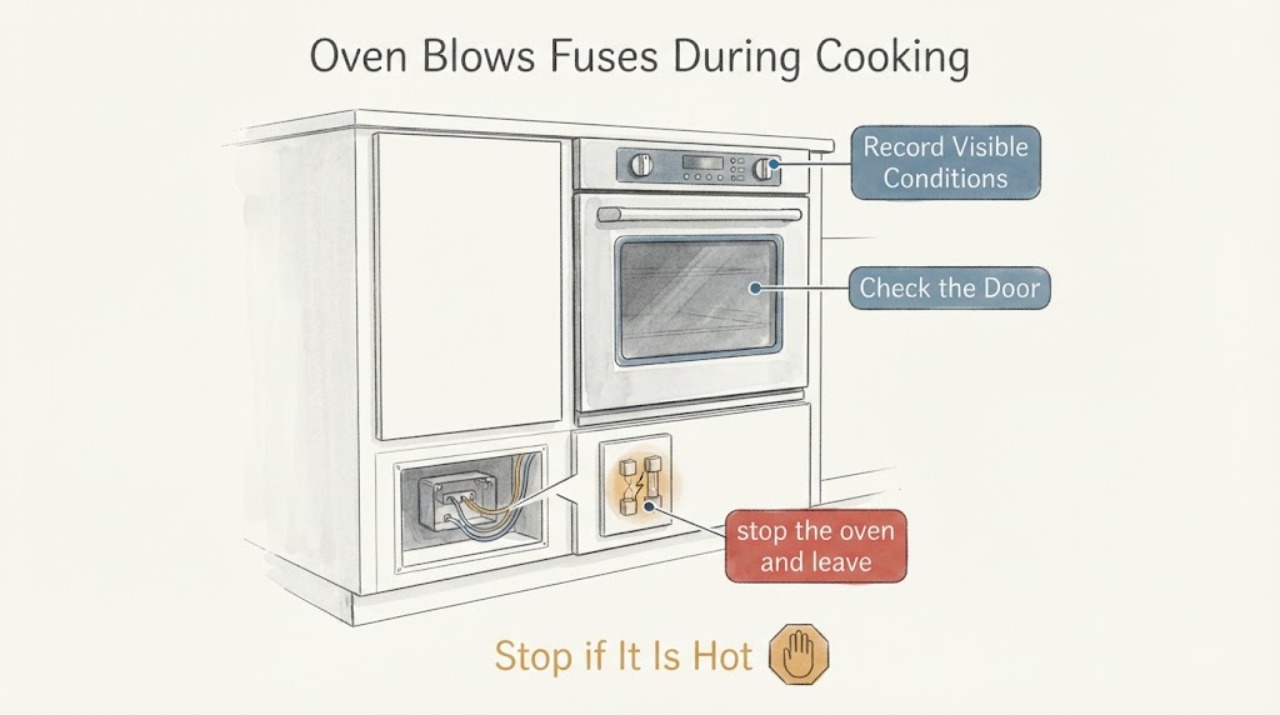
If a Siemens HB634GBS1 iQ700 oven blows a fuse or trips the circuit while cooking, stop using it and do not keep resetting the protection. First note whether the trip happens as soon as power is restored, when the display or light is selected, when a cooking mode starts, or only after the oven heats. From a dry, safe position, isolate the oven at its breaker or isolator and leave it off; do not remove covers or test wiring. Siemens identifies the HB634GBS1 as an electric 220–240 V oven with a 3.6 kW connection rating and 16 A fuse protection, so the trip is a circuit or appliance safety event rather than a setting to bypass. Have the exact E-Nr. and trip timing checked by a qualified appliance technician or electrician before cooking again.
Work through in order
Diagnostic checks
Use only checks that match the exact appliance or system and its official guide.
-
Check 1
After a fuse or circuit trip, stop the oven and leave the protective device in its safe state; isolate the appliance from a dry, safe position if that can be done without touching a hazard.
Expected result: There is smoke, burning odor, visible arcing, a hot connection, damaged insulation, water near electrics, or the circuit trips again.
Next step: Keep clear, do not restore power, and contact the appropriate emergency, electrical, or qualified appliance response. Arrange inspection before reuse.
Stop if: Do not reset repeatedly, touch wet or hot parts, use a larger fuse, or continue cooking.
Why this matters
Why: This is an electrical or fire-safety escalation. The trip cannot be treated as a normal cooking interruption or a fuse that should simply be replaced.
-
Check 2
Record the exact moment of the trip: on restoring power, when the display or light is selected, when a cooking mode is started, or after heating has continued.
Expected result: The oven trips immediately, only when a control or light is used, at the start of heating, or after the cavity becomes hot.
Next step: Give the timing and selected mode to qualified service and keep the oven isolated. Do not repeat the trigger to collect another example.
Stop if: Do not run multiple modes or repeatedly switch the light and controls after a trip.
Why this matters
Why: Different timing changes the service inspection path, but timing alone cannot prove a failed fuse, heating element, relay, fan, lamp circuit, or household circuit.
-
Check 3
With the oven cool and isolated, read the complete E-Nr. and FD information from the rating label behind the door at the lower edge, if it is visible without moving the appliance.
Expected result: The label confirms HB634GBS1 with a full suffix, or the suffix is missing or unreadable.
Next step: Provide the full label information to Siemens or the technician; do not pull out the built-in oven to find it.
Stop if: Do not remove trim, panels, or mounting hardware to reach the label.
Why this matters
Why: The base model identifies the iQ700 family, while the full E-Nr. selects the correct Siemens support and documentation entry. An incomplete identity increases the risk of applying the wrong electrical or repair guidance.
-
Check 4
Inspect only ordinary-access external areas for moisture, scorch marks, a damaged cord or plug where visible, or a burning smell after the power is isolated and the oven has cooled.
Expected result: The external connection looks damaged, the area is wet or hot, or there is no visible external damage.
Next step: Keep the oven off and give the finding to a qualified electrician or appliance technician. Do not remove a cover to continue the inspection.
Stop if: Do not touch wiring, probe the element, operate with panels removed, or energize the oven for a visual test.
Why this matters
Why: A visible supply or moisture problem can require electrical inspection; no visible mark does not clear the internal electronics or heating circuits.
-
Check 5
Compare the oven's electrical identity and event record with the Siemens support path for domestic fuse trips, then request model-specific diagnosis.
Expected result: The household protective device remains stable with the oven isolated, but the oven trips when restored or during cooking; or the household circuit itself remains unstable.
Next step: Arrange Siemens or qualified appliance service for an appliance-specific trip and qualified electrical service for the circuit or protective device. Provide the E-Nr., trip timing, and any hazard observations.
Stop if: Do not change circuit protection, bypass an interlock, or select a replacement control or heater based on the symptom.
Why this matters
Why: A stable household circuit with an oven-specific trip points toward appliance-side diagnosis, while an unstable circuit or isolator requires electrical assessment before appliance testing.
Use your observations
Decision map
Find the observation that best matches what you see, then follow the next safe action.
-
PATH 01Next step
What you see
Smoke, burning odor, visible arcing, abnormal heat, a wet electrical connection, damaged insulation, or a second trip appears.
Do this next
Leave the oven off, isolate power only from a dry safe position, keep clear of the hazard, and contact the appropriate emergency or qualified electrical/appliance response.
Why this path and its safety boundary
Why it matters: This is an immediate electrical or fire-safety boundary, not a troubleshooting branch.
-
PATH 02Next step
What you see
The protection trips as soon as the oven is powered or when the display, light, or a control is selected.
Do this next
Do not retry the control or replace a fuse. Leave the oven isolated and provide the exact E-Nr. and trigger timing to qualified service.
Why this path and its safety boundary
Why it matters: The fault occurs before a normal cooking heat stage and may involve the supply, control electronics, or an accessory circuit; the trigger does not identify a replaceable part.
-
PATH 03Next step
What you see
The oven remains powered until a cooking mode begins or the oven has been heating for a while, then the protection opens.
Do this next
Keep the oven off and have a qualified technician inspect it using the complete E-Nr. and selected mode. Do not run another mode to compare.
Why this path and its safety boundary
Why it matters: The heating-stage timing changes the inspection path toward the appliance load, wiring, thermal condition, or household supply, but it still does not prove which component failed.
-
PATH 04Next step
What you see
The household circuit or isolator trips even with the oven left isolated, or other kitchen equipment loses power at the same time.
Do this next
Use qualified electrical service to assess the circuit before any oven test or repair.
Why this path and its safety boundary
Why it matters: The protective device, circuit, installation, or another load may be involved; replacing an oven part would not address that evidence.
Helpful context
Understand the symptom
Stop after a fuse trip and classify the trigger
A fuse or circuit trip is the safety protection operating, not evidence that the fuse itself is the failed part. Do not reset it repeatedly or select another cooking mode to see whether the oven survives. From a dry, safe position, leave the oven off and write down whether the trip occurred immediately when power returned, when the display or oven light was selected, when a heating mode began, or after the cavity had been heating. That timing helps service separate a supply or control-start event from a heat-stage event without asking you to expose live parts.
Confirm the exact Siemens identity before any service decision
Check the rating label only from ordinary access with the oven cool; Siemens documentation places the E-Number and FD information on the appliance nameplate behind the door at the lower edge. Record the complete E-Nr. suffix, not only HB634GBS1, because Siemens support and manuals are selected by the full product identifier. The BSH specification sheet identifies the HB634GBS1 iQ700 as a built-in electric oven and lists its electrical ratings, but it does not authorize a user to change the fuse rating or open the electronics.
Make only a safe external observation
Once the oven is cool and isolated, look from outside for a wet area, a damaged power cord or plug if the installation exposes one, scorch marks, a burning smell, or a hot connection. Do not remove the oven from its cabinet, open the rear or control panel, probe the heating elements, replace an internal fuse, or energize the oven with a cover removed. A built-in oven may be hard-wired, and a dark display does not make the internal circuit safe to inspect.
Use the timing to give service a useful fault record
Give the technician the complete E-Nr., the circuit or fuse that opened, whether other kitchen equipment lost power, the selected cooking mode and temperature, whether the fan or light was involved, and whether the trip occurred once or repeatedly. If the oven operates until heating begins, say so; if it trips as soon as any control is touched, say that instead. These observations narrow the inspection path, but they do not identify a heater, fan, lamp circuit, relay, control board, or wiring fault by themselves.
Keep the repair within the electrical and appliance boundary
Siemens' troubleshooting guide states that work on electronic components may be performed only by a qualified expert and that the appliance must be disconnected from the mains before such work. Use a qualified electrician when the household circuit, isolator, plug, hard-wiring, or protective device is involved; use Siemens or qualified appliance service when the supply is sound but the oven trips during a control, light, fan, or heating event. Do not fit a larger fuse, bypass protection, or install a control or heating part from a symptom alone.
When checks do not resolve it
Need a professional?
Arrange qualified appliance or electrical service after any repeated fuse trip, any trip during cooking, or any need to open the oven or assess its wiring. Stop immediately for smoke, burning odor, arcing, abnormal heat, a wet electrical area, damaged insulation, or another trip. Do not restore power merely to reproduce the fault.
Common questions
FAQ
Can I replace the fuse with a larger one so the Siemens oven keeps working?
No. The HB634GBS1 specification lists 16 A fuse protection, and changing protective-device sizing can create an unsafe circuit condition. Keep the oven off and have the cause of the trip assessed by a qualified professional.
Does a fuse trip prove that the Siemens control board is bad?
No. The event can involve the household circuit, supply connection, control electronics, light or fan circuit, heating load, wiring, or a thermal condition. The trip timing helps service plan the inspection but does not select a part.
What model information should I give Siemens service?
Give the complete E-Nr. and FD information from the rating label behind the door at the lower edge, together with the cooking mode, trip timing, and whether the display, light, fan, or heating had started. The base label HB634GBS1 alone may not identify the full product variant.
Read the exact guide
Official sources
- iQ700, Built-in Oven, 60 x 60 cm, HB634GBS1Siemens / BSH Home Appliances · Exact HB634GBS1 base model; confirms electric input, 220–240 V, 3.6 kW connection rating, and 16 A fuse protection.
- Siemens Oven Trouble-shooting GuideSiemens / BSH Home Appliances · Siemens/BSH oven troubleshooting and safety guidance; use the full E-Nr. manual for variant-specific procedures.
- Siemens Oven Support and TroubleshootingSiemens Home Appliances · Official Siemens oven support category used to route a domestic-fuse-trip report; select the complete E-Nr. for model-specific support.
Community feedback
Share a repair observation
Share a plain-text repair observation. Accepted observations are published automatically; this page may take a moment to update.