
On this page
Start here
Quick answer
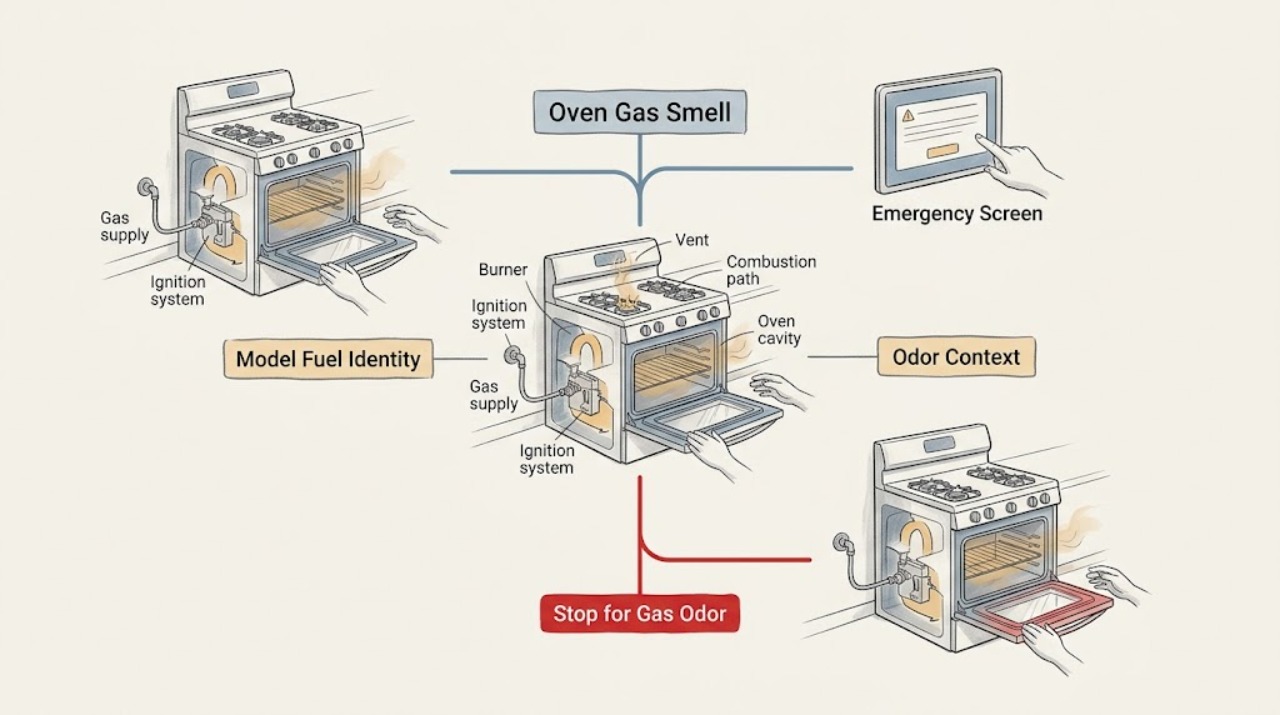
Treat a Siemens oven gas smell as a safety question before treating it as a cleaning question. If the odor is strong, persistent, or accompanied by hissing, delayed ignition, a pop, burst flame, smoke, soot, abnormal flame, or a carbon-monoxide alarm, do not switch lights or controls, create a flame, search for the leak, or test the oven again. Leave the area and contact emergency or gas-safety help from a safe location. Only a faint odor limited to a documented first-use or cooking-residue context, with no abnormal combustion or electrical sign, can follow the exact Siemens model instructions. Confirm that the appliance is actually a gas oven and record its model and fuel type. A clean oven with recurring odor, a smell at the connection, delayed ignition, or unexplained combustion behavior must remain off for qualified gas-appliance service. Carbon monoxide cannot be detected by smell, so a quiet or apparently clean oven is not proof of safe combustion.
Work through in order
Diagnostic checks
Use only checks that match the exact appliance or system and its official guide.
-
Check 1
From the safest available position, determine whether the odor is present now without switching anything, lighting anything, or approaching the range to investigate.
Expected result: Record strong or persistent gas odor, hissing, a CO alarm, possible exposure symptoms, smoke, soot, delayed ignition, a flash, burst, loud pop, or abnormal flame.
Next step: Do not operate controls, switches, phones, or flames in the area. Leave for fresh air and contact emergency or gas-safety help from a safe location; do not re-enter or use the oven until cleared and serviced.
Stop if: Stop immediately for fuel odor, hissing, CO alarm or symptoms, smoke, soot, delayed ignition, burst, pop, or abnormal flame.
Why this matters
Why: Any of these observations is a gas, combustion, fire, or exposure event rather than an ordinary oven-care problem.
-
Check 2
After the safety screen is clear, read the complete Siemens model number from a safe accessible label or manual and confirm gas versus electric configuration; do not pull out the appliance or remove a cover.
Expected result: Record gas range or wall oven, natural gas or propane, recent installation or conversion, and whether the odor is strongest in the cavity, vent, room, rear connection, or control area.
Next step: Use the exact manual and preserve the model and location record for qualified service; keep the oven off if fuel identity or installation is uncertain.
Stop if: Do not move the range, loosen a fitting, alter fuel settings, or remove a panel to identify the appliance.
Why this matters
Why: The model and fuel determine which Siemens instructions apply. An odor at a connection or in the room is not a food-residue diagnosis, and an internal oven odor cannot identify a failed part from outside.
-
Check 3
Without recreating the smell, write down whether it occurred only at first use, during Self Clean, during ordinary baking or broiling, after a failed ignition, after shutoff, or while the oven was idle.
Expected result: Classify the report as faint new-appliance odor, food or grease smoke, Self Clean odor, fuel-like odor, plastic/electrical odor, or recurring unexplained odor.
Next step: Follow a low-risk manufacturer context only when it matches exactly and no hazard occurred; otherwise leave the oven off and arrange qualified service.
Stop if: Do not turn the oven on merely to classify the odor, open a gas fitting, or use a flame to reproduce it.
Why this matters
Why: Context changes the decision: a new-range odor or visible spill can have a limited explanation, while a fuel-like, electrical, or recurring odor needs service or emergency response.
-
Check 4
Only for a new Siemens gas range with a faint first-use odor and no gas, smoke, flame, electrical, or alarm warning, check from outside that removable packaging and ties have been removed.
Expected result: Record all packaging removed and odor limited to the initial use, or odor that is strong, persistent, fuel-like, or located near a connection or control.
Next step: If the exact model manual provides a first-use burn-in instruction, follow it only with its ventilation requirements and only while the safety conditions remain clear. Otherwise arrange service.
Stop if: Do not burn packaging, ignore hissing, or continue first-use operation with smoke, abnormal flame, gas odor, or an alarm.
Why this matters
Why: The Siemens guide describes new-range odor as temporary. A later, strong, or fuel-like odor is not covered by that explanation.
-
Check 5
If the smell is clearly food or grease related and no fuel or electrical warning exists, wait until the oven is cool and inspect only the visible cavity for spills, grease, melted plastic, or damaged cookware.
Expected result: Record visible residue and smoke source, melted material, a clean cavity, soot, or an odor that is stronger at the vent or connection than at the food.
Next step: Remove only accessible residue using the exact Siemens-approved cleaning method after cooling. Keep the oven off and arrange service if odor remains or changes character.
Stop if: Do not burn off plastic, scrape hot residue, use unapproved chemicals, or clean while a gas or electrical hazard is present.
Why this matters
Why: Residue can create a cooking odor, but a clean cavity, soot, fuel-like smell, or electrical odor points elsewhere and should not be cleaned through repeated heating.
-
Check 6
From a safe distance, observe the accessible area around the appliance for recent installation, visible line damage, scorching, or an odor strongest at the rear; do not move the range or touch the connection.
Expected result: Record recent installation/conversion, displaced or damaged visible line, scorching or soot, rear/room odor, or no visible external issue.
Next step: If the connection is damaged or odor is strongest there, leave and arrange gas-safety service from a safe location. If the outside looks normal but odor recurs, arrange appliance service without another test.
Stop if: Do not pull the appliance, tighten or loosen fittings, apply a flame, adjust a regulator, or restart the oven.
Why this matters
Why: An installation, connection, or fuel-conversion concern needs qualified gas assessment. No visible defect does not rule out an internal valve, burner, igniter, pressure, vent, or combustion problem.
-
Check 7
After the oven is off and the area is safe, record any visible soot, unusual flame, delayed ignition, or CO alarm history without opening the burner area or trying to view the flame again.
Expected result: Record no combustion evidence, soot or discoloration, a flame that was yellow or unstable, repeated ignition delay, a pop or burst, or a CO alarm or symptoms.
Next step: Keep the appliance off and arrange qualified gas-appliance service; for a CO event, do not re-enter until emergency responders permit it.
Stop if: Do not run another Bake/Broil cycle, rely on odor fading, or use ventilation as proof that combustion is safe.
Why this matters
Why: Soot, abnormal combustion, or delayed ignition requires trained inspection. A CO alarm or symptoms require fresh air and emergency action even if no gas odor was noticed.
-
Check 8
If the reported smell resembles burning plastic or insulation, note whether it came from the control, cord, receptacle, vent, or cavity without touching a hot component.
Expected result: Record a hot or discolored connection, smoke, spark, melting, breaker trip, odor from the control area, or no visible electrical sign.
Next step: Stop using the oven and isolate power only from a dry safe position when possible; arrange qualified electrical or appliance service based on the location.
Stop if: Do not reset protection repeatedly, touch hot wiring, remove a panel, or restart to see whether the smell returns.
Why this matters
Why: An electrical odor can coexist with a gas appliance but is not explained by normal gas ignition or food residue.
-
Check 9
Only if the oven is cool, dry, odor-free, and free of smoke, flame, gas, and electrical hazards, use one model-authorized power reset after documenting the symptom; do not use a reset to erase an odor event.
Expected result: Record whether the display returns normally, the code clears, the odor does not recur, or the same odor, code, heat, or ignition symptom returns.
Next step: If the symptom returns, keep the oven off and arrange qualified service with the original timeline and safety observations.
Stop if: Do not reset after gas odor, smoke, abnormal flame, burning smell, spark, hot connection, or repeated breaker trip, and do not keep cycling power.
Why this matters
Why: A reset can clear a temporary control state but cannot prove a gas valve, igniter, burner, vent, wiring, or combustion fault is repaired.
-
Check 10
Prepare a professional handoff using the exact model, fuel, odor context, location, and safety observations instead of naming a part from the smell alone.
Expected result: Include first-use/Self Clean/normal-use timing, strength and location, display or code, door and burner behavior, recent installation or conversion, residue or soot, and any hissing, smoke, flame, electrical heat, spark, trip, alarm, or symptoms.
Next step: Keep the appliance off as indicated by the branch and arrange qualified gas-appliance, electrical, or appliance service from a safe condition.
Stop if: Do not remove panels, test gas pressure, inspect a live igniter, bypass a safety device, or operate after an emergency sign.
Why this matters
Why: These facts help distinguish manufacturing or residue odor from a gas connection, pressure, ignition, burner, valve, vent, control, or combustion fault.
Use your observations
Decision map
Find the observation that best matches what you see, then follow the next safe action.
-
PATH 01Safety boundary
What you see
The odor is strong, persistent, or unexplained; gas is heard; a CO alarm or symptoms occur; or there is delayed ignition, a pop, burst, smoke, soot, or abnormal flame.
Do this next
Avoid switches, controls, phones, flames, and engines in the area; leave for fresh air and contact emergency or gas-safety help from a safe location. Do not re-enter or operate the appliance until cleared and serviced.
Why this path and its safety boundary
Why it matters: This is an emergency gas or combustion branch.
Safety stop: Do not search for the leak, relight, reset, open the oven, or test another burner.
-
PATH 02Safety boundary
What you see
The appliance is new, odor is faint and limited to first use, packaging is removed, and there is no gas, smoke, electrical, flame, or alarm warning.
Do this next
Follow only the exact model's first-use and ventilation instructions; stop and service if the odor is strong, persistent, or fuel-like.
Why this path and its safety boundary
Why it matters: The Siemens gas-range guide describes a temporary new-range odor.
Safety stop: Do not continue first-use operation with hissing, abnormal flame, smoke, or a CO concern.
-
PATH 03Safety boundary
What you see
Odor or smoke occurs only during Self Clean or from a visible food spill, with no fuel, electrical, soot, flame, or alarm warning.
Do this next
After cooling, use the exact Siemens-approved care method and arrange service if odor persists or occurs during ordinary operation.
Why this path and its safety boundary
Why it matters: Residue can produce odor, but this context does not explain an unexplained clean-oven or fuel-like smell.
Safety stop: Do not use Self Clean to investigate a gas or electrical odor or continue with uncontrolled smoke.
-
PATH 04Safety boundary
What you see
Odor is strongest at the rear or room, the range was recently installed or converted, or a visible connection is damaged or displaced.
Do this next
Leave the area if gas is suspected and arrange qualified gas or installation service from a safe location.
Why this path and its safety boundary
Why it matters: A supply, connection, pressure, or fuel-configuration issue needs qualified gas assessment.
Safety stop: Do not move the range, adjust fittings, leak-test with a flame, or restart the appliance.
-
PATH 05Safety boundary
What you see
The smell resembles burning plastic or insulation or is paired with a hot connection, spark, smoke, melting, or breaker trip.
Do this next
Stop use, isolate power only from a dry safe position when possible, and arrange qualified electrical or appliance service.
Why this path and its safety boundary
Why it matters: This is an electrical or overheating safety condition, not normal gas ignition.
Safety stop: Do not touch hot parts, reset repeatedly, remove panels, or restart the oven.
-
PATH 06Safety boundary
What you see
The oven is clean but odor returns during ordinary use or the smell cannot be classified confidently.
Do this next
Keep the Siemens oven off and arrange qualified gas-appliance service with the exact model and odor record.
Why this path and its safety boundary
Why it matters: A recurring unexplained odor requires inspection and should not be normalized.
Safety stop: Do not run another Bake, Broil, or Self Clean cycle to reproduce it.
-
PATH 07Safety boundary
What you see
Soot, delayed ignition, repeated flame failure, unusual flame, or a pop occurred without a current emergency odor.
Do this next
Keep the appliance off and arrange qualified gas-appliance inspection; do not attempt another ignition.
Why this path and its safety boundary
Why it matters: The combustion path is not established as safe.
Safety stop: Do not clean soot as a substitute for service, adjust pressure, or continue cooking.
-
PATH 08Safety boundary
What you see
No immediate hazard is visible, but the odor is new, recurring, fuel-like, or uncertain.
Do this next
Do not operate the oven again; give the model, timing, location, and context to qualified service.
Why this path and its safety boundary
Why it matters: No visible sign does not prove safe gas supply or combustion.
Safety stop: Do not rely on ventilation or a successful later ignition as proof of repair.
Helpful context
Understand the symptom
Do not normalize a fuel-like smell
A new appliance can have a temporary manufacturing odor, and food or grease can smoke when heated. Those contexts are different from a strong, persistent, or newly recurring fuel smell. If odor remains after the oven is off, is strongest around a connection, or is paired with hissing, delayed ignition, popping, smoke, soot, or an abnormal flame, use the emergency stop path rather than another ignition attempt.
Confirm the Siemens model and fuel configuration
Siemens ovens and ranges differ by model, fuel, ignition design, controls, and regional instructions. Record the complete model number and whether the appliance uses natural gas or propane according to its documentation. Do not infer a gas leak from a cooktop symptom or apply a gas-range instruction to an electric wall oven. Keep the appliance off while the identity is uncertain.
Gas odor and carbon monoxide are not the same test
Odorized gas may have a sulfur-like smell, but carbon monoxide has no smell or color. A CO alarm, headache, dizziness, nausea, weakness, confusion, or chest symptoms requires fresh air and emergency help. Do not try to identify the source from inside the home or rely on opening a window to make a malfunctioning fuel appliance safe.
When professional service is the answer
A gas professional or qualified appliance technician must assess a connection, pressure, conversion, valve, igniter, burner, vent, or combustion fault. The owner's safe contribution is a precise record of when the odor occurs, where it is strongest, what the display shows, and what happened before the appliance was turned off.
Safety boundary
Stop conditions
- Stop immediately for strong, persistent, or unexplained gas odor, hissing, delayed ignition, a pop or burst, smoke, soot, abnormal flame, or a CO alarm or symptoms.
- Do not operate electrical switches, controls, phones, flames, or engines in a suspected gas area; leave and contact emergency or gas-safety help from a safe location.
- Do not search for a leak, use a match or lighter, repeatedly start the oven, leave a burner lit as a workaround, or use Self Clean to investigate an odor.
- Do not move the range, loosen or adjust gas fittings, change fuel conversion, test pressure, or remove the oven floor, burner, valve, igniter, wiring, or controls.
- Keep the oven off for a clean-oven recurring odor, electrical/plastic smell, hot connection, spark, repeated trip, soot, or any unexplained combustion behavior.
Only after diagnosis
Potential parts
- oven igniter or ignition electrode
Consider only after qualified model-specific diagnosis identifies an ignition component fault; an odor alone does not identify an igniter.
Confirm the complete Siemens model and fuel configuration before selection; installation and testing require qualified service. - oven gas safety valve
Consider only when qualified testing identifies a valve or pressure-control fault after the supply and ignition path are assessed.
Gas-valve fit is model- and fuel-specific; do not modify the gas train as a homeowner check. - oven temperature or flame sensor
Consider only when the exact model's diagnosis links a recurring shutdown, combustion, or error symptom to the applicable sensor.
Verify the exact model manual and professional diagnosis before ordering.
When checks do not resolve it
Need a professional?
Use emergency or gas-safety help for strong, persistent, or unexplained gas odor, hissing, delayed ignition, burst, smoke, soot, abnormal flame, or a CO alarm or symptoms. Arrange qualified gas or installation service for a recent installation/conversion, connection concern, or abnormal pressure/flame pattern. Arrange Siemens appliance service for a clean oven with recurring odor, a fuel-like smell during ordinary use, a recurring code, or an unexplained odor after first-use and residue contexts are excluded.
Common questions
FAQ
Is a smell from a new Siemens gas oven normal?
The Siemens gas-range guide describes a strong odor from a new range as temporary and likely to disappear after a few uses. That does not cover a later, persistent, fuel-like odor or any hissing, delayed ignition, smoke, soot, abnormal flame, electrical odor, or alarm.
What should I do if my Siemens oven smells like gas during normal use?
Do not keep operating it or try to find the leak. Avoid switches, flames, and phones in the area, leave, and contact emergency or gas-safety help from a safe location. Keep the oven off until qualified personnel inspect it.
Can food residue make a Siemens oven smell?
Food or grease can create smoke and odor, but a clean oven with recurring odor, soot, delayed ignition, or a fuel-like smell needs service. Let the oven cool and clean only accessible residue with the exact Siemens-approved method.
Should I use a lighter to test a Siemens gas oven?
No. Never use a flame to find a leak or repeatedly start an oven after a gas odor. Do not adjust fittings or open the burner area; leave and use qualified gas-appliance service.
Can I smell carbon monoxide from a Siemens gas oven?
No. CDC says carbon monoxide is odorless and colorless. If a detector sounds or symptoms occur, leave for fresh air and seek emergency help; do not use the appliance until it has been inspected and serviced.
Read the exact guide
Official sources
- Carbon Monoxide Poisoning BasicsCenters for Disease Control and Prevention · Siemens gas ovens when a CO alarm, symptoms, or combustion concern occurs
- Siemens GAS Range User GuideBSH Home Appliances / Siemens · Siemens gas ranges covered by the linked BSH manual; verify the exact model before applying model-specific details
- Pipeline Leak Recognition and What to DoU.S. Department of Transportation Pipeline and Hazardous Materials Safety Administration · Gas-odor safety response near a Siemens gas oven or range
Community feedback
Share a repair observation
Share a plain-text repair observation. Accepted observations are published automatically; this page may take a moment to update.