
On this page
Start here
Quick answer
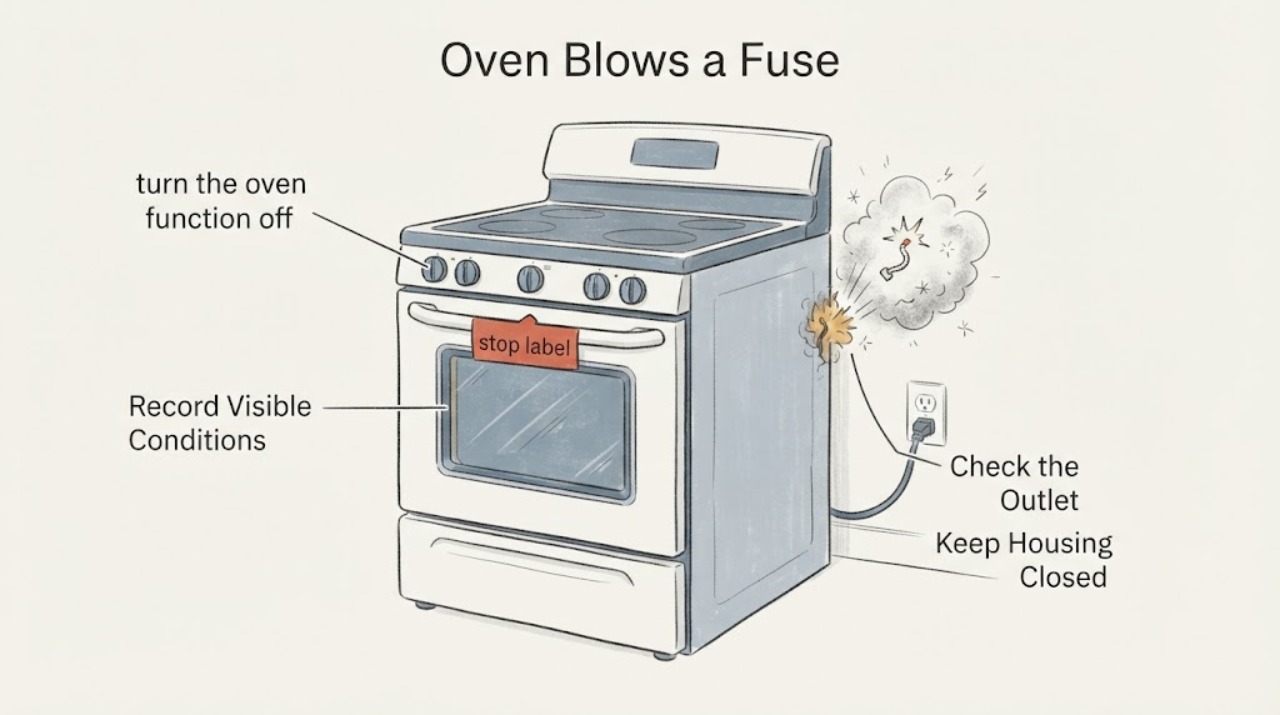
If a Siemens oven blows a fuse or trips the protective device again, stop using it and leave the circuit isolated rather than repeatedly restoring power or fitting a higher-rated fuse or breaker. Record the E-Nr/model and when the trip had already occurred, then make only a cool, de-energized visual check of the accessible cord, plug and oven exterior. Siemens lists domestic-fuse trips as an oven malfunction category and its manual safety guidance routes defective appliances and electrical repairs to trained specialists; the exact cause cannot be assigned without the model and a professional assessment.
Work through in order
Diagnostic checks
Use only checks that match the exact appliance or system and its official guide.
-
Check 1
After a repeated fuse failure or protective-device trip, turn the oven function off and leave the affected circuit isolated. Do not restore power just to reproduce the trip, fit a higher-rated fuse or breaker, or continue cooking if there is smoke, arcing, burning odor, heat damage or a damaged cord or plug.
Expected result: The protective device has failed more than once, or there is smoke, arcing, burning odor, scorching, melted insulation or other electrical damage.
Next step: Keep the oven out of service and arrange qualified appliance service or electrical help. Use emergency services for active smoke or fire.
Why this matters
Why: The condition may be an electrical or appliance fault and continued energizing can increase fire or shock risk.
-
Check 2
With the appliance unpowered, record the complete Siemens E-Nr/model, whether it is a built-in oven or cooker, the protective device type and rating as shown on labels or paperwork, and any recent installation or electrical work. Do not open the fuse board or alter the rating.
Expected result: The model and installation information are available, or the model/rating/configuration remains unknown.
Next step: Give the E-Nr, configuration, rating and installation history to the installer, electrician or Siemens service. Do not choose a fuse or breaker based on appearance or a different model.
Why this matters
Why: Siemens troubleshooting and installation documents are selected by appliance identity; a generic fuse symptom cannot establish the correct circuit or service procedure.
-
Check 3
Only after the oven is cool and the circuit is already isolated, inspect the accessible plug, cord, outlet area and exterior for scorch marks, melting, crushing or moisture. Do not pull out a built-in oven, remove panels, touch terminals or inspect hidden wiring.
Expected result: Visible external damage or moisture is present, or nothing abnormal is visible.
Next step: Leave the circuit isolated and provide a description or photograph to the qualified professional. Do not reconnect the appliance to test whether the mark is still active.
Why this matters
Why: Visible damage is a service clue but does not prove the cause; no visible damage does not clear the oven or its supply circuit.
-
Check 4
Write down when the failure had already occurred: as power was restored, when a function was selected, during preheat, during a particular heating mode, or after the oven had been operating. Do not switch modes or restore power solely to compare them.
Expected result: The existing history shows an immediate trip, a function-associated trip, or no reliable timing.
Next step: For an immediate restoration trip or suspected house-side issue, contact an electrician. For a trip associated with an oven function, contact Siemens or qualified appliance service. If timing is unknown, keep the oven isolated and provide the incomplete history.
Why this matters
Why: Timing helps the professional decide whether to start with the supply/installation or the appliance, but it cannot identify a failed component without model-specific diagnosis.
-
Check 5
Prepare the service handoff with the E-Nr/model, oven configuration, protective-device rating, number of failures, last function in use, recent installation work and visible external findings.
Expected result: The professional receives a complete history, or the model/rating/history remains unavailable.
Next step: Arrange Siemens-authorised appliance service or a qualified electrician as appropriate. Keep the circuit isolated until the professional says it is safe to restore.
Why this matters
Why: The information narrows the safe starting point without turning the symptom into a component diagnosis.
Use your observations
Decision map
Find the observation that best matches what you see, then follow the next safe action.
-
PATH 01Next step
What you see
The fuse fails again, or smoke, arcing, burning odor, scorch marks, melted insulation or cord/plug damage is present.
Do this next
Keep the circuit isolated, leave the oven out of service and arrange qualified electrical/appliance service; use emergency services for active smoke or fire.
Why this path and its safety boundary
Why it matters: This is an electrical safety condition, not an oven setting problem to test.
-
PATH 02Next step
What you see
The failure had already occurred immediately when power was restored, or other house equipment is affected.
Do this next
Contact an electrician and do not keep restoring the circuit or change its protective rating.
Why this path and its safety boundary
Why it matters: The supply protection, installation or house-side wiring needs assessment before the oven is energized again.
-
PATH 03Next step
What you see
The fuse had remained intact until an oven function was already selected or operating.
Do this next
Keep the oven isolated and contact Siemens or qualified appliance service with the E-Nr and function history.
Why this path and its safety boundary
Why it matters: The appliance may need model-specific diagnosis, but timing does not identify a heater, control or other internal part.
-
PATH 04Next step
What you see
The E-Nr/model or protective-device details cannot be confirmed.
Do this next
Do not guess from a similar Siemens oven; have an installer, electrician or service professional identify the appliance and circuit.
Why this path and its safety boundary
Why it matters: The correct Siemens manual, installation requirement and repair boundary cannot be selected safely.
Helpful context
Understand the symptom
Treat the fuse trip as the symptom
Siemens support treats domestic-fuse trips as a distinct oven malfunction category, but the task has no E-Nr, installation type or trip history. A fuse trip can involve the appliance, its connection or the home's protective equipment; it does not identify a failed heating element, thermostat, control or cable. Keep the decision at safe observation and service routing until the exact model is known.
Why internal electrical checks are excluded
Do not remove the oven cover, open a junction box or fuse board, loosen terminals, make energized measurements, bypass protective devices, or substitute a larger fuse or breaker. Siemens' opened manual warns that improper repairs are dangerous and says repairs should be carried out by trained specialist staff using genuine parts where required.
When checks do not resolve it
Need a professional?
Call a qualified electrician for a failure on power restoration, suspected house wiring/protection issues or damage at the outlet or circuit equipment., Call Siemens-authorised appliance service for a trip associated with an oven function, repeated fuse failure or any hidden appliance fault., Keep the oven off and use emergency services for active smoke, fire or arcing.
Have this ready
- complete E-Nr/model and oven configuration
- protective-device type/rating from labels or paperwork
- whether the failure occurred on power restoration or during an already-used oven function
- recent installation/electrical work and visible external damage
Common questions
FAQ
Can I install a larger fuse so the Siemens oven stops blowing it?
No. Leave the affected circuit isolated and have the installer or electrician verify the protective device and wiring. A higher rating can remove protection from a fault.
Does a blown fuse prove the oven heating element failed?
No. The symptom can involve the appliance, its connection or the home's protective equipment. Without the E-Nr and a qualified assessment, do not name or replace a component.
What information should I give Siemens service?
Provide the complete E-Nr/model, oven configuration, protective-device rating, the number of failures, when the failure had already occurred, recent electrical work and any visible external damage.
Read the exact guide
Official sources
- Product category Cooking and Baking - OvensSiemens Home Appliances · Opened the official Siemens oven support category. It lists Domestic fuse trips under oven malfunction and provides the model-specific documentation/service pathway; it does not define a universal failed component.
- User manual and installation instructions HB134JES0MSiemens Home Appliances · Opened the official Siemens manual PDF. It is a specific model-family manual, so it is used only for its explicit general safety statements that improper repairs are dangerous, defective appliances require Customer Service, and the fuse-box trip appears in troubleshooting; no model-specific repair step is generalized to the unspecified task.
Community feedback
Share a repair observation
Share a plain-text repair observation. Accepted observations are published automatically; this page may take a moment to update.