
On this page
Start here
Quick answer
A Siemens washer often refuses or reduces spin when it still has water, detects an unbalanced or overloaded load, has a blocked hose or filter, is in a no-spin or rinse-hold setting, or cannot confirm the door is safe. First note whether the machine drains, whether the drum attempts to turn, the selected spin speed, and any symbol or complete error code. Siemens identifies kinked or blocked hoses, a blocked filter, and load imbalance as common spin-related checks. Stop for a leak near electricity, hot water, violent walking or banging, smoke, a burning smell, repeated power trips, or a damaged cord; do not force the door, tilt the machine, bypass the lock, or open a drain filter with unsafe water present.
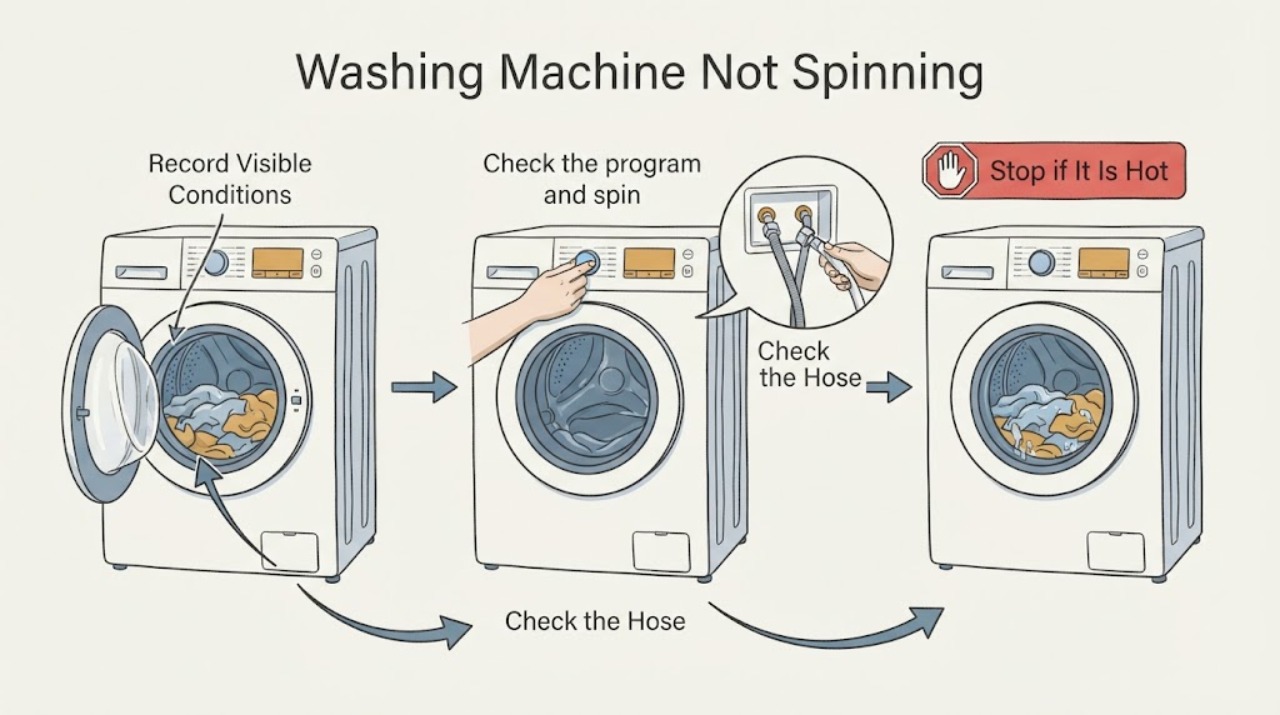
Work through in order
Diagnostic checks
Use only checks that match the exact appliance or system and its official guide.
-
Check 1
Record the selected program, spin-speed option, display stage, complete error code or symbol, whether water is visible, and whether the drum makes any attempt to turn.
Expected result: The washer is in a wash or rinse phase, paused at drain or spin, shows a lock or code, or reaches the end with a wet but drained load.
Next step: Use the matching branch below. Stop for a leak, hot smell, smoke, repeated trip, severe movement, or a damaged appliance.
Why this matters
Why: The stage separates normal program behavior from a drain, lock, setting, balance, or drive symptom and determines the next check.
-
Check 2
Check the program and spin setting against the exact Siemens manual, including any rinse-hold, no-spin, delicate, wool, or low-speed option; do not restart a hot or leaking machine.
Expected result: A no-spin or rinse-hold option is selected, the program is designed for limited movement, or a program with a normal spin sequence is selected.
Next step: Use the manual to cancel the option or select an appropriate program once when safe. If the same symptom remains, continue with the drain and load checks rather than changing random settings.
Why this matters
Why: A selected option or program can intentionally leave water or reduce spin. A suitable spin program that still refuses to run points to another interlock or fault.
-
Check 3
From a dry, safe position, inspect the visible waste-water hose and its connection for a kink, crushing, backup, or obvious foreign-object blockage; do not loosen a wet or pressurized connection.
Expected result: The hose is kinked or backed up, versus the hose appears clear but water remains or the pump does not move water.
Next step: Correct only a visible kink when safe. If water is hot, the floor is wet near electrics, or the path is not safely accessible, stop and arrange service; do not tilt the washer.
Why this matters
Why: Siemens identifies a kinked or blocked waste path as a reason water cannot leave and the spin stage cannot proceed. A clear path with residual water points to a pump, filter, or control issue.
-
Check 4
If the manual authorizes filter access and the appliance is cool, dry, and safely isolated, check the drain-filter area for lint, coins, or other foreign objects; place no hand into a moving pump and do not force a stuck cap.
Expected result: The filter area is blocked, the impeller cannot move as described by the manual, or the filter is clear but the washer still leaves water.
Next step: Refit only as the manual directs and stop if water is hot, uncontrolled, or leaking. If the pump remains ineffective or the cap, housing, or seal is damaged, call service.
Why this matters
Why: A blocked filter can prevent draining and therefore prevent spin. A clear filter with no drain action is evidence for a pump or control diagnosis, not a reason to dismantle the appliance.
-
Check 5
With the washer stopped and the load accessible, redistribute large and small items and remove excess laundry; check for visible foam and confirm that the appliance is not being asked to spin an overloaded drum.
Expected result: The load is bunched, very small and one-sided, oversized, or surrounded by excessive suds, versus balanced with no unusual foam.
Next step: Use the manual’s load and detergent guidance and try the appropriate spin program once when safe. If the washer bangs, walks, or fails with a balanced load, stop and arrange service.
Why this matters
Why: Siemens says the imbalance system can interrupt or reduce spin and can make repeated attempts; foam detection can also add a rinse phase and extend the program.
-
Check 6
Check the door or lid from outside for a fully closed position and an active lock symbol; do not force it, bypass the interlock, or reach into the drum while it can move.
Expected result: A door or key symbol remains, the door is locked with water present, or the door is closed and no lock indication appears.
Next step: Follow the exact model’s door and child-lock procedure. If the drum is stationary, water is safely absent, and the lock still will not release, stop and call service.
Why this matters
Why: The safety lock can prevent spin while water or movement is detected. A locked door with water inside points back to safe drainage, not forced opening.
-
Check 7
If the washer was recently installed or moved, inspect only the visible installation condition: it should sit level and stable, and the manual should confirm that transit protection has been removed; do not pull out a heavy appliance alone.
Expected result: The cabinet rocks, feet are not stable, transport protection may remain, or the washer is level and correctly installed.
Next step: Correct only an obvious, safe external leveling or installation issue using the manual. If movement is violent, metal-on-metal, or persists, stop use and obtain qualified service.
Why this matters
Why: Siemens manuals connect loud vibration or walking with leveling and transport protection, while a stable installation with no balance issue shifts suspicion toward an internal drive or suspension fault.
-
Check 8
Read and photograph the complete error code or symbol and match it only to the Siemens manual for the washer’s E-Nr.; note the phase when it appeared.
Expected result: The manual gives a user-level check, the message clears once, or the same code returns during drain or spin.
Next step: Follow only the manual’s documented user check. If the code returns or the washer remains unsafe or inoperative, stop repeating the program and request service.
Why this matters
Why: Siemens uses multiple code and symbol families across models, so a partial or borrowed code cannot identify a pump, lock, motor, or control component.
-
Check 9
When there is no leak, hot-water hazard, smoke, electrical fault, or severe vibration, perform one restart authorized by the exact manual after setting the washer to its safe stopped state; do not repeatedly cycle power.
Expected result: The washer completes the same spin program, or it stops again with water, a code, no drum movement, or abnormal noise.
Next step: Leave the washer unused and arrange qualified service if the symptom returns. Do not use a restart to conceal a leak, trip, hot smell, or violent movement.
Why this matters
Why: A single restart may clear a temporary control state, but a repeatable failure confirms an unresolved drain, lock, balance, program, or drive condition.
-
Check 10
Prepare a service note with the E-Nr., program and spin setting, water level, code or symbol, hose and filter observations, load and foam condition, installation history, and any noise, walking, leak, heat, or power-trip symptom.
Expected result: The note identifies a repeatable stop at drain, lock, balance, or spin and preserves the evidence before the display changes.
Next step: Keep the washer out of use when the fault is repeatable or safety-related and provide the note to qualified service.
Why this matters
Why: Stage-specific evidence helps Siemens support or a qualified technician choose the correct model procedure without unsafe internal testing.
Use your observations
Decision map
Find the observation that best matches what you see, then follow the next safe action.
-
PATH 01Next step
What you see
The selected program has no spin or rinse hold, and the washer is otherwise behaving normally
Do this next
Use the exact Siemens manual to select an appropriate spin option once; do not infer a fault from a program that intentionally limits spin.
-
PATH 02Next step
What you see
Water remains in the drum or the washer stops before spin
Do this next
Prioritize the external drain hose and model-authorized filter checks with hot-water and wet-electrics precautions; service a clear-path failure.
-
PATH 03Next step
What you see
The load is one-sided, overloaded, or foamy
Do this next
Redistribute or reduce the load and follow detergent guidance; stop if the washer bangs or walks, and service a repeat failure with a balanced load.
-
PATH 04Next step
What you see
A door or key symbol remains or the door is locked with water present
Do this next
Do not force or bypass the lock. Follow the model’s safe drain and lock procedure and call service if the stationary, empty drum remains locked.
-
PATH 05Next step
What you see
The washer was recently installed, moved, or is violently vibrating
Do this next
Stop use and check only safe visible leveling or transit-protection conditions; persistent or severe movement requires qualified service.
-
PATH 06Next step
What you see
The drain path, load, program, and door are correct but the drum still will not spin
Do this next
Stop repeating cycles and arrange service for a possible pump, lock, motor, suspension, or control diagnosis.
-
PATH 07Next step
What you see
A leak near electricity, hot smell, smoke, repeated trip, damaged cord, or uncontrolled movement is present
Do this next
Do not touch the wet or damaged connection; keep people away, isolate only from a safe position when appropriate, and obtain qualified help.
Helpful context
Understand the symptom
What ‘not spinning’ actually tells you
A washer can pause between phases, deliberately limit movement for a delicate program, or repeatedly redistribute laundry before spin. If the drum never reaches spin, the useful clues are whether water remains, whether the door is locked, whether a code is shown, and whether the machine is balanced. A wet load with an empty drum points toward drainage or a spin setting; loud movement points toward balance, installation, or a mechanical fault.
Drain and safety interlocks come first
Many models will not spin while they detect an unsafe water level. Siemens directs users to consider the waste hose, drain pump or filter, rinse-hold selection, and door safety. Treat any filter or hose work as model-specific: water can be hot and may spill, so a safe external inspection is preferable to opening a wet appliance.
Separate a correctable load issue from service evidence
A single bulky item, too much detergent, an unsuitable program, an unlevel appliance, or transport protection left in place can change the spin result. If those conditions are corrected and the washer still will not spin, or the drum scrapes, bangs, leaks, or will not turn when a qualified technician assesses it, stop treating the symptom as a load problem.
Safety boundary
Stop conditions
- Stop immediately for a leak near electrical parts, standing water at the connection, smoke, a burning smell, repeated power trips, or a damaged cord, socket, door, or cabinet.
- Stop for scalding water, violent walking or banging, metal scraping, a loose drum, or a suspected mechanical failure.
- Do not force or bypass the door lock, open a filter with hot or uncontrolled water, tilt the washer, reach into a moving drum, remove panels, or probe live wiring.
- Do not continue using the washer after the same spin failure returns with a balanced load and clear safe drain path.
Only after diagnosis
Potential parts
- drain pump or filter housing
Consider only after a safe hose and filter check shows that water remains and qualified diagnosis identifies a failed pump or damaged housing.
Confirm the complete Siemens E-Nr. and model-specific fit information before any part decision. - door lock assembly
Consider only when the door is correctly closed, water is safely absent, and qualified diagnosis finds a persistent lock or interlock fault.
Do not bypass the lock; verify the exact E-Nr. and diagnosis before selecting a part. - motor or suspension component
Consider only after drain, setting, door, load, and installation checks are satisfactory and a qualified diagnosis confirms an internal drive or suspension fault.
Motor and suspension components vary by model and require exact E-Nr. confirmation.
When checks do not resolve it
Need a professional?
Arrange Siemens or qualified appliance service when the drain path is clear but water remains, a code or lock returns, the washer still will not spin after a balanced-load check, or the drum makes abnormal mechanical noise., Provide the complete E-Nr., program and spin setting, full code or symbol, water level, hose and filter observations, load condition, installation history, and any leak, trip, heat, or vibration evidence., Use urgent local help for an active leak near electricity, smoke, fire, or a dangerous electrical condition; do not touch a wet connection.
Common questions
FAQ
Why does my Siemens washing machine not spin?
The washer may still have water, detect an unbalanced or overloaded load, have a blocked hose or filter, or be using a no-spin or rinse-hold setting. Check the displayed stage and the safe external paths before suspecting an internal part.
Can an unbalanced load stop a Siemens washer from spinning?
Yes. Siemens says its imbalance system can interrupt or reduce spin and may make repeated attempts to redistribute laundry. Redistribute or reduce the load only when the machine is safely stopped.
Why are my clothes wet even though the Siemens cycle finished?
A low-spin program, rinse hold, drain restriction, blocked filter, foam, or imbalance can leave laundry wet. Check the program, water level, and safe external drain path; service a clear-path failure.
Can I open a Siemens washer door if it will not spin?
Do not force it. The door may remain locked while water or movement is detected. Follow the exact manual procedure and call service if the drum is stationary, water is safely absent, and the lock remains.
Should I clean the Siemens drain filter when the washer will not spin?
Only if the exact manual authorizes it and the appliance is cool, safely isolated, and the area is dry. Remaining water may be hot and can spill; stop if access is unsafe or the cap will not move normally.
When does a Siemens washer spin problem need service?
Arrange service when the drain path is clear but water remains, the code or lock returns, the drum will not spin with a balanced load, or the washer bangs, walks, leaks, trips power, smells hot, or shows mechanical damage.
Read the exact guide
Official sources
- Washing machine operating instructionsSiemens Home Appliances · Siemens washer drain, door, spin, foam, and safety troubleshooting examples
- Washing machine operating instructionsSiemens Home Appliances · Siemens washer operating and troubleshooting examples
- Support for Siemens washing machinesSiemens Home Appliances · Siemens washing-machine programs, codes, door, foam, vibration, drain, and service support
- Washing machine is not spinningSiemens Home Appliances · Siemens washer spin, hose, filter, load-balance, and service checks
Community feedback
Share a repair observation
Share a plain-text repair observation. Accepted observations are published automatically; this page may take a moment to update.